Learning Outcomes
- Understand what a qualified claim is and why it is often stronger than an absolute claim
- Identify how modifiers limit certainty, scope, degree, frequency, or condition
- Explain the difference between qualification, concession, and counterclaim
- Revise weak or overgeneralized theses into defensible AP-style claims
- Connect claim wording to evidence, commentary, and a clear line of reasoning
- Apply qualification effectively in argument, synthesis, and rhetorical analysis writing
AP English Language and Composition Syllabus
For the AP English Language and Composition, you are expected to understand how claims are qualified through modifiers, with a focus on the following syllabus points:
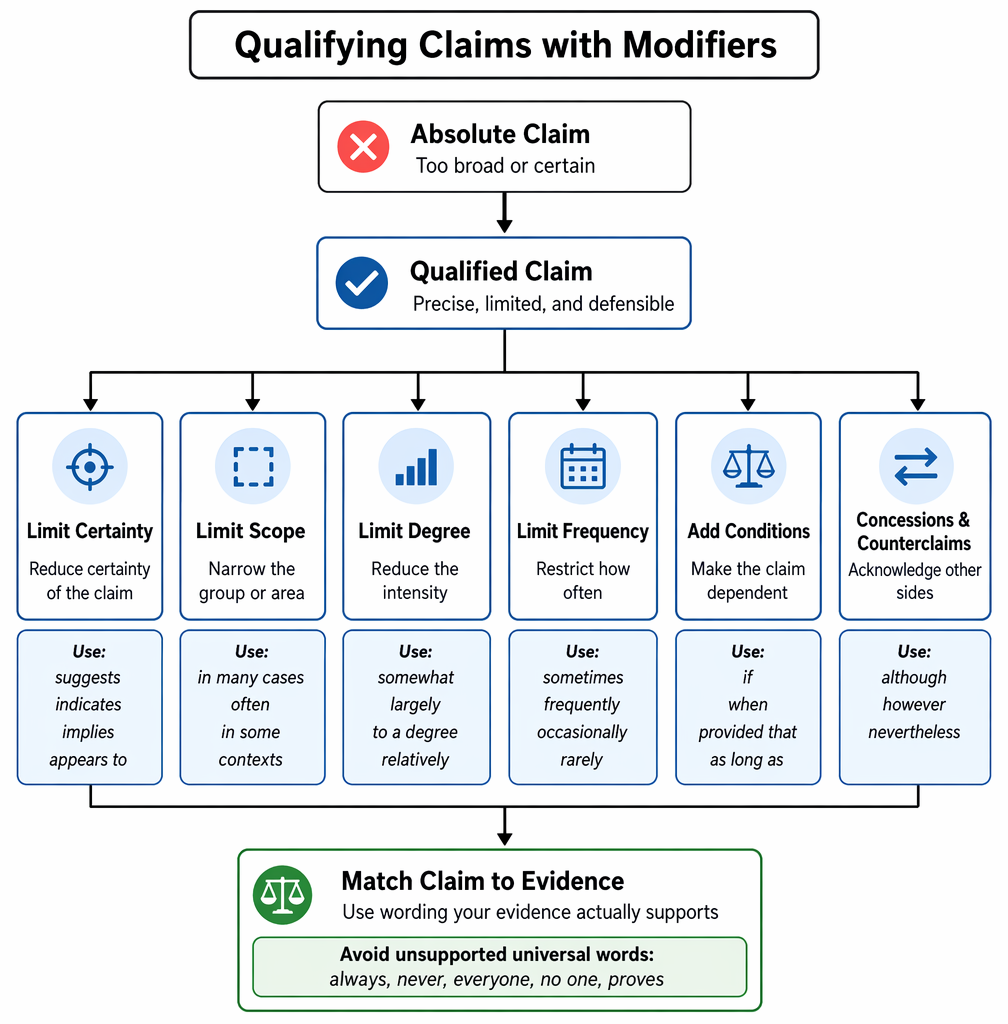
Modifiers in argumentative claims illustrate how lexical choices restrict universality and align thesis statements with available evidence.
- Know that a claim is an arguable position, not just a statement of fact
- Identify how modifiers make a claim more precise by limiting certainty, scope, degree, frequency, or conditions
- Explain why a thesis must present a defensible position rather than a vague list of pros and cons
- Understand the difference between an absolute claim and a qualified claim
- Explain the difference between qualification, concession, and counterclaim
- Know how claim wording must match what the evidence actually supports
- Use interpretive verbs such as suggests, indicates, implies, and appears to when evidence is not fully conclusive
- Avoid unsupported universal words such as always, never, everyone, no one, and proves
Test Your Knowledge
Attempt these questions before reading this article. If you find some difficult or cannot remember the answers, look more closely at that area during your revision.
- What is the difference between an absolute claim and a qualified claim?
- How do modifiers make a thesis more defensible?
- What is the difference between a concession and a counterclaim?
- Why can too much certainty weaken an AP argument essay?
- How could you revise the claim “Social media ruins communication” to make it more accurate?
Introduction
In AP English Language, strong writing does not mean making the loudest claim. It means making the strongest claim your evidence can actually support. That is why qualifying claims with modifiers matters so much. A student who writes “always,” “never,” or “proves” without enough support often sounds less persuasive, not more.
This skill appears across the course. In argument essays, it helps you craft a defensible thesis. In synthesis, it helps you weigh sources instead of copying them. In rhetorical analysis, it helps you describe what a writer’s evidence suggests rather than overstating what it definitively proves.
Key Term: claim
An arguable position a writer takes and then supports with evidence and explanation.
What qualification actually does
A qualified claim is still a claim. It does not dodge the issue. It takes a clear position, but it also shows where that position applies, how strongly it can be stated, and what limits the evidence requires.
Compare these:
- Students learn better with technology.
- Students often learn better with technology when it supports clear teaching goals.
- Technology can improve learning for some students, especially when it is used to individualize pace.
The first sentence is broad and easy to attack. The second and third are more defensible because they narrow the claim. They answer questions a reader would naturally ask: how often, for whom, and under what conditions?
Key Term: qualified claim
A claim that takes a position while acknowledging limits, conditions, exceptions, or degrees of certainty.
A good way to think about this is precision. Qualification is not weakness. It is accuracy. On AP essays, accuracy helps you earn stronger evidence and commentary because your explanation is less likely to outrun your proof.
Consider a weak thesis for an argument prompt:
- Competition is good for everyone.
This fails because “everyone” is almost impossible to support. A better version is:
- Competition can motivate many students, but its benefits depend on how success is defined and whether the environment remains healthy.
Now the writer has room to discuss different groups, conditions, and outcomes. That is far easier to defend in a timed essay.
Test Tip: When writing a thesis, ask: “What is the strongest version of this claim that my evidence can actually support?” Then write that version, not the most dramatic one.
Types of modifiers and how they work
Modifiers are the words and phrases that qualify a claim. They adjust its strength. On AP Lang, they often fall into a few useful categories.
Key Term: modifier
A word or phrase that adjusts the strength, scope, certainty, degree, frequency, or condition of a claim.
Frequency modifiers
These show how often something happens.
Examples:
- often
- sometimes
- usually
- generally
- in many cases
Weak claim:
- Schools ignore student mental health.
Qualified claim:
- Schools often struggle to address student mental health consistently.
Why this works: “often” still criticizes the problem, but it avoids claiming every school fails in every situation.
Possibility and certainty modifiers
These show how sure you are.
Examples:
- may
- might
- can
- could
- likely
- appears to
Weak claim:
- The author proves that technology harms children.
Qualified claim:
- The author suggests that unregulated technology use can harm some children.
This is especially important in rhetorical analysis. Unless the passage gives truly direct, conclusive proof, verbs like suggests, implies, and indicates are usually more accurate than proves.
Key Term: absolute claim
A claim stated with total certainty or universal scope, often using words such as always, never, everyone, or proves.
Degree modifiers
These show extent.
Examples:
- largely
- somewhat
- partly
- to a certain extent
- for the most part
Weak claim:
- Standardized testing damages education.
Qualified claim:
- Standardized testing can largely narrow classroom priorities when schools tie major outcomes to test performance.
Now the claim is sharper. It identifies extent and context.
Scope modifiers
These limit who or what the claim covers.
Examples:
- for some groups
- for many students
- in urban schools
- among first-year voters
- in most cases
Weak claim:
- Social media harms teenagers.
Qualified claim:
- Social media can harm some teenagers, especially those who use it as a replacement for in-person support.
The revised claim avoids treating all teenagers as one group.
Condition modifiers
These show when a claim is true.
Examples:
- when
- if
- under certain conditions
- especially when
- unless
Weak claim:
- Protests create change.
Qualified claim:
- Protests are most effective when they build sustained public attention and connect to political pressure.
This is often the strongest kind of qualification because it links claim directly to cause and effect.
Qualification, concession, and counterclaim
Students often mix these up. They are related, but not the same.
Key Term: concession
An acknowledgment that part of an opposing view has some validity. Key Term: counterclaim
An opposing argument or alternative position.
A qualified claim modifies your own main position.
A concession admits that an opposing point has some truth.
A counterclaim states the opposing side’s argument.
Look at these examples on one issue:
- Qualified claim: School uniforms can improve focus in some schools, especially where dress-based social pressure is severe.
- Counterclaim: Critics argue that uniforms suppress individuality.
- Concession: Although uniforms can limit personal expression, they may still reduce visible inequality in certain settings.
Notice the structure. The writer is not abandoning the claim. The concession increases credibility because it shows awareness of complexity. But the thesis still takes a side.
A weak AP thesis often sounds like this:
- There are pros and cons to school uniforms.
That is not a defensible position. It only announces balance. A stronger thesis is:
- Although school uniforms can restrict self-expression, they generally benefit schools that struggle with distraction and peer pressure.
This combines concession with qualification. It still argues something specific.
Test Tip: Do not confuse “complex” with “indecisive.” A sophisticated thesis still needs a clear stance. “There are advantages and disadvantages” is usually too vague to guide an essay.
Matching claims to evidence and commentary
A claim is only as good as the evidence and explanation under it. On AP essays, students often make one of two mistakes:
- They make a broad claim and support it with narrow evidence.
- They use decent evidence but fail to explain how it supports the specific wording of the claim.
That is why qualification matters. It helps the wording of the claim match the proof.
Suppose your evidence is this:
- In one school survey, 22 of 30 students preferred Friday because clubs, games, and dances often happen then.
What can you responsibly claim?
Too strong:
- Friday is the best day of the week.
Still too strong:
- All students think Friday is best.
Better:
- Many students in this school community appear to view Friday as the most enjoyable day because social events are concentrated there.
Now the claim matches the evidence:
- many students fits 22 of 30 better than “all students”
- in this school community fits a local survey
- appear to view is careful because the evidence is suggestive, not universal
- most enjoyable is more precise than “best”
This also improves commentary. You can write:
- This survey suggests that Friday’s appeal comes less from the day itself than from the activities attached to it.
That is analysis. You are explaining what the evidence means.
Key Term: commentary
The explanation of how and why the evidence supports the claim and line of reasoning. Key Term: line of reasoning
The logical progression that connects thesis, claims, evidence, and commentary.
A useful formula is:
Claim + qualifier + context or condition
For example:
- Public criticism can strengthen democracy when it exposes abuse of power.
- Technological innovation often improves daily life, but its effects depend on access and regulation.
- The author’s imagery suggests that progress is emotionally complicated rather than purely hopeful.
Revising AP-style claims step by step
The best way to learn this skill is to revise bad claims into better ones.
Example 1: Argument essay
Absolute:
- Fear is always beneficial because it pushes people to grow.
Problems:
- “always” is too broad
- no exceptions allowed
- “beneficial” is undefined
Qualified:
- Fear can promote growth when it pushes people to confront meaningful challenges rather than avoid them.
Why it is better:
- can lowers certainty to a supportable level
- when adds condition
- the sentence defines the kind of fear that helps
Example 2: Synthesis essay
Absolute:
- Public libraries are unnecessary because the internet replaced them.
Problems:
- total claim
- ignores access differences
- easy for source evidence to disprove
Qualified:
- Although online resources have reduced some traditional library functions, public libraries remain necessary in communities where they provide internet access, study space, and public services.
Why it is better:
- opens with concession
- takes a clear position
- specifies where and why the claim is true
Example 3: Rhetorical analysis
Overstated:
- The speaker proves that the audience must support reform.
Qualified:
- Through repetition and appeals to shared values, the speaker suggests that reform is both urgent and morally necessary.
Why it is better:
- avoids claiming absolute audience response
- names rhetorical choices
- explains the effect more precisely
Example 4: Common AP classroom topic
Absolute:
- Social media destroys real friendship.
Qualified:
- Social media can weaken friendship when it replaces direct interaction, though it may also maintain connection across distance.
This version is more flexible and more intelligent. It sets up a stronger essay because it can address both harm and limitation without losing the main claim.
Common mistakes students make
First, students think qualifiers automatically weaken writing. Usually the opposite is true. Unsupported certainty is weaker than careful precision.
Second, students qualify too much and erase the argument. A thesis like “There are many ways to think about this issue and it depends on many factors” is so vague that it does not guide the essay.
Third, students add evidence without adjusting the claim. If your example is local, anecdotal, or limited, your claim should also be limited.
Fourth, students confuse qualification with equivocation. Qualification refines a position. Equivocation avoids taking one.
Fifth, students use interpretive evidence with overly forceful verbs. In rhetorical analysis, “proves” is often too strong. “suggests,” “indicates,” or “reveals” are usually more accurate.
A practical checklist:
- Did I take a clear stance?
- Did I avoid unsupported universal words?
- Did I limit the claim to what my evidence supports?
- Did I explain the connection between evidence and claim?
- Did I concede without surrendering my position?
Key Point Checklist
This article has covered the following key knowledge points:
- A claim is an arguable position, not a simple fact
- A qualified claim takes a clear stance while adding limits, conditions, or exceptions
- Modifiers can qualify frequency, certainty, degree, scope, or condition
- Absolute words such as always, never, everyone, no one, and proves are risky unless fully supported
- Qualification usually strengthens AP writing because it makes claims more accurate and defensible
- A qualified claim is different from a concession and from a counterclaim
- A concession admits some truth in an opposing view
- A counterclaim states the opposing argument
- Claim wording should match what the evidence actually supports
- Commentary must explain how evidence supports the claim and line of reasoning
- In rhetorical analysis, verbs such as suggests, implies, indicates, and appears to are often better than proves
- A sophisticated AP thesis can be subtled without becoming vague or indecisive
Key Terms and Concepts
- claim
- qualified claim
- modifier
- absolute claim
- concession
- counterclaim
- commentary
- line of reasoning