Pollution and Human Health - Dysentery from untreated sewage
Learning Outcomes
- Understand how untreated sewage can cause dysentery through fecal contamination and pathogen exposure
- Identify the main sewage-linked pathogens associated with dysentery
- Explain how wastewater treatment reduces disease risk and which stages matter most for pathogen control
- Distinguish pathogen pollution from nutrient pollution in aquatic systems
- Recognise how fecal indicator bacteria are used to detect sewage contamination
- Apply this topic to AP Environmental Science exam questions on pollution, human health, and environmental solutions
AP Environmental Science Syllabus
For the AP Environmental Science, you are expected to understand pollution and human health in relation to waterborne disease, with a focus on the following syllabus points:
- Know that untreated or improperly treated sewage can introduce pathogens into waterways and drinking water supplies
- Understand the causal chain from untreated sewage to fecal contamination, pathogen exposure, dysentery, and dehydration
- Identify dysentery as a severe intestinal disease often involving bloody or mucus-containing diarrhea
- Know that dysentery linked to sewage may be caused by Shigella bacteria or Entamoeba histolytica protozoa
- Explain how fecal-oral transmission occurs through contaminated water, food, hands, recreational water, or crops
- Understand the roles of primary treatment, secondary treatment, and disinfection in wastewater treatment
- Distinguish fecal indicator bacteria such as fecal coliform, E. coli, and enterococci from the actual pathogens causing disease
- Recognise sewage leaks, septic failures, and combined sewer overflows as important sources of pathogen pollution
Test Your Knowledge
Attempt these questions before reading this article. If you find some difficult or cannot remember the answers, look more closely at that area during your revision.
- How does untreated sewage lead to dysentery in human populations?
- What is the difference between Shigella and Entamoeba histolytica?
- Why is dysentery more dangerous than ordinary mild diarrhea?
- Which stage of wastewater treatment is most important for reducing pathogens?
- Why are fecal coliform and enterococci useful in water testing?
Introduction
Dysentery from untreated sewage is one of the clearest examples of how pollution becomes a human health problem. In AP Environmental Science, this topic matters because it links water pollution, sanitation, pathogens, and environmental management in one cause-and-effect chain. Students often remember sewage as a source of nutrients that can cause eutrophication, but they miss that sewage also carries disease-causing organisms that can harm humans directly.
This means sewage is not just an environmental issue. It is also a public health issue. When human waste enters rivers, lakes, groundwater, drinking water systems, or recreational waters without proper treatment, pathogens can spread through the fecal-oral route. Dysentery is one of the serious diseases that can result.
Key Term: dysentery
A severe intestinal infection that causes diarrhea, often with blood or mucus, and can lead to dangerous dehydration.
Introduction to the pollution pathway
Untreated sewage as a source of pathogen pollution
Untreated sewage is wastewater containing human waste, water from toilets, sinks, showers, washing machines, and sometimes industrial or stormwater inputs. The key APES point is that sewage contains more than organic waste. It can also carry pathogens such as bacteria, viruses, protozoa, and parasitic organisms.
Key Term: pathogen
A disease-causing microorganism or infectious agent.
If sewage is discharged directly into a river, leaks from pipes into groundwater, escapes from a failing septic tank, or is released during a combined sewer overflow, it can contaminate water that people later drink or touch. Once that happens, the pollution has moved from the environment into the human body.
This is an important exam distinction. Nutrient pollution and pathogen pollution may come from the same source, but they cause different problems.
- Nutrient pollution from sewage can lead to algal blooms and low dissolved oxygen
- Pathogen pollution from sewage can cause infectious disease directly
Students often blur these together. On an FRQ, if the question is about human disease, you need to focus on pathogens and transmission, not only on eutrophication.
Key Term: wastewater
Water that has been used by humans and may contain sewage, organic waste, chemicals, and pathogens.
A useful causal chain for the exam is:
untreated sewage -> fecal contamination of water or food -> human exposure -> pathogen enters digestive system -> dysentery -> dehydration and possible death
Fecal-oral transmission and why it spreads disease
The main route linking sewage to dysentery is fecal-oral transmission. This means pathogens from feces enter another person’s mouth, usually through contaminated water, food, hands, or surfaces.
Key Term: fecal-oral transmission
The spread of disease when pathogens from fecal matter are ingested through contaminated food, water, hands, or objects.
This route explains why dysentery is strongly associated with poor sanitation. If human waste is not separated from drinking water and food preparation, the opportunity for infection increases sharply. A person does not need to drink visibly dirty water to become infected. Even clear-looking water may contain pathogens.
Exposure can happen in several ways:
- drinking contaminated water
- eating food washed with contaminated water
- eating shellfish from contaminated water
- swallowing recreational water while swimming
- touching contaminated hands or surfaces and then eating
This is why public health measures such as handwashing, safe sanitation, and wastewater treatment are so effective. They break the transmission route rather than waiting to treat the disease afterward.
Test Tip: If an APES question asks how sanitation reduces disease, use the phrase “interrupts fecal-oral transmission”. That is more precise than simply saying “keeps water clean.”
The disease itself and the main pathogens
What makes dysentery serious
Dysentery is not just any diarrheal illness. It is a more severe intestinal disease, usually involving bloody or mucus-containing stool, abdominal pain, cramps, and often fever or vomiting. The immediate danger is usually dehydration, especially in young children, older adults, and people already weakened by poor nutrition or illness.
The reason dehydration becomes dangerous is simple. Severe diarrhea and vomiting cause rapid loss of water and dissolved salts from the body. If that fluid is not replaced quickly, circulation and organ function are affected. In APES terms, the disease is severe not because the pathogen is in the water alone, but because the body’s response causes dangerous fluid loss.
The symptoms students should know include:
- diarrhea, often bloody
- abdominal pain or cramping
- fever
- vomiting in some cases
- dehydration
- weakness
Textbook figures show that dysentery affects millions of people globally each year and is especially deadly where clean water and health care are limited. In the United States, cases still occur, but deaths are much less common because safe water systems and treatment are more available.
Shigellosis and amebiasis
Two important causes of sewage-linked dysentery are commonly tested or discussed.
Key Term: Shigella
A group of bacteria that can cause shigellosis, also called bacillary dysentery.
Shigella infections are caused by bacteria, but another significant cause of dysentery comes from a parasitic organism. Warmer water temperatures, often linked to climate change, can promote the spread of this second pathogen, Entamoeba histolytica.
Key Term: Entamoeba histolytica
A protozoan that causes amebiasis, including amoebic dysentery.
Shigella is bacterial. Infection with it is called shigellosis or bacillary dysentery. It often spreads by the fecal-oral route, including through water contaminated by sewage. Symptoms often begin about 1 to 2 days after exposure.
Entamoeba histolytica is protozoan, not bacterial. Infection with it is called amebiasis or amoebic dysentery. Many infected people may show no symptoms at first, but some develop severe intestinal disease. In serious cases, the infection can spread beyond the intestine, including to the liver.
This difference matters. Students sometimes write that all dysentery is bacterial. That is wrong. Dysentery is a syndrome, not a single organism.
A quick comparison helps:
- Shigella -> bacterium -> usually rapid onset -> shigellosis or bacillary dysentery
- Entamoeba histolytica -> protozoan -> onset may take longer or be absent at first -> amebiasis or amoebic dysentery
Both can be associated with sewage contamination. Both can reach humans through contaminated water or food. Both can cause severe diarrhea and dehydration.
Test Tip: Do not write that fecal coliform or enterococci “cause dysentery.” They mainly indicate fecal contamination. The disease-causing agents are pathogens such as Shigella or Entamoeba histolytica.
Sewage infrastructure, treatment, and prevention
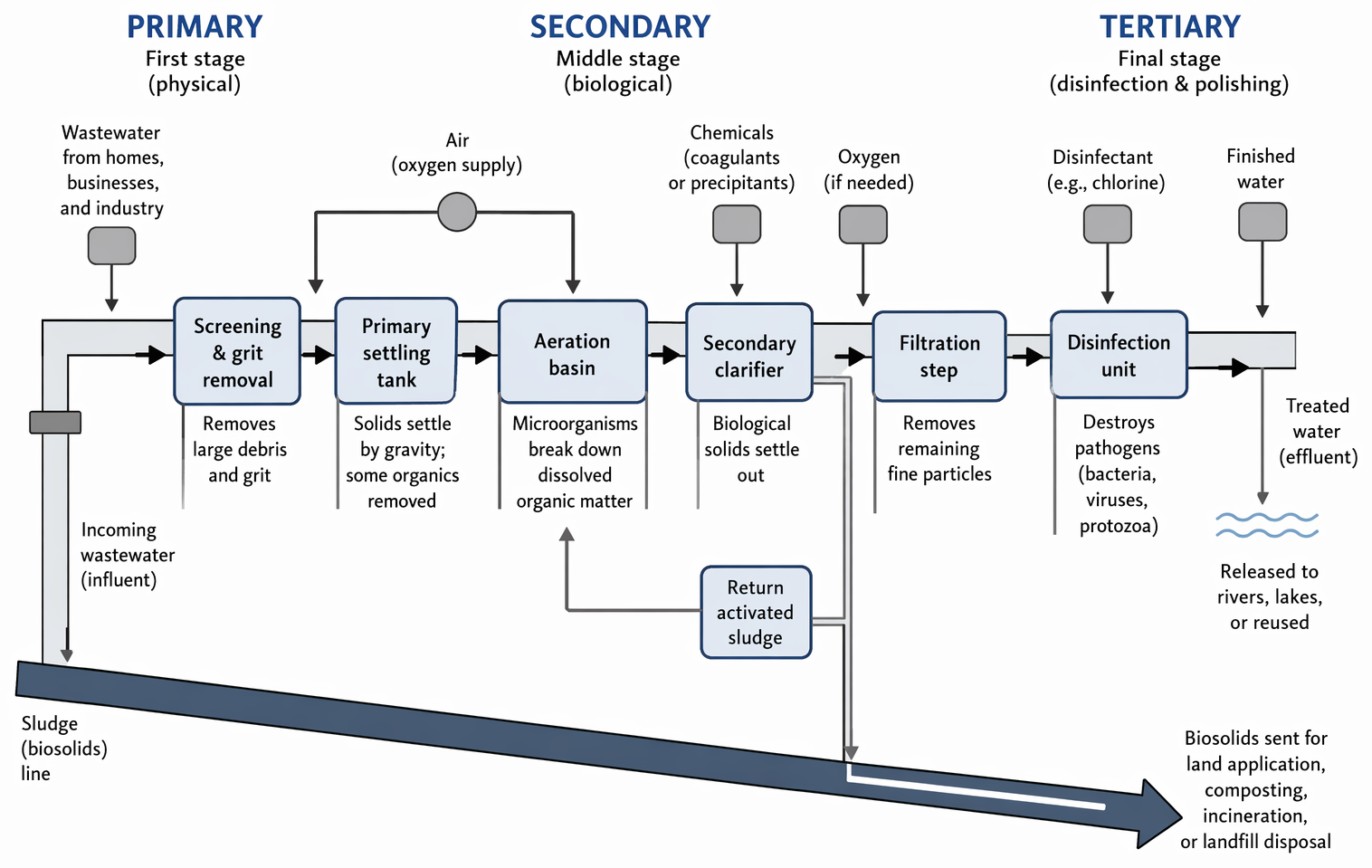
Sewage-borne pathogens spread through contaminated water or food by fecal-oral transmission and can cause dysentery unless removed during treatment.
How sewage enters water supplies
Sewage does not have to be intentionally dumped into a river to become dangerous. It can enter water through several pathways.
- direct discharge of untreated wastewater
- leaking sewer pipes
- failing septic systems
- runoff linked to sewage contamination
- combined sewer overflow events during heavy rain
Key Term: combined sewer overflow (CSO)
A discharge of untreated or partly treated sewage mixed with stormwater when sewer systems overflow during heavy rainfall.
In a CSO event, rainfall exceeds sewer system capacity. As a result, untreated or partly treated sewage is discharged directly into waterways. This is a classic point source because the release comes from an identifiable outfall.
By contrast, if contamination spreads from many diffuse locations through runoff across a broad area, that is more like nonpoint source pollution. APES questions sometimes ask students to classify pollution sources, so sewage gives you good examples of both.
Why treatment stages matter
Wastewater treatment reduces risk, but different stages do different jobs. This is where many students lose marks by saying “sewage treatment removes pathogens” without explaining how.
Physical treatment removes large debris through screens.
Primary treatment allows suspended solids to settle out. It reduces suspended solids and some organic waste, but it does not reliably make wastewater safe from pathogens.
Secondary treatment uses microorganisms, usually aerobic bacteria, to break down biodegradable organic waste. This further reduces suspended solids and BOD-linked waste, but again it is not enough by itself to eliminate pathogen risk.
Disinfection is the key stage for reducing remaining pathogens. Chlorination is common. Ozone and UV can also be used.
So if an FRQ asks which stage is most important for pathogen control, the best answer is the disinfection stage, not primary treatment.
The distinction is:
- primary treatment -> mostly solids removal
- secondary treatment -> mostly biological breakdown of organic waste
- disinfection -> pathogen reduction
This also explains why untreated sewage is dangerous. If waste enters water before these steps occur, pathogens remain active and infectious.
Indicator bacteria and how water is monitored
Testing directly for every pathogen in water is difficult and expensive. Instead, water quality monitoring often uses indicator organisms.
Key Term: fecal coliform
A group of bacteria used as indicators of fecal contamination in water.
A high fecal-coliform result suggests that sewage has entered the water and that disease-causing organisms may also be present, although it does not identify the specific pathogen. Untreated sewage can transmit diseases such as cholera and typhoid, so wastewater is typically screened, settled, biologically treated, and disinfected before discharge. For questions about swimming or other recreational waters, enterococci are the more relevant indicator to consider.
Key Term: enterococci
Bacteria used as indicators of fecal contamination, especially in recreational waters.
Fecal coliform, E. coli, and enterococci do not represent every disease-causing organism in sewage. Their importance is that their presence suggests that fecal waste has entered the water and that pathogens may also be present.
That is the key logic:
indicator bacteria present -> fecal contamination likely -> sewage contamination possible -> pathogen risk higher
In APES, that kind of reasoning matters more than memorising exact lab methods.
Prevention, environmental solutions, and exam application
Breaking the chain of disease transmission
The most effective prevention strategies are those that stop sewage from contacting people in the first place. These include:
- proper wastewater treatment
- safe disposal of human waste
- maintenance of sewer systems
- septic system inspection and repair
- clean drinking water supply
- handwashing
- safe food handling
- preventing sewage contamination of surface water and groundwater
These are not just medical solutions. They are environmental solutions because they reduce pollutant exposure before illness occurs.
Where sanitation systems are poor, the disease burden is much higher. Where treatment and clean water systems are strong, infections are more likely to be contained and treated quickly.
A strong APES answer often links infrastructure to public health:
improved sanitation -> less fecal contamination -> lower pathogen exposure -> fewer dysentery cases
How this appears on the AP exam
This topic can appear in several formats.
In multiple-choice questions, you may need to:
- identify untreated sewage as a source of pathogen pollution
- explain why dysentery is linked to contaminated water
- distinguish pathogen pollution from nutrient pollution
- identify disinfection as the stage that reduces pathogens most directly
- recognise fecal indicator bacteria as warning signs, not the disease itself
In FRQs, you may be asked to explain an environmental health chain, propose a solution, or analyse wastewater treatment.
A strong answer should include:
- the pollutant source: untreated sewage
- the mechanism: fecal contamination
- the transmission route: fecal-oral ingestion or contact
- the health effect: dysentery and dehydration
- the prevention method: sanitation, treatment, and disinfection
Common errors to avoid:
- saying all dysentery is caused by one pathogen
- confusing bacterial indicators with the actual pathogen
- focusing only on eutrophication when the question is about disease
- claiming primary treatment alone makes sewage microbiologically safe
Key Point Checklist
This article has covered the following key knowledge points:
- Dysentery is a severe intestinal disease that often causes bloody or mucus-containing diarrhea
- Untreated sewage can contaminate drinking water, surface water, groundwater, food, shellfish, and recreational water
- The main transmission route from sewage to humans is fecal-oral transmission
- Dehydration is the major immediate health risk in dysentery cases
- Shigella causes bacillary dysentery or shigellosis and is bacterial
- Entamoeba histolytica causes amoebic dysentery or amebiasis and is protozoan
- Sewage causes both nutrient pollution and pathogen pollution, which are not the same thing
- Primary treatment removes solids, secondary treatment removes biodegradable waste, and disinfection is the key stage for reducing pathogens
- Fecal coliform, E. coli, and enterococci are indicator bacteria used to detect fecal contamination
- Combined sewer overflows, sewer leaks, and septic failures are major pathways for sewage pollution
- Safe water, sanitation, handwashing, and wastewater treatment reduce dysentery risk by interrupting fecal-oral transmission
- On APES questions, strong answers should explain the full chain from sewage source to human health effect
Key Terms and Concepts
- dysentery
- pathogen
- wastewater
- fecal-oral transmission
- Shigella
- Entamoeba histolytica
- combined sewer overflow (CSO)
- fecal coliform
- enterococci