Learning Outcomes
- Understand the purpose of IAS 1 Presentation of Financial Statements for limited companies
- Identify the components of a complete set of financial statements under IAS 1
- Explain the main presentation principles, including going concern, accruals, consistency, materiality, offsetting and comparative information
- Distinguish clearly between the statement of financial position and the statement of changes in equity
- Classify assets and liabilities as current or non-current using IAS 1 rules
- Calculate and present movements in equity, including share capital, share premium, retained earnings and dividends
- Avoid common exam errors when drafting limited company financial statements
AQA A-Level Accounting (7127) Syllabus
For the AQA A-Level Accounting (7127), you are expected to understand IAS 1 financial statements for limited companies, with a focus on the following syllabus points:
- Know that IAS 1 sets the overall requirements for presenting limited company financial statements
- Identify the components of a complete set of financial statements: statement of financial position, income statement or statement of profit or loss, statement of changes in equity, statement of cash flows, and notes including accounting policies
- Explain the key presentation principles of fair presentation, going concern, accrual basis, consistency, materiality, comparative information and no offsetting
- Understand that equity is shown separately from current and non-current liabilities
- Distinguish between share capital, share premium, capital reserves, revenue reserves and retained earnings
- Understand that dividends are distributions to owners, not expenses in profit for the year
- Classify items correctly as current assets, non-current assets, current liabilities or non-current liabilities
- Prepare and interpret a statement of changes in equity for a limited company
Test Your Knowledge
Attempt these questions before reading this article. If you find some difficult or cannot remember the answers, look more closely at that area during your revision.
- What does IAS 1 say a complete set of financial statements includes?
- Why are dividends not shown as an expense in profit for the year?
- How do you decide whether an asset is current or non-current?
- What is the difference between the statement of financial position and the statement of changes in equity?
- How is a share issue at a premium shown in equity?
Introduction
IAS 1 is the main presentation standard for limited company financial statements. For AQA, it matters because it gives the overall structure and rules for how company accounts should be presented so that users can compare one period with another and one company with another.
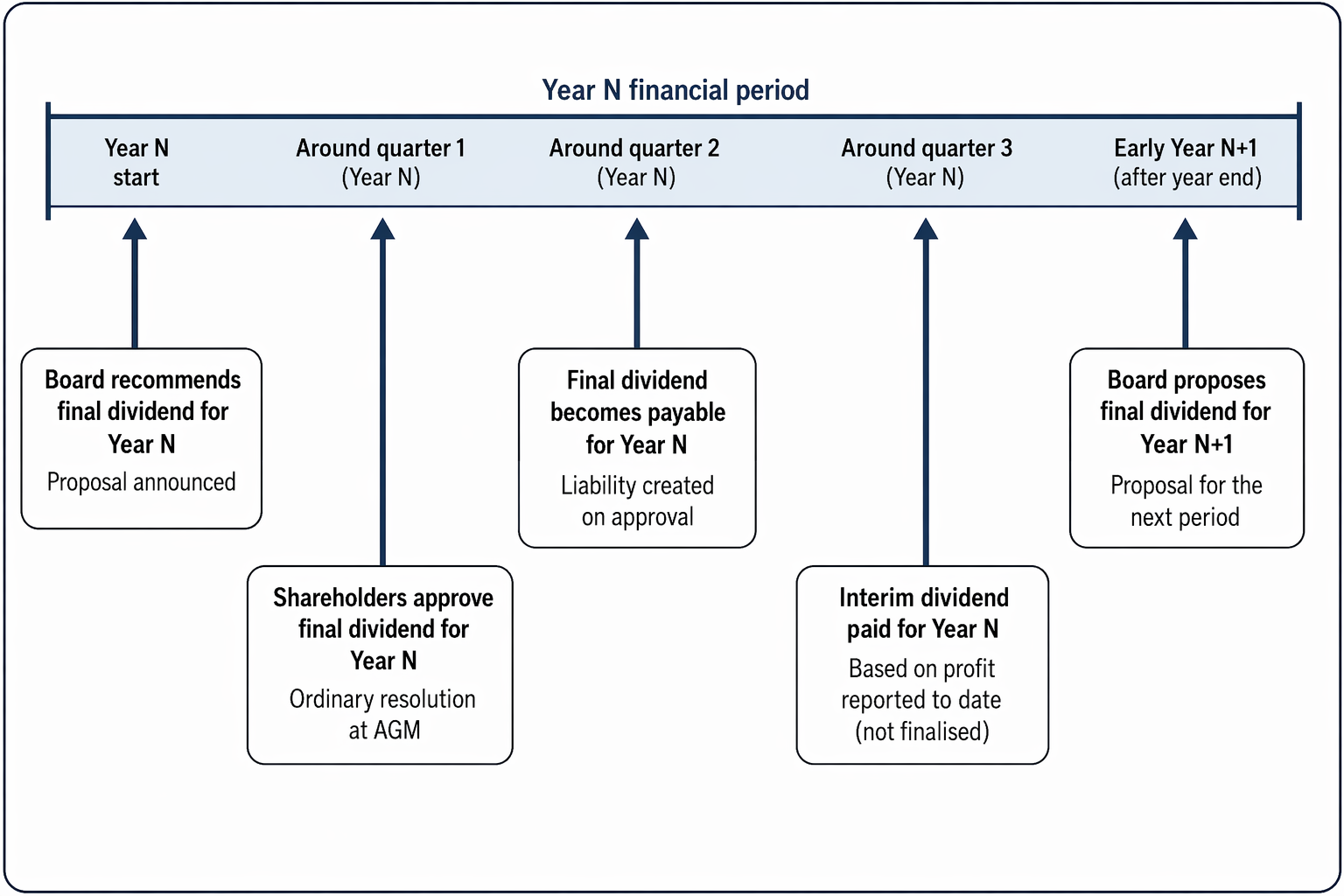
IAS 1 requirements for limited company financial statements include the complete statement set, presentation rules, classification, and changes in equity.
In exam questions, IAS 1 is less about learning every detailed disclosure rule and more about presenting statements correctly, using accurate terminology, classifying items properly and understanding what belongs in profit, equity, assets and liabilities. Many student errors come from putting an item in the wrong statement rather than from difficult calculations.
Key Term: IAS 1 Presentation of Financial Statements
The international accounting standard that sets out the overall requirements for the presentation, structure and content of general purpose financial statements.
What IAS 1 is trying to achieve
IAS 1 aims to make financial statements useful to a wide range of users making economic decisions. It focuses on three broad areas:
- financial position shown in the statement of financial position
- financial performance shown in the income statement or statement of profit or loss
- cash flows shown in the statement of cash flows
For AQA, remember that limited company statements build on sole trader accounts, but company accounts have extra equity detail and must follow IAS terminology.
Key Term: fair presentation
The requirement that financial statements present information in a way that properly reflects the company’s financial position, financial performance and cash flows.
A complete set of financial statements under IAS 1 includes:
- statement of financial position
- income statement or statement of profit or loss
- statement of changes in equity
- statement of cash flows
- notes, including accounting policies and explanatory information
AQA questions often focus most on the statement of financial position and statement of changes in equity, but you still need to know the full set.
Test Tip: If a short-answer question asks for the “components of a complete set of financial statements”, do not stop at income statement and statement of financial position. Include the statement of changes in equity, statement of cash flows and notes.
IAS 1 also requires financial statements to be prepared at least annually. They must clearly show:
- the company name
- the reporting period
- the currency
- the level of rounding if relevant
Comparative figures from the previous period are normally shown as well.
Key Term: comparative information
Figures from the previous accounting period shown alongside current period figures to help users compare performance and position over time.
Core presentation principles you must know
IAS 1 requires several key accounting principles and presentation rules. These are high value in exam questions because they explain why figures are shown in a particular way.
Going concern means the accounts are prepared on the assumption that the company will continue operating in the foreseeable future.
Accruals means income and expenses are matched to the correct accounting period, except in cash flow reporting.
Consistency means presentation and classification should stay the same from one period to the next unless there is a good reason to change.
Materiality means important items should be shown separately, while trivial items may be grouped together.
Key Term: materiality
The idea that items significant enough to affect users’ decisions should be shown separately, while insignificant items may be aggregated.
Offsetting is generally not allowed. You should not net off assets against liabilities or income against expenses unless permitted.
A classic example is:
- cash at bank should not be netted against a bank overdraft
They are shown separately in the correct sections.
Test Tip: If a statement of financial position question includes both bank and bank overdraft, do not combine them into one number unless the question clearly requires it. Separate classification is usually the safer approach.
Common student errors here:
- forgetting that accruals and prepayments still matter in company accounts
- netting bank and overdraft together
- changing headings or classifications without reason
- leaving out comparative figures in narrative questions about IAS 1
Statement of financial position and current or non-current classification
The statement of financial position shows the company’s assets, liabilities and equity at the period end. Under IAS 1, items are usually grouped into:
- non-current assets
- current assets
- equity
- non-current liabilities
- current liabilities
A current asset is one that is:
- expected to be realised, sold or consumed in the normal operating cycle
- held for trading
- expected to be realised within 12 months
- cash or cash equivalent not restricted for more than 12 months
Everything else is non-current.
A current liability is one that is:
- expected to be settled in the normal operating cycle
- held for trading
- due within 12 months
- not deferrable for at least 12 months at the reporting date
This gives some common classifications:
| Item | Classification |
|---|---|
| inventory | current asset |
| trade receivables | current asset |
| cash and cash equivalents | current asset |
| trade payables | current liability |
| tax liability due within 12 months | current liability |
| debentures repayable in five years | non-current liability |
| buildings | non-current asset |
The key area students confuse is equity. Equity is not current or non-current. It is shown separately.
Key Term: equity
The residual interest in the assets of the company after deducting liabilities, shown through items such as share capital, share premium and retained earnings.
For limited companies, the equity section commonly includes:
- ordinary share capital
- share premium
- revaluation reserve
- retained earnings
This is a common classification task in exams.
Comparison: equity vs liabilities
| Equity | Liabilities |
|---|---|
| represents owners’ stake | represents amounts owed |
| includes share capital and reserves | includes loans, debentures, payables |
| dividends reduce equity | interest is an expense and liabilities may remain |
| not classified as current/non-current | classified as current or non-current |
This distinction matters because students often place share capital under non-current liabilities. That is wrong.
Statement of changes in equity and dividends
The statement of changes in equity explains how each equity balance moved during the year. It links opening equity to closing equity.
Typical columns are:
- share capital
- share premium
- retained earnings
- total equity
Typical lines are:
- opening balances
- issue of shares
- profit for the year
- dividends paid
- closing balances
The most tested rule is that dividends are not an expense in the income statement. They are a distribution of profit to owners and are shown through equity.
Key Term: dividends
Distributions of profit to shareholders that reduce retained earnings and are shown in equity, not as an expense in profit for the year.
Worked example: statement of changes in equity
Opening equity balances:
- Ordinary shares of £1 each fully paid: £600,000
- Share premium: £90,000
- Retained earnings: £330,000
During the year:
- 150,000 new ordinary shares issued at £1.60 each
- Dividends paid: £220,000
- Profit for the year: £365,000
Step 1: Calculate the share issue
Nominal value to share capital: 150,000 shares × £1 = £150,000
Premium element: 150,000 shares × £0.60 = £90,000
Total cash raised: 150,000 × £1.60 = £240,000
Step 2: Update each equity column
| Share capital £ | Share premium £ | Retained earnings £ | Total £ | |
|---|---|---|---|---|
| Opening balance | 600,000 | 90,000 | 330,000 | 1,020,000 |
| Issue of shares | 150,000 | 90,000 | - | 240,000 |
| Profit for the year | - | - | 365,000 | 365,000 |
| Dividends paid | - | - | (220,000) | (220,000) |
| Closing balance | 750,000 | 180,000 | 475,000 | 1,405,000 |
This is the exact logic AQA expects.
Common student errors in this topic:
- treating dividends as an expense in the income statement
- putting the full proceeds of a share issue into share capital instead of splitting between share capital and share premium
- forgetting that profit for the year increases retained earnings
- deducting dividends from profit instead of from retained earnings
Exam focus and common pitfalls in IAS 1 questions
AQA uses IAS 1 as a framework, but not every full professional detail is needed in exam answers. Your main priorities are:
- correct statement names
- correct classification
- correct equity treatment
- correct presentation of dividends
- correct use of comparatives and key principles in explanation questions
A final technical point: in full IAS 1, a third statement of financial position may be required in certain retrospective restatement or reclassification cases. This is useful background knowledge, but it is much less likely to be central in AQA questions than the standard two-period format.
When writing longer answers about IAS 1, explain both financial and non-financial usefulness. For example:
- financial statements allow shareholders and lenders to assess profitability, liquidity and financial structure
- comparability helps users track trends
- accounting policies and notes improve understanding
- limits remain because accounts are historical and may involve estimates
How to structure an evaluative answer: Start by stating what IAS 1 improves, such as comparability, consistency and clarity. Then use financial evidence from the statements, such as equity movements, liabilities or asset classification. After that, discuss a limitation, for example that accounts rely on judgement and are backward-looking. Finish with a justified view, such as IAS 1 making accounts more useful, but not removing all uncertainty.
Key Point Checklist
This article has covered the following key knowledge points:
- IAS 1 sets the overall presentation rules for limited company financial statements
- A complete set of financial statements includes the statement of financial position, income statement, statement of changes in equity, statement of cash flows and notes
- IAS 1 aims to improve comparability between periods and between companies
- Key presentation principles include going concern, accruals, consistency, materiality, offsetting and comparative information
- Assets and liabilities are usually classified as current or non-current
- Equity is shown separately and is not classified as current or non-current
- Common equity items include ordinary share capital, share premium, revaluation reserve and retained earnings
- The statement of changes in equity explains movements from opening to closing equity balances
- Dividends are distributions to owners and reduce retained earnings; they are not expenses in profit for the year
- Share issues at a premium must be split between share capital and share premium
- Comparative figures are normally required for the previous period
- Common exam mistakes include misclassifying equity, netting items that should not be offset, and treating dividends as an expense
Key Terms and Concepts
- IAS 1 Presentation of Financial Statements
- fair presentation
- comparative information
- materiality
- equity
- dividends