Learning Outcomes
- Understand why a limited company may revalue a non-current asset
- Identify how an upward revaluation is shown in the statement of financial position and equity
- Explain the treatment of downward revaluations and the same asset principle
- Calculate revaluation surpluses and deficits using carrying amount
- Recalculate depreciation after a revaluation
- Work out profit or loss on disposal of a revalued asset
- Explain how revaluation reserve transfers affect equity but not profit for the year
AQA A-Level Accounting (7127) Syllabus
For the AQA A-Level Accounting (7127), you are expected to understand non-current asset revaluation within limited company accounts, with a focus on the following syllabus points:
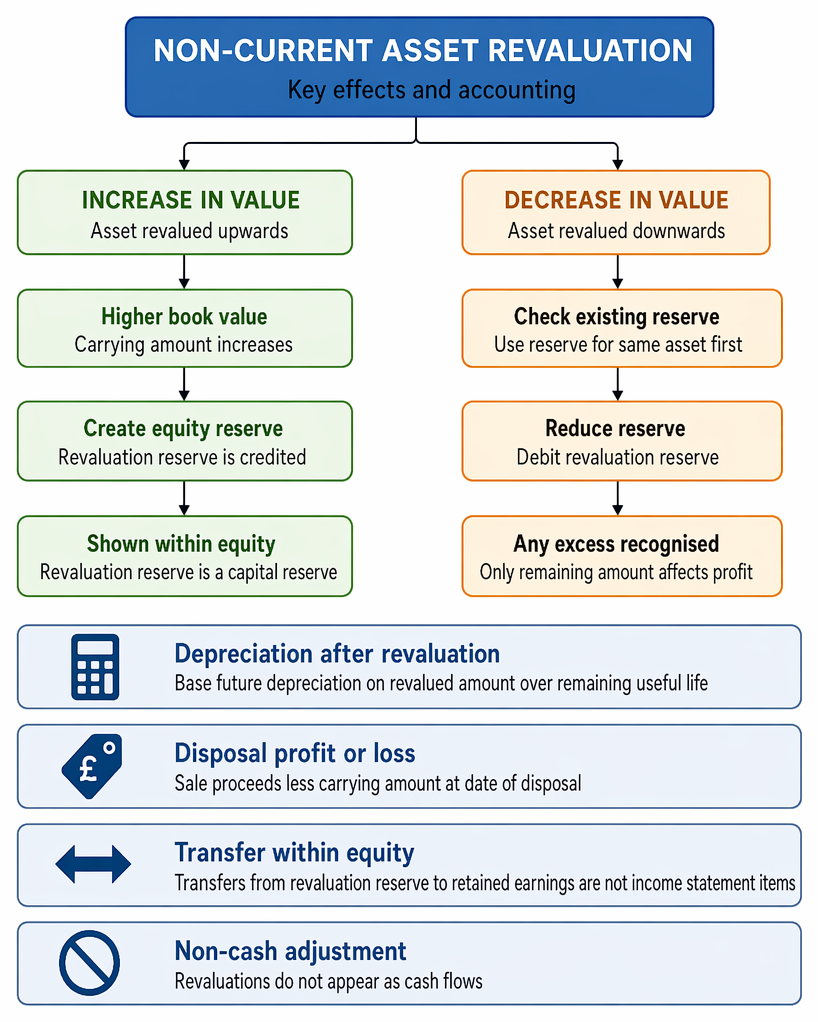
Revalued non-current assets are measured using carrying amount, with gains credited to revaluation reserve and deficits matched to the related asset.
- Know that an upward revaluation increases the carrying amount of a non-current asset and creates a revaluation reserve
- Identify that the revaluation reserve is a capital reserve shown within equity
- Explain the difference between an upward revaluation and a downward revaluation
- Understand that a downward revaluation is first set against any existing revaluation reserve for the same asset
- Know that depreciation after revaluation is based on the revalued amount over the remaining useful life
- Calculate profit or loss on disposal using sale proceeds less carrying amount at the date of disposal
- Understand that any transfer from revaluation reserve to retained earnings is a movement within equity, not an income statement item
- Recognise that a revaluation is a non-cash adjustment and does not appear as a cash flow
Test Your Knowledge
Attempt these questions before reading this article. If you find some difficult or cannot remember the answers, look more closely at that area during your revision.
- What is the difference between original cost and carrying amount when calculating a revaluation surplus?
- How is an upward revaluation shown in the statement of financial position?
- What happens if a non-current asset is revalued downwards but there is already a revaluation reserve for that same asset?
- How do you calculate depreciation after a revaluation?
- When a revalued asset is sold, does the revaluation reserve go through profit for the year?
Introduction
Non-current asset revaluation is an important limited company topic because it links asset values, reserves, depreciation and equity. In exam questions, students often lose marks by using original cost instead of carrying amount, or by sending revaluation movements through the wrong part of the accounts.
For AQA, you need to be secure on the accounting treatment and also on the logic behind it. A revaluation changes the book value of an asset. It may also change future depreciation, alter the equity section of the statement of financial position, and affect the treatment on disposal.
Key Term: carrying amount
The book value of a non-current asset at a given date, usually cost or valuation less accumulated depreciation.
The basic treatment of an upward revaluation
A limited company may decide to revalue a non-current asset, most commonly property, to reflect a higher current value. The key point is that the revaluation is based on the asset’s carrying amount, not usually its original cost.
If the asset’s value rises:
- increase the non-current asset to the revalued amount
- record the increase in a revaluation reserve
- show both in the statement of financial position
Key Term: revaluation reserve
A capital reserve created when a non-current asset is revalued upwards above its carrying amount.
This reserve is part of equity. It increases the shareholders’ stake in the business, but it is not trading profit and is generally not available for dividend payments.
Key Term: capital reserve
A reserve created from a non-trading gain, such as share premium or revaluation, which is not normally distributable as dividends.
A simple example:
A property has:
- cost £500,000
- accumulated depreciation £80,000
So carrying amount:
- £500,000 - £80,000 = £420,000
It is revalued to £560,000.
Revaluation surplus:
- £560,000 - £420,000 = £140,000
This means:
- non-current assets increase by £140,000
- revaluation reserve increases by £140,000
Worked example:
| Item | £ |
|---|---|
| Revalued amount | 560,000 |
| Less carrying amount before revaluation | 420,000 |
| Revaluation surplus | 140,000 |
In the statement of financial position, the asset is shown at the new carrying amount and equity includes the revaluation reserve.
A common AQA error is to calculate the increase from original cost:
- £560,000 - £500,000 = £60,000
That is wrong because the asset had already been depreciated.
Test Tip: In any revaluation question, calculate the carrying amount first. Examiners often award method marks for this step.
Downward revaluations and the same asset principle
A downward revaluation reduces the carrying amount of the asset. The treatment depends on whether there is already a revaluation reserve relating to that same asset.
Key Term: same asset principle
Revaluation gains and losses must be matched to the reserve or prior loss of the same asset, not just any asset in the business.
This is a major exam distinction.
If an asset is revalued downwards:
- first use any existing revaluation reserve for that same asset
- any remaining deficit is charged to the income statement
Worked example 1: reserve fully covers the fall
A building has carrying amount £300,000 and a revaluation reserve for that same building of £50,000.
It is revalued down to £270,000.
Revaluation decrease:
- £300,000 - £270,000 = £30,000
Treatment:
- reduce revaluation reserve by £30,000
- no income statement charge
Worked example 2: reserve only partly covers the fall
Same building:
- carrying amount £300,000
- revaluation reserve £20,000
New valuation:
- £260,000
Decrease:
- £300,000 - £260,000 = £40,000
Treatment:
- £20,000 against revaluation reserve
- £20,000 charged to income statement
Students often make two mistakes here:
- Using the total revaluation reserve of the company, rather than the reserve for the same asset
- Charging the whole decrease to the income statement even when a reserve exists
There is also a reverse rule. If an asset suffered a previous downward revaluation charged to the income statement, and later goes up in value, the increase is recognised in the income statement first to reverse that earlier loss. Any extra increase then goes to revaluation reserve.
Example:
- carrying amount after previous write-down: £180,000
- previous loss charged to income statement: £25,000
- new valuation: £220,000
Increase:
- £220,000 - £180,000 = £40,000
Treatment:
- first £25,000 to income statement
- remaining £15,000 to revaluation reserve
This is a high-value exam distinction because it tests whether you can apply the rule, not just state it.
Test Tip: If a question includes previous revaluation losses or existing reserves, stop and identify whether they relate to the same asset before posting anything.
Depreciation after revaluation
Once an asset has been revalued, future depreciation must be based on the revalued amount and the remaining useful life.
This is one of the most tested calculation areas.
Worked example:
A property has a carrying amount of £240,000 at 31 December. It is revalued to £300,000. It has 10 years of remaining useful life.
New annual depreciation:
- £300,000 ÷ 10 = £30,000 per year
If the asset had not been revalued, and historic cost carrying amount remained £240,000 over 10 years, depreciation would have been:
- £240,000 ÷ 10 = £24,000 per year
Extra depreciation caused by revaluation:
- £30,000 - £24,000 = £6,000
This extra amount is sometimes called excess depreciation.
Key Term: excess depreciation
The difference between depreciation based on the revalued amount and depreciation based on historic cost.
A transfer may be made from revaluation reserve to retained earnings for this excess depreciation. The key exam point is that this is:
- a movement within equity
- not an income statement item
- not compulsory in every question unless required
So if a company transfers the £6,000 excess depreciation:
- debit revaluation reserve £6,000
- credit retained earnings £6,000
No effect on profit for the year.
Students often make these errors:
- continuing to depreciate using original cost
- using original total life instead of remaining life
- putting the reserve transfer through the income statement
Side-by-side comparison:
| Historic cost basis | Revaluation basis |
|---|---|
| Depreciation based on old carrying amount | Depreciation based on revalued carrying amount |
| Lower annual charge | Usually higher annual charge after upward revaluation |
| No revaluation reserve effect | May create excess depreciation transfer within equity |
If a question gives gross cost and accumulated depreciation separately at revaluation date, focus on the final carrying amount after revaluation. At A-level, the critical marks are usually for correct carrying amount, reserve movement and revised depreciation.
Disposal of a revalued asset
When a revalued asset is sold, profit or loss on disposal is still calculated in the normal way:
- sale proceeds
- minus carrying amount at date of disposal
Do not add the revaluation reserve to disposal profit.
Worked example:
A revalued property has:
- carrying amount at disposal date £270,000
- sale proceeds £290,000
Profit on disposal:
- £290,000 - £270,000 = £20,000
That £20,000 goes to the income statement.
Suppose a revaluation reserve of £35,000 remains for that asset. On disposal, this may be transferred to retained earnings:
- debit revaluation reserve £35,000
- credit retained earnings £35,000
Again, this is only within equity.
Key Term: retained earnings
Profits kept in the business after tax and dividends, shown as a revenue reserve within equity.
This means two separate effects happen on disposal:
- Profit or loss on sale goes to the income statement
- Remaining revaluation reserve may be transferred to retained earnings within equity
Worked example in full:
| Item | £ |
|---|---|
| Sale proceeds | 290,000 |
| Less carrying amount | 270,000 |
| Profit on disposal | 20,000 |
Separate equity transfer:
- revaluation reserve to retained earnings = £35,000
Students often confuse these and report total “gain” as £55,000. That is incorrect.
How to structure an evaluative answer
If revaluation appears in a longer written response, do more than describe the entries. Build an argument.
Good financial evidence to cite:
- increase or decrease in carrying amount
- impact on equity through revaluation reserve
- higher future depreciation after upward revaluation
- effect on disposal profit calculation
- whether the reserve is distributable or not
Useful non-financial factors:
- relevance of up-to-date asset values to users
- whether the asset is property, where revaluation is more common
- whether revaluation improves the usefulness of the statement of financial position
- whether future profits may look lower because depreciation rises
Limitations to discuss:
- revaluation does not create cash
- reserve movements do not improve liquidity
- increased asset values do not mean increased distributable profits
- valuations may need judgement and can become outdated
A strong judgement might sound like:
- upward revaluation improves the relevance of the statement of financial position, but it does not create cash and may reduce future reported profit through higher depreciation
That is much better than a vague point such as “revaluation has pros and cons”.
Key Point Checklist
This article has covered the following key knowledge points:
- A revaluation surplus is calculated from carrying amount to revalued amount
- An upward revaluation usually increases the asset and creates a revaluation reserve
- The revaluation reserve is a capital reserve within equity
- A downward revaluation is set first against any reserve for the same asset
- Any remaining downward revaluation is charged to the income statement
- A later upward revaluation first reverses previous losses on the same asset taken to the income statement
- Depreciation after revaluation is based on the revalued amount over the remaining useful life
- Excess depreciation is the difference between revalued depreciation and historic cost depreciation
- Transfers from revaluation reserve to retained earnings are movements within equity only
- Profit or loss on disposal is sale proceeds minus carrying amount at disposal date
- The revaluation reserve is not added to disposal profit
- Revaluations are non-cash adjustments and do not appear as cash flows
Key Terms and Concepts
- carrying amount
- revaluation reserve
- capital reserve
- same asset principle
- excess depreciation
- retained earnings