Learning Outcomes
- Understand why limited companies publish accounts and the rules that govern them
- Identify the main elements of published accounts and the purpose of each
- Explain the difference between statutory accounts and the annual report and accounts
- Distinguish between the directors' report and the auditor's report
- Understand the meaning of true and fair view in company reporting
- Assess the benefits and limitations of published accounts for stakeholders
- Apply these points in short-answer and evaluative exam questions
AQA A-Level Accounting (7127) Syllabus
For the AQA A-Level Accounting (7127), you are expected to understand published accounts requirements for limited companies, with a focus on the following syllabus points:
- Know that limited companies are required to produce annual financial statements for publication
- Identify the role of the Companies Act 2006 and IAS 1 Presentation of Financial Statements
- Know the main elements of published accounts: statement of profit or loss, statement of financial position, statement of changes in equity, statement of cash flows, notes, directors' report and auditor's report
- Explain the purpose of each element of the published accounts
- Understand the meaning of true and fair view and the responsibility of directors for approving accounts
- Explain how published accounts are used by internal and external stakeholders
- Assess the benefits and limitations of published accounts
- Distinguish published accounts from internal use accounts
Test Your Knowledge
Attempt these questions before reading this article. If you find some difficult or cannot remember the answers, look more closely at that area during your revision.
- What is the difference between statutory accounts and the annual report and accounts?
- Name the main financial statements included in published accounts.
- What is the purpose of the notes to the financial statements?
- How does the directors' report differ from the auditor's report?
- Give two benefits and two limitations of published accounts.
Introduction
Published accounts are the public financial reports of a limited company. They exist because shareholders and other stakeholders need reliable information about company performance, financial position and cash flows. For AQA, this topic is not about memorising every legal detail. It is about knowing what must be published, why it is published, what each part does, and why the information is useful but still limited.
The topic also links strongly to analysis and evaluation. In exam answers, students often score well on listing components, but lose marks by failing to explain purpose, responsibility and limitation. You need to know both the structure and the reasoning behind it.
Key Term: published accounts
Annual financial information produced by a limited company for shareholders and other stakeholders, following company law and accounting rules.Exam Warning: Do not rely on keyword recognition alone; check the precise condition, exception, calculation step, or evidence the question requires.
Introduction to published accounts and the reporting framework
Limited companies must produce annual financial statements. These are not prepared in any format the company chooses. They are shaped by the legal and regulatory framework, mainly company law and accounting standards.
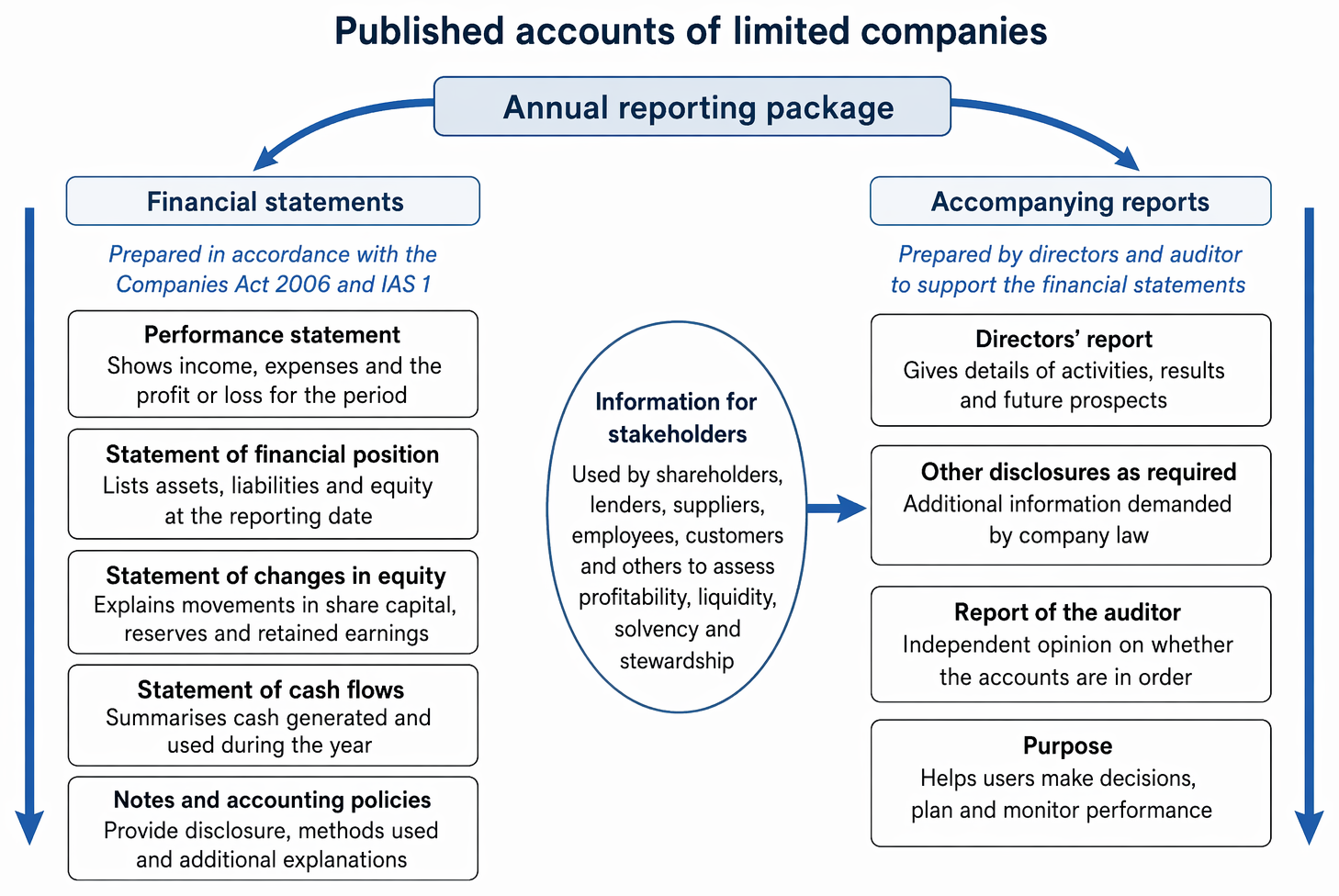
Limited company financial reporting framework identifies required statements, accompanying reports, and directors’ responsibility for a true and fair view.
Key Term: legal and regulatory framework
The set of rules governing financial reporting, including company law and accounting standards.
For this course, the main accounting standard is IAS 1 Presentation of Financial Statements. It sets out how financial statements should be presented so that users can compare one year with another and compare one company with another.
A key legal idea is that directors must only approve accounts if they are satisfied that the accounts give a true and fair view of the company's assets, liabilities, financial position and profit or loss.
Key Term: true and fair view
The requirement that financial statements should present information honestly, appropriately and without material misleading bias.
You should also know the difference between two related terms:
- Statutory accounts are the accounts required by law and filed at Companies House
- Annual report and accounts is the fuller report made available to shareholders, containing the financial statements and accompanying reports
This distinction matters because exam questions may ask what is filed by law and what is included in the wider published reporting package.
Key Term: statutory accounts
The annual accounts a company is legally required to prepare and file. Key Term: annual report and accounts
The wider published report containing the financial statements and supporting reports for shareholders.
IAS 1 also expects important presentation principles to be followed:
- going concern
- accrual basis, except for cash flow information
- consistency
- materiality
- separate presentation rather than offsetting
- comparative information for the previous period
Test Tip: If a question asks about why published accounts are comparable, mention standard formats, consistent accounting policies and comparative figures from the previous year.
What a complete set of published accounts includes
AQA expects you to know the main elements of published accounts and the purpose of each. The safest list is:
- statement of profit or loss
- statement of financial position
- statement of changes in equity
- statement of cash flows
- notes to the financial statements, including accounting policies
- directors' report
- auditor's report, where an audit is required
The specification does not require detailed group accounts knowledge, and the statement of overall income is not examined in this context, so keep the focus on the listed items above.
Main elements of published accounts and their purpose
Statement of profit or loss, statement of financial position and statement of changes in equity
The statement of profit or loss shows financial performance for the year. It reports whether the company made a profit or a loss after taking account of income and expenses.
Key Term: statement of profit or loss
The financial statement showing the company's performance over the accounting period.
Its purpose for stakeholders:
- shareholders assess profitability and dividend potential
- management assess operating performance
- lenders assess ability to service finance costs
- government can use profit figures in tax assessment
The statement of financial position shows the company's assets, liabilities and equity at the year end.
Key Term: statement of financial position
The financial statement showing assets, liabilities and equity at a specific date.
Its purpose:
- shows what the company owns and owes
- helps assess liquidity and solvency
- helps lenders consider security
- helps suppliers judge whether the company can pay debts
The statement of changes in equity explains movements in equity during the year.
Key Term: statement of changes in equity
The financial statement showing movements in share capital, reserves and retained earnings during the year.
Typical movements include:
- profit for the year
- dividends paid
- issue of shares
- movements in reserves
This statement matters because the statement of profit or loss gives the year's result, but the statement of changes in equity shows what happened to that result. It links profit, dividends and reserves clearly.
A common student mistake is to describe the statement of changes in equity as just a reserve statement. It is wider than that. It tracks all major changes in shareholders' equity.
Statement of cash flows, notes and accounting policies
The statement of cash flows shows cash movements during the year.
Key Term: statement of cash flows
The financial statement showing cash inflows and outflows during the accounting period.
For AQA, this statement is usually divided into:
- operating activities
- investing activities
- financing activities
Its purpose:
- explains why profit is not the same as cash
- shows whether operations are generating cash
- reveals major investment spending
- shows how the company is financed
This is especially useful because a company may report profit but still face liquidity pressure.
The notes to the financial statements are a required part of the accounts, not an optional extra.
Key Term: notes to the financial statements
Supporting disclosures that explain figures, accounting policies and additional details needed to understand the statements.
Their purpose is to provide:
- the basis of preparation
- accounting policies used
- further detail required by standards
- extra explanation that helps users understand the statements
For example, notes may explain how depreciation is calculated or give extra breakdowns of assets and liabilities.
Key Term: accounting policies
The specific accounting methods chosen by a company, such as its depreciation method.
Accounting policies are important because they affect comparability and interpretation. If two companies use different methods, profit and asset values may not be directly comparable. Policies should be applied consistently unless a justified change is made.
A common exam error is to say that notes are separate from the financial statements. They are part of the complete set.
Test Tip: If asked why notes matter, do not just say "they provide more detail". Add what kind of detail: accounting policies, extra disclosures, and explanation needed for understanding.
Directors' report and auditor's report
The directors' report is prepared by the directors and gives narrative information about the company.
Key Term: directors' report
A report by directors giving information on company activities, performance and other required disclosures.
Typical areas covered include:
- principal activities
- review of the year's performance
- likely future developments
- directors serving during the year
- dividend information
Its purpose is different from the financial statements. It gives explanation and context from the directors' viewpoint.
The auditor's report is an independent report by external auditors where an audit is required.
Key Term: auditor's report
An independent report stating the auditor's opinion on whether the financial statements have been properly prepared and give a true and fair view.
The report normally deals with:
- responsibilities of directors and auditors
- basis of the audit opinion
- the auditor's opinion
An unqualified opinion means the auditors are satisfied that the accounts have been properly prepared and give a true and fair view.
Key Term: unqualified audit opinion
An audit opinion stating that the financial statements have been properly prepared and give a true and fair view.
A qualified opinion means the auditors believe there is an important problem that users should be told about.
Key Term: qualified audit opinion
An audit opinion showing that the auditors have concerns about part of the financial statements.
A very common confusion is responsibility. Remember:
- directors prepare and approve the accounts
- auditors examine the accounts and express an opinion on them
That distinction is highly examinable.
Stakeholder use, benefits and limitations of published accounts
How stakeholders use published accounts
Internal stakeholders include:
- shareholders
- management
- employees
External stakeholders include:
- customers
- suppliers
- lenders
- government and agencies
- local community
Each group uses the published accounts differently.
Shareholders look at:
- profit
- dividends
- retained earnings
- long-term financial strength
Management look at:
- performance
- efficiency
- growth
- comparison with previous periods
Employees look at:
- job security
- ability to support pay
- long-term survival
Suppliers and lenders focus strongly on:
- liquidity
- asset backing
- ability to pay amounts due
Government looks at:
- profits
- activity levels
- tax implications
Customers and the local community may look at:
- long-term continuity
- stability
- wider economic contribution
A strong exam answer explains not just who uses the accounts, but what decision each user is trying to make.
Benefits and limitations of published accounts
Benefits of published accounts include:
- they are produced regularly
- they are available to shareholders and other stakeholders
- they follow common rules and formats
- they are often audited, which increases trust
- they allow year-to-year and company-to-company comparison
Key Term: comparability
The quality of financial information that allows users to compare one period with another or one business with another.
Published accounts also support accountability. They help shareholders assess how directors have managed company resources.
But published accounts have important limitations:
- they are historical, not forward-looking
- they may be out of date by the time users read them
- they contain summarised information, not full internal detail
- they may omit non-financial matters such as staff morale or product life cycle
- they are affected by judgement and estimates
- they may not reveal sudden changes after the year end
These limitations matter in evaluative answers. Published accounts are useful, but not complete.
How to structure an evaluative answer
For a longer exam response on published accounts, organise your answer like this:
- State what published accounts provide
- Explain which stakeholders use them and for what decisions
- Give clear benefits using financial reporting features such as comparability, audit and standardisation
- Add limitations such as historic nature, delay, summarisation and missing non-financial information
- Reach a judgement
Financial evidence to cite:
- profit figures
- liquidity position
- cash flow information
- equity changes
- trade receivables, trade payables and asset values
Non-financial points to discuss:
- management quality
- market conditions
- staff motivation
- future strategy
- competition
Avoid generic comments like "accounts have limitations". Be precise about why. For example, say that annual reporting can be stale because performance may have changed materially before publication.
Key Point Checklist
This article has covered the following key knowledge points:
- Published accounts are annual financial reports prepared by limited companies for shareholders and other stakeholders
- The legal and regulatory framework includes company law and accounting standards
- IAS 1 sets out overall presentation requirements for financial statements
- Directors must only approve accounts if they give a true and fair view
- Statutory accounts are the legal accounts filed, while the annual report and accounts is the wider reporting package
- Main elements include the statement of profit or loss, statement of financial position, statement of changes in equity, statement of cash flows and notes
- Notes to the financial statements include accounting policies and supporting explanation
- The directors' report provides narrative information from directors
- The auditor's report gives an independent opinion where an audit is required
- Stakeholders use published accounts to assess profitability, liquidity, solvency and stewardship
- Benefits include comparability, transparency and audit assurance
- Limitations include historic data, delay, summarisation and missing non-financial information
Key Terms and Concepts
- published accounts
- legal and regulatory framework
- true and fair view
- statutory accounts
- annual report and accounts
- statement of profit or loss
- statement of financial position
- statement of changes in equity
- statement of cash flows
- notes to the financial statements
- accounting policies
- directors' report
- auditor's report
- unqualified audit opinion
- qualified audit opinion
- comparability