Learning Outcomes
- Understand the difference between a share issue, a rights issue and a bonus issue
- Calculate the number of new shares issued from a stated ratio
- Record share issues at par and at a premium using correct double entry
- Explain the effect of rights issues and bonus issues on equity and net assets
- Prepare extracts from the statement of financial position and statement of changes in equity
- Avoid common exam errors, especially with nominal value, issued share capital and reserves
AQA A-Level Accounting (7127) Syllabus
For the AQA A-Level Accounting (7127), you are expected to understand accounting for share issues, rights issues and bonus issues, with a focus on the following syllabus points:
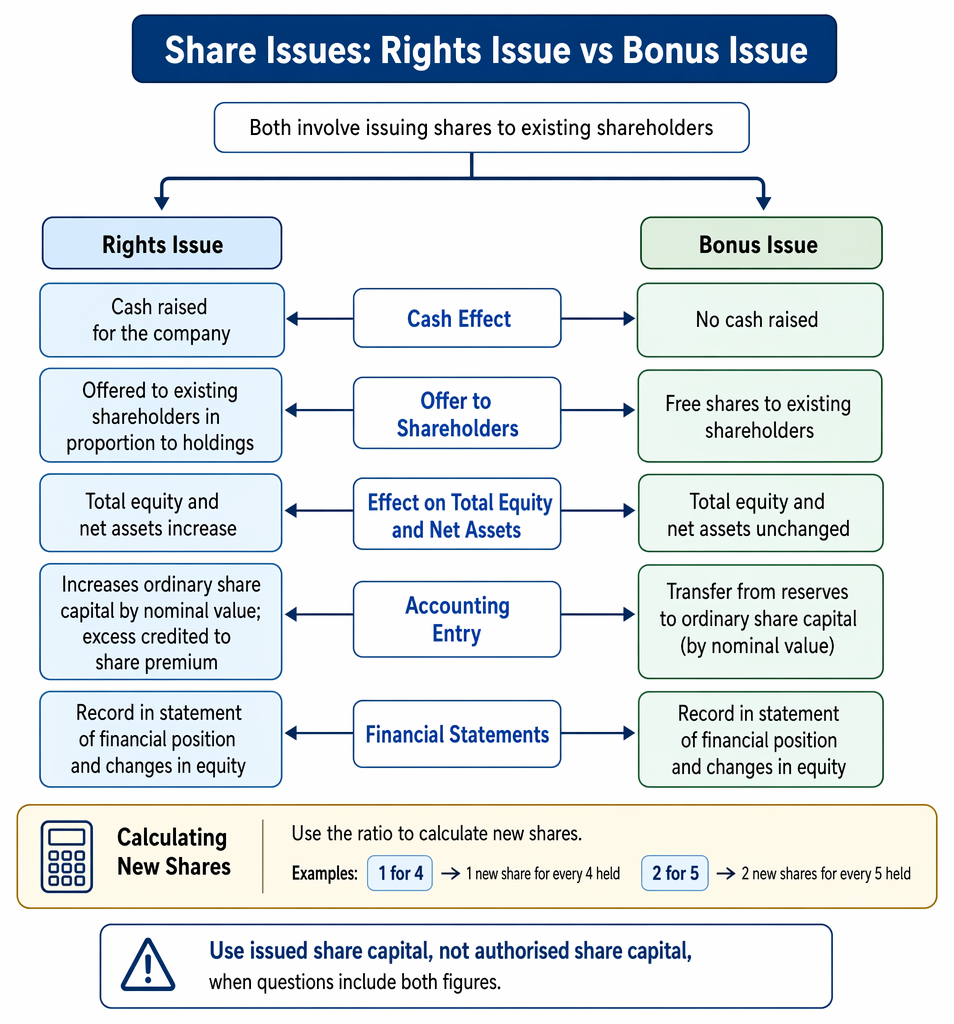
Ordinary, rights and bonus share issues are compared by their effects on cash, equity components and net assets.
- Know that a normal issue of shares and a rights issue both raise cash for the company
- Identify that ordinary share capital is increased by nominal value, while any excess is credited to share premium
- Explain that a rights issue is offered to existing shareholders in proportion to their holdings
- Understand that a bonus issue gives free shares to existing shareholders by capitalising reserves
- Distinguish clearly between the effect of a rights issue and a bonus issue on total equity and net assets
- Calculate new shares issued from ratios such as 1 for 4 or 2 for 5
- Record the effect of these transactions in the statement of financial position and statement of changes in equity
- Use issued share capital, not authorised share capital, when questions include both figures
Test Your Knowledge
Attempt these questions before reading this article. If you find some difficult or cannot remember the answers, look more closely at that area during your revision.
- What is the difference between a share issue at par and a share issue at a premium?
- How does a rights issue differ from a bonus issue in terms of cash received?
- How is share premium calculated on a rights issue?
- Why does a bonus issue not change total equity?
- How would a rights issue appear in a statement of changes in equity?
Introduction
This subtopic is tested regularly because it combines double-entry bookkeeping, company equity and financial statement presentation. In AQA questions, you may be asked to calculate the number of shares issued, split proceeds between share capital and share premium, or show the effect in the statement of changes in equity.
The key to this topic is to separate three ideas. A share issue is the general issue of new shares for cash. A rights issue is also a cash issue, but it is offered to existing shareholders in proportion to their current holdings. A bonus issue is different because no cash is raised at all: reserves are converted into ordinary share capital.
Key Term: equity
The owners’ interest in a company, made up of issued share capital and reserves.Test Tip: When revising Share issues, rights issues, bonus issues, connect each definition, method, or rule to the kind of question the assessment is likely to ask.
Exam Warning: Do not rely on keyword recognition alone; check the precise condition, exception, calculation step, or evidence the question requires.
Ordinary share issues: at par and at a premium
A limited company may issue ordinary shares when it is first set up or when it needs extra finance later. The accounting treatment depends on whether the shares are issued at nominal value or above nominal value.
Key Term: nominal value
The face value of a share stated by the company, such as £1, 50p or 25p.
If shares are issued at par, the full amount received is credited to ordinary share capital.
Example: a company issues 10,000 £1 ordinary shares at par.
Step 1: calculate cash received 10,000 shares × £1 = £10,000
Double entry:
- Dr Bank £10,000
- Cr Ordinary share capital £10,000
If shares are issued above nominal value, the excess is share premium.
Key Term: share premium
The amount received above the nominal value of shares issued.
Example: a company issues 5,000 £1 ordinary shares at £1.50.
Step 1: calculate total cash received 5,000 × £1.50 = £7,500
Step 2: calculate ordinary share capital 5,000 × £1 = £5,000
Step 3: calculate share premium 5,000 × (£1.50 - £1.00) = 5,000 × £0.50 = £2,500
Double entry:
- Dr Bank £7,500
- Cr Ordinary share capital £5,000
- Cr Share premium £2,500
Statement of financial position effect:
- Bank increases by £7,500
- Ordinary share capital increases by £5,000
- Share premium increases by £2,500
Common student errors:
- Putting the full proceeds into ordinary share capital
- Forgetting that share premium is only the excess over nominal value
- Assuming all shares have a nominal value of £1
Test Tip: Always check the nominal value of the share before doing any calculation. AQA often uses 50p or 25p shares to test accuracy.
Rights issues: cash raised from existing shareholders
A rights issue is a new issue of shares offered to existing shareholders in proportion to their current holdings. The accounting treatment is the same pattern as a normal cash share issue, but the context is different.
Key Term: rights issue
An issue of shares for cash offered to existing shareholders in proportion to their existing holdings.
Companies use rights issues to raise new finance, often for expansion. Existing shareholders may buy the new shares offered to them, and in practice rights may also be sold, but for AQA the main focus is the accounting effect.
The standard method is:
- Calculate existing number of shares
- Apply the rights ratio
- Calculate cash received
- Split the proceeds between ordinary share capital and share premium
Worked example:
A company has 200,000 £1 ordinary shares in issue. It makes a 1 for 4 rights issue at £1.50 per share.
Step 1: existing shares Already given: 200,000 shares
Step 2: new shares issued 1 for 4 means one new share for every four existing shares
New shares = 200,000 × 1/4 = 50,000 shares
Step 3: cash received 50,000 × £1.50 = £75,000
Step 4: ordinary share capital increase 50,000 × £1.00 = £50,000
Step 5: share premium increase 50,000 × (£1.50 - £1.00) = £25,000
Double entry:
- Dr Bank £75,000
- Cr Ordinary share capital £50,000
- Cr Share premium £25,000
Effect on financial statements:
- Bank increases by £75,000
- Share capital increases by £50,000
- Share premium increases by £25,000
- Total equity increases by £75,000
- Net assets increase by £75,000
This is the critical point: a rights issue increases both total equity and net assets because new cash enters the business.
Side-by-side comparison:
| Feature | Normal share issue | Rights issue |
|---|---|---|
| Cash received? | Yes | Yes |
| Offered to existing shareholders? | Not necessarily | Yes |
| Share capital increases? | Yes | Yes |
| Share premium possible? | Yes | Yes |
| Total equity increases? | Yes | Yes |
Common student errors:
- Confusing a rights issue with a bonus issue
- Using the value of issued share capital as if it were the number of shares
- Forgetting to divide by nominal value when the shares are not £1 shares
Example with non-£1 shares:
Ordinary share capital = £100,000 of 50p shares Number of shares = £100,000 ÷ £0.50 = 200,000 shares
A 1 for 4 rights issue gives:
- New shares = 200,000 ÷ 4 = 50,000
- Increase in share capital = 50,000 × £0.50 = £25,000
Test Tip: If the question gives ordinary share capital in £ and a nominal value in pence, convert to number of shares before using the ratio.
Bonus issues: capitalisation of reserves
A bonus issue gives free shares to existing shareholders. No cash is received. Instead, reserves are turned into ordinary share capital.
Key Term: bonus issue
Free shares issued to existing shareholders by capitalising reserves.
A bonus issue changes the composition of equity, not the total. Shareholders hold more shares, but the company does not become richer and no new cash enters.
The basic double entry is:
- Dr reserve account
- Cr ordinary share capital
The reserve used may be share premium, retained earnings, or another permitted reserve named in the question. In AQA questions, if the directors want reserves to remain in their most distributable form, use share premium first because retained earnings are distributable.
Worked example:
A company has 200,000 £1 ordinary shares in issue and retained earnings of £200,000. It makes a 1 for 2 bonus issue.
Step 1: calculate new shares 200,000 × 1/2 = 100,000 new shares
Step 2: calculate increase in ordinary share capital 100,000 × £1 = £100,000
Double entry:
- Dr Retained earnings £100,000
- Cr Ordinary share capital £100,000
Effect on financial statements:
- Ordinary share capital increases by £100,000
- Retained earnings decrease by £100,000
- Bank unchanged
- Total equity unchanged
- Net assets unchanged
This is the key distinction from a rights issue.
Side-by-side comparison:
| Feature | Rights issue | Bonus issue |
|---|---|---|
| Cash received? | Yes | No |
| Bank increases? | Yes | No |
| Share capital increases? | Yes | Yes |
| Share premium may increase? | Yes | No |
| Reserve reduced? | No | Yes |
| Total equity increases? | Yes | No |
| Net assets increase? | Yes | No |
Worked example with reserve choice:
A company has:
- Ordinary shares of 25p each, fully paid: £800,000
- Share premium: £225,000
- Revaluation reserve: £185,000
- Retained earnings: £215,000
Bonus issue: 2 for 5
Step 1: existing shares £800,000 ÷ £0.25 = 3,200,000 shares
Step 2: new shares 3,200,000 × 2/5 = 1,280,000 shares
Step 3: increase in ordinary share capital 1,280,000 × £0.25 = £320,000
If the directors wish to keep reserves in the most distributable form:
- use share premium first: £225,000
- then the remaining £95,000 from a less distributable reserve if allowed by the question
Common student errors:
- Thinking a bonus issue raises finance
- Forgetting that no bank entry is made
- Calculating the issue from authorised share capital instead of issued share capital
- Missing the clue about which reserve to use
Showing the effect in the statement of changes in equity
This topic is often examined through the statement of changes in equity. You need to show clearly which part of equity changes.
For a rights issue:
- share capital increases
- share premium may increase
- retained earnings unchanged by the issue itself
Example:
Opening balances:
- Share capital £200,000
- Share premium £0
- Retained earnings £200,000
Rights issue:
- Share capital +£100,000
- Share premium +£80,000
Closing balances:
- Share capital £300,000
- Share premium £80,000
- Retained earnings £200,000
- Total £580,000
For a bonus issue:
- share capital increases
- reserve used decreases
- total unchanged
Example:
Opening balances:
- Share capital £200,000
- Share premium £0
- Retained earnings £200,000
Bonus issue:
- Share capital +£100,000
- Retained earnings -£100,000
Closing balances:
- Share capital £300,000
- Share premium £0
- Retained earnings £100,000
- Total £400,000
A good written explanation for AO3:
- A rights issue increases total equity because shareholders subscribe cash for new shares.
- A bonus issue does not increase total equity because it is only a transfer within equity from reserves to ordinary share capital.
How to structure an evaluative answer: If a longer question asks about the impact on shareholders or the company, use:
- financial evidence: increase in bank, increase in share capital, movement in share premium, no change in total equity for bonus issues
- non-financial factors: reason for raising finance, existing shareholders keeping ownership proportion, shareholder perception
- limitations: published figures show accounting effect, but not whether the finance raised will be used well
Key Point Checklist
This article has covered the following key knowledge points:
- A share issue raises cash and increases ordinary share capital
- If shares are issued above nominal value, the excess is credited to share premium
- A rights issue is a cash issue offered to existing shareholders in proportion to their holdings
- The accounting treatment of a rights issue is the same pattern as any cash issue of shares
- New shares issued in a rights issue or bonus issue are calculated from the number of shares in issue
- A bonus issue gives free shares to existing shareholders by capitalising reserves
- A bonus issue does not increase bank, net assets or total equity
- A rights issue increases bank, net assets and total equity
- In statement of changes in equity, a rights issue increases share capital and possibly share premium
- In statement of changes in equity, a bonus issue increases share capital and reduces a reserve by the same amount
- Calculations must be based on issued share capital, not authorised share capital
- The nominal value of the share must always be checked before calculating share numbers or capital increases
Key Terms and Concepts
- equity
- nominal value
- share premium
- rights issue
- bonus issue