Learning Outcomes
This article explains how to apply microeconomic welfare analysis in a CFA Level 1 context, including:
- defining consumer surplus and producer surplus precisely, and relating them to individual willingness to pay and marginal cost schedules;
- locating and shading consumer surplus and producer surplus on linear and non-linear supply and demand diagrams, and linking the diagram areas to numerical values;
- computing changes in consumer surplus, producer surplus, and total (social) surplus when equilibrium price or quantity changes;
- explaining the conditions under which a competitive market allocation is economically efficient and total surplus is maximized;
- identifying, illustrating, and calculating deadweight loss created by taxes, subsidies, price ceilings, and price floors;
- distinguishing between pure transfers (such as tax revenue or quota rents) and true welfare losses to society;
- analyzing how different types of government intervention redistribute surplus between consumers, producers, and the government;
- interpreting welfare diagrams and numerical data to answer CFA-style multiple-choice questions quickly and accurately;
- integrating welfare analysis with demand and supply elasticity to comment on tax incidence and the relative burden on buyers and sellers.
CFA Level 1 Syllabus
For the CFA Level 1 exam, you are expected to understand the concepts of microeconomic welfare, with a focus on the following syllabus points:
- Calculation and graphical representation of consumer surplus and producer surplus
- Determination of equilibrium efficiency and deadweight loss due to market interventions (such as taxes or price floors/ceilings)
- Interpretation of welfare effects of supply and demand shifts, taxes, and government policies
- Application of welfare analysis to assess economic efficiency and cost to society
Test Your Knowledge
Attempt these questions before reading this article. If you find some difficult or cannot remember the answers, look more closely at that area during your revision.
- Define consumer surplus. Where is it represented on a supply and demand graph?
- Explain how a per-unit sales tax affects consumer surplus, producer surplus, and total welfare.
- What does deadweight loss represent in welfare economics?
- How would the imposition of a binding price ceiling affect producer and consumer surplus?
Introduction
Welfare analysis in microeconomics measures how the allocation of resources in a market affects buyers, sellers, and society as a whole. Understanding consumer surplus and producer surplus enables analysts to assess market efficiency, evaluate the welfare impact of policies such as taxes or price controls, and distinguish between private benefits and the total gains to society.
Test Tip: When revising Consumer surplus producer surplus and welfare, connect each definition, method, or rule to the kind of question the assessment is likely to ask.
Consumer Surplus
Consumer surplus is the net benefit that buyers receive from purchasing a good, calculated as the difference between the maximum price a buyer is willing to pay and the price actually paid for each unit. In a competitive market, this is represented by the area under the demand curve and above the market price, up to the quantity traded.
Key Term: Consumer Surplus
The difference between the total amount a consumer is willing to pay for a good and the amount actually paid, summed across all units purchased.
Producer Surplus
Producer surplus measures the net benefit that sellers receive from selling a good, calculated as the difference between the price actually received and the minimum price at which the producer would be willing to sell each unit. On a supply and demand diagram, producer surplus equals the area above the supply curve and below the equilibrium price, up to the quantity traded.
Key Term: Producer Surplus
The difference between the total revenue received by producers and the total variable cost of production, summed across all units sold. Key Term: Total Surplus (Social Surplus)
The sum of consumer surplus and producer surplus; represents the total net benefit to society from trading the good or service.
Market Efficiency and Deadweight Loss
Market equilibrium in a perfectly competitive market maximizes total surplus, so the allocation is efficient—there is no way to make someone better off without making someone else worse off. Market interventions such as taxes, subsidies, or price ceilings/floors can reduce total surplus and generate a deadweight loss to society.
Key Term: Deadweight Loss
The reduction in total surplus that occurs when the quantity traded in a market is less than the efficient equilibrium level due to distortions such as taxes, subsidies, or price controls.
Worked Example 1.1
Suppose the market for widgets is in equilibrium at a price of $10 and a quantity of 200 units. The demand curve is linear and slopes downward; the supply curve is linear and slopes upward.
Question: Where on a standard supply and demand diagram can you find consumer surplus and producer surplus?
Answer:
Consumer surplus is the area under the demand curve and above $10, up to Q = 200. Producer surplus is the area above the supply curve and below $10, up to Q = 200. Total surplus is the sum of these two areas.
Effects of Taxes and Price Controls
A specific tax (such as a per-unit sales tax) raises the price paid by buyers, reduces the price received by sellers, and lowers the quantity bought and sold. The difference between the pre-tax and post-tax total surplus is the deadweight loss. Price ceilings and price floors can also create deadweight loss by either producing shortages or surpluses, leading to missed gains from trade.
Market welfare analysis traces equilibrium identification, surplus regions on demand and supply curves, and total surplus computed as geometric areas.
Worked Example 1.2
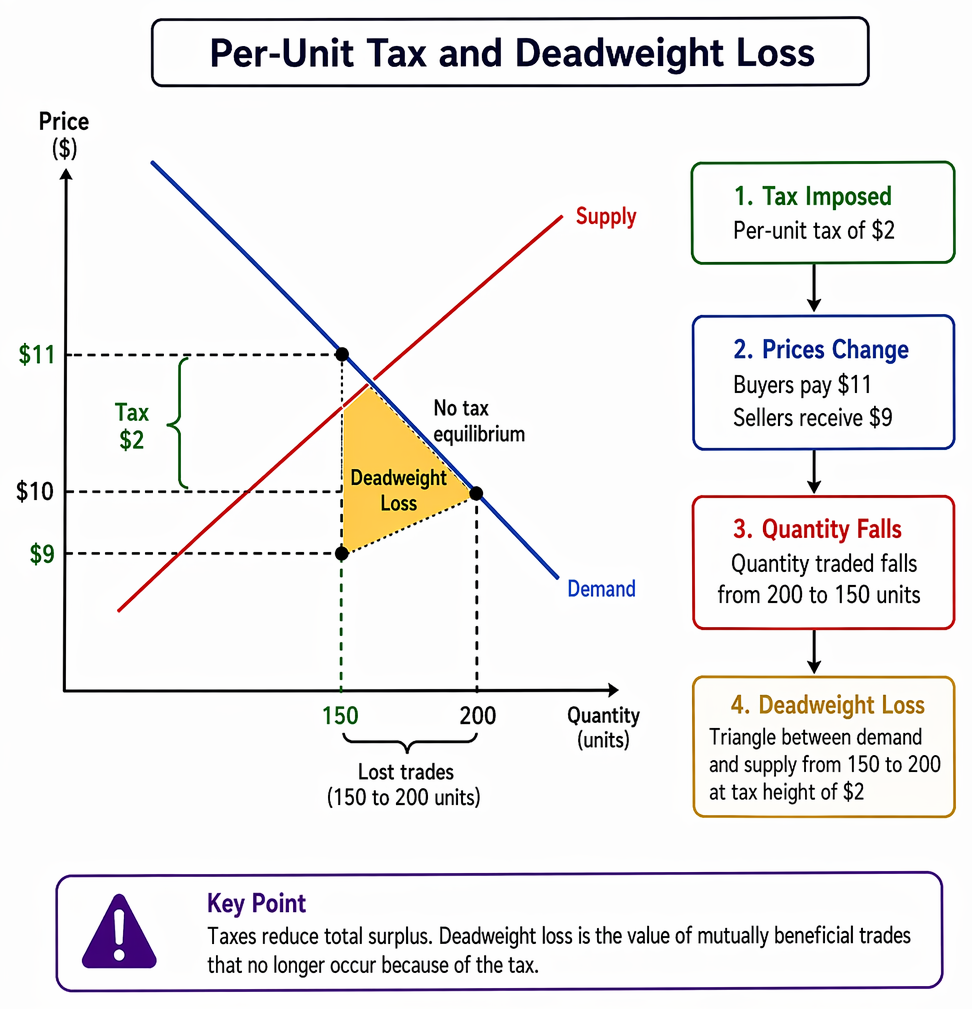
A government imposes a $2 per unit tax in the widget market. After the tax is introduced, consumers pay $11, producers receive $9, and 150 units are sold (down from 200 without the tax). Calculate the deadweight loss.
Answer:
Deadweight loss is the area of the triangle formed between the demand and supply curves from the new lower quantity (150) out to the original equilibrium quantity (200), at the per-unit tax amount ($2). It represents lost trades where the buyers’ willingness to pay would have exceeded the sellers’ cost, but those trades do not occur because of the tax.Exam Warning: A common error is to think that all taxes are simply a transfer from consumers and producers to the government. In fact, taxes also create deadweight loss—a reduction in overall welfare—by preventing mutually beneficial trades. Always identify deadweight loss when analyzing the welfare effects of market interventions.
Application: Changes in Surplus Due to Shifts and Interventions
Changes in demand, supply, taxes, or regulations will shift the areas of consumer and producer surplus and potentially create deadweight loss. An analyst should be able to illustrate these changes and calculate the new areas using basic geometry if given a linear supply and demand diagram.
Worked Example 1.3
Suppose the government sets a binding price ceiling below equilibrium. What happens to consumer surplus, producer surplus, and total surplus?
Answer:
A binding price ceiling decreases producer surplus and increases consumer surplus for buyers able to purchase at the lower price, but creates deadweight loss as some mutually beneficial trades do not occur. Total surplus decreases compared to the free market equilibrium.
Summary
- Consumer surplus is the benefit buyers receive from a good in excess of the price paid.
- Producer surplus is the benefit sellers receive above their cost of production.
- Total surplus is maximized at competitive equilibrium; any reduction in quantity traded from equilibrium results in deadweight loss.
- Government interventions such as taxes and price controls reduce total welfare by creating deadweight loss.
Key Point Checklist
This article has covered the following key knowledge points:
- Identify and illustrate consumer and producer surplus on supply and demand diagrams
- Calculate total (social) surplus and interpret market efficiency
- Explain how taxes, subsidies, and price controls create deadweight loss
- Evaluate welfare impacts of market interventions
Key Terms and Concepts
- Consumer Surplus
- Producer Surplus
- Total Surplus (Social Surplus)
- Deadweight Loss