Learning Outcomes
This article explains the microeconomic foundations of demand, supply, and elasticities, including:
- analysing linear and non-linear demand and supply functions, and linking algebraic forms to correctly drawn market diagrams;
- calculating, classifying, and interpreting price, income, and cross-price elasticities using both percentage-change and point-slope formulas in typical CFA Level 1 problem formats;
- distinguishing normal, inferior, Giffen, and Veblen goods based on sign and magnitude of relevant elasticities and describing how each behaves in response to price and income changes;
- assessing how demand elasticity affects total and marginal revenue, expenditure, and the shape of the demand curve at different price ranges;
- comparing price elasticity of demand with price elasticity of supply and explaining the key economic determinants that drive greater or lesser responsiveness in each case;
- evaluating the impact of demand or supply shocks, taxes, and other policy interventions on equilibrium price, quantity, and tax incidence using elasticity concepts;
- identifying whether a scenario reflects a movement along a curve or a shift of the curve and selecting the elasticity measure most appropriate for answering exam-style questions.
CFA Level 1 Syllabus
For the CFA Level 1 exam, you are expected to understand the fundamental mechanics of demand and supply, the application and interpretation of various elasticities, and their role in market outcomes, with a focus on the following syllabus points:
- Constructing and interpreting demand and supply functions and curves
- Calculating price, income, and cross-price elasticities, and understanding their determinants
- Distinguishing among normal, inferior, and Giffen goods based on elasticity and consumer behaviour
- Analysing how elasticities affect total revenue, expenditure, and equilibrium adjustment
- Predicting the effects of shocks to demand or supply on equilibrium price and quantity using elasticity concepts
Test Your Knowledge
Attempt these questions before reading this article. If you find some difficult or cannot remember the answers, look more closely at that area during your revision.
- A 10% increase in the price of good X results in a 15% decrease in quantity demanded. What is the price elasticity of demand for X, and how would you describe it?
- If two goods have a positive cross-price elasticity, what is their relationship?
- Explain what happens to total revenue for a firm if it raises the price of a good with inelastic demand.
- What distinguishes a Giffen good from an inferior good?
Introduction
Microeconomic analysis begins with the theory of demand and supply. These tools underpin equilibrium price and quantity determination in competitive markets. Understanding how quantities respond to changes in price or income is measured by various elasticities, key to evaluating market scenarios and predicting firm or consumer reactions.
Key Term: demand function
A mathematical relationship showing the quantity of a good consumers are willing to buy at various prices, holding other factors constant. Key Term: supply function
A mathematical relationship showing the quantity of a good producers are willing to sell at various prices, holding other factors constant.Test Tip: When revising Demand supply and elasticities, connect each definition, method, or rule to the kind of question the assessment is likely to ask.
Exam Warning: Do not rely on keyword recognition alone; check the precise condition, exception, calculation step, or evidence the question requires.
Demand, Supply, and Market Equilibrium
The market demand function shows how quantity demanded () depends on own price (), income (), and prices of related goods ():
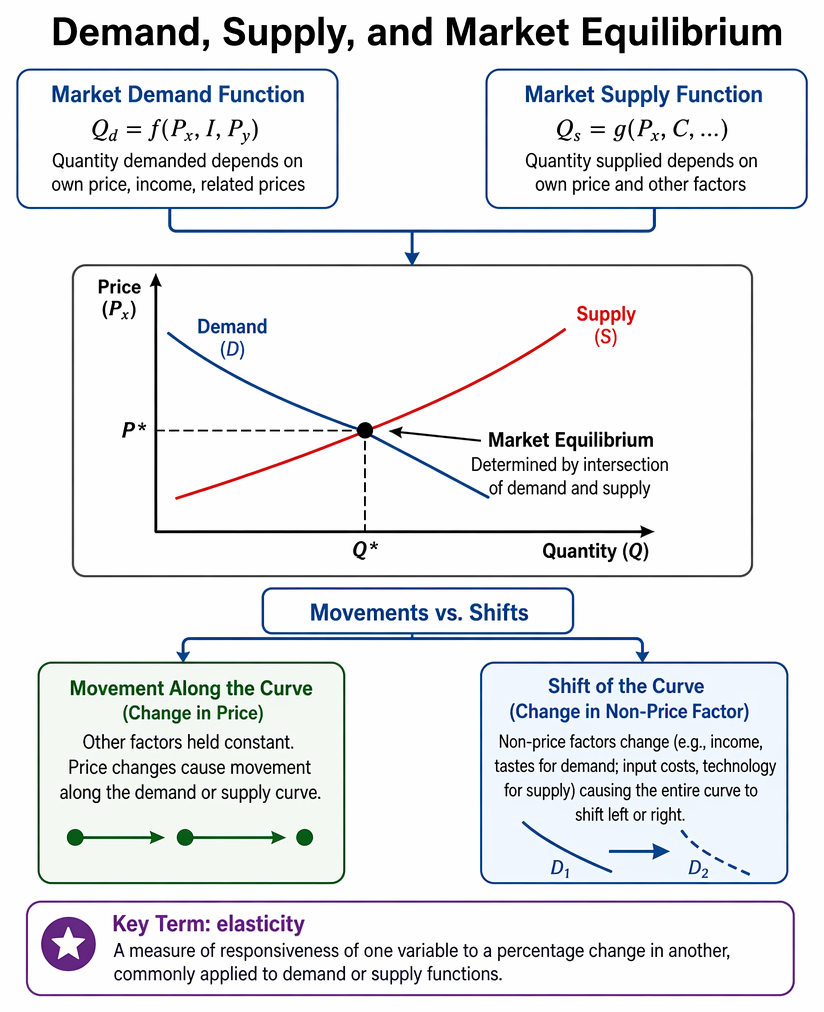
Demand categories are separated by income elasticity sign and by upward-sloping demand cases arising from strong income effects or status consumption.
Market supply functions similarly, but from the supplier’s standpoint. The intersection of the demand and supply curves determines market equilibrium.
Movements vs. Shifts
A movement along the curve occurs when price changes, with other factors held constant. A shift in demand or supply occurs when a non-price factor changes (e.g., income, tastes for demand; input costs, technology for supply). Exam questions frequently ask you to identify whether a result is due to a movement along or a shift of the curve.
Key Term: elasticity
A measure of responsiveness of one variable to a percentage change in another, commonly applied to demand or supply functions.
Price Elasticity of Demand
The price elasticity of demand () quantifies the responsiveness of quantity demanded to a given change in own price:
If , demand is elastic (responsive); if , demand is inelastic (unresponsive); if , demand is unit elastic.
Determinants
Elasticity depends on:
- Availability of close substitutes (more substitutes ⇒ more elastic demand)
- Proportion of income spent (greater proportion ⇒ more elastic demand)
- Time horizon (demand is usually more elastic in the long run)
- Definition of the market (broad categories have less elastic demand)
Key Term: inelastic demand
When the percentage change in quantity demanded is less than the percentage change in price; i.e.,
Key Term: elastic demand
When the percentage change in quantity demanded is greater than the percentage change in price; i.e.,
Key Term: unit elastic demand
When the percentage change in quantity demanded equals the percentage change in price; i.e.,
Income and Cross-Price Elasticities
-
Income elasticity of demand () measures responsiveness of quantity demanded to income changes:
- : normal good (demand rises as income rises)
- : inferior good (demand falls as income rises)
Key Term: normal good
A good for which demand increases as consumer income rises:
Key Term: inferior good
A good for which demand decreases as income rises:
-
Cross-price elasticity of demand () measures responsiveness of demand for one good to the price change of another:
- : the goods are substitutes
- : the goods are complements
Key Term: substitutes
Goods for which a price increase of one leads to an increase in demand for the other:
Key Term: complements
Goods for which a price increase of one leads to a decrease in demand for the other:
Elasticity and Revenue
The effect of a price change on total revenue ():
- If demand is elastic, raising price lowers revenue.
- If demand is inelastic, raising price increases revenue.
- If demand is unit elastic, revenue is maximized.
Key Term: total revenue
The total amount received by sellers in a market, calculated as price times quantity sold.
The Special Cases: Giffen, Veblen, and Giffen Goods
- Normal good: .
- Inferior good: .
- Giffen good: Extremely inferior, where a rise in price leads to higher quantity demanded due to a strong income effect (very rare and for CFA, mostly theoretical).
- Veblen good: Good for which demand increases as price rises, because the high price confers status.
Key Term: Giffen good
An inferior good for which a price increase leads to higher quantity demanded due to a dominant negative income effect. Rare in practice. Key Term: Veblen good
A good for which higher price increases quantity demanded because of the good’s prestige appeal, not covered by standard theory of demand.
Price Elasticity of Supply
Price elasticity of supply measures responsiveness of quantity supplied to a change in price:
- : supply is elastic.
- : supply is inelastic.
- : supply is unit elastic.
Determinants mirror those for demand: time horizon, ability to shift resources, spare capacity.
Worked Example 1.1
Question: If the price of tablets increases by 20% and quantity supplied increases by 30%, what is the price elasticity of supply, and is supply elastic or inelastic?
Answer:
Since
supply is elastic in this case.
Elasticity and Adjustment to Shocks
When demand or supply shifts (e.g., due to an income shock, technology change, or regulation), the new equilibrium price and quantity depend not only on the direction and size of the shift but also on the shape and elasticity of the curves. More elastic demand or supply leads to smaller equilibrium price changes and larger changes in quantity, and vice versa.
Worked Example 1.2
A tax on a good for which demand is highly inelastic and supply is highly elastic is introduced. Who bears most of the tax burden?
Answer:
Consumers bear most of the tax burden, as they are unresponsive to price increases.
Worked Example 1.3
Question: A 10% increase in the price of good Y causes a 7% increase in demand for good X. What is the cross-price elasticity, and what is the relationship between X and Y?
Answer:
which is positive. X and Y are substitutes.
Summary
Elasticities allow us to measure and predict how demand or supply will react to price, income, or price changes of other goods. These concepts underpin a correct understanding of shifts versus movements and the consequences for market revenue and adjustment to shocks. For the CFA exam, be ready to apply formulas, interpret results, and link elasticities to practical scenarios.
Key Point Checklist
This article has covered the following key knowledge points:
- Define and interpret price, income, and cross-price elasticities for demand and supply
- Calculate and classify elasticities as elastic, inelastic, or unit elastic using given data
- Analyse how elasticities affect revenue, expenditure, and incidence of taxes
- Recognise characteristics and practical examples of normal, inferior, Giffen, and Veblen goods
- Predict and explain outcomes when market demand or supply shifts, incorporating elasticities
- Distinguish between movements along and shifts of demand or supply curves
Key Terms and Concepts
- demand function
- supply function
- elasticity
- inelastic demand
- elastic demand
- unit elastic demand
- normal good
- inferior good
- substitutes
- complements
- total revenue
- Giffen good
- Veblen good