Learning Outcomes
This article explains how commodity term structure, convenience yield, and roll return interact in pricing and performance of futures-based investments, including:
- Defining the term structure of commodity futures and relating curve shape to expectations, inventory conditions, and risk compensation.
- Distinguishing clearly between contango and backwardation using spot prices, near-term contracts, and longer-dated futures quotations.
- Linking low or high inventory levels to changes in convenience yield and resulting shifts in the futures curve.
- Applying the Theory of Storage to explain how storage costs and convenience yield jointly determine the futures–spot relationship.
- Using the cost-of-carry model to infer an implied convenience yield from observed spot and futures prices.
- Calculating roll return for long futures positions and decomposing total commodity return into price, collateral, and roll components.
- Interpreting the sign and magnitude of roll return under contango versus backwardation for long-only commodity index strategies.
- Assessing how shifts in the futures curve affect expected performance of futures roll strategies relative to spot price movements.
- Recognizing typical CFA Level 2 exam question formats involving convenience yield estimation, curve interpretation, and roll-return attribution.
CFA Level 2 Syllabus
For the CFA Level 2 exam, you are expected to understand key drivers of commodity futures pricing and returns, with a focus on the following syllabus points:
- Describe the relationship between spot prices, futures prices, and the shape of the futures curve (contango vs. backwardation).
- Explain the concept of convenience yield and its effect on commodity pricing.
- Calculate and interpret roll return for fully collateralized futures positions.
- Apply the Theory of Storage when analyzing commodity futures returns.
Test Your Knowledge
Attempt these questions before reading this article. If you find some difficult or cannot remember the answers, look more closely at that area during your revision.
- What does a positive convenience yield indicate about the market supply of a commodity?
- If the futures market is in contango, is the roll return on a long futures position positive, negative, or zero?
- Explain the difference between backwardation and contango using spot and futures prices.
- How does the Theory of Storage connect inventory levels with convenience yield?
Introduction
Understanding the pricing of commodity derivatives requires more than simply observing spot and futures prices. Unique to commodities, factors such as convenience yield and storage costs influence the futures curve and ultimately the sources of return for investors. This article clarifies how term structure, convenience yield, and roll return interact and affect the total return of commodity investments.
Test Tip: When revising Term structure convenience yield and roll return, connect each definition, method, or rule to the kind of question the assessment is likely to ask.
Term Structure, Convenience Yield, and Commodity Futures
Commodity markets often display a range of futures prices across different maturities. This structure, known as the term structure of futures, can slope upward or downward depending on expectations, inventory, and risk compensation.
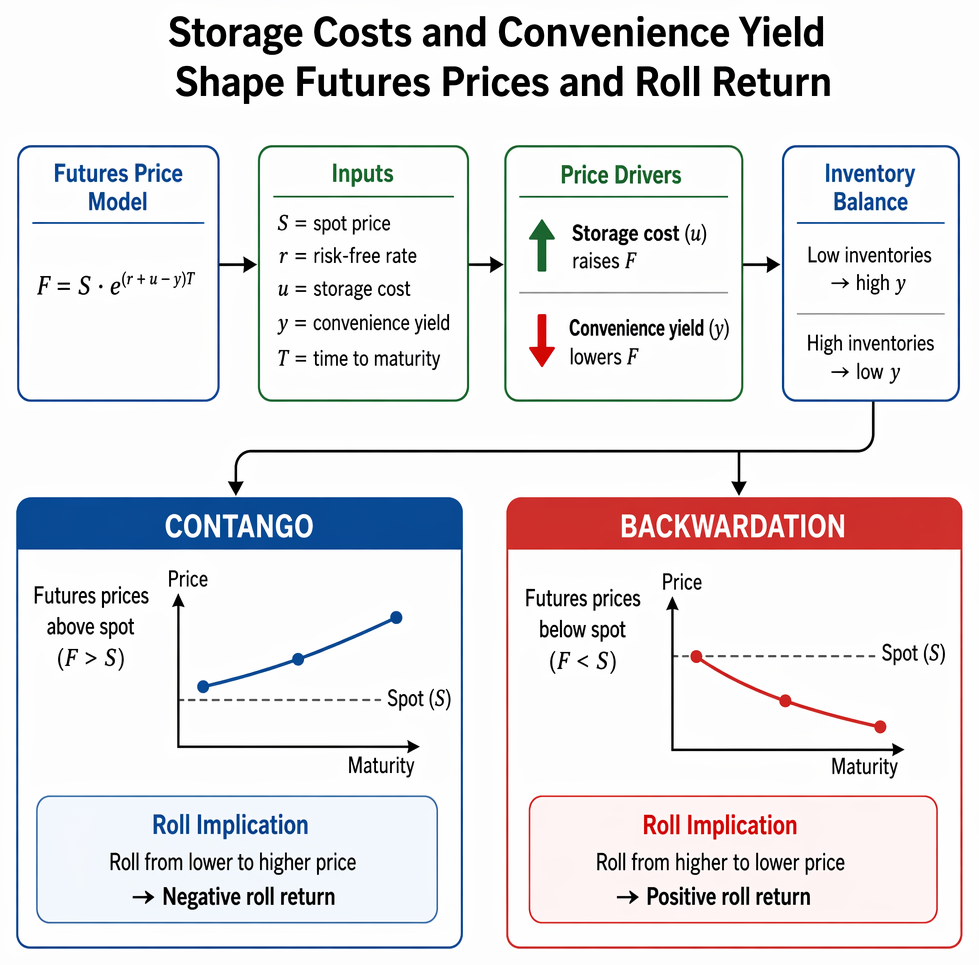
Inventory conditions map to convenience yield, futures-spot pricing, term-structure shape, and the sign of roll return on long positions.
Key Term: term structure of futures
The sequence of futures prices for different contract maturities on the same reference commodity at a fixed point in time.
The position of futures relative to the spot price gives rise to two main types of markets:
- Contango: Futures prices are higher than the spot price.
- Backwardation: Futures prices are lower than the spot price.
The shape of the curve has important implications for the roll return earned by investors who maintain exposure by rolling over expiring contracts.
Key Term: contango
A market condition where futures prices are above the current spot price; further-dated contracts generally trade higher than near-term contracts. Key Term: backwardation
A market condition where futures prices are below the current spot price; further-dated contracts are priced lower than nearer maturities or spot.
Components of Futures Price
A widely used model for futures price () formation on a storable commodity considers spot price, storage costs, risk-free rate, and convenience yield:
Where:
- = futures price
- = spot price
- = risk-free rate
- = storage cost (expressed as a yield)
- = convenience yield
- = time to contract maturity (in years)
Storage costs increase futures prices, but convenience yield reduces them. When physical inventory provides a valuable benefit—such as insuring against shortages—convenience yield is high, often leading to backwardation.
Key Term: convenience yield
The implied non-monetary benefit of holding a physical commodity, such as ensuring supply or production continuity; higher when inventories are low.
Theory of Storage
The Theory of Storage states that the decision to hold inventory is driven by the balance between storage costs and the convenience yield. As inventory falls, the risk of a stockout or inability to meet demand rises—making immediate physical supply increasingly valuable.
When commodity stocks are tight, convenience yield is high and can more than offset storage costs, causing backwardation. When inventories are ample, the convenience yield falls, storage costs dominate, and contango is more likely.
Worked Example 1.1
A wheat trader observes that spot wheat trades at $500 per ton, risk-free rate is 2% annually, and storage costs are 3% per year. Current one-year futures are $520. Calculate the implied convenience yield.
Answer:
The formula:
Plug values:
The implied convenience yield is 1.08%.
Roll Return and Futures Investing
When investing in commodities through rolling long futures contracts, total return comprises price return (change in spot), collateral return, and roll return. Roll return arises when maturing futures positions are closed and replaced with new contracts.
Key Term: roll return
The gain or loss from rolling expiring futures contracts into a new position with a different maturity, due to the slope of the futures curve.
In backwardation, rolling a futures position forward means selling contracts at higher prices and buying at lower, creating a positive roll return. In contango, rolling from a lower expiring contract to a higher new contract causes a negative roll return.
Worked Example 1.2
A manager holds a long futures position expiring at $70. The next-available contract is at $72. What is the roll return from rolling into the next contract?
Answer:
Roll return = (price of expiring contract − price of next contract) / price of expiring contract
The roll return is negative, consistent with contango.
Exam Warning: Many CFA exam candidates forget that positive roll return is only possible in backwardation. If the futures curve is upward-sloping (contango), rolling incurs a loss. Be sure to consider current market shape when answering calculation or conceptual questions on roll return.
Practical Implications for Investors
The impact of roll return is significant for commodity index investors. In long-only strategies, persistent contango can reduce total returns below spot price performance. Conversely, backwardation can increase returns above the spot price change.
Futures curves, and thus roll return, can change rapidly with inventory levels, market shocks, or seasonal patterns.
Theories of Commodity Futures Returns
Several theories explain the return structure of commodities:
- Insurance Theory: Producers hedge by selling futures, so buyers of futures contracts (speculators) expect extra return, leading to a tendency for backwardation.
- Hedging Pressure Hypothesis: Considers both producers and consumers’ hedging needs, explaining either contango or backwardation depending on which hedgers dominate.
- Theory of Storage: Emphasizes storage costs and convenience yield as the main determinants of futures prices’ position relative to spot.
Key Term: Theory of Storage
The concept that futures prices reflect the combined effects of storage costs and convenience yield, with the futures/spot relationship driven by inventory balance.
Summary
Understanding commodity return sources requires careful attention to term structure, especially the roles of convenience yield and storage costs. Roll return can be positive or negative and is linked directly to the shape of the futures curve. The Theory of Storage ties these elements together, showing that the balance of inventory costs and benefits determines whether markets are in contango or backwardation.
Key Point Checklist
This article has covered the following key knowledge points:
- Distinguish between contango and backwardation using spot and futures prices
- Define and interpret convenience yield in commodity markets
- Apply the Theory of Storage to explain the futures/spot price relationship
- Calculate and interpret roll return for long futures positions
- Understand how inventory levels impact the term structure and investor returns
Key Terms and Concepts
- term structure of futures
- contango
- backwardation
- convenience yield
- roll return
- Theory of Storage