Learning Outcomes
This article explains how advanced GIPS standards govern performance presentation, reporting, and verification for composites and pooled funds, including:
- Identifying all required elements of a GIPS-compliant performance presentation at the composite and pooled fund level, and recognizing common omissions in exam vignettes.
- Distinguishing required, recommended, and prohibited disclosures, including the correct treatment and labeling of non-compliant, pre-compliance, and legacy performance information.
- Evaluating the appropriateness of fee and expense treatment, benchmark selection and changes, and required risk measures presented in GIPS reports.
- Assessing whether claims of GIPS compliance, firm-level verification, and composite-level performance examinations are correctly worded, properly supported, and free of misleading implications.
- Analyzing composite construction policies, including discretion, minimum asset levels, inclusion of non-fee-paying portfolios, carve-outs with allocated cash, and portability of performance.
- Determining when internal dispersion, alternative risk measures, or explanations of material events are required to fairly present historical performance.
- Interpreting how non-compliant, ported, or advertisement-only track records may be shown alongside fully compliant results without violating GIPS.
- Applying these standards to exam-style scenarios to spot violations, justify corrections, and select the most accurate statement among close alternatives.
CFA Level 2 Syllabus
For the CFA Level 2 exam, you are required to understand GIPS standards advanced presentation, reporting, and verification, with a focus on the following syllabus points:
- Defining the required elements of GIPS-compliant performance presentations
- Identifying and applying required disclosures for compliant and non-compliant performance
- Explaining the purpose, scope, and limitations of GIPS verification and performance examinations
- Evaluating whether performance reports, advertisements, and related claims meet GIPS requirements
Test Your Knowledge
Attempt these questions before reading this article. If you find some difficult or cannot remember the answers, look more closely at that area during your revision.
Atlas Capital Management, a global equity manager, claims compliance with the GIPS standards. The firm has existed for 18 years and has been GIPS compliant for the last 8 years. It prepares a GIPS composite report for its Global Sustainable Equity composite. Key features of the report and firm practices are:
- The report shows 8 full years of annual composite returns, all calculated gross of management fees but net of trading expenses and withholding taxes. Net-of-fees returns are not shown.
- For each year, the report includes benchmark returns, composite assets, and percentage of total firm assets, but does not show a 3-year annualized standard deviation.
- The composite includes all actual, discretionary, fee-paying portfolios following the Global Sustainable Equity strategy, plus one large non-fee-paying portfolio that belongs to a founding partner.
- Three years ago the firm changed the composite benchmark from a broad world equity index to a more appropriate ESG index. The report shows the current ESG index only and does not mention the prior benchmark.
- The front page of the report states: “Atlas Capital is GIPS compliant and the Global Sustainable Equity composite is GIPS verified for the period 2016–2023 by Alpha Verifiers LLC.”
Use this vignette to answer the following questions.
-
Regarding the length and content of the track record presented, which statement is most consistent with the GIPS standards?
- a) The composite must present at least 10 years of compliant performance immediately.
- b) Presenting 8 years is acceptable because the firm is only required to show performance from the date of initial GIPS compliance.
- c) The firm may initially present 5 years and must add one compliant year each year up to a minimum of 10 years.
- d) The firm may choose any length of history as long as inception-to-date performance is available upon request.
-
Which aspect of Atlas’s return and risk presentation is most clearly inconsistent with GIPS requirements for a composite report?
- a) Showing only gross-of-fees returns when net-of-fees returns are available.
- b) Failing to show 3-year annualized ex post standard deviation for the composite and benchmark.
- c) Presenting composite assets and firm assets in percentage terms instead of absolute values.
- d) Including withholding taxes in the return calculations.
-
How should the inclusion of the non-fee-paying portfolio in the composite be treated under GIPS?
- a) It must be excluded because non-fee-paying portfolios are never allowed in GIPS composites.
- b) It may be included, but the proportion of composite assets represented by non-fee-paying portfolios must be disclosed.
- c) It may be included if it is the largest portfolio in the composite; otherwise it must be excluded.
- d) It may be included only if composite returns are reported net of a model fee.
-
Which issue in Atlas’s benchmark disclosure is most likely to violate GIPS?
- a) Using an ESG index rather than a broad world equity index.
- b) Not disclosing that the benchmark is a price-only index.
- c) Failing to disclose that the benchmark was changed three years ago and not presenting both old and new benchmark returns for the relevant periods.
- d) Using a custom benchmark rather than a published index.
-
Which statement about Atlas’s verification disclosure is most accurate under current GIPS standards?
- a) It is correct to say the composite is “GIPS verified” if the verifier tested that composite.
- b) The firm may claim firm-wide GIPS verification, but GIPS verification cannot be claimed for a single composite; a GIPS performance examination is the correct term for a composite.
- c) The phrase “GIPS certified” should be used instead of “GIPS verified.”
- d) Verification at the firm level automatically implies that every composite has been examined in detail.
Introduction
The Global Investment Performance Standards (GIPS) provide a globally accepted framework for calculating and presenting investment performance in a fair, consistent, and transparent way. At Level 2, you are expected not just to recall rules, but to analyze whether a firm’s performance report, advertisement, or compliance claim meets the standards.
GIPS presentation and reporting requirements are central to this framework: they dictate what must appear in a compliant performance presentation (now more precisely called a GIPS report), how information about composites and pooled funds must be disclosed, and what statements a firm may or may not make about its compliance and verification.
Key Term: GIPS performance presentation
A performance report (GIPS report) containing all required GIPS-compliant statistics, measures, and disclosures for a composite or pooled fund, prepared in accordance with GIPS standards to enable fair comparison and transparency. Key Term: GIPS verification
An independent review by a qualified third party, conducted at the firm or asset owner level, assessing whether the firm has complied with the GIPS standards on a firm‑wide basis and whether its policies and procedures are designed to calculate and present performance in compliance with GIPS.
GIPS 2020 also introduced the concept of a performance examination for a specific composite or pooled fund, which is distinct from firm-level verification. Level 2 questions often test whether you can distinguish these concepts and recognize correct and incorrect wording.
Key Term: composite
An aggregation of individual portfolios managed according to a similar investment mandate, objective, or strategy, and used as the unit of performance reporting under GIPS.
The following sections build on the basics to cover more advanced issues: composite construction, required risk and return statistics, handling of non-compliant periods, and the exact scope of verification and performance examinations.
GIPS Presentation Requirements
Firms claiming GIPS compliance must provide prospective clients and investors with GIPS reports that include all prescribed elements. The standards distinguish between:
- Composite reports: for strategies marketed to segregated account clients.
- Pooled fund reports: for strategies marketed primarily through pooled vehicles (e.g., mutual funds, SICAVs).
The CFA curriculum mostly focuses on composite reports, but the core principles are similar.
Key Term: GIPS report
A standardized performance report prepared for a composite or pooled fund that contains all required GIPS statistics and disclosures for a defined period.
Length of Performance History
The article already notes a “minimum of 10 years of annual performance (or since inception if shorter).” Under GIPS 2020, the timing works as follows:
- A firm must initially present at least 5 years of GIPS-compliant performance (or since inception, if the composite has existed for less than 5 years).
- After the initial 5-year period, the firm must add one additional year of compliant performance each year, up to a minimum of 10 years.
- The firm may choose to present more than 10 years (e.g., 15 or 20), as long as the full history is compliant or clearly labeled otherwise.
Exam questions often test this “build-up” requirement, so distinguish between:
- The minimum initial requirement (5 years) and
- The ongoing requirement to extend the record to at least 10 years.
Core Content of a Composite GIPS Report
At a high level, each composite report must include:
- Firm identification and definition
- Name of the firm.
- Firm definition (which entities are included or excluded).
Key Term: firm (GIPS definition)
The entity that is held out to clients as the investment firm; all discretionary, fee‑paying portfolios managed by this entity (and its defined related entities) are subject to inclusion in composites.
-
Composite information
- Composite name and description.
- Composite inception date and composite creation date.
- The composite’s investment mandate, objective, or strategy description.
-
Performance statistics
- Annual total returns for each year in the presentation period, commonly expressed as time‑weighted returns (TWR) for most traditional asset classes.
- For each period, the corresponding benchmark return.
- Composite assets at the end of each year.
- Total firm assets at the end of each year or the composite’s proportion of firm assets.
-
Risk statistics
- A 3-year annualized ex post standard deviation of composite and benchmark returns (or another appropriate risk measure if standard deviation is not relevant), for each year where at least 36 monthly returns are available.
- If fewer than 36 months of returns exist, the report must state that the 3‑year standard deviation is not presented.
Key Term: internal dispersion
A measure of the dispersion of individual portfolio returns within a composite (for example, equal-weighted standard deviation) for each annual period, required when the composite has a sufficient number of constituent portfolios.
Depending on composite size, GIPS may require a measure of internal dispersion for each year (e.g., standard deviation of portfolio returns, high/low return). This highlights the range of client experiences within the strategy.
Fee and Expense Treatment
GIPS is strict about how fees and expenses are handled:
-
Gross-of-fees returns must:
- Be net of actual transaction costs (trading expenses).
- May be before or after non-investment management fees (e.g., custody) but the treatment must be disclosed.
-
Net-of-fees returns must:
- Be net of actual investment management fees (including performance-based fees).
- Be net of transaction costs.
- May include or exclude other administrative fees, with appropriate disclosure.
Where possible, GIPS encourages presenting both gross and net returns, because prospective clients may negotiate fee schedules. Exams frequently test whether:
- Net-of-fees returns properly reflect actual investment management fees, and
- The disclosure clearly describes which fees are included or excluded.
Key Term: model fee
A hypothetical fee (e.g., highest or most representative fee) applied to gross-of-fees returns to calculate a net-of-fees series when actual fees differ across portfolios.
If a model fee is used (rather than each portfolio’s actual fee), that fact and the model fee itself must be disclosed.
Benchmarks
A key requirement is to present composite performance relative to an appropriate benchmark:
- Benchmarks must be consistent with the composite’s investment mandate, risk, and style.
- The benchmark’s name and description must be disclosed, including whether it is:
- A broad market index,
- A style or sector index, or
- A custom benchmark (in which case the construction methodology must be described).
Key Term: custom benchmark
A benchmark created by the firm, often by combining multiple indices or using a rules-based methodology, to better reflect a strategy’s investment universe and style.
If the benchmark is changed:
- The firm must disclose the date of change,
- The reason for the change, and
- Present both the old and new benchmark returns for the relevant periods so users can evaluate the impact of the change.
If no appropriate benchmark exists, the firm must state that fact and explain why.
Currency, Valuation, and Calculation Methodology
GIPS reports must clearly state:
- The base currency used for performance and any related risk measures.
- The valuation frequency and methodology (e.g., fair value, trade-date accounting).
- The method used to calculate time‑weighted returns (e.g., daily‑weighted using daily valuations or subperiod valuation after large cash flows).
Key Term: significant cash flow
A cash flow large enough, relative to portfolio size, to warrant temporary exclusion from the composite or a revaluation to avoid distorting composite performance.
If the firm has policies to temporarily remove portfolios from a composite due to significant cash flows, those policies must be disclosed.
Composite Construction Policies
GIPS requires a written composite construction policy that must be applied consistently. The report must support understanding of:
- Discretion: which portfolios are considered discretionary and thus included.
Key Term: discretion (GIPS)
The ability of the firm to implement the strategy for a portfolio without material client-imposed restrictions that prevent full implementation of the intended investment strategy.
- Minimum asset levels for inclusion in a composite.
- Rules for new accounts joining and accounts leaving the composite.
- Rebalancing guidelines for portfolios within the composite.
An important core requirement (and common exam trap) remains:
- All actual, discretionary, fee-paying portfolios must be included in at least one composite. Excluding poorly performing accounts or selectively creating composites (“cherry‑picking”) is prohibited.
Special Topics: Carve-Outs and Portability
Key Term: carve-out
A portion of a portfolio (e.g., the equity segment of a balanced account) that is treated as a separate account for composite construction purposes.
Under GIPS 2020, carve-outs with allocated cash may be included in composites if:
- The firm allocates cash and related income to the carve-out using a consistent, documented methodology, and
- The carve-out is managed with its own, well-defined investment strategy.
Key Term: portability (of performance)
The ability to present a track record from a prior entity at the new firm if certain conditions are met (e.g., substantially all decision-makers move to the new firm, the strategy remains substantially the same, and appropriate records are obtained).
If a track record is ported from a previous firm, the GIPS report must disclose:
- That performance was gained from another firm,
- The periods affected, and
- Any material differences in the strategy or investment process.
Worked Example 1.1
A firm has track records for five years but merged two composites three years ago. How should the firm present historical GIPS-compliant results for the composite?
Answer:
Performance must be shown for the composite since inception, including periods before the merger, using a documented, consistent methodology. The firm should:
- Recalculate historical returns for the now-merged composite according to its current composite definition, if possible, and
- Provide disclosures explaining the merger, dates, and any changes to composite construction, benchmarks, or risk characteristics. If the firm is initially presenting performance, it must show at least 5 years (or since inception if shorter) and then add annual performance until it reaches 10 years.
Required and Prohibited Disclosures
Beyond the numeric returns and risk statistics, GIPS reports rely heavily on disclosure to ensure that users interpret the data correctly.
Required Disclosures (Selected Highlights)
While the full list is extensive, some commonly tested required disclosures include:
-
Statement of GIPS compliance:
- A claim of compliance must use prescribed language, such as: “XYZ Firm has prepared and presented this report in compliance with the Global Investment Performance Standards (GIPS®).”
- Partial compliance (e.g., “we comply with GIPS for equities only”) is not permitted.
-
Firm definition and description: clarifying which entities and business units are included in the GIPS-compliant firm.
-
Composite description: enough detail for a prospective client to understand what the strategy does and how it is implemented.
-
Fee and expense disclosures: including:
- Whether performance is gross or net,
- Which fees are included in net-of-fees returns,
- Whether model fees are used, and
- Treatment of transaction costs, custody, and other expenses.
-
Benchmark description: including name, type, and whether it is custom or modified. Any benchmark changes must be explained and dated.
-
Use of borrowing, derivatives, and short selling:
- If these materially affect performance or risk, the report must disclose their use and high-level approach.
-
Valuation and calculation methods: including use of fair value, frequency of portfolio valuations, and time-weighting methodology.
-
Currency: the base currency for performance.
-
Availability of additional information: such as a list and description of all composite strategies and whether pooled fund share classes are available.
-
Material events: any major events that would help explain performance, such as key personnel departures, significant changes to the investment process, or restructuring of the firm.
Key Term: material event (GIPS)
An event that the firm reasonably believes could affect how a prospective client interprets the composite or pooled fund performance, such as a major team departure or change in investment objective.
Prohibited Practices and Disclosures
Certain practices are explicitly inconsistent with GIPS:
-
Guaranteeing future performance:
- Language implying that historical returns are indicative of, or guarantee, future results is prohibited.
- Instead, firms usually must include a disclaimer such as “Past performance is not necessarily indicative of future results.”
-
Cherry-picking:
- Selectively excluding underperforming portfolios or only showing top-performing composites is not allowed.
- Firms must offer a list of all composite descriptions upon request.
-
Misleading claims of compliance or verification:
- Stating or implying “partial GIPS compliance” is not permitted.
- Using terms like “GIPS certified” is improper; the correct term is “GIPS verified” for a firm-level verification and “GIPS performance examination” for a specific composite or pooled fund.
-
Mislabeling non-GIPS performance as compliant:
- Performance for periods or portfolios that do not meet all GIPS requirements may not be labeled as GIPS-compliant.
- If shown alongside compliant periods, they must be clearly distinguished and explained.
Worked Example 1.2
A GIPS report for a fixed-income composite includes the following statement: “The XYZ Core Bond Composite is expected to achieve returns of 200 bps over the benchmark annually with a standard deviation of 4%.”
Which issue is most likely to violate GIPS?
Answer:
The statement implies an expected return target that could be interpreted as a guarantee or prediction of future performance, which is inconsistent with GIPS. The firm may describe investment objectives (e.g., “seeks to outperform the benchmark by 200 bps over a full market cycle”) but must avoid guaranteeing or promising returns.
GIPS Verification: Scope and Importance
GIPS verification is an optional, but commonly used, third‑party assurance service. Understanding its scope and limitations is an important Level 2 skill.
What Verification Covers
Firm-level verification tests whether:
- The firm has complied with all firm-wide GIPS requirements for the periods specified.
- The firm has designed and implemented policies and procedures to calculate and present performance in compliance with GIPS.
- All actual, discretionary, fee-paying portfolios are properly included in composites in accordance with the firm’s composite construction policies.
Verification is conducted by an independent, qualified verifier and covers the entire firm, not selected composites only.
What verification does not do:
- It does not guarantee the accuracy of every number in each composite report.
- It does not opine on the investment merits or competitiveness of the firm.
- It does not prevent errors; it only provides reasonable assurance that policies/procedures are designed and implemented to comply with GIPS.
Performance Examinations vs Verification
GIPS 2020 distinguishes between:
- Verification: a firm-level engagement.
- GIPS performance examination: an optional engagement on a specific composite or pooled fund.
Key Term: GIPS performance examination
An independent assessment of whether a specific composite or pooled fund’s performance has been calculated and presented in compliance with the GIPS standards, for the periods examined.
A firm may:
- Have firm-level verification,
- Have performance examinations for certain composites or pooled funds,
- Have both, or
- Have neither, and still legitimately claim GIPS compliance (verification is optional).
Correct wording is tested frequently. For example:
- Acceptable: “XYZ Firm has been verified for the periods 1 January 2018 through 31 December 2023 by ABC Verifiers.”
- Acceptable: “The Global Equity Composite has had a GIPS performance examination for the periods 1 January 2018 through 31 December 2023 by ABC Verifiers.”
- Not acceptable: “The Global Equity Composite is GIPS verified” (because verification is firm-level, not composite-level).
Worked Example 1.3
An asset management firm receives a verification report stating that the firm has been verified for the period 2019–2023. The firm also engaged the verifier to perform a GIPS performance examination for its Global Equity composite for 2021–2023. How may the firm correctly describe these engagements in its composite report?
Answer:
The firm may state both:
- “XYZ Firm has been verified for the periods 1 January 2019 through 31 December 2023 by ABC Verifiers.”
- “ABC Verifiers has conducted a GIPS performance examination of the Global Equity Composite for the periods 1 January 2021 through 31 December 2023.” It must not say that the composite is “GIPS verified.” Verification applies only to the firm; performance examinations apply to specific composites or pooled funds.
Exam Warning: GIPS verification is always firm-level. When a question mentions “verification of a single composite,” this is a red flag. Under GIPS 2020, the correct composite-level engagement is a GIPS performance examination, not composite “verification.”
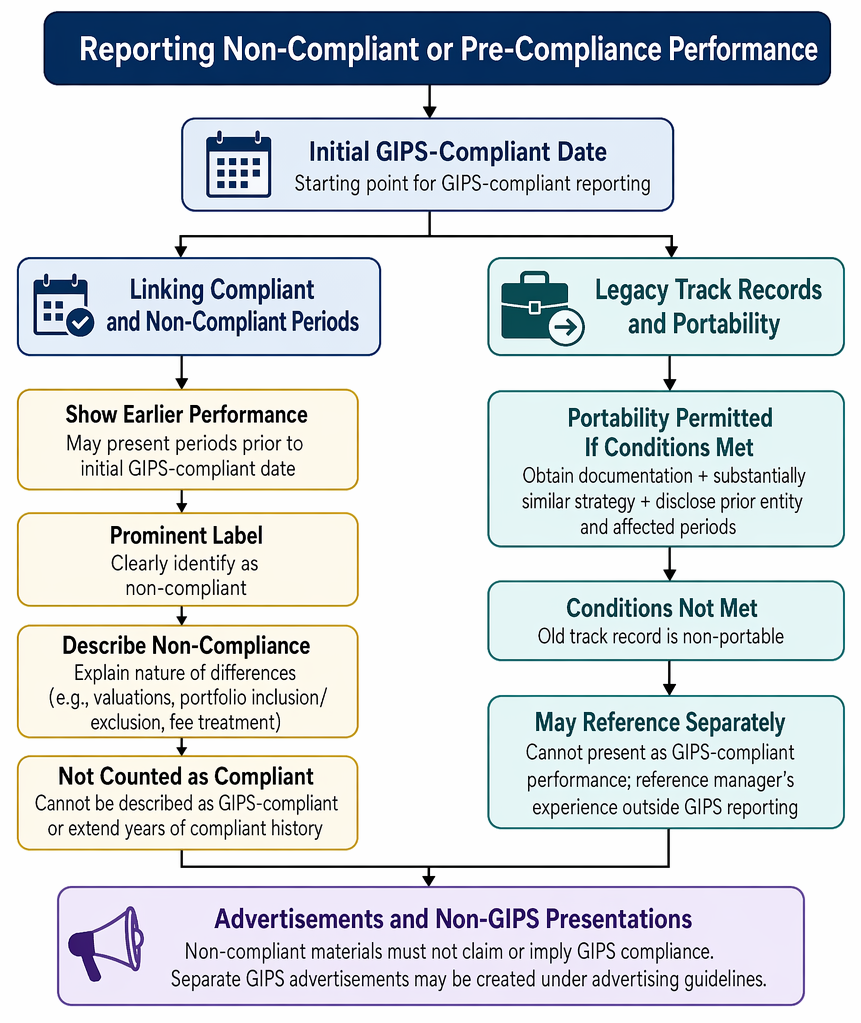
Reporting Non-Compliant Performance
Many firms become GIPS compliant after having managed strategies for years. Others may acquire or port performance from different entities. How such non-compliant or pre-compliance performance is reported is a rich source of exam questions.
GIPS composite report content is grouped into firm data, composite characteristics, return metrics, risk disclosures, and operational reporting policies.
Key Term: non-compliant performance
Performance that does not fully meet all applicable GIPS requirements—for example, because historical records do not support compliant calculations or because policies were not in place.
Linking Compliant and Non-Compliant Periods
If a firm wishes to show periods prior to its initial GIPS-compliant date:
- The GIPS-compliant period must be clearly identified.
- Earlier, non-compliant performance may be presented, but:
- It must be prominently labeled as non-compliant.
- The firm must describe the nature of the non-compliance, such as differences in valuation frequency, inclusion/exclusion of certain portfolios, or non-standard fee treatment.
Non-compliant returns cannot be described as GIPS-compliant or used to extend the “years of compliant performance” count.
Legacy Track Records and Portability
When a portfolio manager moves from one firm to another, GIPS allows for portability if conditions are met, but:
- The firm must obtain sufficient documentation to re-create performance under GIPS.
- The strategy at the new firm must be substantially similar to that at the prior firm.
- The GIPS report must disclose that performance was earned at a prior entity and the periods affected.
If the conditions are not met, the old track record is non-portable. The new firm may not present it as its own GIPS‑compliant performance, but may reference the manager’s experience separately (outside of GIPS performance reporting).
Worked Example 1.4
A firm is newly compliant and wishes to present three years of older results calculated using different methodologies. How should it do this?
Answer:
The GIPS-compliant period must be shown separately, with the earlier results clearly designated as non-compliant and accompanied by a description of differences and limitations. For example, the report might show:
- 2021–2023: GIPS-compliant composite returns, clearly labeled as such.
- 2018–2020: “Pre-compliance performance, calculated using XYZ methodology that differs from current GIPS-compliant policies.” The older results cannot be counted toward the minimum 5- or 10‑year compliant history and cannot be described as GIPS-compliant.
Non-Compliant Presentations and Advertisements
Firms may still create non-GIPS presentations or marketing materials. However:
- If a presentation is not GIPS-compliant, it must not use the GIPS compliance claim or imply compliance.
- A firm may create separate GIPS advertisements following the GIPS Advertising Guidelines, which are different from full GIPS reports and contain fewer required elements.
Worked Example 1.5
A firm produces a one-page factsheet for a composite that shows only the last 3 years of annual returns and states: “This factsheet is prepared in compliance with the GIPS standards. Past returns are calculated according to the firm’s standard methodology.”
Answer:
This is misleading. A full GIPS report must meet all presentation requirements, including minimum history (initially 5 years), required disclosures, and risk measures. A 3‑year factsheet cannot claim to be a GIPS report. The firm could instead:
- Label the factsheet as a GIPS advertisement if it meets the separate advertising guidelines, or
- Present it as non-GIPS marketing material with no claim of GIPS compliance.
Revision Tip: For the exam, remember: all actual, discretionary, fee-paying portfolios must be included in a composite. Exclusions or selective inclusion of “good” accounts are not allowed. Non-compliant or pre-compliance performance may be shown, but only with clear labeling and explanation, never as GIPS-compliant.
Summary
GIPS-compliant presentation and reporting ensure that performance data is transparent, complete, and fair. For Level 2, the emphasis is on recognizing whether a given report:
- Includes all required return and risk statistics over an appropriate performance history,
- Correctly treats fees, expenses, and benchmarks,
- Provides mandatory disclosures about methodology, currency, material events, and available additional information, and
- Properly distinguishes GIPS-compliant performance from non-compliant or legacy track records.
Verification and performance examinations provide additional assurance but are optional. Verification is always firm-level, whereas a GIPS performance examination applies to a specific composite or pooled fund. Neither guarantees the accuracy of every figure or future performance.
Misleading claims (such as implying partial compliance, “GIPS certification,” or composite “verification”) and cherry-picked performance are inconsistent with the standards and are common exam traps.
Key Point Checklist
This article has covered the following key knowledge points:
- GIPS-compliant composite reports must initially show at least 5 years of annual, composite-level performance (or since inception) and then build up to at least 10 years.
- All actual, discretionary, fee-paying portfolios must be included in at least one composite according to documented composite construction policies.
- Required report content includes annual returns, benchmark returns, composite and firm assets, 3‑year risk measures, and (where applicable) internal dispersion.
- Required disclosures cover firm definition, composite description, methodology, valuation, benchmarks, fees and expenses, currency, material events, and availability of additional information.
- Prohibited practices include guarantees of future performance, cherry-picking composites or portfolios, partial compliance claims, and mislabeling non-compliant periods as GIPS-compliant.
- Non-compliant or pre-compliance periods may be shown, but must be clearly separated, labeled, and explained; they cannot be counted toward the compliant history requirement.
- Firm-level GIPS verification is optional and confirms that policies and procedures are designed and implemented in compliance with GIPS; it does not verify specific composites.
- GIPS performance examinations apply to individual composites or pooled funds and must be distinguished from firm-level verification in wording and scope.
Key Terms and Concepts
- GIPS performance presentation
- GIPS verification
- composite
- GIPS report
- firm (GIPS definition)
- internal dispersion
- model fee
- custom benchmark
- significant cash flow
- discretion (GIPS)
- carve-out
- portability (of performance)
- material event (GIPS)
- GIPS performance examination
- non-compliant performance