Learning Outcomes
This article explains GIPS firm-wide requirements and composite construction, including:
- Defining a GIPS firm and stating why compliance can only be claimed at the firm (or asset owner) level, not for individual strategies, funds, or business units.
- Identifying which portfolios must be included in composites – specifically all actual, fee-paying, discretionary portfolios – and explaining the exam-relevant rationale for this requirement.
- Describing how firms create and describe composites based on investment mandate, objective, or strategy, and how minimum asset levels and significant cash flow policies can legitimately affect composite membership.
- Explaining when newly eligible portfolios join a composite, when terminated portfolios must be removed, and why their historical results must remain in past composite returns.
- Recognizing the prohibition on hindsight-driven changes to composite definitions and portfolio reassignments, and evaluating scenarios where firms attempt to improve performance by reshaping composites.
- Understanding the role of written policies, procedures, and record-keeping in supporting consistent composite construction, accurate performance calculation, and reliable, GIPS-compliant client and prospect reporting.
- Interpreting typical GIPS composite reports and using the standards to assess whether a firm’s practices align with ethical principles of fair representation, full disclosure, and comparability for CFA Level 1 exam questions.
CFA Level 1 Syllabus
For the CFA Level 1 exam, you are required to understand GIPS standards for performance reporting, with a focus on the following syllabus points:
- Explain why the GIPS Standards require firm-wide compliance, not just compliance by a single strategy or department.
- Identify the steps in composite construction and explain the requirements for including new portfolios and removing terminated portfolios.
- Describe how and why firms must present all actual, fee-paying, discretionary portfolios in at least one composite.
- Recognize the importance of written policies and procedures for GIPS compliance.
- Explain the periodic review obligations and records retention.
Test Your Knowledge
Attempt these questions before reading this article. If you find some difficult or cannot remember the answers, look more closely at that area during your revision.
-
Under the GIPS standards, at what level can a claim of compliance be made?
- a) At the level of any individual fund or strategy
- b) Only at the composite level
- c) Only at the firm (or asset owner) level
- d) At the level of any business unit the firm chooses
-
Which portfolios must be included in at least one composite for a GIPS-compliant firm?
- a) All client portfolios, including hypothetical model portfolios
- b) All actual, fee-paying, discretionary portfolios
- c) Only the portfolios used for marketing to prospective clients
- d) Only the largest portfolios managed by each team
-
When should a terminated portfolio stop contributing to a composite’s performance?
- a) At the date the termination notice is received
- b) At the end of the last complete performance measurement period it was managed to the composite strategy
- c) At the start of the month in which it is terminated
- d) Immediately after the portfolio underperforms its benchmark
-
Can a firm accurately claim “GIPS compliance” for a single well-performing strategy while other strategies follow different performance reporting practices?
- a) Yes, if that strategy has a compliant composite history
- b) Yes, if that strategy is the firm’s flagship product
- c) No, because GIPS compliance must be firm-wide
- d) No, unless a verifier approves that specific strategy
Introduction
Investment managers are under pressure to provide potential and existing clients with transparent, comparable, and fair performance data. The Global Investment Performance Standards (GIPS) provide a globally accepted framework for calculating and presenting investment results. However, GIPS compliance is not just about producing compliant reports for a single product; it is a firm-wide commitment demanding systematic processes and controls for constructing and maintaining composites.
Key Term: GIPS Standards
The Global Investment Performance Standards are a standardized, voluntary set of ethical principles and requirements for investment managers to ensure consistency and fairness in reporting investment performance. Key Term: Composite
A composite is an aggregation of individual portfolios managed to a similar strategy, mandate, or investment objective, grouped to present a representative performance record.
Because clients rarely invest in the exact portfolio used in marketing materials, they need evidence that the performance shown is representative of how the firm actually manages money for all similar portfolios. Composites, built and maintained according to GIPS rules, provide this evidence.
Test Tip: When revising Firm-wide requirements and composite construction, connect each definition, method, or rule to the kind of question the assessment is likely to ask.
The Role of Firm-Wide Compliance
GIPS are designed to eliminate misleading practices such as:
- Cherry-picking only the best portfolios for performance reporting.
- Dropping poor-performing portfolios from a track record.
- Changing portfolio groupings after the fact to make results appear smoother or stronger.
To prevent these abuses, GIPS requires that compliance be claimed at the firm level, and that all actual, fee-paying, discretionary portfolios be included in at least one composite. Understanding how the firm is defined and how composites are constructed is central to many GIPS-related questions at Level 1.
Key Term: GIPS Firm
A GIPS firm is the distinct legal entity or group of affiliated entities held out to clients and prospects as a single investment management business, for which GIPS compliance is claimed. Key Term: Firm-Wide Compliance
Firm-wide compliance means that all required GIPS provisions are applied to all relevant portfolios managed by the defined GIPS firm, not just to selected products, strategies, or business units.
GIPS Firm Definition and Firm-Wide Compliance
GIPS compliance is not selective. A compliant claim can only be made at the firm level—not for individual funds, strategies, or offices. For exam purposes, remember:
- The unit of compliance is the firm, not the composite.
- A firm must first define itself as a GIPS firm before it can claim compliance.
A firm is defined under GIPS as a distinct legal entity or group of affiliated entities held out to the public as a single business. Examples include:
- A stand‑alone asset management company.
- The asset management division of a larger financial group, if presented to clients as a separate business.
- Several legal entities across countries that are branded and marketed as one global asset manager.
Once defined, all actual, fee-paying, discretionary portfolios managed by the firm must be included in at least one composite.
Key Term: Actual, Fee-Paying, Discretionary Portfolio
An investment portfolio that represents real client assets (not hypothetical), for which the firm receives a management fee, and over which the firm has the authority to make investment decisions consistent with a stated strategy or mandate. Key Term: Discretionary Portfolio
A discretionary portfolio is one in which the firm is free to implement its investment strategy, subject to agreed guidelines. Client-imposed restrictions that prevent the firm from following the intended strategy may make a portfolio non‑discretionary for that composite.
Why GIPS Requires Firm-Wide Compliance
GIPS standards insist on firm-wide compliance to:
- Avoid cherry-picking only successful strategies for “GIPS-compliant” labels.
- Ensure that composite performance reflects all similar portfolios, not just a selected subset.
- Improve comparability between managers across markets and jurisdictions.
- Align with the ethical objective of fair representation and full disclosure.
If a firm were allowed to claim compliance only for a single composite, poor practices in other parts of the firm could still mislead clients. Thus, statements such as “Our Global Equity Composite is GIPS compliant” are not acceptable. The correct claim relates to the firm.
Worked Example 1.1
A global bank has an asset management division that manages mutual funds and separate accounts. The bank wants to claim GIPS compliance only for its institutional separate account business, excluding the mutual funds, because the mutual fund systems are not fully aligned with GIPS.
Answer:
This is not acceptable. The defined GIPS firm must include all assets managed on a discretionary basis for clients that the firm holds itself out as managing. The bank cannot claim GIPS compliance only for a subset of its institutional business while excluding mutual funds that are part of the same asset management brand.
Composite Construction Requirements
A firm's responsibility is to group portfolios according to consistent strategies, mandates, or objectives—these form composites. Every compliant firm must construct composites according to written policies and procedures, and must:
- Include all actual, fee-paying, discretionary portfolios in at least one composite, with no selective exclusion.
- Define composites based on investment mandate, objective, or strategy, not based on performance.
- Create a composite for each distinct investment strategy marketed to clients.
- Establish pre-defined criteria for portfolio inclusion and exclusion—these cannot be changed retroactively to boost or suppress returns.
Key Term: Composite Description
A composite description is a written summary of the key features of a composite’s strategy, including its investment objective, key risks, types of securities, and any relevant constraints. Key Term: Composite Minimum Asset Level
A composite minimum asset level is a pre‑defined asset size below which portfolios following the strategy are temporarily excluded or not added to the composite, to avoid including portfolios too small to be managed to the stated strategy efficiently.
For attracting clients with claims of GIPS compliance, including all eligible portfolios prevents cherry-picking and ensures that reported results are genuinely representative.
Practical Aspects of Composite Construction
In practice, composite construction involves:
- Defining each composite clearly (e.g., “Global Large‑Cap Equity, benchmarked to MSCI World”).
- Assigning every actual, fee-paying, discretionary portfolio to at least one composite on a timely basis.
- Calculating composite returns using asset-weighted portfolio returns, so that larger portfolios have a proportionally greater impact.
Firms may:
-
Set a minimum asset level for a composite, but only if:
- The threshold is defined in advance, and
- It is applied consistently to all portfolios.
-
Close composites when the strategy is no longer offered, but must still present the historical results when relevant to prospects.
Worked Example 1.2
A firm manages 50 separate accounts using the same “Core Bond” strategy. Ten of these accounts are small and difficult to manage to the benchmark due to frequent small cash flows. The firm wants to exclude these 10 accounts from the composite to improve performance.
Answer:
The firm cannot simply exclude underperforming or inconvenient portfolios. If the 10 small accounts are actual, fee-paying, discretionary portfolios following the Core Bond strategy, they must be included in the composite. The firm could establish a pre-defined minimum asset level going forward, but it cannot retroactively exclude existing accounts or ignore their historical performance.
Joining and Terminating Portfolios
Portfolios must be included in composites at the start of their first full performance measurement period after they become discretionary and fee-paying. When a portfolio terminates, it must be removed from the composite after the last complete month it was managed according to the composite strategy.
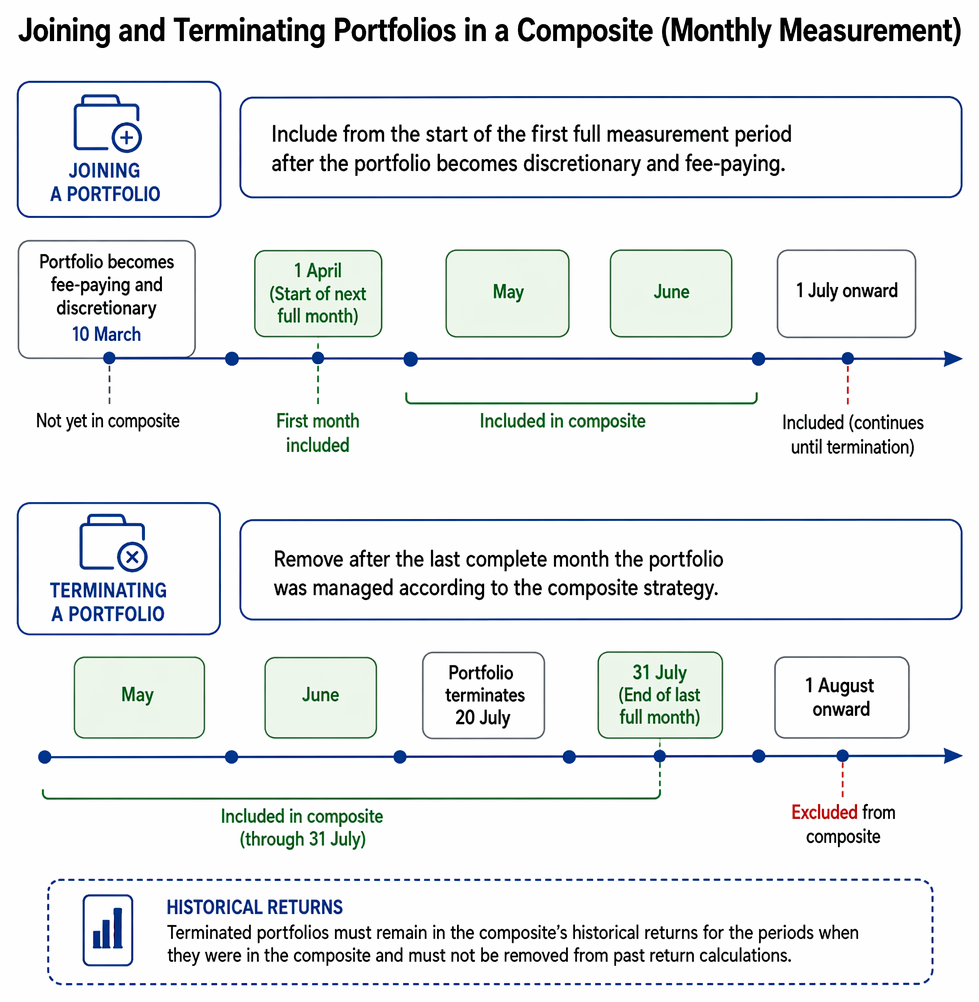
Firm-wide composite construction requires each eligible actual client portfolio to be fee-paying, discretionary, and assigned without selective exclusion.
For example, if performance is measured monthly:
- A portfolio that becomes fee-paying and discretionary on 10 March would first be included from 1 April.
- A portfolio terminated on 20 July would be included through 31 July (the end of the last full month), and excluded from 1 August onward.
Key Term: Terminated Portfolio
A terminated portfolio is one that has been fully withdrawn or is no longer managed by the firm, or no longer managed to the relevant composite strategy. Key Term: Significant Cash Flow
A significant cash flow is a large external cash inflow or outflow that materially affects the portfolio’s ability to be managed according to the composite strategy during a period, potentially triggering temporary composite treatment according to firm policy.
Worked Example 1.3
A firm launches a high-yield bond composite on 1 January 2022. Portfolio A becomes fee-paying and discretionary on 5 January 2022.
Answer:
Portfolio A must be included in the composite from 1 February 2022, the start of the next full measurement period after it became eligible.
Treatment of Terminated Portfolios
Terminated portfolios:
- Must remain in the composite’s historical returns for the periods when they were in the composite.
- Should not be removed from past return calculations, even if they later perform poorly before termination.
- Are excluded only from future periods after the last complete measurement period under management.
The GIPS standards are focused on avoiding any adjustment of history to improve reported performance.
Worked Example 1.4
A CFA charterholder reviewing a manager's GIPS report observes that terminated portfolios remain in the composite for additional months after being closed.
Answer:
This is non-compliant. Terminated portfolios must be removed from the composite at the end of the last complete month under management. Keeping them in the composite beyond that point would distort results and misstate assets in the composite.
Consistency and Integrity of Composites
The GIPS standards prohibit creating composites based on hindsight, performance, or outcome. Changing composite definitions retroactively is not allowed. Portfolios cannot be moved between composites simply to improve results.
Key requirements include:
- Composites must be defined in advance, using consistent, written criteria.
- Portfolios can only be moved between composites when there is a documented, genuine change in mandate, objective, or strategy (for example, a growth equity mandate formally converted to a value equity mandate).
- Changes in composite definitions must be applied prospectively and documented in the firm’s policies and composite description.
Exam Warning: A common error is trying to restrict GIPS compliance to a subset of managed strategies, or re‑shaping composites after the fact to hide poor performance. GIPS requires firm-wide compliance and prohibits hindsight-based composite construction—claiming compliance for just one strategy or team is misleading and non-compliant.
Worked Example 1.5
A firm has a “Global Growth Equity” composite. After three years of poor performance, it decides to move its worst-performing portfolios into a new “Special Situations Equity” composite and restate historical performance for Global Growth Equity excluding these portfolios.
Answer:
This is not allowed under GIPS. Portfolios cannot be moved between composites to improve reported performance, and historical composite returns cannot be restated to exclude poor-performing portfolios. Composite membership and definitions must be based on pre‑defined criteria, not on outcomes.
Written Policies and Documentation
Compliant firms must maintain clear, written policies and procedures describing all actions taken to construct, maintain, and terminate composites. This documentation must cover at least:
- Firm definition and any definition changes.
- The process for classifying portfolios as fee-paying and discretionary.
- Composite assignment and criteria for inclusion/exclusion, including any minimum asset levels.
- The timing and treatment of portfolio additions and terminations.
- How significant cash flows are identified and handled.
- How portfolio and composite returns are calculated and valued (e.g., frequency of valuation, pricing sources).
Key Term: Policies and Procedures
Policies and procedures are the documented rules, processes, and controls a firm uses to ensure consistent application of GIPS requirements, including composite construction, calculation methodology, and error correction.
These written policies serve several purposes:
- They guide staff in making consistent decisions about composite membership.
- They provide evidence to clients, verifiers, and regulators that the firm applies GIPS in a disciplined manner.
- They support training of new employees involved in performance measurement and reporting.
Firms must keep documented evidence to demonstrate compliance to clients and, upon request, to verifiers or regulators.
Ongoing Monitoring, Review, and Record Retention
GIPS compliance is not a one-off exercise. Firms are required to:
- Periodically review portfolios to confirm that composite assignments remain appropriate.
- Update discretionary status when client guidelines or restrictions change.
- Monitor whether portfolios still meet any composite minimum asset level thresholds.
- Review and, if necessary, update policies and procedures as regulations, products, or operational processes change.
Key Term: Prospective Client
A prospective client is any investor who has expressed interest in a strategy and is qualified to invest, to whom the firm must provide the appropriate GIPS composite report for that strategy.
Firms must keep records supporting:
- The definition of the GIPS firm.
- Composite definitions and descriptions.
- Portfolio-level data (holdings, valuations, cash flows, fees).
- Discretionary status and composite membership history.
- Calculations of portfolio and composite returns.
These records must be retained for at least seven years (or longer if required by law or regulation) from the end of each period. Without adequate records, a firm cannot support its claim of GIPS compliance.
Summary
GIPS standards demand that compliance be a firm-wide system, not selective or limited to specific offerings. A GIPS firm is a clearly defined business entity, and the claim of compliance applies to all its relevant business. Firms must systematically include all actual, fee-paying, discretionary portfolios in composites, define composite inclusion rules in writing, and maintain rigorous controls over composite construction and change.
Composite construction must follow pre‑defined, documented criteria and avoid any retrospective adjustments designed to improve reported results. New portfolios must be added to composites in a timely and consistent way, and terminated portfolios must be removed after the last full measurement period, while remaining in the historical record for the periods when they were included.
Accurate record-keeping, clear composite descriptions, and regular review underpin the integrity of a firm's performance presentations. These practices allow prospective clients to compare managers on a fair, like-for-like basis and ensure that performance presentations reflect how the firm actually manages money, not just its best results.
Key Point Checklist
This article has covered the following key knowledge points:
- GIPS compliance must be claimed for the entire GIPS firm, not for selected products, composites, or strategies.
- A GIPS firm is a distinct business entity or combination of entities held out as a single investment management business.
- All actual, fee-paying, discretionary portfolios must be included in at least one composite.
- Composites must be defined based on investment mandate, objective, or strategy, not on performance.
- Composite construction must follow pre-defined, documented criteria; retroactive changes or performance-based portfolio switches are prohibited.
- New eligible portfolios are added at the start of the next full measurement period; terminated portfolios are removed after their last complete period but remain in the historical record.
- Minimum asset levels and significant cash flow policies may be used, but must be documented and applied consistently.
- Written policies and procedures are essential for defining the firm, classifying portfolios, assigning them to composites, and calculating performance.
- Firms must conduct ongoing monitoring of composite membership and retain supporting records for at least seven years.
- Prospective clients must receive the relevant composite performance, not a single “representative” portfolio, to ensure fair and comparable performance reporting.
Key Terms and Concepts
- GIPS Standards
- Composite
- GIPS Firm
- Firm-Wide Compliance
- Actual, Fee-Paying, Discretionary Portfolio
- Discretionary Portfolio
- Composite Description
- Composite Minimum Asset Level
- Terminated Portfolio
- Significant Cash Flow
- Policies and Procedures
- Prospective Client