Learning Outcomes
After reading this article, you will be able to extend short answers in IELTS Speaking Part 1 more naturally and confidently. You will learn practical techniques to avoid giving brief, incomplete replies and instead build fluent responses that sound authentic in an interview. By the end, you will recognize common examiner expectations, apply strategies to develop fuller answers, and avoid the most frequent errors that lower scores in this part of the interview.
IELTS Academic, General & UKVI Syllabus
For IELTS, you need to show the ability to extend your answers appropriately in the Speaking Part 1 interview. In this article, revise these key syllabus points:
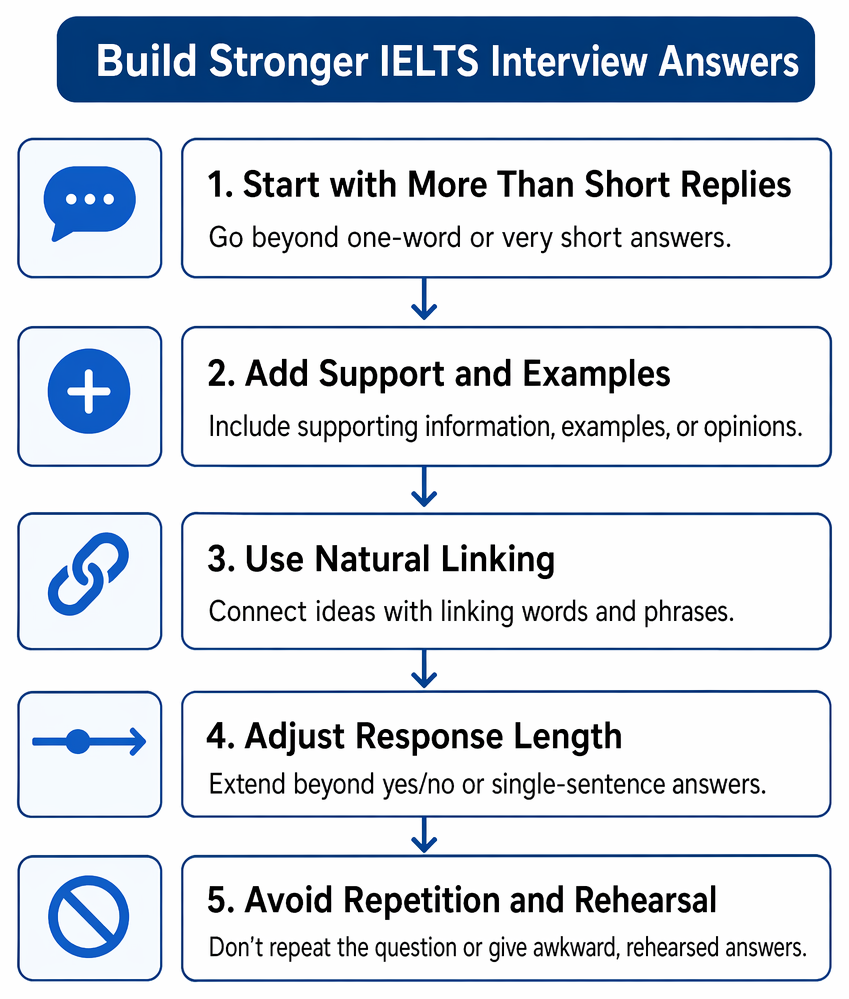
Interview-answer development follows a progression from classifying prompt type to adding support, using cohesive markers, and ending without question repetition.
- Respond to simple personal interview questions with more than one-word or very short replies.
- Add supporting information, examples, or opinions to basic responses to demonstrate fluency.
- Use natural linking words and phrases to connect ideas in extended answers.
- Adjust response length to move beyond short yes/no or single-sentence statements.
- Avoid repeating the question or producing awkward, rehearsed answers.
Test Your Knowledge
Attempt these questions before reading this article. If you find some difficult or cannot remember the answers, look more closely at that area during your revision.
- If the examiner asks, "Do you like reading?", what is the problem with answering only "Yes"?
- What linking words can you use to connect ideas and make your answer longer in Speaking Part 1?
- Why does the examiner want you to give a bit more detail, even when answering very simple questions about yourself?
Introduction
In the IELTS Speaking Part 1, many candidates give answers that are too short. If you only reply with one word or a single sentence, you miss a chance to show your language skills and your score may be limited. The examiner is looking for evidence that you can communicate in a relaxed and natural way. Extending your answers—by giving reasons, examples, or personal opinions—demonstrates fluency and helps you sound less mechanical and more like a confident speaker.
Key Term: Extending Answers
Providing more information in your reply than just a single word, yes/no, or a basic sentence, usually by adding explanations, examples, or extra details. Key Term: Fluency
The ability to speak smoothly and naturally without unnecessary pauses or hesitation, especially when giving longer answers.
Why Short Answers Lose Marks
Exam questions in Part 1 often ask about your work, studies, family, hometown, hobbies, or opinions. Many candidates respond with only "yes", "no", or a few words. For example:
Examiner: Do you play any sports? Candidate: No.
This kind of reply does not show your ability to use English in conversation. The examiner cannot assess your pronunciation, range of grammar, or ability to explain ideas. Longer, connected answers are necessary to achieve higher speaking bands.
Typical Ways to Extend an Answer
You can extend a Part 1 answer by following these practical methods:
- Give a reason or explanation.
- Add an example or story.
- Say how often you do something, with who/when/where, or compare with the past.
- Express a personal opinion, preference, or feeling.
These additions make your speech more interesting and show the examiner you can use English communicatively.
Key Term: Supporting Detail
Extra information you add after your main idea to explain or illustrate your answer further.
Useful Linking Words to Build Natural Flow
Simple linking words and phrases can help you structure extended answers. Common options include:
- because, so, but, actually, to be honest, for example, in fact, the reason is, usually, especially, I mean, as well, actually, as a result.
These words give your response a natural, conversational style and connect your ideas smoothly.
Key Term: Linking Word
A word or phrase that joins parts of your answer so it flows better and avoids sounding like separate, short sentences.
Worked Example 1.1
Examiner: Do you like listening to music?
Weak short answer: Yes.
Better extended answer: Yes, I really like listening to music, especially when I'm travelling or studying. For example, yesterday I listened to some classical music while I was preparing for exams. It helps me relax and concentrate.
Answer:
The extended answer gives a clear reason, specific example, and uses "especially" to add detail. This reply allows the examiner to assess your fluency and range.
Worked Example 1.2
Examiner: What do you usually do at weekends?
Weak short answer: I stay at home.
Better extended answer: Usually, I spend my weekends at home because I need to rest after a busy week. Sometimes, I’ll watch some films or meet my friends for a coffee if I feel like going out.
Answer:
The improved reply offers a reason, adds some variety, and uses linking words naturally.
Worked Example 1.3
Examiner: Do you enjoy cooking?
Weak answer: Not really.
Better answer: Not really, to be honest. I’m not very good at cooking, so I prefer to eat out or order takeaway. Actually, my mother does most of the cooking at home.
Answer:
Here, the candidate explains why they do not enjoy cooking, adds an opinion, and makes a comparison. This demonstrates more relevant language for IELTS.Exam Warning: Many students use the same phrase to start every answer ("To be honest...", "Actually...") or always repeat the question before their reply. This makes your answers sound unnatural and memorised. Vary your approach and use a mix of words and structures.
Revision Tip: After practising questions, record yourself. Listen to check if your answers naturally extend with extra detail, or are too short and repetitive.
Key Point Checklist
This article has covered the following key knowledge points:
- Explain why short answers limit your score in IELTS Speaking Part 1.
- Identify ways to naturally extend your responses.
- Use linking words and supporting details to build fluent, fuller replies.
- Recognize examiner expectations for more than yes/no or single-sentence answers.
- Avoid repeating the question and using the same memorised phrases every time.
- Practise varying your responses and supporting your ideas.
Key Terms and Concepts
- Extending Answers
- Fluency
- Supporting Detail
- Linking Word