Learning Outcomes
After reading this article, you will be able to identify and avoid "yes-no traps" during the IELTS Speaking Part 1 introduction and interview phase. You will know how to recognise closed questions, provide fuller answers instead of brief yes/no responses, and apply active strategies to extend your spoken contributions for higher marks in the exam.
IELTS Academic, General & UKVI Syllabus
In IELTS, you must demonstrate the ability to give relevant, developed answers in Part 1 of the Speaking test. For revision, focus on these syllabus requirements:
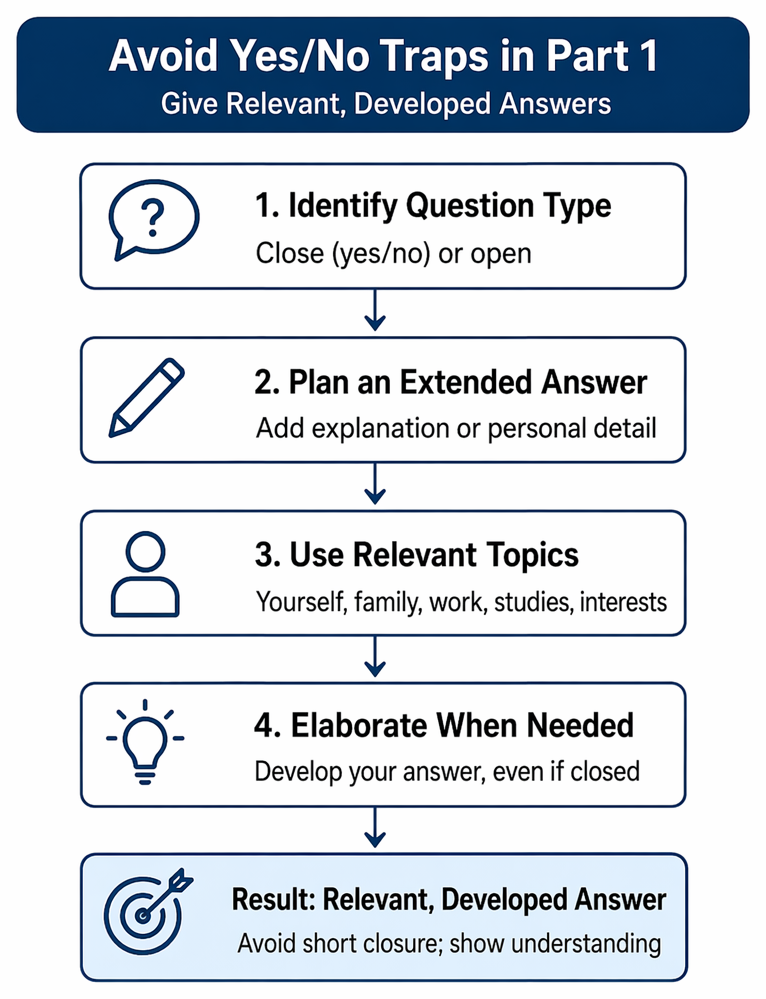
Extended replies to closed questions are organised by recognition cues, answer-expansion techniques, and benefits including clearer support and improved fluency.
- Distinguish between question types in Speaking Part 1 and avoid simply giving yes/no responses.
- Use extended answers with explanation or personal detail, rather than short closure.
- Respond effectively to general interview questions about yourself, family, work, studies, and interests.
- Show understanding when elaboration is required, even if the question is closed.
Test Your Knowledge
Attempt these questions before reading this article. If you find some difficult or cannot remember the answers, look more closely at that area during your revision.
- What is a "yes-no trap" in IELTS Speaking Part 1 and why can it lower your score?
- If an examiner asks, "Do you like reading?" what is wrong with answering, "Yes" and stopping there?
- How can you develop a longer response to a closed question such as, "Do you live in a house?"
- True or false: In IELTS Speaking Part 1, it is usually best to answer with just "yes" or "no" unless the examiner asks "why?"
Introduction
In Part 1 of the IELTS Speaking test, the examiner asks straightforward questions about familiar topics such as your home, studies, or everyday preferences. Many questions can be answered with "yes" or "no," but doing so will restrict your score. Short, closed replies show limited language and fail to demonstrate your speaking skills. Learning to avoid these traps and deliver fuller, natural answers is essential for a better result.
Key Term: Yes-No Trap
A Speaking Part 1 question that can be answered with "yes" or "no," but where minimal response leads to lost marks because of inadequate development. Key Term: Closed Question
A question that expects a "yes" or "no" as a grammatically correct answer, but requires more detail for IELTS assessment.
Speaking Part 1 and Interview Structure
The examiner will introduce the test and ask questions about you or general topics. Most questions are intentionally simple to help you settle in, but the examiner still expects you to expand your answers.
Why Avoid Yes-No Answers?
Single-word or very brief answers prevent you from showing your language range, fluency, and ability to support ideas—all assessed in the IELTS criteria. Longer answers display:
- Vocabulary range.
- Fluency and pronunciation.
- Ability to support ideas or give reasons.
- Willingness to communicate naturally.
Even when a question can be answered in one word, full marks require more.
Recognising Yes-No Traps
Look for questions starting with "Do you...?", "Are you...?", "Have you...?" For example:
- "Do you enjoy watching movies?"
- "Are you working or studying?"
- "Have you travelled to other countries?"
These are closed questions. Giving only a yes/no reply is a classic trap.
Moving Beyond Yes-No
Always aim to provide at least one of the following after your basic yes/no response:
- A reason or explanation ("because...")
- An example ("For example, last weekend I...")
- A brief detail or description.
Useful Sentence Starters
- "Yes, I do. For instance, I try to go to the cinema every Friday after work."
- "No, I don’t. I prefer to spend my free time outdoors, because I find it more relaxing than watching TV."
- "Yes, I am. At the moment, I’m studying engineering at university, which I really enjoy."
Key Term: Extending an Answer
The technique of adding details, examples or explanations to a simple reply to demonstrate fuller speaking ability on IELTS.
Common Yes-No Trap Examples
Example 1
Examiner: "Do you often eat out?"
- Weak answer: "Yes."
- Better answer: "Yes, I do. My family usually goes to a restaurant every Sunday, because it’s a way for us to spend time together."
Example 2
Examiner: "Have you got any brothers or sisters?"
- Weak answer: "No."
- Better answer: "No, I’m an only child. Sometimes I wish I had a younger sister to talk to, but I do have several close cousins I see regularly."
Key Term: Parroting
Repeating part of the examiner’s question in your answer to start a fuller response, e.g., "No, I don't play any musical instruments, but..."
Worked Example 1.1
You are asked:
"Do you like watching sports?"
Candidate A:
"Yes."
Answer:
This is too short—does not demonstrate your language range or ability to justify your answers. Candidate B:
"Yes, I do. In fact, football is my favourite sport. I usually watch it on TV with my father every weekend, and sometimes we go to local matches together."
Answer:
This response shows preference, example, and routine, all helpful for score improvement.
Worked Example 1.2
Examiner asks:
"Are you a student?"
Possible strong answer:
"Yes, I’m studying computer science at the local college. I chose this course because I’ve always been interested in computers, and I hope to work in software development after I graduate."
Answer:
The answer starts with "yes" but immediately expands, explaining the course, motivation, and future plans.Exam Warning: If you rely solely on "yes" or "no" responses, you demonstrate poor fluency, restrict your vocabulary, and miss key points in the IELTS marking criteria. This can keep your score below Band 6, even if your English is otherwise good.
Revision Tip: When practising for Speaking Part 1, write possible follow-up sentences for common closed questions. This trains you to give at least one extra detail or reason every time.
Summary
Avoiding yes-no traps in IELTS Speaking Part 1 means recognising simple closed questions and always providing a longer, more personal answer. This lets you demonstrate the skills required for a high IELTS Speaking score.
Key Point Checklist
This article has covered the following key knowledge points:
- Identify yes-no traps in Speaking Part 1 questions.
- Understand why closed, minimal answers limit your score.
- Extend answers beyond "yes" or "no" with explanations, examples, or details.
- Practise adding follow-up information to every closed question.
- Realise that examiners expect more than a one-word reply, even when the question form is simple.
Key Terms and Concepts
- Yes-No Trap
- Closed Question
- Extending an Answer
- Parroting