Learning Outcomes
After reading this article, you will be able to effectively compare ideas, evaluate different viewpoints, and hypothesise about situations in IELTS Speaking Part 3 and relevant Writing tasks. You will know common question types, suitable structures, and linking language for balanced, reasoned responses. You will also recognise how to demonstrate higher-level thinking such as weighing arguments and imagining outcomes, as required for higher IELTS band scores.
IELTS Academic, General & UKVI Syllabus
For IELTS, you must demonstrate the ability to compare, evaluate, and hypothesise when discussing ideas in Speaking Part 3 and writing essays in Task 2. For revision, target these syllabus points:
- Present similarities and differences between topics, options, or views using accurate language.
- Evaluate arguments by explaining advantages, disadvantages, or strengths and weaknesses.
- Hypothesise or speculate about future or imagined scenarios using appropriate phrases and structures.
- Respond clearly and logically to questions asking for comparisons, opinions, justifications, or predictions.
- Use a range of linking words to contrast, support, or sequence ideas coherently.
Test Your Knowledge
Attempt these questions before reading this article. If you find some difficult or cannot remember the answers, look more closely at that area during your revision.
- What types of questions in IELTS Speaking Part 3 require comparing or evaluating?
- Name two linking phrases used to show contrast between ideas in discussion.
- How do you form a hypothetical statement about the future using "if"?
- Why is evaluating both sides of an argument important for a high IELTS Speaking band?
Introduction
IELTS Speaking Part 3 and many Writing Task 2 essays require you to compare topics, evaluate viewpoints, and hypothesise about possible situations. Examiners expect you to move beyond simple opinions by discussing advantages, disadvantages, making contrasts, and imagining consequences. These advanced functions show your ability to think logically and use English flexibly.
Key Term: Compare
To explain similarities and/or differences between two or more topics, arguments, or examples using appropriate structures and vocabulary. Key Term: Evaluate
To judge the strengths, weaknesses, or overall value of an idea, argument, or option by analysing its advantages and disadvantages. Key Term: Hypothesise
To discuss situations that are imaginary, possible, or not yet real, using suitable language to show you are speculating or making predictions.
Approaching Part 3 Discussion: Understanding the Functions
IELTS Part 3 questions require deeper thought than simple personal opinions. The most common functions you must address are:
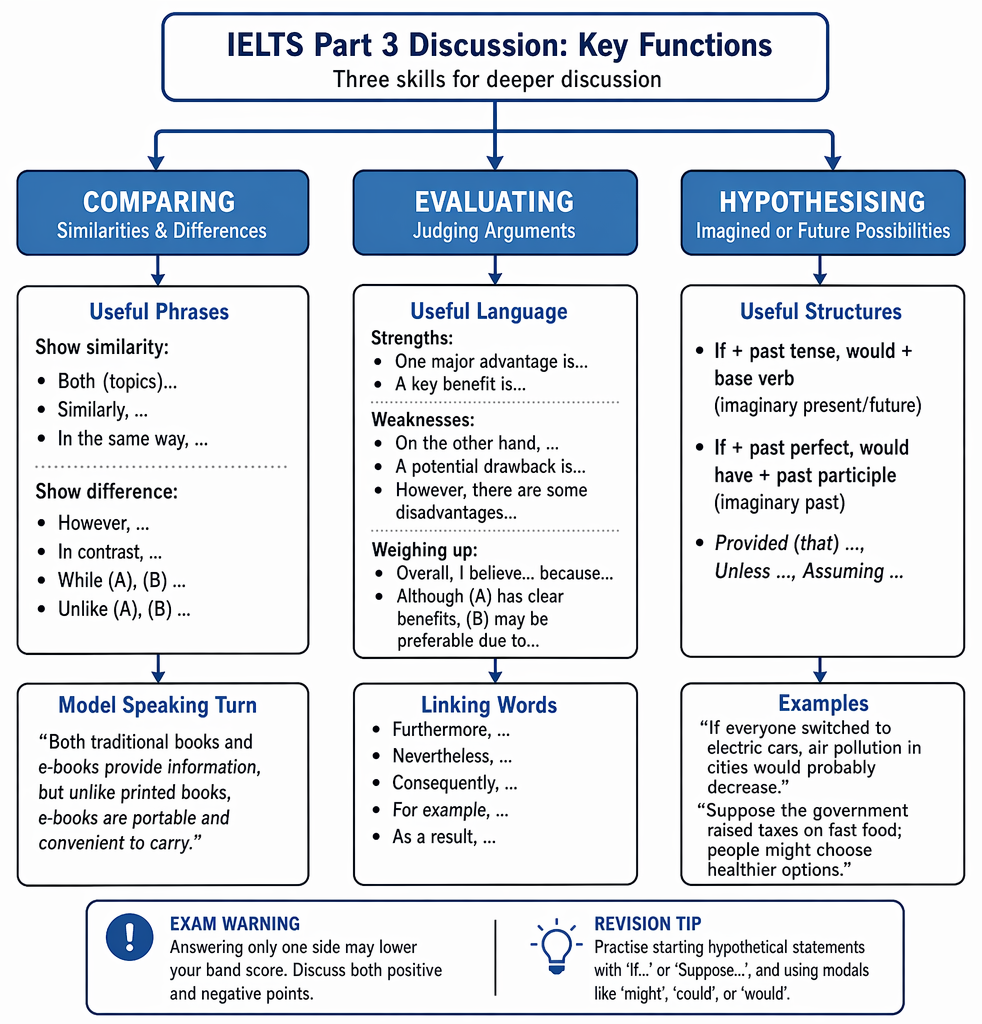
Opinion prompts are presented as a structured process requiring strengths, weaknesses, explicit treatment of both positions, one supporting example, and justification.
- Comparing: How are two things similar or different?
- Evaluating: What are the benefits and drawbacks? Which idea is stronger?
- Hypothesising: What might happen if circumstances change? What could result from a possible action?
These skills are fundamental for higher IELTS band levels.
Comparing: Presenting Similarities and Differences
When comparing, you must clearly state what is the same and what differs.
Key Term: Linking Phrase
A word or group of words used to connect and relate ideas, such as 'however', 'in contrast', 'both', or 'whereas'.
Useful Structures and Phrases
To show similarity:
- Both (topics)...
- Similarly, ...
- In the same way, ...
To show difference:
- However, ...
- In contrast, ...
- While (A), (B) ...
- Unlike (A), (B) ...
Model Speaking Turn
"Both traditional books and e-books provide information, but unlike printed books, e-books are portable and convenient to carry."
Evaluating: Judging Arguments or Opinions
Evaluation means giving reasons or evidence to support which idea is stronger, more useful, or more important.
- What are the advantages and disadvantages?
- Which is better or more effective? Why?
Useful Language
Introducing strengths:
- One major advantage is...
- A key benefit is...
Introducing weaknesses:
- On the other hand, ...
- A potential drawback is...
- However, there are some disadvantages...
Weighing up:
- Overall, I believe... because...
- Although (A) has clear benefits, (B) may be preferable due to...
Linking Words for Balanced Discussion
- Furthermore, ...
- Nevertheless, ...
- Consequently, ...
- For example, ...
- As a result, ...
Hypothesising: Talking About Imagined or Future Possibilities
Hypothesising involves speculating about situations that are not real, not certain, or are predictions.
Useful Structures
- If + past tense, would + base verb (imaginary present/future)
- If + past perfect, would have + past participle (imaginary past)
- Provided (that) ..., Unless ..., Assuming ...
Examples
"If everyone switched to electric cars, air pollution in cities would probably decrease."
"Suppose the government raised taxes on fast food; people might choose healthier options."
Worked Example 1.1
The number of people living in large cities is increasing each year. Some believe this trend brings prosperity, while others are concerned about stress and overcrowding.
Question: Compare the potential benefits and drawbacks of more people moving to cities. Which argument do you find stronger? Why?
Answer:
One benefit of urban growth is the availability of better jobs and improved services, such as hospitals and schools. However, a drawback is increased congestion and rising living costs. For instance, city dwellers may struggle to find affordable housing. Overall, while the economic advantages are significant, I think the disadvantages, especially regarding quality of life, are more serious.
Worked Example 1.2
Examiner: How would life change if public transport was completely free?
Answer:
If public transport were free, more people might leave their cars at home, resulting in less traffic and pollution. However, free transport could be overcrowded if the system cannot handle the extra demand. Overall, it could make cities cleaner and less congested, provided the government invested in expanding services.
Worked Example 1.3
Some schools now use only online classes. Others believe face-to-face learning is more effective.
Question: Evaluate both approaches and hypothesise what might happen if all classes moved online.
Answer:
Online classes offer flexibility and convenience. On the other hand, they may reduce student motivation and limit social interaction. If all classes switched to online-only, some students could succeed, especially self-motivators, but others might struggle without face-to-face support from teachers. Therefore, a mix could be more effective than relying solely on digital learning.Exam Warning: Answering only one side (e.g., listing advantages without any disadvantages) may lower your band score. Discuss both positive and negative points for balanced evaluation, even if a question asks for your opinion.
Revision Tip: Practise starting hypothetical statements with 'If...' or 'Suppose...', and using modal verbs like 'might', 'could', or 'would'. This shows flexible English.
Summary
When answering IELTS Part 3 discussion questions, focus on comparing, evaluating, or hypothesising as required. Use linking words and balanced arguments. Give clear examples and support conclusions with reasons. Show you can speculate about future or unreal situations using correct grammar.
Key Point Checklist
This article has covered the following key knowledge points:
- Explain and recognise questions that require comparing, evaluating, or hypothesising.
- Present similarities and differences using suitable structures.
- Discuss strengths and weaknesses of arguments, with clear linking words.
- Speculate about imagined or possible future situations with correct hypothetical language.
- Use examples and give reasons for choices or opinions in discussion.
- Avoid focusing only on one side when evaluation is required.
- Practise a full range of linking and contrast phrases appropriate for IELTS Part 3 and Writing.
Key Terms and Concepts
- Compare
- Evaluate
- Hypothesise
- Linking Phrase