Learning Outcomes
After reading this article, you will be able to use linking language and signposting expressions confidently in IELTS Speaking Part 2. You will learn how to organize your long turn (cue card) answer, connect ideas smoothly, guide your listener clearly, and structure each part with appropriate transitions—boosting both your fluency and coherence band scores.
IELTS Academic, General & UKVI Syllabus
For IELTS, you are required to effectively organize and connect ideas in Speaking Part 2 using linking language and signposting. For your revision, prioritize these syllabus areas:
- Understand how to introduce, develop, and conclude your cue card speech using signposting phrases.
- Use a range of linking words (e.g., firstly, however, on the other hand, finally) to connect and transition between ideas.
- Organize your response logically, showing clear progression through the cue card prompts.
- Apply spoken discourse markers to highlight examples, contrasts, reasons, and results.
- Maintain a high level of fluency and coherence by linking sentences and managing the flow of information.
- Avoid abrupt topic shifts or listing ideas without clear connections.
Test Your Knowledge
Attempt these questions before reading this article. If you find some difficult or cannot remember the answers, look more closely at that area during your revision.
- What is a "signposting phrase" and why is it important for IELTS Speaking Part 2?
- Name two linking words you can use to introduce examples in your cue card answer.
- How can you indicate clearly that you are moving to the next bullet point on the cue card?
- True or false: Using "and, and, and" to connect all your points in Speaking Part 2 is an effective way to demonstrate coherence.
Introduction
IELTS Speaking Part 2, also called the "long turn" or "cue card" section, asks you to speak for around two minutes on a given topic. Success here depends not only on your vocabulary or fluency but equally on your ability to organize and connect ideas. Examiners expect clear linking language and signposting to show your speech is structured, logical, and easy to follow.
Key Term: Linking Language
Words or phrases used to join sentences and ideas, showing clear relationships such as sequence, contrast, reason, or result. Key Term: Signposting
Spoken expressions that help your listener follow your structure, indicating when you begin, give examples, change topic, make a contrast, or summarize.
A well-organized long turn uses a mix of linking words and signposts. This helps you move smoothly from one point to another, keeps your ideas connected, and clearly marks each cue card prompt for the examiner.
The Purpose of Linking and Signposting in Speaking Part 2
Linking language and signposting are essential for these reasons:
- They show you are in control of your talk, guiding the listener at each step.
- They help you build clear, logical paragraphs in spoken form.
- They increase your "Coherence & Connectivity" band score, a key assessment area in IELTS Speaking.
- They give you time to think as you transition between ideas.
Using such language allows you to sound more natural and fluent, similar to native speakers or advanced candidates.
Common Categories of Linking Language and Signposting
Knowing a range of linking and signposting expressions will help you manage any cue card or topic. Some of the most useful categories are:
Sequencing
These phrases help you order your ideas or progress through the cue card prompts:
- "To begin with," "Firstly," "First of all," "The first thing I'd like to mention is..."
- "Secondly," "Then," "After that," "Next..."
- "Finally," "Lastly," "To sum up..."
Adding Information
Use these when you want to expand or give more detail about a point:
- "Also," "In addition," "What's more," "Apart from that..."
Giving Examples
To illustrate your points, use:
- "For example," "For instance," "To give you an example," "Such as..."
Contrasting or Changing Topic
Show contrast or shift topics with:
- "However," "But," "On the other hand," "Although..."
- "Anyway," "Moving on to..."
Emphasizing or Summarizing
Highlight key points or wrap up with:
- "The main thing is..." "What I want to emphasize is..." "So, in conclusion..."
How to Use Linking Language for Cue Card Structure
When the examiner gives you a cue card, you usually see:
- An introduction prompt ("Describe a time when...", "Talk about a place where...")
- 2–4 bullet points to guide your speech
- A final "explain why" or "explain how you felt" point
A strong answer uses signposting language to move methodically between points, clearly marking each transition.
Key Term: Cue Card
The card given to you in IELTS Speaking Part 2, containing a main topic and several prompts that should structure your answer.
When you move to each bullet, use signposting. For example:
- "Let me start by explaining..."
- "Next, I'll talk about..."
- "After that, I'd like to mention..."
- "Finally, I'd like to explain why I think..."
This approach helps both you and the examiner keep track of your speech.
Essential Linking Words and Signposting Phrases for IELTS Speaking
Below are some high-utility expressions you can use in the Speaking Part 2 long turn:
- Introduction: "I'd like to talk about...", "I'm going to describe...", "The topic I want to discuss is..."
- Sequence: "First of all...", "Then...", "After that...", "Finally..."
- Adding: "Also...", "In addition...", "Another thing is..."
- Example: "For example...", "For instance...", "Such as..."
- Contrast: "However...", "But...", "In contrast..."
- Result: "So...", "That's why...", "Because of this..."
- Reason: "The main reason is...", "This is because..."
- End/Conclusion: "To sum up...", "In summary...", "Overall..."
Making Your Cue Card Response Coherent: Step-by-Step
Here is a proven approach:
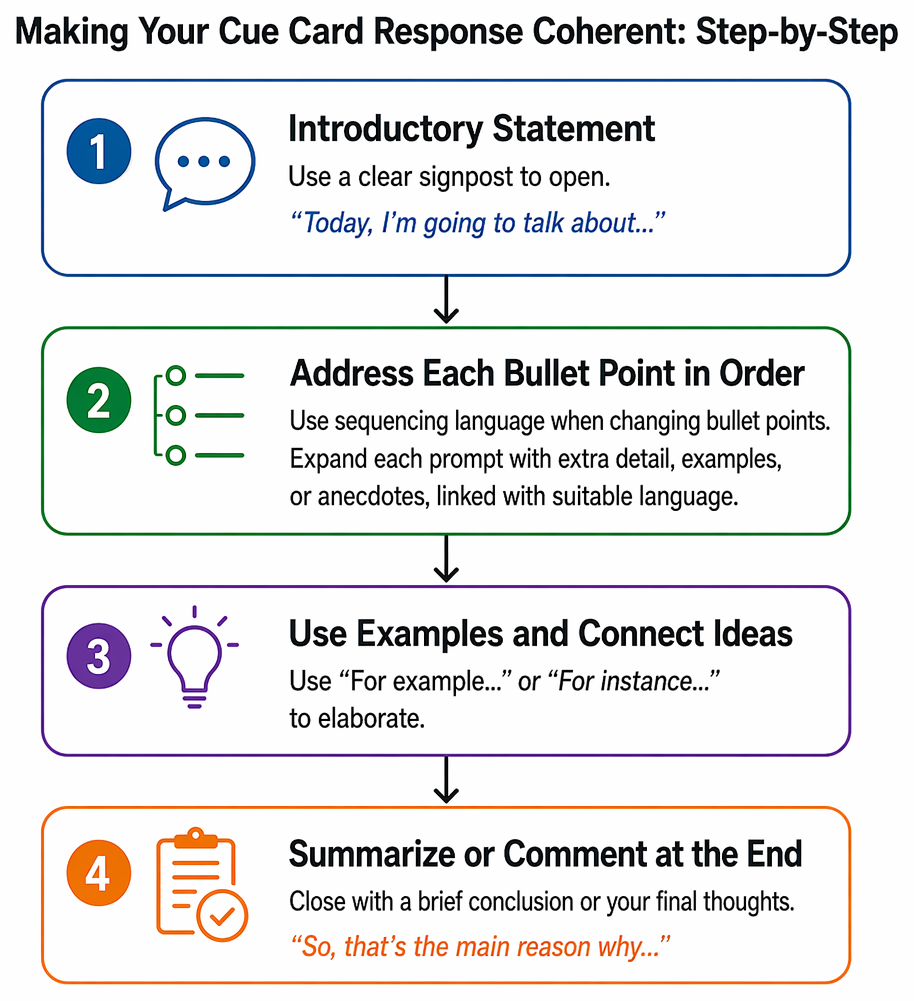
Signposting functions are paired with sample discourse markers for sequencing, addition, exemplification, contrast, topic shift, reason, and result.
-
Introductory Statement
- Use a clear signpost to open. ("Today, I'm going to talk about...")
-
Address Each Bullet Point in Order
- Use sequencing language when changing bullet points.
- Expand each prompt with extra detail, examples, or anecdotes, linked with suitable language.
-
Use Examples and Connect Ideas
- Use "For example..." or "For instance..." to elaborate.
-
Summarize or Comment at the End
- Close with a brief conclusion or your final thoughts. ("So, that's the main reason why...")
Avoiding Common Mistakes
- Do not speak in a list ("...and, and, and..."). Vary your linking words.
- Avoid repeating the same signpost ("firstly, secondly, thirdly") in one answer—use variety.
- Never ignore the cue card prompts—each needs to be addressed and clearly signposted.
Worked Example 1.1
You should spend about 1 minute preparing your answer.
Describe a place where you like to relax. You should say:
- where it is
- what it looks like
- how often you go there and explain why you like going there to relax.
Sample Response (using linking language and signposting):
Today, I'd like to talk about a place where I often go to relax. First of all, this place is a small public garden near my apartment. It's located in the city center, just five minutes' walk from my building.
As for what it looks like, it's quite peaceful, with several large trees, green lawns, and colorful flowers. In addition, there are benches where people can sit and read or just enjoy the view.
Regarding how often I go there, I try to visit the garden at least three times a week, usually in the evenings after work.
Finally, I'd like to explain why this place helps me relax. The main reason is that it's much quieter than anywhere else in the city. For example, I can sit and listen to the birds or think about my day.
Answer:
The highlighted linking words and signposting phrases clearly guide the examiner through the structure of your response and connect your ideas logically, which is essential for fluency and coherence.
Worked Example 1.2
Describe an occasion when you helped someone.
You should say:
- who you helped and why
- what you did
- how they responded and explain how you felt about it.
Model Answer (featuring linking and signposting):
Let me start by describing who I helped and why. A few months ago, my friend was ill and unable to shop for groceries. Because of this, I decided to help.
As for what I did, I went to the supermarket to buy food and delivered it to her apartment.
Regarding her response, she was very grateful and thanked me several times.
In summary, helping her made me feel happy because I could make a real difference to her day.
Answer:
Notice how clear signposting and linking language show when you move to each part of the cue card, resulting in a well-structured long turn.Exam Warning: A frequent error is to ignore the bullet points in the cue card or to move between them with no clear signposting. This can make your response sound unclear or disorganized. Always use linking and signposting phrases to guide your listener, and check you have addressed each prompt fully.
Revision Tip: While practicing, record yourself and listen for your use of linking language. Make a checklist of phrases to use for each type of idea (sequence, example, contrast, conclusion) to ensure you are ready for any topic.
Summary
Linking language and signposting are critical for organizing your cue card answer and achieving a high band score for fluency and coherence. Practice using a range of linking words, varying your expressions, and always use signposts to transition between different ideas or cue card prompts.
Key Point Checklist
This article has covered the following key knowledge points:
- Define and explain the use of linking language and signposting in IELTS Speaking Part 2.
- Provide essential categories of linking words for sequencing, examples, contrast, and conclusion.
- Demonstrate how to structure a cue card response clearly with signposting phrases.
- Show how to move between each cue card prompt using linking language.
- Alert you to common mistakes to avoid (overuse of "and," omitting transitions, ignoring bullet points).
Key Terms and Concepts
- Linking Language
- Signposting
- Cue Card