Learning Outcomes
After reading this article, you will be able to: (1) interpret LSAT prompts and scenarios with precision; (2) identify and separate relevant facts from extraneous information; (3) determine explicit and implicit constraints that shape valid answers; and (4) apply LSAT task instructions accurately to construct and evaluate arguments as required in test scenarios.
LSAT Syllabus
For LSAT, you are required to understand how to analyze prompts and scenarios effectively. This includes recognizing the facts, defining the constraints, and applying instructions to answer the question as intended. For your revision, focus on:
- determining what information in a scenario is relevant to the task
- separating facts from opinions, background details, or irrelevant data
- spotting all constraints, including those that may be implicit or embedded in the wording
- interpreting task instructions exactly as written, without bringing in outside knowledge or assumptions
Test Your Knowledge
Attempt these questions before reading this article. If you find some difficult or cannot remember the answers, look more closely at that area during your revision.
- On the LSAT, what is the primary risk of overlooking a constraint embedded within the scenario or prompt?
- Which of the following is typically considered an explicit fact in an LSAT scenario?
- a) Background context stated in the instruction
- b) A value judgment about an argument's validity
- c) A directly stated event in the scenario description
- d) Opinions attributed to outside experts not referenced in the question
- Why is it important to differentiate between relevant and extraneous information in a prompt before answering an LSAT question?
- If a scenario introduces a principle that "no decision can be made unless two criteria are satisfied," which of the following is a valid constraint for your answer?
Introduction
You cannot answer LSAT questions accurately unless you read the prompt and scenario with care. Most questions require you to extract facts, spot all constraints, and apply the instructions exactly—without relying on real-world assumptions. This skill is critical for all LSAT sections but especially logical reasoning and reading comprehension. Misinterpreting a prompt or misunderstanding a constraint often leads directly to wrong answers or wasted time.
Understanding how to deconstruct the scenario is foundational to strong LSAT performance.
Identifying Relevant Facts
LSAT questions are designed to test your ability to work only with the facts provided. You must distinguish between information given as evidence in the stimulus and any background or opinion content.
Key Term: fact
A fact is a statement in the scenario or prompt that is presented as true for the purposes of the question, whether or not it aligns with your outside knowledge.
When reading an LSAT scenario, seek out:
- Statements directly describing actions, events, or relationships
- Data presented as true for the purposes of the question
- Anything explicitly labeled by the author as an assumption for that question
Details provided as context or opinion, unless referenced or required by the question stem, are almost always extraneous and should not be treated as facts.
Worked Example 1.1
Stimulus: "A committee will select students for an award. Students must have a GPA above 3.5, have completed at least one service project, and have no disciplinary record. Jin has a 3.7 GPA, participated in three service projects, and was given a warning for tardiness."
Question: Which fact(s), if any, disqualify Jin under the prompt's scenario?
Answer:
Jin’s warning for tardiness may not be a disciplinary record (depends on the scenario’s definitions), but otherwise, all facts suggest eligibility. Only facts clearly described as discipline records would disqualify. The answer must be based only on information provided.
Spotting Explicit and Implicit Constraints
Many LSAT questions include instructions restricting what you may assume or how you must construct your answer. Constraints limit the possible universe of acceptable answers.
Key Term: constraint
A condition—stated or implied—that restricts which answers are possible or acceptable under the scenario.
Constraints may appear as:
- Requirements specified in the question stem ("only if," "unless," "must," "cannot," etc.)
- Logic rules defined within the scenario
- Prohibitions or limits embedded in the facts (e.g., "Students selected cannot be from the same school")
Some constraints are explicit—clearly stated using restrictive terms. Others are implicit, arising from how rules interact or from the scenario structure. Spotting these is essential.
Worked Example 1.2
Stimulus: "Five events—A, B, C, D, E—must be scheduled Monday through Friday, one per day. B cannot be before D. C must be scheduled on Tuesday. A must be before E."
What is an implicit constraint created by these facts and rules?
Answer:
Because C must be on Tuesday, A and E cannot take place before Tuesday. B cannot be on Monday if D is after Monday. Constraints include both scheduling rules and positional requirements created by these interlocking conditions.
Applying Instructions and Avoiding Outside Knowledge
Every LSAT prompt contains precise instructions about how your answer must be constructed. Use only what is presented; do NOT bring in outside facts.
Key Term: relevant information
Content that must be used (or is permitted) according to the scenario and prompt's instructions to answer the question.
Do not:
- Infer additional facts unless the scenario enables such inference by logic
- Substitute your own definitions or interpretations for those supplied in the prompt
- Use real-world knowledge, even if the scenario describes familiar concepts, unless specifically requested by the prompt
Exam Warning: LSAT questions sometimes include information that is incorrect or counterintuitive in real life. For the exam, you must ignore outside knowledge and work exclusively with the scenario as presented. Answers that rely on real-world assumptions will be marked wrong.
Distinguishing Relevant vs. Distracting Information
Prompts often include extraneous details intended to distract or to test your discipline in focusing on the actual task. Identifying what is genuinely required—and what is not—saves time and improves accuracy.
Revision Tip: When preparing for LSAT scenarios, practice underlining (or digitally highlighting) only the facts and constraints needed for the question. Ignore unneeded background.
Structuring Your Approach
To avoid errors or wasted time:
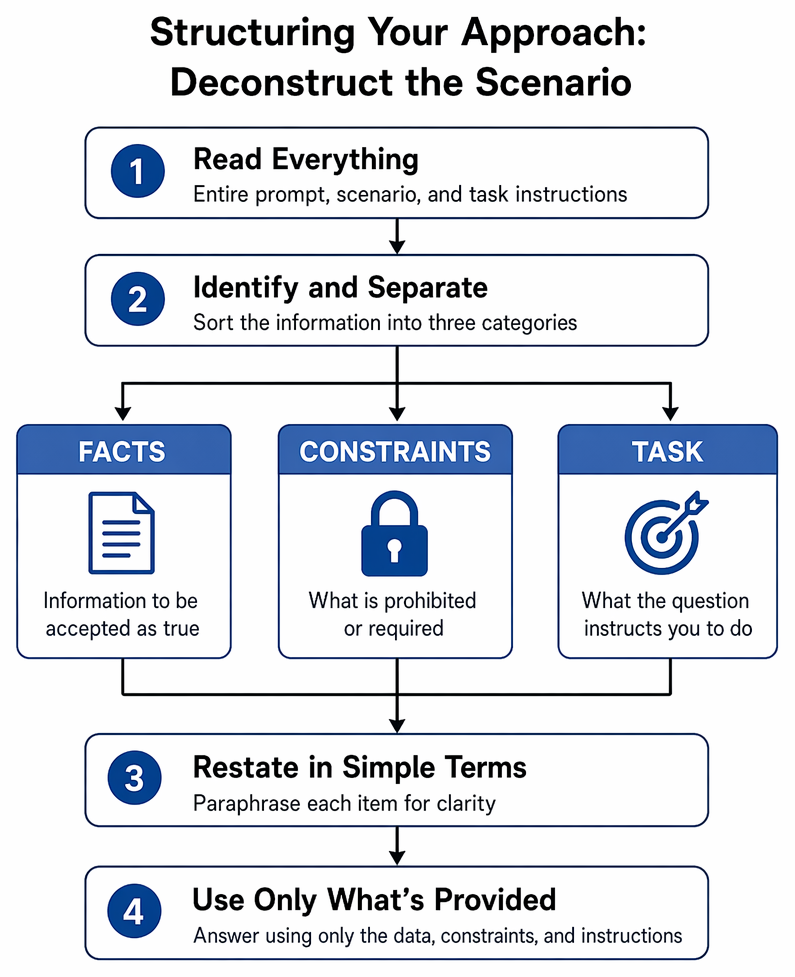
Statement-screening process distinguishing stated facts, rule-based inferences, task relevance, and information that must be disregarded.
-
Read the entire prompt and scenario, including any task instructions.
-
Identify and clearly separate the following:
- All facts (information to be accepted as true for this question)
- Every constraint (what is prohibited or required)
- The specific task (what the question instructs you to do)
-
Restate each in simple terms to ensure clarity.
-
Answer only using the data, constraints, and instructions provided.
Worked Example 1.3
Stimulus: "A science camp groups students by grade. Eighth graders cannot be with sixth graders. The group must have three or more students. The scenario gives: Ivan is in seventh grade, Jonas is in eighth grade, and Kim is in sixth grade."
Question: Is it possible to form a valid group with Ivan, Jonas, and Kim?
Answer:
No. Jonas (eighth grade) and Kim (sixth grade) cannot be together due to the explicit constraint. Focus only on the constraints provided, not any real-world assumptions about grouping.
Key Point Checklist
This article has covered the following key knowledge points:
- The difference between facts, opinions, and extraneous scenario information
- How to identify explicit and implicit constraints within an LSAT scenario
- The meaning of "relevant information" for responding to a specific task
- Why outside knowledge or assumptions must be excluded in your answer
- Techniques for structuring your approach to answer within facts and constraints
Key Terms and Concepts
- fact
- constraint
- relevant information