Learning Outcomes
By the end of this article, you should be able to accurately interpret LSAT essay prompts and identify the required task. You will understand how to determine the persuasive aim of the essay, structure a logical argument, and apply these skills efficiently in a timed exam setting. This article will help you avoid common misunderstandings and maximize the clarity and relevance of your written response.
LSAT Syllabus
For LSAT, you are required to understand not only the content of essay prompts but also the specific task and persuasive goal behind them. In your revision, focus on:
- Identifying precisely what the essay prompt is asking you to do
- Recognizing and articulating the main persuasive goal expected in your response
- Structuring clear and logical arguments to address the prompt and persuade your intended reader
- Avoiding common misreadings and errors in handling typical LSAT essay tasks
Test Your Knowledge
Attempt these questions before reading this article. If you find some difficult or cannot remember the answers, look more closely at that area during your revision.
- What are the typical task verbs that signal what the LSAT essay prompt requires you to do?
- Why is it important to identify the persuasive goal when structuring your LSAT essay response?
- If a prompt requires you to argue for one of two options, what approach should you take to address both the pros and cons?
- True or false? The LSAT essay always requires you to present both sides without taking a position.
Introduction
Understanding the LSAT essay prompt goes beyond simply reading the question. The exam tests not only your reasoning but also your ability to follow instructions and fulfil a persuasive writing task. Many candidates lose marks by missing the actual task set, failing either to address the correct question or omitting the core persuasive requirement.
Recognizing the persuasive goal ensures you are targeting your arguments at the right outcome and audience. The clarity with which you address the task given fundamentally shapes your answer’s effectiveness.
Key Term: essay prompt
The essay prompt is the exam question or scenario that tells you exactly what issue you must address and what type of task you must complete. Key Term: persuasive goal
The persuasive goal is the outcome you are meant to achieve with your written response—usually to argue clearly for a position using structured reasoning that addresses criteria set by the question. Key Term: task identification
Task identification means correctly discerning what the question is asking you to do (e.g., analyze, argue, recommend, compare).
Worked Example 1.1
Prompt: A university committee must choose between renovating the old library and building a new student centre. You are asked to write an essay recommending one option over the other, considering student needs and the university's long-term interests.
Question: What is the precise task, and what is your persuasive goal? Answer:
The task is to select one of the two options, weighing them against the given criteria. The persuasive goal is to construct a logical argument advocating your chosen option while demonstrating why it better meets both student needs and long-term interests, likely also addressing potential weaknesses in your position.
ANALYSING THE ESSAY PROMPT
LSAT prompts are formulaic, requiring you to perform a specific type of argumentation. Careful reading allows you to identify:
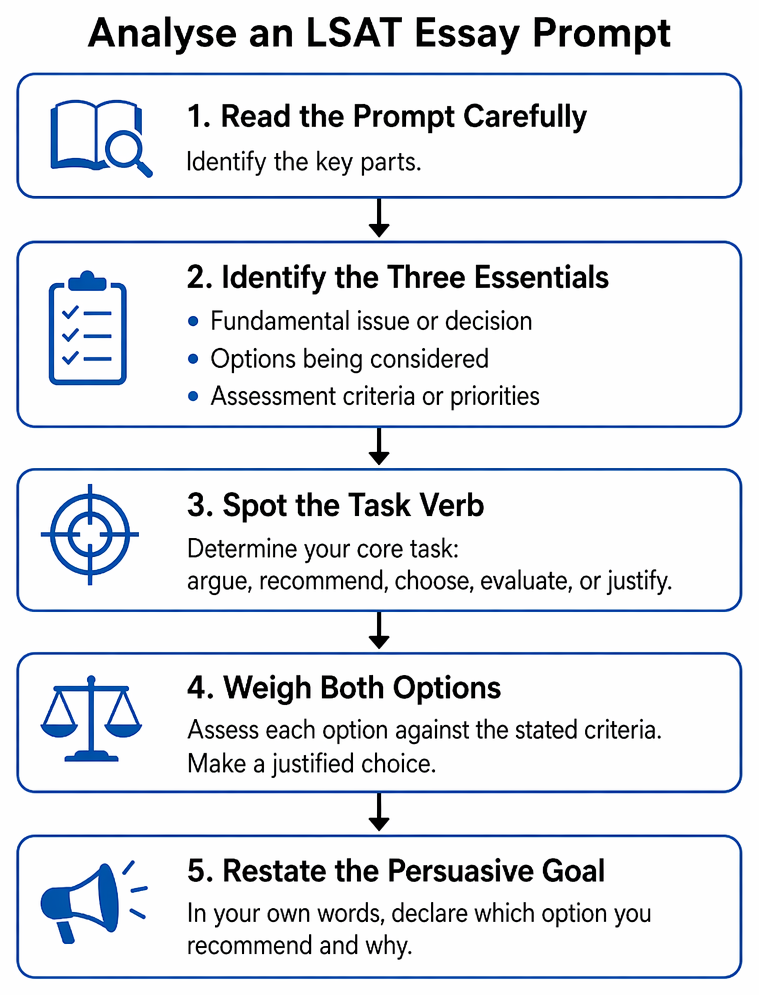
Prompt-driven decision process maps task verbs to position selection, comparative evaluation, counterpoint acknowledgment, priority application, and reasoned conclusion.
- The fundamental issue or decision required
- The two or more options being considered
- The assessment criteria or priorities you must apply
Missing any part of this analysis risks misunderstanding the question, leading to partial or irrelevant answers.
Revision Tip: After reading each prompt, restate in your own words what you believe the examiners want you to persuade the reader to accept.
Spotting Task Verbs and Fulfilling Requirements
Look for words such as “argue,” “recommend,” “choose,” “evaluate,” or “justify.” These verbs define your core task. For example, “Write an argument for recommending one scheme over another, addressing the following considerations.” Here, you must advocate a position, not discuss both sides equally.
Focus also on any listed constraints or evaluation points—often given as “criteria” or “considerations.” These guide what evidence or reasons you should focus on.
Exam Warning: Failing to address all listed criteria, or not clearly stating a position when required, may mean you do not fully meet the exam’s assessed objective.
Addressing Both Sides While Persuading
Where two options are given, it’s not usually enough to list their features. Even if instructed to “consider both viewpoints,” you must make and justify a choice. The examiner expects you to weigh the strengths and weaknesses of both before arguing for your recommended option, supported by evidence based on the stated priorities.
Worked Example 1.2
Prompt: The school board is considering either extending the school day or adding more holiday study programs. Write a persuasive essay recommending one option, considering cost to families and student wellbeing.
Task: Identify your approach.
Answer:
Begin by clearly identifying both options and the assessment criteria. Weigh the impact of each choice on cost and wellbeing, then argue why your recommended option is superior in meeting these—addressing possible objections to your chosen path.
Building Your Argument Structure
Once you know the precise task and persuasive goal, you can structure your essay:
- Introduction: Restate the issue, options, and criteria. Declare your recommendation.
- Body Paragraphs: Assess each option in relation to the criteria, showing why your choice better satisfies them.
- Counterpoint Acknowledgment: Anticipate possible objections or acknowledge an advantage of the alternative, and explain why your recommended choice remains preferable.
- Conclusion: Reiterate your position and sum up the main reasons supporting it.
Avoid generalities or emotional appeals; the focus is on clear reasoning and use of the prompt’s criteria.
Worked Example 1.3
Scenario: The city council must choose to fund new parks or increase library budgets. Prompt asks you to recommend one, using factors: long-term social benefit and budget efficiency.
Task: Correct persuasive structure.
Answer:
Explain both options, then compare their ability to deliver long-term social benefit and efficient use of funds. Make a clear, reasoned recommendation, explicitly addressing both criteria, and briefly note a potential benefit of the rejected option.
Summary
Table 1: LSAT Essay Task Checklist
| Step | What to Do | Why It Matters |
|---|---|---|
| 1 | Read the prompt extremely carefully, noting all required elements | Avoid missing parts of the task |
| 2 | Identify the decision, options, and criteria | Ensures you structure your argument correctly |
| 3 | Determine the persuasive goal (what you must prove or advocate) | Shapes your overall strategy |
| 4 | Make a clear recommendation or argument | Directly meets the assessment objective |
| 5 | Use the prompt’s criteria throughout your reasoning | Demonstrates you have followed instructions |
| 6 | Anticipate and address at least one counterargument | Shows mature, effective persuasion |
Key Point Checklist
This article has covered the following key knowledge points:
- The LSAT essay prompt tells you both the decision and criteria your answer must address
- Accurately identifying both the core task and the persuasive goal is essential
- LSAT essays require choosing a position—even when discussing both options
- The assessment criteria in the prompt must be referenced throughout your answer
- Effective structure aids clarity and meets examiner expectations
Key Terms and Concepts
- essay prompt
- persuasive goal
- task identification