Learning Outcomes
This article explains mistake and misunderstanding as defenses to contract enforceability in MBE-style contract questions, including:
- How mutual mistake, unilateral mistake, and misunderstanding differ, and why each doctrine matters for contract formation, enforceability, and common bar-exam fact patterns.
- When a mistake must concern an existing fact rather than value judgments, future predictions, or mere disappointment with how a deal turns out.
- How courts determine whether a party bears the risk of mistake through contract language, conscious ignorance, or judicial allocation of risk.
- How to distinguish mistake from misrepresentation and from a simple bad bargain, and the different remedies associated with each doctrine.
- How ambiguous terms create misunderstandings when parties attach different reasonable meanings to the same language, and when that prevents contract formation.
- The circumstances in which mistake or misunderstanding renders a contract void, voidable, or enforceable, and which party may invoke the defense.
- Typical remedies for mistake and misunderstanding—rescission, restitution, and reformation—and how the bar exam tends to frame remedy-related issues.
MBE Syllabus
For the MBE, you are required to understand when a contract may be unenforceable due to mistake or misunderstanding, with a focus on the following syllabus points:
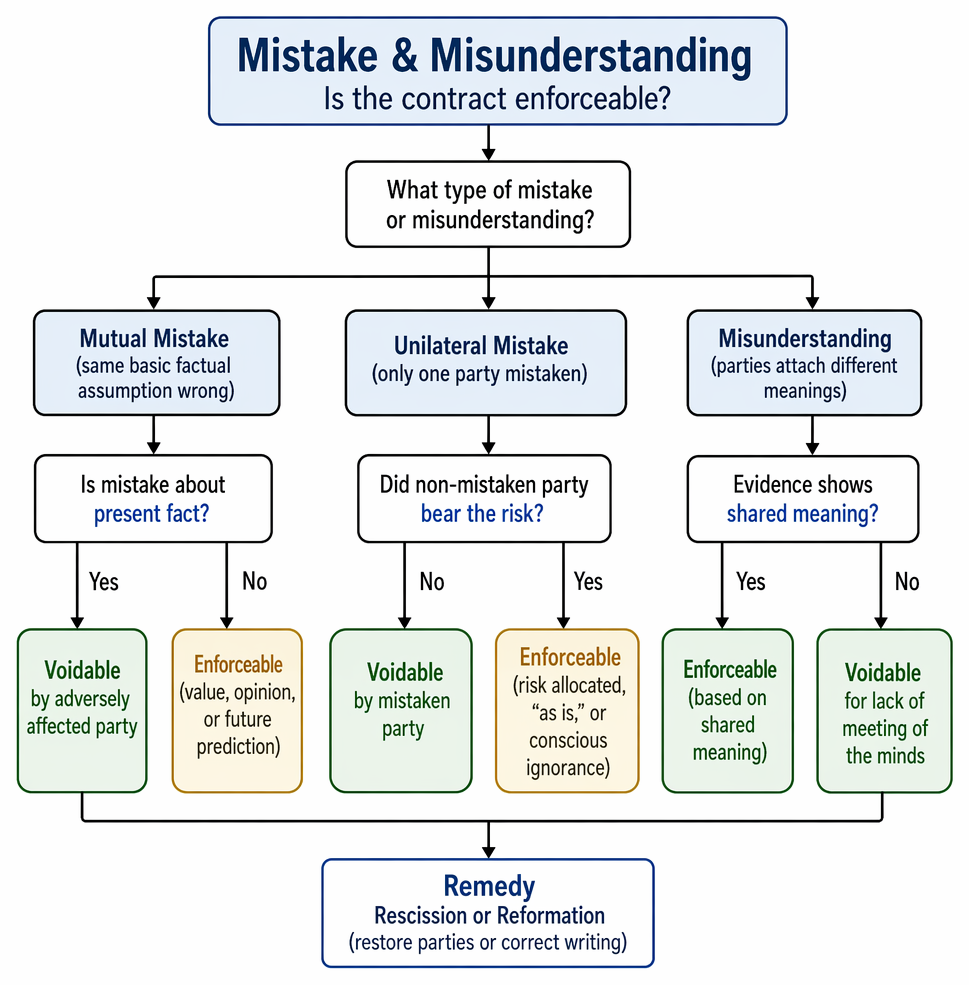
Mutual mistake analysis identifies the conditions for voidability and rescission and preserves enforcement for mistakes limited to value or opinion.
- Recognize the difference between mutual mistake, unilateral mistake, and misunderstanding.
- Identify when a contract is void or voidable due to mistake or misunderstanding.
- Apply the rules for mistake regarding facts versus value or opinion.
- Distinguish mistakes about present facts from incorrect predictions about the future.
- Analyze when a party is treated as bearing the risk of mistake (e.g., “as is” clauses, conscious ignorance).
- Understand when rescission or reformation is the appropriate remedy.
- Analyze the effect of mistake and misunderstanding on enforceability in MBE-style questions.
Test Your Knowledge
Attempt these questions before reading this article. If you find some difficult or cannot remember the answers, look more closely at that area during your revision.
-
Which of the following is most likely to make a contract voidable?
- a) A mutual mistake about a basic fact that is material to the contract.
- b) A unilateral mistake about price, with no knowledge by the other party.
- c) A mutual mistake about the value of the subject matter.
- d) A misunderstanding about a minor contract term.
-
If two parties attach different reasonable meanings to an ambiguous term in a contract, and neither knows of the other's interpretation, what is the result?
- a) The contract is voidable by either party.
- b) The contract is enforceable according to the more reasonable meaning.
- c) There is no contract.
- d) The contract is enforceable according to the drafter's meaning.
-
Which of the following best describes the effect of a unilateral mistake known to the other party?
- a) The mistaken party is always bound.
- b) The contract is automatically void.
- c) The contract may be voidable if the non-mistaken party knew or should have known of the mistake.
- d) The contract is enforceable unless the mistake is about value.
Introduction
Contracts may be unenforceable if a party can show a valid defense. Among the most frequently tested defenses are mistake and misunderstanding. These doctrines address situations where parties are not truly in agreement due to an error about facts or terms. Understanding when mistake or misunderstanding will prevent contract enforcement is essential for MBE success.
At a high level:
- Mistake deals with a wrong belief about an existing fact at the time of contracting.
- Misunderstanding deals with the parties using the same words but reasonably intending different things.
Both are primarily formation defenses: they question whether there was genuine assent. If successful, the usual remedy is rescission (unwinding the contract) and restitution, and occasionally reformation (rewriting the contract) where the written document misstates an agreed deal.
Key Term: Mutual Mistake
A situation where both parties are mistaken about a basic fact that is central to the contract at the time of agreement. Key Term: Unilateral Mistake
A situation where only one party is mistaken about a basic fact, and the other party is not. Key Term: Misunderstanding
A situation where the parties attach different reasonable meanings to an ambiguous term, and neither is aware of the other's interpretation.
A critical MBE point: mistake must concern an existing fact at the time of contract formation, not a prediction or judgment about future events. Being wrong about whether a stock will go up, or whether a business will be profitable, is not the kind of “mistake” that makes a contract voidable.
Types of Mistake
Mistake as a defense falls into two main categories: mutual mistake and unilateral mistake. A related but distinct concept is misunderstanding, where the parties attach different meanings to a contract term.
These doctrines interact with the objective theory of contracts. Ordinarily, the law enforces the reasonable meaning of the parties’ words and conduct, regardless of their hidden mental states. Mistake and misunderstanding are narrow exceptions, used only where that objective approach would be unfair.
Mutual Mistake
A contract is voidable by the adversely affected party if all of the following are true:
- Both parties are mistaken about a basic fact existing at the time of contract formation.
- The mistake goes to a fundamental assumption on which the contract was made.
- The mistake has a material effect on the agreed exchange.
- The adversely affected party did not bear the risk of the mistake.
If these requirements are met, the contract may be rescinded. On the MBE, mutual mistake commonly involves:
- Existence of the subject matter (e.g., the goods had already perished).
- Identity of the subject matter (e.g., thinking the goods are one thing when they are another).
- Other basic qualities (e.g., authenticity).
A mutual mistake about the value or quality of the subject matter is generally not a defense. A bad bargain, standing alone, is not enough.
1. Basic assumption and material effect
The mistaken fact must be something both parties treated as a basic assumption of the transaction (for example, that a cow is fertile, that a painting is authentic, or that the property is zoned for a particular use). The mistake must also have a material effect on the agreed exchange—typically, it must significantly alter the value or the nature of what is being exchanged.
- If the fact is marginal or the impact on the deal is minor, courts will not grant rescission.
2. Allocation of risk
Even if there is a mutual mistake, the adversely affected party cannot avoid the contract if that party is treated as having assumed the risk of the mistake. Risk may be allocated:
- By agreement (e.g., an “as is” clause, or a clause assigning responsibility for certain unknown conditions).
- By conscious ignorance: where a party knows their knowledge is limited but contracts anyway, treating that limited knowledge as sufficient.
- By the court, where it is reasonable to assign the risk to one party under the circumstances.
If a buyer knows there is a real chance a painting may not be genuine and decides to “take a gamble,” mutual mistake will not apply; this is treated as a conscious assumption of risk rather than a mistake.
Worked Example 1.1
Two parties contract for the sale of "100 crates of apples." Seller believes this refers to 100 crates of green apples, while Buyer believes it means 100 crates of red apples. Neither party is aware of the other's interpretation, and both meanings are reasonable in the context.
Answer:
There is no contract. This is a misunderstanding: both parties attached different reasonable meanings to an ambiguous term, and neither knew of the other's interpretation. Because there is no single objectively reasonable meaning that both shared, there was no “meeting of the minds” as to that term.
Worked Example 1.2
A homeowner agrees to sell a painting to a buyer for $5,000. Both believe the painting is an original by a famous artist. After the sale, it is discovered that the painting is a copy worth only $100.
Answer:
The contract is voidable for mutual mistake. Both parties were mistaken about a basic fact (authenticity), which was material to the contract’s value and purpose, and neither appears to have assumed the risk that the painting might be a copy.
Worked Example 1.3
A contractor submits a bid to build a house for $200,000 but makes a calculation error and meant to bid $220,000. The homeowner accepts the bid, knowing that similar bids are much higher and suspecting a mistake.
Answer:
The contract may be voidable for unilateral mistake. The homeowner knew or should have known of the contractor's error because the bid was dramatically out of line with others. Enforcing the contract would unfairly capitalize on the mistake.
Worked Example 1.4
Buyer agrees to purchase a “diamond” ring from Seller for $15,000. Both parties believe the stone is a diamond. Before delivery, an appraisal reveals the stone is actually cubic zirconia worth $200. Neither party knew or suspected this.
Answer:
The contract is voidable for mutual mistake. The identity/quality of the stone (being a diamond rather than cubic zirconia) was a basic assumption of the bargain and has a material effect on the exchange. Unless Buyer assumed the risk (for example, by agreeing to buy “as is” without any representation), Buyer may rescind.
Worked Example 1.5
Owner agrees to sell a parcel of land to Buyer for $100,000. Both parties believe the land is zoned for residential construction. Unknown to both, the zoning had been changed the prior week to prohibit any building. The land’s value as non-buildable property is only $5,000.
Answer:
The contract is voidable for mutual mistake. Both parties’ basic assumption—that the land could be developed—was wrong, and that mistake drastically affects the value of the deal. Unless the contract allocates the zoning risk to Buyer (for example, by making Buyer responsible for checking zoning), Buyer can avoid the contract.
Unilateral Mistake
If only one party is mistaken, the contract is usually enforceable. Courts do not lightly grant relief simply because one party miscalculated or misjudged. However, the mistaken party may avoid the contract if:
- The mistake concerns a basic assumption, has a material effect, and the mistaken party does not bear the risk; and
- Either:
- The non-mistaken party knew or had reason to know of the mistake, or
- The mistake makes enforcement unconscionable.
A unilateral mistake about value or opinion is not a defense. The doctrine is aimed at genuine factual errors, not bad business judgments.
Common MBE patterns for unilateral mistake include:
- Clerical or mathematical errors in bids.
- Mis-typed prices in advertisements or offers.
- One party misreading a quantity term, where the other party should recognize the error.
When the other party knows or should know of the mistake—because the error is obvious or the terms are wildly out of line with market values—the law often treats the situation as unfair exploitation rather than genuine agreement.
Relief can be:
- Rescission, where the mistaken party is allowed to walk away, often with restitution.
- Reformation, particularly where a writing fails to reflect the parties’ actual agreement because of a drafting error.
On the MBE, look closely at:
- How large the discrepancy is (a $10 error will rarely justify rescission; a $100,000 error might).
- Whether the non-mistaken party had reason to suspect a mistake.
- Whether the parties have relied significantly on the erroneous contract.
Misunderstanding (Ambiguous Terms)
If a contract term is ambiguous and each party attaches a different reasonable meaning to it, this is a misunderstanding rather than a mistake about external facts.
The key rules:
- If neither party knows or has reason to know of the other’s different interpretation, and both interpretations are reasonable, there is no contract as to that term. If the term is essential, there is no contract at all.
- If one party knows or has reason to know of the ambiguity and the other does not, the contract is enforced according to the meaning of the uninformed party.
- If both parties know of the ambiguity and realize they are attaching different meanings, there is no contract unless they actually intended the same meaning.
This doctrine reflects the objective approach: the law protects the party who reasonably, but innocently, understood the term one way, and refuses to enforce an agreement when no shared understanding existed.
Worked Example 1.6
Seller contracts to sell “chicken” to Buyer. Seller believes “chicken” means any kind of chicken, including stewing hens; Buyer believes it means only young broilers suitable for roasting. The industry uses “chicken” both ways. Seller knows Buyer is planning to resell to restaurants that serve roast chicken but says nothing.
Answer:
A court is likely to interpret “chicken” according to Buyer’s understanding. Seller had reason to know of Buyer’s meaning (based on Buyer’s stated purpose), while Buyer had no reason to suspect Seller meant something broader. Under misunderstanding principles, where one party knows or should know of the other’s interpretation, the contract is enforced according to the innocent party’s meaning.
Mistake vs. Misunderstanding vs. Bad Bargain
On the MBE, three lines must be kept straight:
- Mutual mistake: both parties are wrong about an external fact (e.g., authenticity, zoning, existence of the subject matter).
- Misunderstanding: the parties use the same words but mean different things (e.g., “apples,” “chicken,” “twelve fifty”).
- Bad bargain: one party is simply unhappy because the deal turned out poorly or the market moved; this is not a legal mistake.
Also distinguish mistake from misrepresentation:
- Mistake: no one has made a false statement; both parties are innocently wrong.
- Misrepresentation/fraud: one party has made a false statement of material fact, and the other has justifiably relied on it. That is a separate defense, often leading to rescission and possibly damages.
Exam Warning: On the MBE, a mistake about value or quality (e.g., paying too much or too little) is not a defense. Only a mistake about a basic fact, not opinion or value, may make a contract voidable. If a “value” question appears, ask whether there is really a basic factual mistake (like authenticity or zoning) that explains the change in value. If not, it is almost certainly just a bad bargain.
Additional exam pointers:
- An incorrect prediction about the future (e.g., “I thought the stock price would rise”) is not a mistake of existing fact.
- A party who knows they are ignorant on a point but proceeds anyway is usually treated as assuming the risk—mutual mistake will not apply.
- Only the adversely affected party may invoke mistake; the other party cannot use mistake to force rescission when the error actually benefits them.
Revision Tip: If you see an ambiguous term in a contract, always ask whether both parties reasonably interpreted it differently. If so, and neither knew of the other's meaning, there is no contract. If one side knew, the contract is construed against the party who knew of the other’s interpretation.
Also, whenever you see a party claiming “I made a mistake,” quickly classify:
- Mutual vs unilateral?
- Fact vs value/opinion/future prediction?
- Who bore the risk?
- Did the other party know or have reason to know of the error?
Answering those questions will usually lead you to the correct outcome.
Key Point Checklist
This article has covered the following key knowledge points:
- Mistake requires a belief that is not in accord with an existing fact at the time of contract formation.
- Mutual mistake allows rescission if both parties are mistaken about a basic, material fact, and the adversely affected party did not bear the risk.
- Conscious ignorance or contractual allocation of risk will defeat a mutual mistake defense.
- Unilateral mistake is usually not a defense unless enforcing the contract would be unconscionable or the other party knew or should have known of the mistake.
- A mistake about value, quality, or future events is generally not enough; look for a basic factual assumption (like authenticity) to bring it within the doctrine.
- Misunderstanding of an ambiguous term may prevent contract formation if both parties attach different reasonable meanings and neither is aware of the other's meaning.
- If one party knows or has reason to know of the other’s interpretation of an ambiguous term, the contract is enforced according to the innocent party’s meaning.
- Remedies for mistake typically include rescission and restitution, and sometimes reformation where a writing fails to capture the parties’ actual agreement.
- Only the adversely affected party may invoke mistake or misunderstanding as a defense.
Key Terms and Concepts
- Mutual Mistake
- Unilateral Mistake
- Misunderstanding