Learning Outcomes
This article explains the Statute of Frauds as a defense to contract enforceability on the MBE, including:
- Distinguishing contracts that fall within the Statute of Frauds from those that do not, using the classic M R SOUR categories and common exam mnemonics.
- Identifying and evaluating the requirements for a sufficient writing and signature under both common law and UCC Article 2, including electronic records and signatures.
- Comparing how the Statute of Frauds operates in land, one-year, suretyship, marriage, and goods contracts, and spotting mixed or borderline fact patterns.
- Applying the major common law and UCC exceptions—such as part performance, full performance, specially manufactured goods, merchant’s confirmatory memo, payment or delivery, judicial admission, and promissory estoppel—to determine when an otherwise unenforceable agreement can still be enforced.
- Analyzing the consequences of noncompliance with the Statute of Frauds for contract and restitutionary remedies, and differentiating between unenforceable and void agreements.
- Assessing when contract modifications, rescissions, or actions taken by agents must independently satisfy the Statute of Frauds, with particular attention to the equal dignities rule and exam-style modification questions.
- Developing a structured approach to Statute of Frauds questions that allows rapid issue spotting, rule selection, and application under timed MBE conditions.
MBE Syllabus
For the MBE, you are required to understand when the Statute of Frauds prevents enforcement of a contract and how a party may raise this defense, with a focus on the following syllabus points:
- Recognize which types of contracts are subject to the Statute of Frauds.
- Distinguish common law Statute of Frauds from the UCC Statute of Frauds.
- Identify the requirements for a writing and signature (including electronic records and signatures).
- Apply the main exceptions to the Statute of Frauds (e.g., part performance, full performance, specially manufactured goods, judicial admission, merchant’s confirmatory memo, promissory estoppel).
- Analyze the effect of noncompliance with the Statute of Frauds on contract enforceability and restitutionary remedies.
- Determine when contract modifications or rescissions must satisfy the Statute of Frauds.
- Recognize agency and “equal dignities” issues related to Statute of Frauds compliance.
Test Your Knowledge
Attempt these questions before reading this article. If you find some difficult or cannot remember the answers, look more closely at that area during your revision.
-
Which of the following contracts must generally be in writing to be enforceable?
- a) A contract for the sale of $300 worth of goods.
- b) A contract to lease an apartment for 10 months.
- c) A contract to sell land.
- d) A contract to provide consulting services for 11 months.
-
Under the Statute of Frauds, which element is NOT required for a writing to be sufficient?
- a) Identification of the parties.
- b) The price term (for all contracts).
- c) The subject matter.
- d) The signature of the party to be charged.
-
Which of the following is an exception that may allow enforcement of an oral contract for the sale of goods over $500?
- a) The buyer has paid part of the price and accepted part of the goods.
- b) The contract is for the sale of land.
- c) The contract is for services lasting 18 months.
- d) The contract is between merchants for $400 worth of goods.
-
If a contract is within the Statute of Frauds and is not evidenced by a sufficient writing, what is the usual result?
- a) The contract is void.
- b) The contract is unenforceable by either party.
- c) The contract is enforceable if the parties intended to be bound.
- d) The contract is enforceable only by the party who did not sign.
Introduction
The Statute of Frauds is a classic MBE topic and a common enforcement defense. It does not determine whether a contract was formed; rather, it tells you whether an otherwise valid contract can be enforced in court. On exam day, always work through the same sequence:
- Does this agreement fall within the Statute of Frauds?
- If so, is there a sufficient writing signed by the party to be charged?
- If not, does an exception make the contract enforceable anyway?
Key Term: Statute of Frauds
A legal rule requiring certain types of contracts to be evidenced by a writing signed by the party against whom enforcement is sought. If the rule is not satisfied and no exception applies, the contract is generally unenforceable in an action for breach.
Because the Statute of Frauds is an affirmative defense, it must be raised by the party resisting enforcement. If that party fails to plead it, the defense is waived, and the court may enforce the contract despite the lack of a writing.
The policy behind the Statute is evidentiary: to reduce the risk of fraud and perjury in proving certain important contracts, not to protect parties from “bad deals.”
Test Tip: When revising Statute of frauds, connect each definition, method, or rule to the kind of question the assessment is likely to ask.
Contracts Within the Statute of Frauds
Not all agreements must be in writing. The Statute of Frauds applies only to specific categories of contracts. A common mnemonic is M R SOUR:
- Marriage – contracts made in consideration of marriage.
- Real property – contracts for the sale of an interest in land.
- Suretyship – a promise to answer for the debt of another.
- One year – contracts that cannot, by their terms, be performed within one year.
- UCC – contracts for the sale of goods for $500 or more.
- R (sometimes) – certain promises by an executor or administrator to pay estate debts from personal funds (less frequently tested on the MBE).
The main types tested on the MBE are:
- Contracts for the sale of land or interests in land (including leases over one year).
- Contracts that cannot, by their terms, be performed within one year from the date of making.
- Contracts to answer for the debt or duty of another (suretyship).
- Contracts made in consideration of marriage (other than mutual promises to marry).
- Contracts for the sale of goods for $500 or more (UCC Article 2).
Land contracts
Land contracts within the Statute include:
- Contracts to sell land or any interest in land (e.g., easements, mineral rights).
- Leases of real property for more than one year (a one-year lease starting today is outside the Statute in many jurisdictions).
A contract to build a house on land is a services contract, not a contract for the sale of an interest in land, so it is outside this land category (though it may still fall under the one-year rule).
One-year rule
Key Term: One-Year Rule
A contract that, by its terms, cannot possibly be performed within one year from the date it is made must be in writing to be enforceable.
The test is possibility, not likelihood. Ask: is there any way performance could be completed within one year, consistent with the contract terms?
- A contract “for two years” of employment cannot be fully performed within one year → within the Statute.
- A contract “for life” is not within the Statute, because the person might die within a year.
- An indefinite-duration contract (“for as long as you perform satisfactorily”) is outside the one-year provision, because it could end within a year.
Suretyship
Key Term: Suretyship
A promise to pay the debt or perform the obligation of another person if that person fails to do so.
This category covers secondary promises—a promisor who says, “If she does not pay, I will.” The original debtor remains primarily liable; the surety backs that obligation.
Key Term: Main-Purpose Exception
If the surety’s main purpose in making the promise is to serve their own economic interest, the promise is treated as primarily for the surety’s own benefit and is taken out of the Statute of Frauds; no writing is required.
For example, if a bar owner promises a beer supplier, “Ship more beer to my tenant bar; if the tenant does not pay, I will,” so that the owner’s own bar will keep attracting customers, the main-purpose exception likely applies.
Marriage
Contracts “in consideration of marriage” are within the Statute. This includes prenuptial agreements and promises like “If you marry my daughter, I’ll transfer you my farm.” Mutual promises merely to marry, without additional property or economic exchanges, are not within this provision.
UCC Statute of Frauds—goods $500 or more
Key Term: UCC Statute of Frauds
Under UCC § 2‑201, a contract for the sale of goods for a price of $500 or more must be evidenced by a signed writing indicating a contract for sale and specifying a quantity, with several important exceptions.
Goods are tangible, movable items. The $500 threshold is measured by the contract price, not the market value at breach. A contract for $499 worth of goods is outside the Statute; a contract for exactly $500 is within it.
Remember also: if a contract modification raises the price to $500 or more, the contract as modified must satisfy the UCC Statute of Frauds.
Worked Example 1.1
A homeowner orally agrees to sell her house to a buyer. The buyer pays a deposit and moves in, but the homeowner refuses to transfer title. Is the oral agreement enforceable?
Answer:
The contract is for the sale of land, so it falls within the Statute of Frauds. However, the buyer has taken possession and paid part of the price. Under the part performance exception for land contracts (discussed below), taking possession plus either payment or improvements can allow specific performance despite the lack of a writing. The oral agreement may therefore be enforceable in equity.
Worked Example 1.2
On January 1, an employer orally hires a manager “for three years,” starting immediately. On January 2, the employer fires the manager without cause, and the manager sues.
Answer:
A three-year contract cannot possibly be fully performed within one year of its making, so it is within the one-year provision of the Statute of Frauds and must be in writing. There is no sufficient writing and no full-performance exception (the manager only worked one day), so the contract is unenforceable for breach. The manager may still recover the value of one day of work in restitution.
Worked Example 1.3
A wholesaler sells beer on credit to Tenant, who runs a bar in Landlord’s building. Landlord tells the wholesaler, “If Tenant can’t pay, I’ll cover the bill.” Tenant later defaults, and the wholesaler sues Landlord on Landlord’s oral promise.
Answer:
This is a suretyship promise—Landlord promises to pay Tenant’s debt if Tenant does not. Normally, that promise must be in writing. However, if Landlord’s main purpose was to keep the bar stocked so that Landlord’s own building would retain customers and value, the main‑purpose exception takes the promise out of the Statute. The oral promise may be enforceable.
Writing and Signature Requirements
If a contract is within the Statute of Frauds, it must be evidenced by a writing signed by the party to be charged (the party against whom enforcement is sought), unless an exception applies.
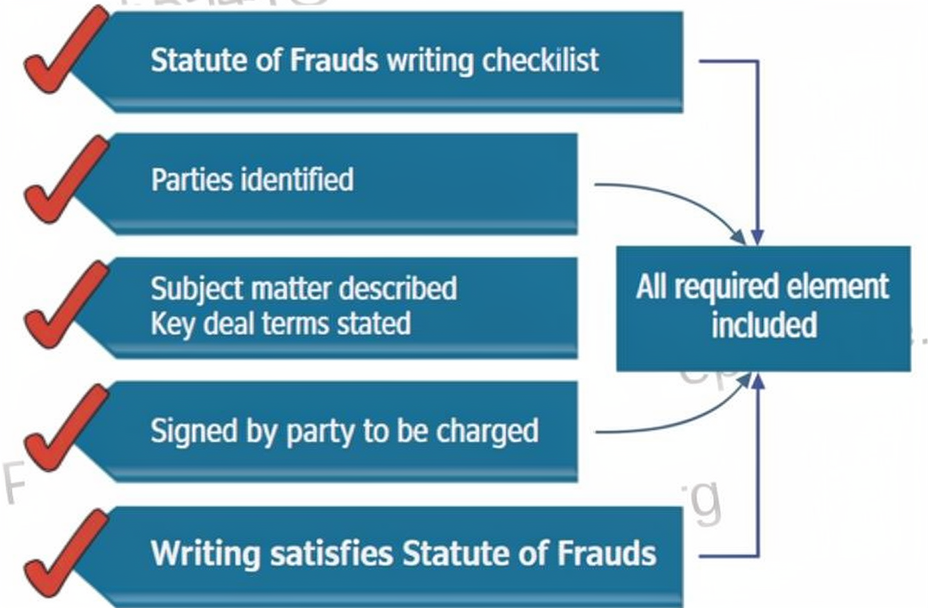
Statute of Frauds compliance requires a signed writing, including related documents or email, identifying the parties and stating material terms.
At common law, the writing must:
- Identify the parties.
- Reasonably describe the subject matter.
- Indicate that a contract has been made.
- State the essential terms (e.g., price and property description in a land sale).
Under the UCC, for contracts for goods of $500 or more, the writing must:
- Indicate that a contract for sale has been made.
- Be signed by the party to be charged.
- State a quantity (the only essential term; other terms can be omitted or misstated without invalidating the memorandum, though they may affect what can be enforced).
The writing does not need to be a formal contract. It can be a note, letter, email, text message, or even multiple documents that clearly relate to the same transaction and can be read together.
Key Term: Sufficient Writing
Any written memorandum, signed by the party to be charged, that reasonably identifies the subject matter and the essential terms of the contract (and, under the UCC, states a quantity) is sufficient to satisfy the Statute of Frauds. Key Term: Electronic Signature
Any electronic sound, symbol, or process attached to or logically associated with a record and adopted by a person with the intent to sign (e.g., typed name in an email, a scanned signature). Electronic signatures satisfy Statute of Frauds “signature” requirements.
Merchant’s confirmatory memo
Under UCC § 2‑201(2):
Key Term: Merchant’s Confirmatory Memo
Between merchants, a signed writing confirming an oral contract and sent within a reasonable time satisfies the Statute of Frauds against the recipient if the recipient has reason to know its contents and does not object in writing within 10 days.
This special rule allows a merchant to enforce an oral contract for goods of $500 or more against another merchant even though the recipient did not sign anything, so long as the confirming memo was not objected to.
Key Term: Merchant
A person who deals in goods of the kind or otherwise holds himself out as having knowledge or skill peculiar to the practices or goods involved in the transaction.
Worked Example 1.4
A merchant sends a signed email to a buyer stating: “Confirming our agreement: 1,000 widgets at $10 each, delivery next month.” The buyer receives the email and does not respond. The buyer later refuses to take delivery. Can the seller enforce the contract?
Answer:
Yes. The email is a signed writing indicating a contract and stating a quantity (1,000 widgets), so it satisfies the UCC Statute of Frauds as to the seller. Because the buyer did not sign, the contract is not automatically enforceable against the buyer under the normal rule. However, if both parties are merchants, the email also operates as a merchant’s confirmatory memo. The buyer’s failure to object within 10 days makes the writing enforceable against the buyer as well.
Worked Example 1.5
A manufacturer orally agrees to buy “all the steel you can supply me this year” from a supplier for $200,000. The supplier sends the manufacturer an unsigned note on letterhead saying, “Glad we could do business—looking forward to supplying you this year.” The note mentions no quantity. The supplier later claims the Statute of Frauds as a defense.
Answer:
This is a UCC goods contract for more than $500, so the Statute applies. A writing must state a quantity. “All you can supply” can be interpreted as output, but the note does not specify any quantity and there is no other quantity term. An unsigned note also does not show the manufacturer’s signature. The writing therefore does not satisfy the UCC Statute of Frauds as to either party. Unless an exception applies (e.g., part performance), the supplier can successfully assert the Statute of Frauds defense.
Exceptions to the Statute of Frauds
Even if a contract is within the Statute of Frauds and lacks a sufficient signed writing, several exceptions may allow enforcement. It helps to separate common law exceptions from UCC exceptions.
Common law exceptions
Part performance (land contracts)
Key Term: Part Performance Exception
An exception allowing enforcement of an oral contract for the sale of land if the buyer has taken steps that strongly indicate a contract, typically any two of: (1) payment of all or part of the price, (2) taking possession, (3) making substantial improvements.
Most jurisdictions require at least two of these three (“PIP”: Payment, Improvements, Possession). The remedy is usually specific performance of the land sale in equity; the exception does not automatically allow money damages.
Full performance (one-year contracts)
Key Term: Full Performance Exception
For contracts that, by their terms, cannot be performed within one year, full performance by either party takes the contract out of the Statute of Frauds; the performing party can enforce the other party’s promise even without a writing.
Partial performance of a long-term services contract does not satisfy the Statute (though restitution may be available), but full performance does.
Promissory estoppel
Key Term: Promissory Estoppel (SOF Context)
A doctrine that may allow enforcement of an oral promise within the Statute of Frauds when the promisee reasonably and foreseeably relied on the promise to their detriment, and injustice can be avoided only by enforcement.
Courts are cautious but may use promissory estoppel, for example, when an employee relies on an oral multi‑year employment contract to relocate, resign another job, or incur substantial expenses.
UCC exceptions
Specially manufactured goods
Key Term: Specially Manufactured Goods Exception
Under the UCC, an oral contract for goods made specially for the buyer is enforceable if the seller has made a substantial start or made commitments for their procurement, and the goods are not suitable for sale to others in the ordinary course of business.
Once the seller has substantially begun manufacturing or has committed to purchase non‑returnable inputs, the Statute of Frauds cannot be used to avoid the contract.
Part performance — payment or delivery
Under UCC § 2‑201(3)(c), an oral contract for goods is enforceable:
- To the extent goods have been received and accepted by the buyer, or
- To the extent the price has been paid and accepted by the seller.
The contract is only enforceable up to the quantity of goods actually accepted or paid for.
Judicial admission
Key Term: Judicial Admission
A statement by the party to be charged, made in pleadings, testimony, or in court, admitting that a contract was made. Under the UCC, such an admission makes the contract enforceable up to the quantity admitted.
Merchant’s confirmatory memo (revisited)
As discussed above, a merchant’s signed confirmation that is not objected to within 10 days satisfies the Statute against the recipient merchant even though the recipient never signed.
Worked Example 1.6
A buyer orally orders 1,000 custom-printed T‑shirts with her logo from a manufacturer for $6,000. The shirts are not suitable for sale to others. The manufacturer purchases fabric and prints 400 shirts before the buyer cancels. The manufacturer sues for breach.
Answer:
This is a UCC contract for goods over $500, so the Statute applies. There is no writing, but the goods are specially manufactured and the seller has made a substantial start (purchasing fabric and printing 400 shirts). The specially manufactured goods exception applies. The oral contract is enforceable despite the lack of a writing, and the manufacturer can recover expectation damages.
Worked Example 1.7
A buyer orally agrees to buy 100 kegs of beer from a brewer for $7,500. The brewer delivers 25 kegs, which the buyer receives and stores. The buyer then refuses to accept or pay for the remaining 75 kegs, asserting the Statute of Frauds.
Answer:
This is a UCC goods contract over $500, with no sufficient writing. However, the buyer has received and accepted 25 kegs. Under the part performance rule, the contract is enforceable to the extent of the goods accepted—25 kegs—but the Statute of Frauds bars enforcement as to the remaining 75 kegs. The buyer must pay for 25 kegs but is not contractually obligated to take the rest.
Worked Example 1.8
Two merchants orally agree that Seller will supply 500 laptops to Buyer at $600 each. The next day Seller sends Buyer a signed letter: “Confirming our oral agreement of yesterday: 500 laptops at $600 each, delivery in 30 days.” Buyer receives the letter and remains silent. Sixty days later Buyer refuses to accept the laptops, claiming the Statute of Frauds.
Answer:
The letter is a signed writing indicating a contract and specifying a quantity (500 laptops). Between merchants, this is a merchant’s confirmatory memo. Because Buyer did not object in writing within 10 days, the memo satisfies the UCC Statute of Frauds against Buyer. Buyer cannot successfully assert the Statute of Frauds as a defense.Exam Warning: The Statute of Frauds is a defense to enforcement, not to contract formation. If a contract is within the Statute and lacks a sufficient writing, it is unenforceable by either party unless an exception applies. However:
- If both parties fully perform, the defense is effectively waived.
- If the party to be charged admits the contract in court, the admission can itself satisfy the Statute (under the UCC).
- The Statute must be affirmatively pleaded as a defense; otherwise it is waived.
Effect of Noncompliance
If a contract within the Statute of Frauds is not evidenced by a sufficient writing and no exception applies, the contract is unenforceable by either party in an action on the contract. It is not void; the court simply will not award contractual damages for breach.
Key Term: Unenforceable Contract
A contract that, although formed, cannot be enforced in court due to failure to comply with the Statute of Frauds or other legal requirements.
Even when the contract is unenforceable, a party who has conferred a benefit may still recover in restitution (quantum meruit). For example:
- A builder who partially performs under an oral three‑year construction contract may recover the reasonable value of labor and materials supplied, even though they cannot sue for expectation damages on the contract itself.
- A buyer who pays money on an unenforceable land contract can often recover the payment to avoid unjust enrichment if specific performance is unavailable.
The Statute limits contract remedies but does not bar all claims arising out of the transaction.
Modifications, Rescission, and the Statute of Frauds
If a contract as modified falls within the Statute of Frauds, the modification must also satisfy the Statute. Conversely, if the contract as modified would be outside the Statute, the modification need not be in writing, even if the original contract was in writing.
- Common law: oral modifications are generally permitted even if the original contract says “no oral modifications,” but they still must satisfy the Statute of Frauds if the modified contract falls within it.
- UCC: parties may agree that modifications must be in a signed writing, and such “no‑oral‑modification” clauses are generally enforceable (especially in contracts between merchants).
Key Term: Equal Dignities Rule
If the primary contract must be in writing under the Statute of Frauds, the agent’s authority to enter into that contract on the principal’s behalf must also be in writing.
Thus, an agent cannot orally bind a principal to a land sale contract that must itself be in writing, unless the agent has written authority.
Rescission
An agreement to rescind (cancel) a contract is treated differently from a modification:
- Oral rescission of a contract that satisfied the Statute of Frauds is generally valid, because rescission extinguishes duties rather than creating new ones.
- Exception: if the rescission itself involves the transfer of an interest in land or some other matter that independently falls within the Statute, a writing may be required.
Worked Example 1.9
Mickey contracts in writing to buy five kegs of beer from Pabst for $500. Later, Mickey and Pabst orally agree to modify the deal to three kegs for $300. Mickey then refuses to pay for the three kegs, claiming the oral modification is unenforceable under the Statute of Frauds.
Answer:
The original contract ($500) is within the UCC Statute of Frauds and is properly in writing. The modification reduces the quantity and price so that the contract as modified is for $300—outside the Statute. Because a contract for $300 worth of goods does not need to be in writing, the oral modification is effective even though the original contract was in writing.
Worked Example 1.10
Same original facts as Example 1.9, but Mickey and Pabst orally agree to modify the contract to 10 kegs for $1,000. Mickey disputes the modification.
Answer:
The contract as modified is for $1,000 of goods, so the modification itself falls within the UCC Statute of Frauds. An oral modification is not enforceable unless an exception applies (e.g., part performance). Absent such an exception, the contract remains at the original five kegs for $500.
Summary
The Statute of Frauds is a powerful enforcement defense on the MBE. Work systematically:
- Identify whether the contract falls into one of the Statute categories (land, one-year, suretyship, marriage, goods $500+).
- Determine whether there is a sufficient signed writing, applying the proper rules (common law vs UCC) and recognizing that electronic writings and signatures count.
- If there is no sufficient writing, carefully test each exception: part performance, full performance, specially manufactured goods, payment/delivery, judicial admission, merchant’s confirmatory memo, and promissory estoppel.
- Remember that failure to comply with the Statute makes a contract unenforceable, not void, and that restitution may still be available.
- Always consider the contract as modified, and watch for agency authority (equal dignities rule) and the effect of oral rescission.
Key Point Checklist
This article has covered the following key knowledge points:
- The Statute of Frauds requires certain contracts to be evidenced by a writing signed by the party to be charged to be enforceable.
- Main categories: land contracts, contracts not performable within one year, suretyship, marriage consideration, and goods over $500.
- The one-year rule focuses on possibility of performance within one year, not probability.
- Suretyship promises are generally within the Statute, but the main‑purpose exception can remove them.
- A sufficient writing must identify the parties, subject matter, and essential terms and be signed; under the UCC, quantity is the essential term.
- Electronic records and signatures can satisfy Statute of Frauds writing and signature requirements.
- The UCC includes a special rule for merchant’s confirmatory memos.
- Key exceptions: part performance (land), full performance (one-year contracts), specially manufactured goods, judicial admission, merchant’s confirmatory memo, and payment or delivery under the UCC.
- Promissory estoppel can, in some circumstances, override a Statute of Frauds defense.
- The Statute of Frauds is an enforcement defense; noncompliance makes contracts unenforceable, not void, but restitution and equitable remedies may still be available.
- Modifications must satisfy the Statute if the contract as modified is within it; oral rescission is generally effective.
- Under the equal dignities rule, an agent’s authority must be in writing when the contract to be made is subject to the Statute of Frauds.
Key Terms and Concepts
- Statute of Frauds
- Suretyship
- Main-Purpose Exception
- One-Year Rule
- UCC Statute of Frauds
- Sufficient Writing
- Electronic Signature
- Merchant’s Confirmatory Memo
- Merchant
- Equal Dignities Rule
- Part Performance Exception
- Full Performance Exception
- Judicial Admission
- Specially Manufactured Goods Exception
- Promissory Estoppel (SOF Context)
- Unenforceable Contract