Learning Outcomes
This article explains premeditation and deliberation in homicide, including:
- How to precisely define premeditation and deliberation, distinguish them from mere intent to kill and malice aforethought, and recognize those distinctions in statute language and fact patterns.
- How premeditation and deliberation operate as elements of first-degree murder in common law–style degree jurisdictions, and how they separate first-degree murder from second-degree murder and voluntary manslaughter.
- How examiners test "instantaneous" versus extended pre-planning, including how much time is legally sufficient for premeditation and what facts show a cool, reflective decision rather than an impulsive killing.
- How prosecutors prove premeditation and deliberation through direct and circumstantial evidence, using planning activity, motive, and manner of killing, and how to evaluate the strength of that evidence on multiple‑choice questions.
- How heat of passion, adequate provocation, cooling time, intoxication, and mental disturbance interact with premeditation and deliberation, and when they negate or undermine first-degree liability.
- How felony murder fits into a first-degree murder framework, when proof of premeditation and deliberation is unnecessary, and how to spot statute-based upgrades to first-degree.
- How to approach MBE-style homicide questions systematically—identifying the mental state, classifying the degree of homicide, eliminating trap answers, and selecting between first-degree murder, second-degree murder, and voluntary manslaughter.
MBE Syllabus
For the MBE, you are required to understand homicide classifications and mental states, with a focus on the following syllabus points:
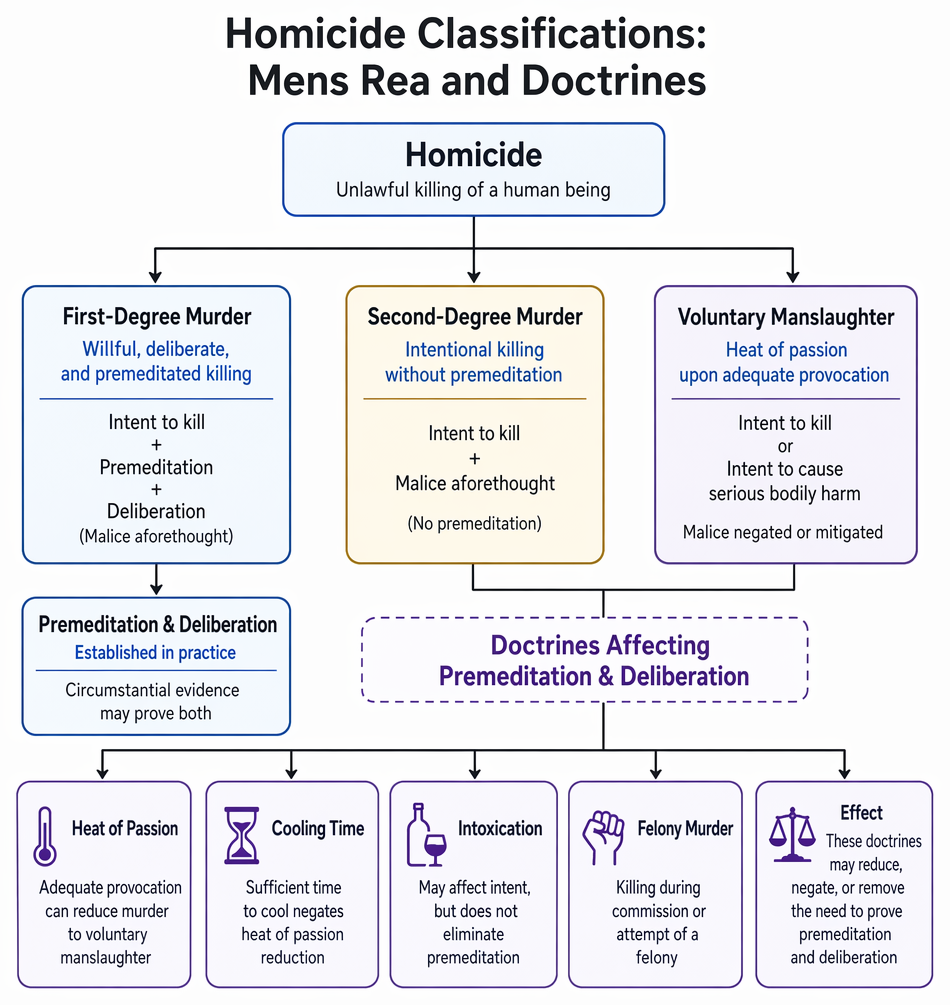
Premeditation and deliberation function as first-degree murder elements, with proof commonly inferred from planning activity, motive, and manner of killing.
- The distinction between intent to kill, premeditation, deliberation, and malice aforethought.
- The requirements for first-degree murder under typical statutes (willful, deliberate, and premeditated killing).
- The difference between first-degree and second-degree murder, and how voluntary manslaughter fits into the framework.
- How premeditation and deliberation are established in practice, including reliance on circumstantial evidence.
- How doctrines such as heat of passion, adequate provocation, cooling time, intoxication, and felony murder affect the need to prove premeditation and deliberation.
Test Your Knowledge
Attempt these questions before reading this article. If you find some difficult or cannot remember the answers, look more closely at that area during your revision.
-
Which of the following best describes "premeditation" in the context of first-degree murder?
- a) The intent to cause serious bodily harm.
- b) A conscious decision to kill, formed before the act.
- c) Killing in the heat of passion.
- d) Reckless disregard for human life.
-
To prove first-degree murder, the prosecution must generally show:
- a) Only that the defendant intended to kill.
- b) That the killing was accidental but foreseeable.
- c) That the defendant acted with premeditation and deliberation.
- d) That the defendant acted negligently.
-
Which scenario most likely lacks "deliberation" for first-degree murder?
- a) Defendant calmly plans and executes a killing.
- b) Defendant kills after careful reflection.
- c) Defendant kills in a sudden rage after provocation.
- d) Defendant waits for the victim to arrive before killing.
-
A defendant, enraged by an insult, storms out, retrieves a gun from home, returns five minutes later, and immediately shoots the victim. The jurisdiction follows common law degrees of murder. Which is the best classification?
- a) First-degree murder, because there was time for reflection.
- b) Second-degree murder, because the intent formed in anger.
- c) Voluntary manslaughter, because any killing in anger is manslaughter.
- d) Involuntary manslaughter, because the defendant did not intend to kill.
-
Which of the following is most helpful circumstantial evidence of premeditation and deliberation?
- a) The defendant was extremely intoxicated at the time of the killing.
- b) The defendant previously threatened to kill the victim and waited in ambush.
- c) The defendant had no prior relationship with the victim.
- d) The killing occurred during a sudden fistfight in a crowded bar.
Introduction
Premeditation and deliberation are essential elements that distinguish first-degree murder from other forms of homicide. On the MBE, the most frequently tested distinction is between a killing that is intentional but impulsive (usually second-degree murder or voluntary manslaughter) and a killing that is intentional and the product of reflection (first-degree murder).
Most traditional statutes define first-degree murder as a "willful, deliberate, and premeditated killing." Each word matters. A killing can be intentional ("willful") yet still fall short of first-degree murder if it is not also deliberate and premeditated.
Key Term: Intent to Kill
A conscious objective or purpose to cause the death of another human being. Key Term: Malice Aforethought
The common law mental state for murder, satisfied by an intent to kill, intent to cause serious bodily injury, extreme recklessness (depraved heart), or intent to commit a felony that results in death.
The Role of Premeditation and Deliberation
First-degree murder typically requires proof that the defendant not only intended to kill but also acted with premeditation and deliberation. These elements raise a homicide from second-degree murder or manslaughter to the most serious form of criminal homicide.
Key Term: Premeditation
Premeditation is the process of thinking about and planning a killing before carrying it out, even if only for a short time. Key Term: Deliberation
Deliberation means the defendant made a considered, cool decision to kill, reflecting on the choice and weighing the consequences rather than acting in a sudden, uncontrolled passion. Key Term: First-Degree Murder
The most serious form of homicide in degree jurisdictions, requiring a willful, deliberate, and premeditated killing (or falling under an enumerated first-degree category, such as certain felony murders).
Many statutes also treat certain killings—such as those committed by poison, by lying in wait, or during specified felonies—as first-degree murder even if premeditation and deliberation are not separately proved. On the MBE, unless the statute in the question says otherwise, assume that an "intentional, willful, deliberate, and premeditated" killing is what distinguishes first-degree from second-degree murder.
Distinguishing Premeditation and Deliberation from Intent
Intent to kill is present in both first- and second-degree murder. What sets first-degree murder apart is that the defendant formed the intent to kill after some period of reflection (premeditation) and made a conscious, rational decision (deliberation), rather than acting impulsively.
Key Term: Second-Degree Murder
An intentional killing that lacks premeditation and deliberation, or a killing with malice based on serious-bodily-injury intent, depraved heart, or non–first-degree felony murder.
Three common exam distinctions:
- Intent without reflection: A defendant who suddenly decides to kill and immediately acts, with no time to think it over, typically commits second-degree murder.
- Reflection without coolness: A defendant acting under an overwhelming passion or extreme emotional disturbance may have technically had time to form intent, but lacks the calm, reflective state needed for deliberation. That often leads to second-degree murder or voluntary manslaughter, depending on provocation.
- Intent plus reflection in a cool state: When the defendant has time and the mental capacity to consider the decision to kill and proceeds anyway, first-degree murder is appropriate.
Key Term: Heat of Passion
An intense emotional state—such as rage, terror, or jealousy—that may reduce an intentional killing from murder to voluntary manslaughter if it is caused by adequate provocation and the defendant acts before cooling off. Key Term: Adequate Provocation
Conduct that would cause a reasonable person to lose self-control, such as serious assault or discovering a spouse in the act of adultery, depending on jurisdiction.
Time: How Much Is Needed for Premeditation
A recurring MBE issue is the amount of time required to premeditate. The law does not require days or hours of planning. Many courts explain that premeditation can occur in a very short period—sometimes described as occurring in a "moment" or even in the time it takes for a thought to cross the mind.
For exam purposes:
- There must be some opportunity for reflection, even if brief.
- The critical question is whether the defendant actually reflected, not how long the reflection lasted.
- If the defendant forms the intent to kill and immediately acts in a way that appears impulsive and emotionally driven, premeditation is usually lacking.
Typical indicators of sufficient time for reflection:
- Leaving the scene to obtain a weapon and returning.
- Waiting for the victim at a particular location.
- Engaging in conduct that shows preparation (such as disabling security cameras or luring the victim to an isolated area).
Cool Reflection: The Essence of Deliberation
Deliberation requires a cool mind capable of reflection. Even if the defendant thought about killing, there is no deliberation if the defendant was overwhelmed by intense passion that would cause a reasonable person to lose self-control.
Deliberation is usually negated when:
- The defendant acts in the heat of passion based on adequate provocation, and there has not been sufficient cooling time.
- The defendant is so impaired (e.g., by extreme voluntary intoxication or mental disturbance) that calm, rational weighing of choices is unrealistic.
However, the bar exam often expects that mere anger or resentment does not automatically negate deliberation. The key is whether the defendant had the capacity for calm reflection, even if angry.
Proof of Premeditation and Deliberation
Premeditation and deliberation can be shown by direct or circumstantial evidence. The prosecution does not need to prove a lengthy planning period; even a brief moment of reflection can suffice if the defendant had time to think and chose to kill.
Key Term: Direct Evidence
Evidence that, if believed, directly proves a fact, such as a confession or an eyewitness account of the defendant stating, "I am going to kill you." Key Term: Circumstantial Evidence
Evidence that requires inferences to connect it to the fact in issue, such as prior threats, procurement of a weapon, or the manner of killing.
Common circumstantial evidence includes:
-
Planning activity before the killing
- Obtaining or loading a weapon in anticipation of the encounter.
- Luring the victim to a particular location.
- Lying in wait for the victim.
-
Motive to kill
- Financial gain (e.g., life insurance).
- Jealousy, revenge, or prior serious conflict.
- Gang or criminal organization disputes.
-
Manner of killing suggesting a preconceived plan
- Execution-style shooting (e.g., shot to the back of the head at close range).
- Use of poison or a deadly trap.
- Multiple wounds focused on vulnerable areas.
The MBE often describes these facts without explicitly labeling them as "planning activity" or "manner of killing"; it is your job to infer that such details support premeditation and deliberation.
Key Term: Felony Murder
A killing proximately caused during the commission or attempted commission of a felony, where malice is supplied by the felony and premeditation is usually not separately required.
Remember: in many jurisdictions, felony murder is classified as first-degree murder by statute. In those cases, the prosecution does not need to prove premeditation and deliberation; the participation in the qualifying felony supplies the necessary mental state. The MBE question stem will usually make this clear.
Distinguishing First- and Second-Degree Murder
Second-degree murder generally requires intent to kill but lacks premeditation and deliberation. Killings that occur impulsively, in the heat of passion, or without prior reflection are usually classified as second-degree murder.
Key Term: Depraved Heart Murder
A killing resulting from extreme recklessness that shows an abandoned and malignant heart, such as firing into a crowded room without caring who might be hit. Key Term: Voluntary Manslaughter
An intentional killing that would be murder but is reduced because the defendant acted in the heat of passion due to adequate provocation and before cooling off, or under some recognized partial excuse (such as imperfect self-defense in some jurisdictions).
When evaluating a fact pattern:
- If the defendant intended to kill and the evidence shows planning plus calm reflection, think first-degree murder.
- If the defendant intended to kill but acted spontaneously, or the evidence suggests only an impulsive response to a situation, think second-degree murder.
- If the defendant intended to kill and acted under adequate provocation before cooling off, think voluntary manslaughter, not first-degree murder.
- If the defendant did not intend to kill but acted with extreme recklessness, think depraved heart murder (usually second-degree).
Interaction with Heat of Passion and Cooling Time
A common bar exam trap is the interplay between premeditation/deliberation and heat of passion.
Key Term: Cooling Time
The period between the provocation and the killing, during which a reasonable person would have calmed down and regained self-control.
Key points:
- If the defendant kills immediately after adequate provocation, the killing may be voluntary manslaughter, not first- or second-degree murder.
- If a significant cooling period passes, the law treats the defendant as having regained the capacity for deliberation. A later intentional killing may then be first-degree murder, because the defendant had time to reflect and chose to proceed.
- The MBE often signals cooling time with facts such as:
- The defendant leaving the scene and returning later.
- Hours or days passing between the provocative event and the killing.
- The defendant resuming normal activities before acting.
Thus, when adequate provocation is followed by a meaningful delay, the presence of planning or calm behavior may transform what might otherwise be manslaughter into premeditated, deliberate first-degree murder.
Intoxication and Deliberation
Voluntary intoxication is sometimes tested in connection with first-degree murder:
- First-degree murder based on a willful, deliberate, and premeditated killing is often treated as a specific intent crime, meaning voluntary intoxication might, in theory, negate the mental state needed for deliberation.
- However, on the MBE, merely being drunk does not automatically negate premeditation and deliberation. The question must suggest that the defendant was so intoxicated that calm reflection was impossible.
- If intoxication prevents the formation of a deliberate, premeditated intent to kill, the crime may be reduced to second-degree murder or manslaughter, depending on the remaining mental state.
Proof of Premeditation and Deliberation (Expanded)
Premeditation and deliberation can be shown by direct or circumstantial evidence. The prosecution does not need to prove a lengthy planning period; even a brief moment of reflection can suffice if the defendant had time to think and chose to kill.
Common evidence includes:
- Planning activity before the killing.
- Motive to kill.
- Manner of killing suggesting a preconceived plan (e.g., lying in wait, use of poison).
On the MBE, pay close attention to sequence:
- Did the defendant retrieve a weapon, return, and then kill? That sequence is strong evidence of premeditation and deliberation.
- Did the defendant pick up a weapon that happened to be nearby during an argument and immediately strike? That sequence often suggests a lack of deliberation.
Worked Example 1.1
A defendant waits outside the victim's home with a loaded gun. When the victim arrives, the defendant shoots and kills her. The prosecution argues the defendant acted with premeditation and deliberation.
Answer:
The facts support premeditation and deliberation. The defendant waited for the victim, indicating planning, and had time to reflect before acting. The waiting behavior is classic "lying in wait," which many statutes treat as evidence of premeditated and deliberate killing. This is likely first-degree murder.
Worked Example 1.2
During a heated argument, a defendant grabs a nearby object and strikes the victim, killing him instantly. The defendant had no prior plan to kill.
Answer:
This scenario likely lacks deliberation. The killing was impulsive, in the midst of a heated argument, without time for reflection. Although the defendant intended to strike (and perhaps to kill), there is no indication of cool, calculated decision-making. This would typically be second-degree murder, not first-degree, unless adequate provocation is present and the jurisdiction would classify it as voluntary manslaughter.
Worked Example 1.3
A spouse discovers their partner in bed with another person. In a rage, the spouse storms out, drives home, retrieves a gun, returns to the scene 20 minutes later, and calmly shoots the partner.
Answer:
Initially, the spouse experiences classic provocation that could support voluntary manslaughter. However, the 20-minute period, driving away, and then returning with a gun strongly suggest cooling time and renewed decision-making. By the time of the killing, the spouse has engaged in planning (retrieving the weapon, returning) and acts calmly. The provocation defense is significantly weakened, and the facts now support a finding of premeditation and deliberation. First-degree murder is the best classification.
Worked Example 1.4
A defendant, after drinking heavily, says to a friend, "I should kill my boss for firing me," laughs, and later that night sees the boss on the street. In a drunken impulse, the defendant suddenly pulls out a knife and stabs the boss repeatedly, killing him. There is no evidence of prior planning beyond the earlier comment.
Answer:
The earlier statement shows anger and perhaps a general desire for revenge but does not clearly show a formed plan. At the moment of the killing, the defendant acts impulsively. The heavy drinking may undermine the idea of cool, rational reflection. On these facts, there is strong evidence of an intentional killing (at least second-degree murder), but weak evidence of premeditation and deliberation. Unless more facts support planning or calm reflection, this is best treated as second-degree murder.
Worked Example 1.5
A defendant commits an armed robbery at a convenience store. During the robbery, the clerk reaches for the phone, and the defendant immediately shoots and kills the clerk. The jurisdiction classifies any killing in the course of a robbery as first-degree felony murder.
Answer:
Here, the killing clearly occurs during the commission of a robbery, a qualifying felony for felony murder in many jurisdictions. Under the statute described, the killing is first-degree murder without the need to prove premeditation and deliberation. The classification is based on felony murder, not on a willful, deliberate, and premeditated killing.Exam Warning: On the MBE, do not assume that intent alone is enough for first-degree murder. Look for facts showing the defendant had time to reflect and made a conscious decision to kill. Be wary of distractors that treat any intentional killing as automatically premeditated.
Additional pitfalls:
- Heat-of-passion disguise: A question may describe a very emotional scene. If adequate provocation and lack of cooling time are present, voluntary manslaughter is likely, not first-degree murder.
- Short but sufficient time: A brief pause, such as stepping back, aiming, and then firing, can be enough for premeditation if the defendant has a moment to choose whether to proceed.
- Overreliance on motive: Motive alone (e.g., life insurance) does not prove premeditation without some evidence that the defendant actually decided to kill.
- Ignoring statutes: If the question provides a specific statute for that jurisdiction, follow it—even if it departs from pure common law categories.
Revision Tip: If the facts mention planning, waiting, or a calm, rational decision to kill, consider premeditation and deliberation. If the killing is sudden or provoked, first-degree murder is unlikely unless enough time passes for cooling and renewed reflection.
Key Point Checklist
This article has covered the following key knowledge points:
- First-degree murder in degree jurisdictions requires a willful, deliberate, and premeditated killing, unless a statute independently classifies the killing as first-degree (such as felony murder).
- Premeditation is planning or reflection before the act, even if brief, and focuses on whether the defendant thought about killing ahead of time.
- Deliberation is a rational, cool decision to kill, requiring a mind capable of weighing options rather than acting in an uncontrollable passion.
- Intent to kill alone can support second-degree murder; premeditation and deliberation are what raise an intentional killing to first-degree.
- Evidence of planning activity, motive, and the manner of killing are standard circumstantial indicators of premeditation and deliberation.
- Heat of passion, adequate provocation, and lack of cooling time can reduce an intentional killing from murder to voluntary manslaughter and are usually inconsistent with deliberation.
- Voluntary intoxication may, in rare cases, undermine deliberation, but mere drinking is not enough; the question must show inability to engage in calm reflection.
- Felony murder can be first-degree murder by statute without proof of premeditation and deliberation, because the predicate felony supplies the malice.
- Sudden, impulsive killings, particularly during arguments or fights, typically lack deliberation and are not first-degree murder.
- Exam questions often test the distinction between intent and premeditation, as well as the interaction between premeditation, heat of passion, and cooling time.
Key Terms and Concepts
- Intent to Kill
- Malice Aforethought
- Premeditation
- Deliberation
- First-Degree Murder
- Second-Degree Murder
- Heat of Passion
- Adequate Provocation
- Cooling Time
- Felony Murder
- Depraved Heart Murder
- Voluntary Manslaughter
- Direct Evidence
- Circumstantial Evidence