Learning Outcomes
This article explains misdemeanor manslaughter, including:
- The core definition, structure, and policy justifications of the misdemeanor-manslaughter (unlawful-act) rule as a specific form of involuntary manslaughter tested on the MBE.
- How an unintentional killing that occurs during the commission or attempted commission of a misdemeanor or other non-felonious unlawful act can satisfy the elements of involuntary manslaughter, even without proof of malice or extreme recklessness.
- How to distinguish misdemeanor manslaughter from felony murder, depraved-heart murder, and purely negligence-based involuntary manslaughter, and how examiners use the nature of the predicate offense to steer you toward the correct theory.
- How causation, foreseeability, and intervening acts limit liability for unlawful-act killings, including when a death is considered a natural and probable consequence versus wholly unforeseeable and therefore outside the rule.
- The different treatment of malum in se and malum prohibitum offenses as predicates, with emphasis on dangerous or violent misdemeanors, regulatory violations aimed at preventing physical harm, and trivial technical breaches unlikely to support homicide liability.
- Common MBE and essay traps, such as assuming every death during a misdemeanor qualifies, overlooking defenses to the predicate offense, misclassifying non-BARRK felonies, and failing to recognize when fact patterns support both criminal negligence and unlawful-act manslaughter theories.
MBE Syllabus
For the MBE, you are required to understand how homicide liability can arise from the commission of a misdemeanor or other non-felonious unlawful act, with a focus on the following syllabus points:
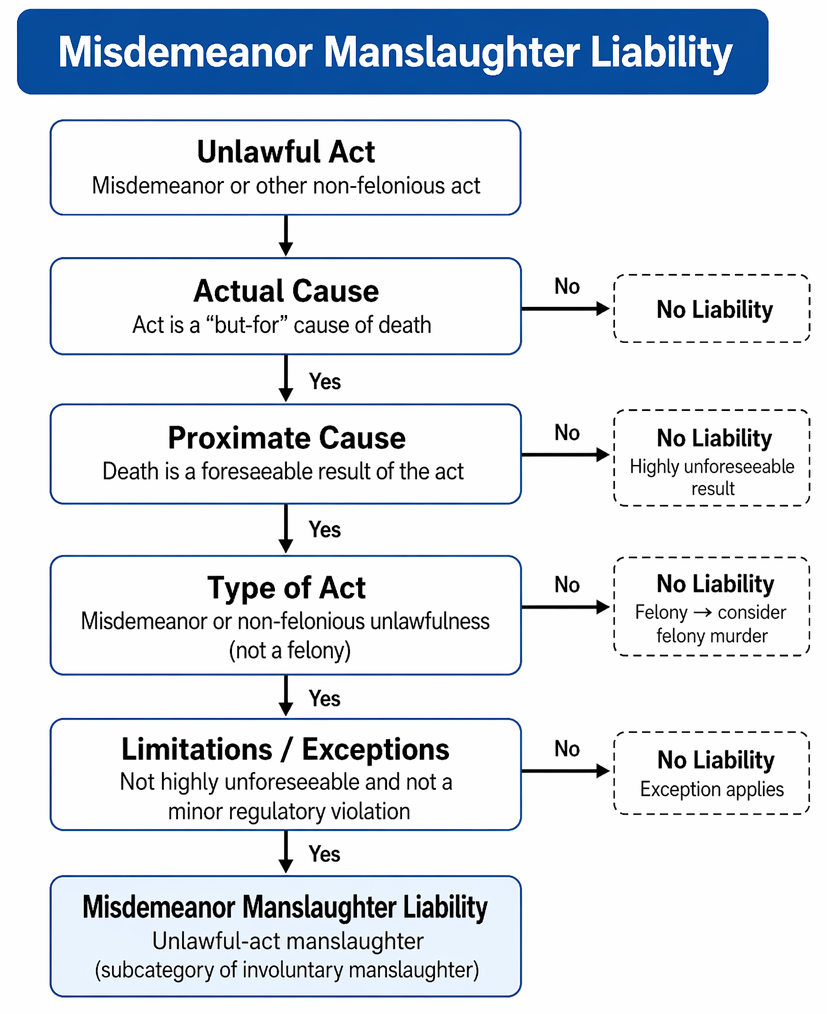
Death occurring during a felony, misdemeanor, or other non-felonious act is classified by predicate offense and foreseeable causation.
- The definition and scope of the misdemeanor-manslaughter rule.
- The distinction between felony murder and misdemeanor manslaughter.
- The relationship between misdemeanor manslaughter and involuntary manslaughter generally.
- The requirements for actual and proximate causation, including foreseeability.
- The types of misdemeanors and non-felonious unlawful acts that can trigger liability.
- The limitations and exceptions to the rule, including highly unforeseeable results and minor regulatory violations.
- How unlawful-act manslaughter fits into the broader law of homicide on the MBE.
Test Your Knowledge
Attempt these questions before reading this article. If you find some difficult or cannot remember the answers, look more closely at that area during your revision.
-
Which of the following best describes the misdemeanor-manslaughter rule?
- a) Any death caused during the commission of a felony is murder.
- b) Any death caused during the commission of a misdemeanor or non-felonious unlawful act can be involuntary manslaughter if causation and foreseeability are satisfied.
- c) Any death caused by criminal negligence is voluntary manslaughter.
- d) Any death caused during a misdemeanor is always murder.
-
A defendant commits a non-dangerous misdemeanor, and during the act, a bystander dies in an unforeseeable way. Is the defendant guilty of involuntary manslaughter under the misdemeanor-manslaughter rule?
- a) Yes, always.
- b) No, because the death was not a natural and probable consequence of the misdemeanor.
- c) Yes, if the misdemeanor was malum prohibitum.
- d) No, because only felonies can ever support homicide liability.
-
The misdemeanor-manslaughter rule generally does NOT apply if:
- a) The misdemeanor is malum in se.
- b) The death is a foreseeable result of the misdemeanor.
- c) The death is caused by a dangerous misdemeanor.
- d) The death is wholly unforeseeable and accidental.
Introduction
Misdemeanor manslaughter is a classic common law doctrine that appears on the MBE as a specific form of involuntary manslaughter.
Key Term: Involuntary Manslaughter
An unlawful killing of a human being without malice that results from either (1) criminal or gross negligence, or (2) the commission or attempted commission of a misdemeanor or other non-felonious unlawful act (the misdemeanor-manslaughter or unlawful-act theory).
Involuntary manslaughter is different from murder because it does not require malice. The defendant need not intend to kill or even to cause serious injury. Many outlines capture this by noting that there is effectively “no intent” requirement for manslaughter: the key is an unlawful killing based on negligence or an unlawful act.
One way involuntary manslaughter can arise is through criminal negligence.
Key Term: Criminal Negligence
A gross deviation from the standard of care, involving disregard of a substantial risk of serious bodily injury or death, sufficient to support criminal liability.
The other classic route, and the focus here, is the misdemeanor-manslaughter rule (also called unlawful-act manslaughter).
Key Term: Misdemeanor-Manslaughter Rule
The rule that an unintentional killing committed during the commission or attempted commission of a misdemeanor or other non-felonious unlawful act can constitute involuntary manslaughter if the unlawful act proximately causes a reasonably foreseeable death. Key Term: Unlawful-Act Manslaughter
A form of involuntary manslaughter where liability is based on causing a death in the course of any unlawful act that is not a felony-murder predicate, typically a misdemeanor or similarly minor offense.
Although the MBE focuses far more heavily on felony murder and negligence-based homicide, you must be able to recognize when a seemingly minor misdemeanor can supply the basis for manslaughter liability.
Place of Misdemeanor Manslaughter in the Homicide Structure
On the MBE, the basic hierarchy for an unintentional killing is:
- Felony murder (if a qualifying felony is involved).
- Depraved-heart/reckless-disregard murder (extreme recklessness).
- Involuntary manslaughter:
- Criminal negligence, or
- Misdemeanor/unlawful-act manslaughter.
If no malice can be established and no felony-murder rule applies, but the defendant was engaged in a misdemeanor or other unlawful act when a death occurred, misdemeanor manslaughter should be on your radar.
The Misdemeanor-Manslaughter Rule
The misdemeanor-manslaughter rule holds that if a person causes the death of another during the commission or attempted commission of a misdemeanor (or certain non-felonious unlawful acts), they may be guilty of involuntary manslaughter, even if the death was unintentional and even if the defendant did not act with criminal negligence toward the risk of death.
The critical requirements are:
- A predicate unlawful act that is not a qualifying felony for felony murder.
- A causal connection between that unlawful act and the death.
- A reasonably foreseeable risk of the type of harm that occurred.
This doctrine is a counterpart to felony murder:
Key Term: Felony Murder
A doctrine that elevates a killing to murder when a death is caused during the commission or attempted commission of a qualifying felony, typically an inherently dangerous felony such as the BARRK felonies. Key Term: BARRK Felonies
The traditional set of felonies—burglary, arson, robbery, rape, and kidnapping—that are considered inherently dangerous and commonly support felony-murder liability.
Where felony murder deals with deaths during dangerous felonies (often BARRK), misdemeanor manslaughter applies to deaths during lesser offenses.
Elements and Scope
To apply the misdemeanor-manslaughter rule, the following must be established:
- The defendant was committing or attempting to commit a misdemeanor or other non-felonious unlawful act.
- The unlawful act caused the death of another person.
- The death was a natural and probable consequence of the unlawful act (i.e., reasonably foreseeable).
The predicate act need not be a technical “misdemeanor” in the modern statutory sense. On exams, the following commonly qualify:
- Traditional misdemeanors (e.g., simple battery, minor theft, non-aggravated assault).
- Non-BARRK or non-enumerated felonies, where the exam is treating them under an “unlawful-act manslaughter” theory rather than felony murder.
- Regulatory offenses or violations, especially in traffic or public safety, when they create a foreseeable risk of death.
Malum in Se vs. Malum Prohibitum
MBE questions often signal whether a misdemeanor is inherently wrongful or merely regulatory.
Key Term: Malum in Se
An offense that is inherently wrong or evil, such as assault, battery, or theft, generally recognized as wrongful even without a statute. Key Term: Malum Prohibitum
An offense that is wrong only because it is prohibited by statute or regulation, such as failing to register a vehicle or driving without a license.
Most jurisdictions are more willing to impose misdemeanor-manslaughter liability when:
- The misdemeanor is malum in se, especially when it is violent or involves a risk of physical harm (e.g., assault, battery, reckless driving), or
- The misdemeanor is committed in a dangerous way.
When the misdemeanor is malum prohibitum, courts typically require a clear showing that:
- The statute aims to protect against the type of harm that occurred, and
- The death was a reasonably foreseeable result of violating that statute.
For a purely technical or low-risk regulatory violation, with a death that appears completely remote and surprising, misdemeanor-manslaughter liability is unlikely.
Causation and Foreseeability
Causation is critical. The defendant’s unlawful act must be both the actual cause and the proximate cause of the victim’s death.
Key Term: Actual Cause
Also called “cause-in-fact”: the death would not have occurred when it did but for the defendant’s conduct. Key Term: Proximate Cause
A legal limitation on liability that asks whether the death was a natural and probable consequence of the defendant’s conduct, without highly extraordinary or unforeseeable intervening events breaking the causal chain. Key Term: Foreseeability (in Misdemeanor Manslaughter)
The requirement that the death be a natural and probable consequence of the defendant’s unlawful act; the general type of harm must be reasonably foreseeable, even if the precise manner or extent of the harm is not.
Apply these carefully on the MBE:
- The defendant must set in motion a chain of events that leads to death.
- Intervening acts (e.g., grossly negligent medical care, bizarre third-party conduct) may or may not break the chain.
- The “eggshell skull” principle still applies: if bodily injury is foreseeable, the defendant takes the victim as found, even if the victim’s particular vulnerability makes death more likely than expected.
If the death is highly unusual or unforeseeable in relation to the misdemeanor, the misdemeanor-manslaughter rule does not apply, even though the death followed the unlawful act in time.
Distinguishing from Felony Murder
Misdemeanor manslaughter must be distinguished from felony murder, especially where the exam fact pattern includes a “felony” that is not one of the classic BARRK felonies.
Felony murder:
- Requires a qualifying felony (usually inherently dangerous).
- Produces murder liability (commonly second-degree or first-degree, depending on the jurisdiction).
- Does not require intent to kill; the malice of the felony is “transferred” to the killing.
Misdemeanor manslaughter:
- Involves a misdemeanor or non-felonious unlawful act (and, in some outlines, felonies that do not qualify for felony murder).
- Produces involuntary manslaughter liability, not murder.
- Also does not require intent to kill; the unlawful act substitutes for the mens rea.
A further point:
- For felony murder, the predicate felony must be independent of the killing. If the only “felony” is essentially the assault that caused death, many jurisdictions refuse to apply felony murder and instead analyze the case as depraved-heart murder or manslaughter.
- Some exam sources label deaths caused by non-BARRK felonies (or felonies not qualifying for felony murder) as “misdemeanor manslaughter” or “unlawful-act manslaughter.” On the MBE, if the felony is clearly not within the felony-murder category, look for involuntary manslaughter as the correct answer.
Relationship to Criminal Negligence
Involuntary manslaughter can arise either from:
- Gross or criminal negligence, or
- Misdemeanor/unlawful-act manslaughter.
On some facts:
- The defendant’s conduct both violates a statute (a misdemeanor) and is grossly negligent.
- Either theory could support a conviction for involuntary manslaughter.
When both seem plausible, the MBE answer choices usually list involuntary manslaughter (without specifying a theory) rather than forcing you to choose between “negligence manslaughter” and “misdemeanor manslaughter.” Focus on whether the killing is unintentional and whether at least one recognized basis (gross negligence or unlawful-act) is satisfied.
Worked Example 1.1
A defendant is driving without a valid license (a misdemeanor). While driving, he negligently strikes and kills a pedestrian. Is the defendant guilty of involuntary manslaughter under the misdemeanor-manslaughter rule?
Answer:
The defendant can be guilty of involuntary manslaughter, but the precise theory depends on jurisdiction. Some courts treat this as misdemeanor manslaughter if they are willing to apply the rule to malum prohibitum traffic offenses and the death is a foreseeable result of unlawful driving. Others emphasize the defendant’s negligent driving and ground liability in criminal negligence instead. On the MBE, if the death is a foreseeable result of the unlawful driving, involuntary manslaughter is an appropriate answer.
Worked Example 1.2
A shopkeeper commits the misdemeanor of selling alcohol to a minor. The minor later dies from alcohol poisoning after consuming the alcohol. Is the shopkeeper guilty of involuntary manslaughter?
Answer:
Possibly. Selling alcohol to a minor is often treated as a malum prohibitum offense, but it is designed to prevent harms that include serious injury or death to minors. If it was reasonably foreseeable that selling alcohol to a minor could lead to dangerous overconsumption and death, and there are no unusual intervening events, a conviction for involuntary manslaughter under the misdemeanor-manslaughter rule is plausible. If the death resulted from a highly unexpected chain of events (e.g., the minor’s drink is secretly poisoned by a third party), causation and foreseeability might fail.
Worked Example 1.3
During an argument, D commits a misdemeanor battery by pushing V in the chest. V, who has a fragile skull unknown to D, falls backward, hits his head on the pavement, and dies. Can D be convicted under the misdemeanor-manslaughter rule?
Answer:
Yes. Simple battery is a classic malum in se misdemeanor that carries a foreseeable risk of bodily injury. Once some bodily injury is foreseeable, the “eggshell skull” rule applies: D takes V as found. The fact that V’s unusual fragility made death more likely does not break causation. The unintentional killing during the battery supports a conviction for involuntary manslaughter via misdemeanor manslaughter.
Worked Example 1.4
A landlord fails to obtain a required city certificate to rent out an apartment, a malum prohibitum regulatory misdemeanor. Unknown to the landlord, a tenant’s guest is sleeping on the balcony and is killed when a freak lightning bolt strikes the building. Does the misdemeanor-manslaughter rule apply?
Answer:
No. While the landlord committed a regulatory misdemeanor, the death is wholly unforeseeable and not a natural and probable consequence of failing to obtain a certificate. There is no proximate cause. This is the type of “wholly unforeseeable and accidental” death that falls outside misdemeanor manslaughter.
Worked Example 1.5
D is committing the misdemeanor of reckless driving by excessively speeding in a residential area. A child suddenly darts into the street, and D’s car strikes and kills the child. Is D guilty of involuntary manslaughter?
Answer:
Almost certainly yes. Reckless driving is at least a dangerous misdemeanor and may independently constitute criminal negligence. A traffic fatality is a foreseeable result of such conduct. The unintentional killing during the dangerous misdemeanor supports liability for involuntary manslaughter, on either a misdemeanor-manslaughter theory, a criminal-negligence theory, or both.
Common Exam Pitfalls
Several recurring traps appear in MBE questions on this topic:
-
Assuming every death during a misdemeanor triggers manslaughter. The rule is not automatic. Causation and foreseeability are always required.
-
Ignoring the nature of the misdemeanor. Courts (and examiners) distinguish between:
- Dangerous or violent misdemeanors (more likely to support liability), and
- Technical, low-risk regulatory violations (less likely unless the harm is clearly what the regulation targets).
-
Confusing felony murder with misdemeanor manslaughter. If the predicate crime is a BARRK felony or another clearly enumerated felony, think felony murder, not misdemeanor manslaughter. If it is a lesser offense or non-BARRK felony, involuntary manslaughter is more likely.
-
Overlooking defenses to the predicate misdemeanor. If the defendant has a valid defense (e.g., self-defense to an assault charge), there may be no predicate unlawful act to support the rule. You must then ask whether criminal negligence or another homicide theory applies.
-
Missing the time frame. The killing must occur during the commission or attempted commission of the misdemeanor or in immediate flight. If the misdemeanor is fully complete and only later, through an unrelated act, a death occurs, the rule may not apply.
Exam-Focused Strategy
When analyzing an MBE homicide question involving a misdemeanor or minor unlawful act:
-
Identify the predicate offense and classify it:
- Is it a BARRK felony? If so, think felony murder.
- Is it another felony? Check whether the question treats it as a felony-murder predicate; otherwise, consider unlawful-act manslaughter.
- Is it a misdemeanor or regulatory violation? Think misdemeanor manslaughter, subject to causation and foreseeability.
-
Ask whether there is malice:
- Intent to kill,
- Intent to inflict serious bodily injury,
- Extreme recklessness (depraved heart), or
- Felony murder.
- If none apply, you are in manslaughter territory.
-
Evaluate causation:
- Is the unlawful act the “but-for” cause?
- Is the death a natural and probable consequence of that act?
-
Consider whether criminal negligence is present:
- Many pattern facts are strong enough for both gross negligence and misdemeanor manslaughter. If “involuntary manslaughter” is a choice, it is often correct regardless of the precise sub-theory.
Exam Warning: The misdemeanor-manslaughter rule does not convert every accidental death during a misdemeanor into manslaughter. If the death is wholly unforeseeable or results from a remote, extraordinary chain of events, most courts will not impose liability. Likewise, a trivial or technical regulatory violation, without any real risk of physical harm, rarely supports misdemeanor-manslaughter liability for a subsequent death.
Revision Tip: When you see an unintentional killing on the MBE, quickly triage: (1) Is there a qualifying felony?—think felony murder. (2) Is there clear malice?—think murder. (3) If not, ask whether the defendant’s conduct is grossly negligent or whether the defendant was committing a misdemeanor or non-felonious unlawful act that foreseeably produced the death. Always classify the predicate offense as malum in se or malum prohibitum and then evaluate foreseeability.
Key Point Checklist
This article has covered the following key knowledge points:
- Involuntary manslaughter can arise from criminal negligence or from the misdemeanor-manslaughter (unlawful-act) rule.
- The misdemeanor-manslaughter rule imposes involuntary manslaughter liability for deaths caused during misdemeanors or non-felonious unlawful acts, provided causation and foreseeability are satisfied.
- Most jurisdictions are more willing to apply the rule when the predicate offense is malum in se or inherently dangerous; malum prohibitum offenses typically require a clear, foreseeable connection to the death.
- Causation requires both actual and proximate cause; the death must be a natural and probable consequence of the unlawful act, not a highly unusual or unforeseeable result.
- The rule is distinct from felony murder, which applies to deaths during qualifying felonies and results in murder, not manslaughter.
- On the MBE, many fact patterns support involuntary manslaughter under either a criminal-negligence theory or a misdemeanor-manslaughter theory; the key is recognizing that an unintentional, reasonably foreseeable killing during an unlawful act fits within involuntary manslaughter.
- Defenses to the predicate misdemeanor, or a complete lack of foreseeability, can negate misdemeanor-manslaughter liability even when a death occurs.
Key Terms and Concepts
- Misdemeanor-Manslaughter Rule
- Unlawful-Act Manslaughter
- Involuntary Manslaughter
- Criminal Negligence
- Malum in Se
- Malum Prohibitum
- Felony Murder
- BARRK Felonies
- Actual Cause
- Proximate Cause
- Foreseeability (in Misdemeanor Manslaughter)