Learning Outcomes
This article explains parties to crime and accomplice liability for MBE purposes, including:
- How common‑law categories of principals and accessories compare with modern statutory treatment, and how exam questions signal which framework controls.
- The conduct that can make a person an accomplice—aid, counsel, encouragement, or omission with a duty—and the required dual intent to assist and to bring about the substantive offense.
- The scope of accomplice liability for the target crime and for additional offenses that are natural and probable consequences of the intended crime, and when unforeseeable acts break the chain.
- The distinction between accomplices and accessories after the fact, and the separate obstruction‑type liability that applies once the underlying felony is complete.
- Key defenses and limitations on accomplice liability, including effective withdrawal, lack of shared purpose, feigned accomplice situations, and impossibility issues.
- How protected‑class and necessary‑party doctrines prevent imposing liability on individuals the statute is designed to safeguard or deliberately exempts.
- The interaction of accomplice rules with inchoate crimes—attempt, conspiracy, and solicitation—and how overlapping liability is treated on the MBE.
- Typical MBE multiple‑choice patterns testing these doctrines, including traps involving mere presence, mere knowledge, and overbroad use of the natural‑and‑probable‑consequences doctrine.
MBE Syllabus
For the MBE, you are required to understand criminal liability for participation in crimes and inchoate offenses, with a focus on the following syllabus points:
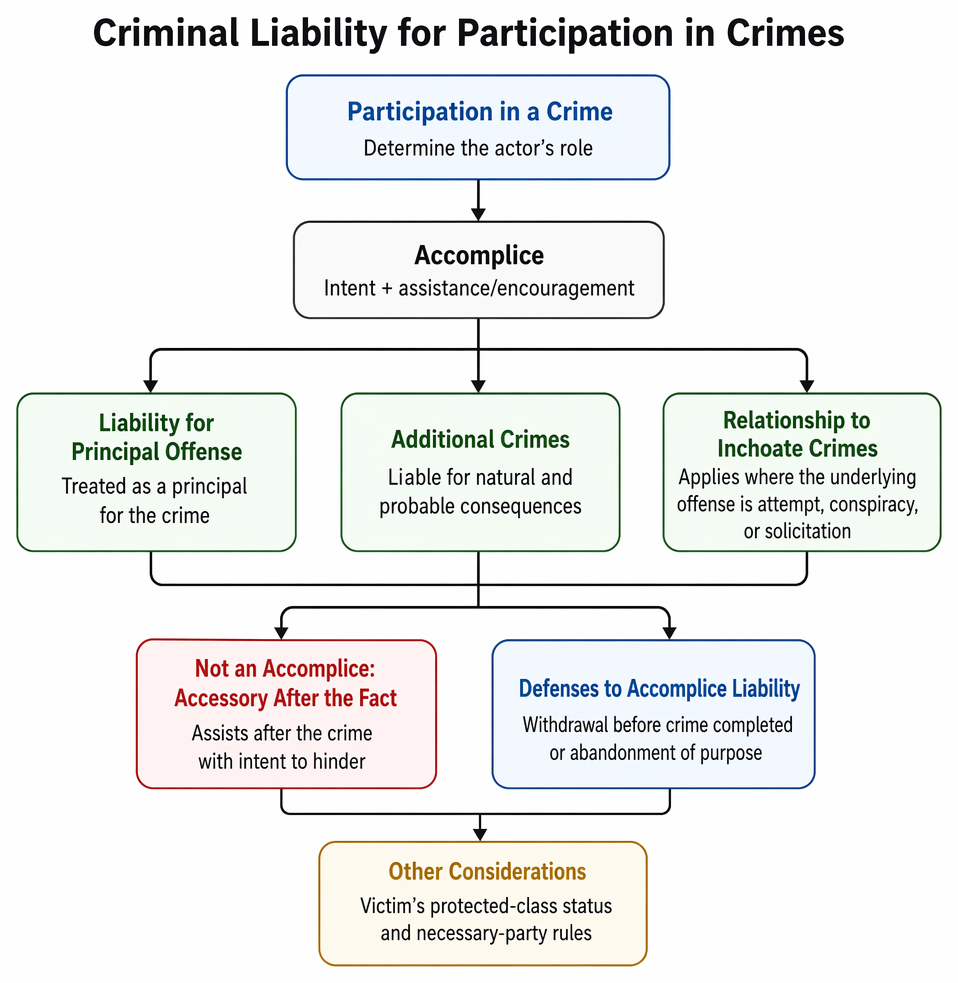
Aid or encouragement combined with dual intent establishes accomplice liability, whereas mere presence or knowledge alone does not.
- Common‑law categories of principals and accessories, and their modern statutory treatment.
- The actus reus and mens rea required for accomplice liability.
- Liability of accomplices for the principal offense and for additional crimes that are natural and probable consequences.
- Distinguishing accomplices from accessories after the fact.
- Defenses to accomplice liability, including withdrawal and abandonment.
- The effect of the victim’s protected‑class status and necessary‑party rules.
- Interaction between accomplice liability and inchoate crimes (attempt, conspiracy, solicitation).
Test Your Knowledge
Attempt these questions before reading this article. If you find some difficult or cannot remember the answers, look more closely at that area during your revision.
-
Which of the following is required for accomplice liability at common law and on the MBE?
- a) Physical presence at the scene of the crime.
- b) Intent to assist and intent that the principal commit the crime.
- c) Actual commission of the crime by the accomplice.
- d) Mere knowledge that a crime will occur.
-
An accessory after the fact is:
- a) Liable for the original felony.
- b) Liable for all foreseeable crimes.
- c) Liable for a separate crime of assisting a felon after completion of the crime.
- d) Not criminally liable.
-
Which defense is generally available to an accomplice who only encouraged a crime?
- a) Withdrawal by timely repudiation.
- b) Mistake of law.
- c) Duress by a third party.
- d) Voluntary intoxication.
Introduction
For criminal liability, it is not only the person who directly commits the crime who may be held responsible. The law recognizes different categories of parties who participate in or assist with criminal conduct. On the MBE you are frequently asked to sort out who is a principal, who is an accomplice, who (if anyone) is an accessory after the fact, and whether any defenses apply.
Parties to a Crime: Principal, Accomplice, Accessory
At common law, parties to a felony were classified as principals (first or second degree), accessories before the fact, and accessories after the fact. Modern statutes have largely abolished these distinctions, except for accessories after the fact, and treat most participants as principals.
Key Term: Principal
The person whose acts or omissions constitute the actus reus of the crime. A principal is the main actor in the commission of the offense. Key Term: Principal in the First Degree
A principal who personally engages in the proscribed conduct—the one who physically commits, or attempts to commit, the crime. Key Term: Principal in the Second Degree
A person who is present at the scene (actually or constructively) and aids, counsels, or encourages the principal in the first degree during the commission of the crime. Key Term: Accessory Before the Fact
At common law, a person who aids, counsels, or encourages the crime but is not present at the scene. Modern statutes generally treat this person as an accomplice/principal. Key Term: Accomplice
A person who, with the intent to assist and the intent that the crime be committed, aids, counsels, or encourages the principal before or during the commission of the crime. Key Term: Accessory After the Fact
A person who, knowing a felony has been completed, assists the principal to avoid arrest, prosecution, or conviction. This is a separate crime from the original felony.
Under modern codes (and on the MBE), you should generally assume that anyone who intentionally helps before or during the crime is treated as a principal (i.e., as an accomplice), and that only those who help after completion are classified as accessories after the fact.
Note also that at common law there were no “accessories” to misdemeanors: anyone assisting a misdemeanor was simply a principal. Modern statutes often follow the same functional approach.
Accomplice Liability: Act and Intent
To be liable as an accomplice, a person must satisfy both an act requirement and a mental‑state requirement.
Act Requirement: Aid, Counsel, Encourage, or Omit
The accomplice must aid, counsel, or encourage the principal before or during the crime. Typical forms of assistance include:
- Providing weapons or tools
- Serving as a lookout or getaway driver
- Giving detailed information or plans
- Providing a false alibi arranged in advance
Importantly, assistance can also be by omission.
Key Term: Actus Reus of Accomplice Liability
The voluntary act (or omission where there is a legal duty) of aiding, counseling, or encouraging the principal before or during the commission of the crime.
If the defendant has a legal duty to act (e.g., a parent, police officer, or security guard) and intentionally fails to fulfill that duty in order to facilitate the crime, that omission can satisfy the actus reus of accomplice liability.
Mere presence at the scene or passive failure to stop a crime, without a legal duty and without intent to assist, is not enough.
Mental State Requirement: Dual Intent
The accomplice must also possess a specific mental state.
Key Term: Dual Intent (Accomplice Liability)
The accomplice must intend (1) to assist the principal, and (2) that the principal commit the substantive offense (or at least have the required mental state for that offense).
Thus:
- Mere knowledge that a crime will occur is ordinarily insufficient.
- Paying market price for goods knowing they will be resold illegally is usually not enough; deliberately providing an important tool to help commit a known planned crime usually is.
For crimes defined by recklessness or negligence (e.g., depraved‑heart murder), the accomplice must intend to assist the conduct and must have the mental state required for the result (e.g., act with recklessness as to the risk of death).
Scope of Accomplice Liability
Once accomplice liability is established, the accomplice’s exposure is broad.
Key Term: Natural and Probable Consequences Doctrine
An accomplice is liable not only for the crime aided or encouraged, but also for any additional crimes that are the natural and probable consequences of the intended crime.
On the MBE, this usually means:
- The accomplice is liable for the target crime (e.g., robbery) and
- Any further crimes by the principal that are reasonably foreseeable outgrowths (e.g., an assault or homicide committed during the robbery), but
- Not for bizarre or independent acts entirely outside the common plan.
If the principal commits a different crime of the same general type and the variation is reasonably foreseeable, the accomplice is usually liable. If the principal commits a completely independent crime for his own purposes, the accomplice is not.
An accomplice may be convicted even if:
- The principal is not prosecuted or is acquitted, or
- The principal has a personal defense (e.g., insanity, infancy, diplomatic immunity).
What matters is that the substantive offense itself was in fact committed by someone and that the accomplice had the required act and intent.
Exam Warning: On the MBE, mere knowledge that a crime will occur is not enough for accomplice liability. The accomplice must have the intent to assist and the intent that the crime be committed.
Defenses to Accomplice Liability
Defenses operate at several levels: some negate the act or intent requirements, others limit the scope of liability.
Withdrawal (Abandonment)
Withdrawal is the main affirmative defense tested.
Key Term: Withdrawal (Accomplice Liability)
The accomplice’s timely and effective termination of participation, which can cut off liability for subsequent crimes but not for crimes already committed.
The requirements depend on the nature of the prior assistance:
-
If the accomplice only encouraged the crime
- Timely repudiation of the encouragement communicated to the principal before the crime is committed is generally sufficient.
-
If the accomplice provided physical assistance (weapons, tools, transportation)
- Withdrawal usually requires either:
- Neutralizing the assistance (e.g., retrieving weapons, disabling the getaway car), or
- Giving timely notice to law enforcement or otherwise taking reasonable steps to prevent the crime.
- Withdrawal usually requires either:
Even a complete and effective withdrawal will not erase liability for crimes already completed. It can, however, prevent liability for later crimes (including foreseeable additional crimes) that occur after the withdrawal.
Other Potential Defenses
- Lack of requisite intent: If the alleged accomplice did not intend to aid or did not share the principal’s criminal purpose, there is no accomplice liability.
- Feigned accomplice: Undercover officers or informants who pretend to assist but actually intend to frustrate the crime are not accomplices.
Key Term: Feigned Accomplice
A person (often an undercover officer) who appears to agree to assist in a crime but actually intends to prevent or report it; not an accomplice because the required criminal intent is lacking.
- Impossibility: Factual impossibility is not a defense if the elements of attempt or the substantive offense are otherwise met; legal impossibility may be.
Protected Classes and Necessary Parties
Certain doctrines limit accomplice liability even when the normal elements are satisfied.
Key Term: Protected Class Doctrine
A person within the class of individuals the statute is designed to protect cannot be held liable as an accomplice to the violation.
Classic examples:
- A minor involved in statutory rape cannot be prosecuted as an accomplice or conspirator to the statutory rape statute that is designed to protect minors.
- A patient in a statute criminalizing unlicensed medical practice is not an accomplice to the doctor’s unauthorized practice.
Key Term: Necessary Parties Doctrine
When a crime necessarily requires two or more parties, and the statute intends to punish only one, the unpunished party is not liable as an accomplice.
For example:
- If a statute criminalizes the sale of drugs but expressly exempts purchasers, the buyer is not liable as an accomplice to the seller’s crime (though the buyer may be guilty of a separate possession offense if created by statute).
Conversely, when a statute criminalizes the conduct of both parties (e.g., both the seller and buyer of contraband), each is treated as a principal, not as a mere accomplice to the other.
Revision Tip: If the statute protects a certain class (e.g., minors in statutory rape), that class cannot be prosecuted as accomplices or conspirators.
Accessory After the Fact
An accessory after the fact is not liable for the original felony, but for a separate offense.
Key Term: Accessory After the Fact
A person who, knowing a completed felony has been committed, intentionally assists the felon to avoid arrest, trial, or punishment.
Key points:
- The substantive offense must be a completed felony.
- The accessory must know the felony was committed.
- The assistance must be designed to help the felon avoid apprehension or punishment (e.g., hiding the felon, destroying evidence, providing escape transportation).
On the MBE, accessories after the fact are almost always liable for a separate obstruction‑type offense (e.g., “hindering prosecution”), not for the original crime.
Relationship to Inchoate Crimes
Accomplice rules apply to inchoate crimes as well:
- One can be an accomplice to an attempt, solicitation, or conspiracy if the elements of accomplice liability are met.
- Conspiracy does not merge with the completed offense, but solicitation and attempt do; accomplice and conspiracy liability can therefore overlap.
MBE questions often test whether a person is guilty of both conspiracy and as an accomplice, or only one.
Worked Example 1.1
A, knowing that B plans to rob a store, gives B a map of the store and advice on the best escape route. B robs the store and, during the robbery, assaults a security guard. Is A liable for robbery and assault?
Answer:
Yes. A is an accomplice to robbery because he intentionally assisted B and intended the robbery to occur. A is also liable for the assault if it was a foreseeable consequence of the robbery (a natural and probable consequence of an armed robbery is resistance by store security and violence by the robber).
Worked Example 1.2
C, a friend of D, learns that D has just committed a burglary. C allows D to hide in her garage to avoid arrest. Is C liable for burglary?
Answer:
No, C is not liable for burglary. C is an accessory after the fact and may be guilty of a separate crime for assisting D after the burglary was complete, but she is not an accomplice to the burglary itself.
Worked Example 1.3
Nine gang members attend a “party” called by their leader. Unknown to them, the leader intends to kill an informant. In front of the others, the leader suddenly stabs and kills the informant. The others do nothing. Are the eight non‑leaders guilty as accomplices to murder?
Answer:
No, mere presence at the scene and failure to intervene, without a legal duty and without prior agreement or intent to assist, are insufficient for accomplice liability. There is no evidence that the eight members shared the leader’s intent or provided any aid, counseling, or encouragement in advance.
Worked Example 1.4
E agrees to be a lookout while F burglarizes a house. The night before the planned burglary, E calls F and says, “I am out. This is a bad idea.” F ignores this and commits the burglary alone. Is E liable for burglary?
Answer:
No. E’s only assistance was encouragement, which he effectively repudiated before the crime was committed. His timely withdrawal cuts off accomplice liability for the burglary and for any foreseeable additional crimes committed during that burglary.
Worked Example 1.5
G sells a gun to H at market price. G knows that H is a gang member and strongly suspects the gun will be used in a future robbery, but G does not care. H in fact uses the gun in a robbery. Is G liable as an accomplice to robbery?
Answer:
Generally no. Mere knowledge that a buyer is likely to use goods in a crime, without purpose to facilitate that crime, is insufficient for accomplice liability on the MBE. If, however, G gave a deep discount or otherwise indicated a desire to help the robbery succeed, a court might infer the required intent.
Worked Example 1.6
J intentionally disables his store’s alarm so that his friend K can break in and steal merchandise. J later regrets this and, just before K arrives, he re‑arms the alarm and calls the police. The police arrest K at the scene and no property is taken. Is J liable as an accomplice to attempted burglary?
Answer:
J’s initial disabling of the alarm was assistance, but his later steps—neutralizing the assistance and alerting authorities—constituted effective withdrawal before any attempt occurred. Because K was caught before entering or taking a substantial step inside, there is no completed offense to which J could be an accomplice on these facts.
Key Point Checklist
This article has covered the following key knowledge points:
- Common‑law categories (principal in first and second degree, accessory before the fact, accessory after the fact) are largely merged under modern statutes, except for accessories after the fact.
- Accomplice liability requires both an act (aid, counsel, encourage, or omission with a duty) and dual intent: intent to assist and intent that the crime be committed.
- Mere presence, mere knowledge, or passive failure to stop a crime (without duty) is not enough for accomplice liability.
- Accomplices are liable for the target offense and for additional crimes that are natural and probable consequences of the intended crime.
- Withdrawal can cut off liability for future crimes but not for crimes already completed; effective withdrawal depends on the kind of assistance originally given.
- Members of a protected class cannot be liable as accomplices to offenses designed to protect them, and necessary‑party rules prevent imposing accomplice liability where the legislature deliberately exempts one party.
- Accessories after the fact commit a separate crime of assisting a felon after completion of the felony and are not liable for the substantive offense.
- Accomplice rules apply to inchoate crimes as well; conspiracy does not merge, but attempt and solicitation do.
Key Terms and Concepts
- Principal
- Principal in the First Degree
- Principal in the Second Degree
- Accessory Before the Fact
- Accomplice
- Actus Reus of Accomplice Liability
- Dual Intent (Accomplice Liability)
- Natural and Probable Consequences Doctrine
- Withdrawal (Accomplice Liability)
- Feigned Accomplice
- Protected Class Doctrine
- Necessary Parties Doctrine
- Accessory After the Fact