Learning Outcomes
This article explains the reasonably prudent person standard in negligence, including:
- How the objective reasonably prudent person standard defines breach of the duty of care and interacts with risk–utility concepts like the Hand formula.
- How “under similar circumstances” incorporates external conditions, notice of risks, and physical characteristics without personalizing the standard to mental traits or inexperience.
- When and how the standard is modified for defendants with physical disabilities and for children, including jurisdictional presumptions about very young children.
- How the adult activity rule operates to replace the child standard with the ordinary adult standard in MBE-style questions involving driving or other inherently adult, dangerous activities.
- How professionals and defendants with superior skill or knowledge are held to heightened expectations, and the different roles custom plays for professionals versus ordinary actors.
- Why mental illness, low intelligence, and voluntary intoxication never reduce the standard of care, even when they causally contribute to the accident.
- How emergencies, sudden physical incapacitation, and superior knowledge of specific hazards are evaluated, and how to deploy these doctrines systematically when working through multiple-choice negligence fact patterns.
MBE Syllabus
For the MBE, you are required to understand the standard of care in negligence, with a focus on the following syllabus points:
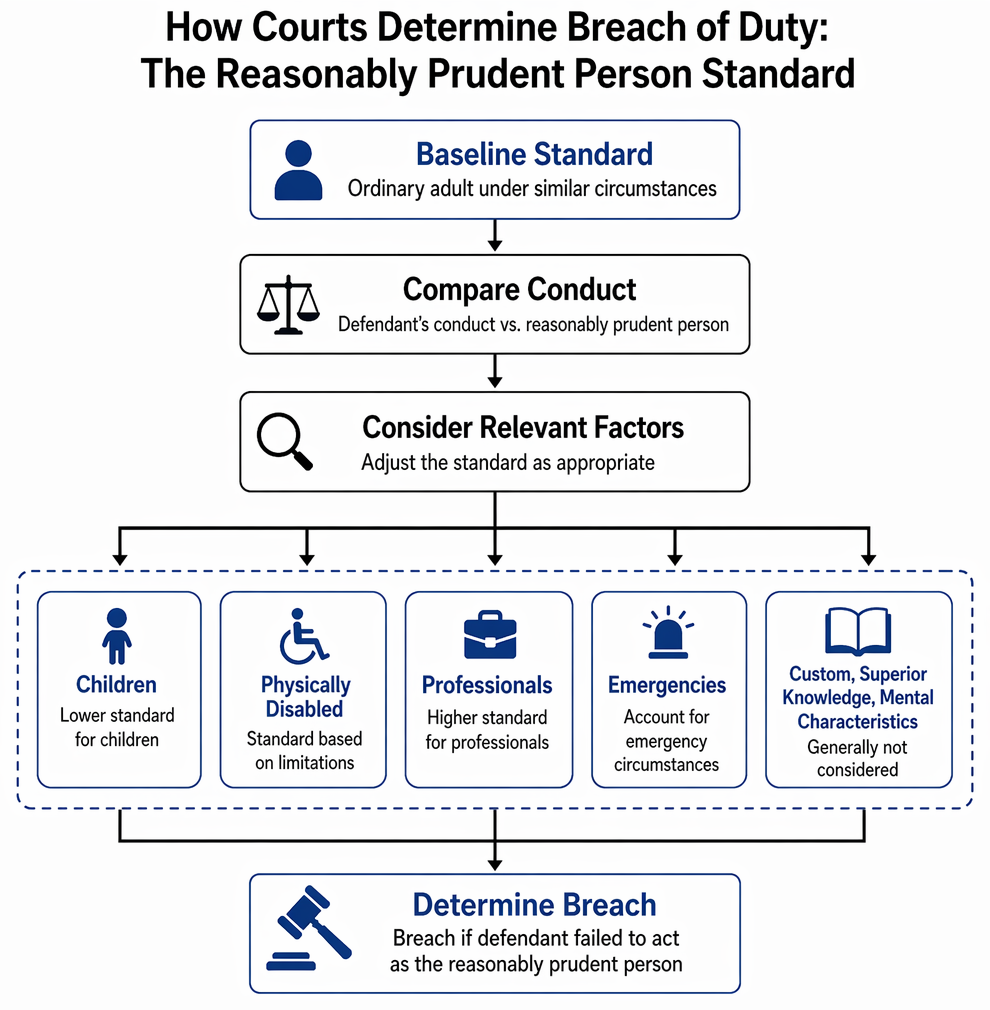
Adult negligence conduct is measured objectively, allowing for physical disability and emergency, but not mental impairment, inexperience, or intoxication.
- The objectively defined duty of the reasonably prudent person under similar circumstances.
- Variations in the standard of care for children, physically disabled defendants, and professionals.
- The effect of emergencies, custom, superior knowledge, and mental characteristics.
- How courts use the reasonably prudent person standard to determine breach of duty.
- Application of these concepts in multiple‑choice questions involving ordinary adults and special defendants.
Test Your Knowledge
Attempt these questions before reading this article. If you find some difficult or cannot remember the answers, look more closely at that area during your revision.
-
Which of the following best describes the standard of care for an adult defendant in a negligence case?
- a) The care a perfect person would use.
- b) The care a reasonable person with the defendant’s actual abilities would use.
- c) The care a reasonably prudent person would use under similar circumstances.
- d) The care the defendant personally believes is appropriate.
-
A 10-year-old child injures someone while riding a bicycle. What standard of care applies?
- a) The reasonably prudent adult standard.
- b) The standard of a child of similar age, experience, and intelligence.
- c) Strict liability.
- d) The standard of a professional cyclist.
-
Which of the following is NOT a recognized exception to the reasonably prudent person standard?
- a) Physical disability.
- b) Mental illness.
- c) Emergency situations.
- d) Superior skill or knowledge.
Introduction
Negligence law uses the concept of the reasonably prudent person to set the standard of care. This standard is objective: it asks what a hypothetical reasonable person would do in the defendant’s situation, not what the defendant personally thought was reasonable. The standard applies broadly, but there are important exceptions and modifications for certain categories of defendants.
Negligence questions on the MBE usually turn on whether the defendant breached a duty of care. That inquiry almost always reduces to: did the defendant act as a reasonably prudent person would have acted under the same or similar circumstances? Understanding precisely what that means—and when the baseline standard changes—is critical for spotting the right duty and evaluating breach.
Key Term: Reasonably Prudent Person
The hypothetical person who exercises average care, skill, and judgment in conduct, serving as the legal standard for negligence.
The Objective Standard
The default rule is that every adult is held to the standard of a reasonably prudent person under similar circumstances. This standard does not account for a defendant’s actual mental abilities, experience, or personal beliefs. Instead, it is an external, community-based measure.
Key Term: Objective Standard
A legal test that judges conduct by what a reasonable person would do, not by the defendant’s subjective intentions or beliefs.
Key features of the objective standard:
- It is impersonal: the defendant’s own clumsiness, stupidity, anxiety, or carelessness does not excuse substandard conduct.
- It is context-sensitive: the “circumstances” matter (e.g., weather, visibility, known risks, emergency, physical disability).
- It is not perfection: the law demands ordinary prudence, not “the most cautious person imaginable.”
Courts often express the standard in risk–utility terms (sometimes formalized as the Hand formula): a reasonably prudent person takes precautions when the burden of the precaution is less than the probability of harm times the gravity of the harm. You do not need to calculate numbers on the MBE, but you should recognize that:
- Failure to take very cheap precautions against serious risks is often unreasonable.
- Refusal to take extremely expensive or impractical precautions against remote risks may still be reasonable.
Key Term: Hand Formula
A way of expressing the reasonably prudent person test: a person is negligent if the burden of adequate precautions is less than the probability and gravity of foreseeable harm.
Considering the Circumstances
“Under similar circumstances” is not filler; it is where many exam issues live. The reasonably prudent person is imagined as being in the defendant’s shoes with:
- The same physical characteristics (e.g., blindness).
- The same knowledge of specific facts that the defendant actually had or reasonably should have had.
- The same external conditions (e.g., nighttime, heavy rain, crowded street, emergency).
But the reasonably prudent person does not share the defendant’s:
- Low intelligence.
- Mental illness or cognitive impairment.
- Inexperience (e.g., a new driver).
- Voluntary intoxication.
Those traits do not lower the standard.
Key Term: Mental Disability Rule
Mental illness, cognitive impairment, low intelligence, and voluntary intoxication do not lower the reasonably prudent person standard; the defendant is held to the ordinary adult standard.
Modifications for Physical Characteristics
If a defendant has a physical disability, the standard is adjusted: the defendant is compared to a reasonably prudent person with the same disability. For example, a blind person is judged by what a reasonable blind person would do.
Key Term: Physical Disability Standard
The standard of care applied to a defendant with a physical disability, comparing them to a reasonable person with that same disability.
Important points:
- The law does not require the physically disabled to act as if they had no disability.
- It does require them to take reasonable precautions in light of their disability (e.g., use a cane, rely on assistance, avoid high‑risk activities).
- Sudden unexpected physical incapacitation (e.g., unforeseeable heart attack while driving) may excuse conduct if the event itself was not reasonably foreseeable.
Children
Children are generally held to the standard of a child of similar age, experience, and intelligence. This is still an objective standard, but the “reasonably prudent person” is a reasonably prudent child with similar characteristics.
Key Term: Child Standard
The standard of care for children, based on what a reasonable child of similar age, experience, and intelligence would do.
Common refinements:
- Many jurisdictions conclusively presume very young children (often under age 5) incapable of negligence.
- Older children are judged more strictly as they age and as their experience grows.
- The fact-finder may weigh evidence of the child’s actual intelligence and experience to determine what care is reasonable for that child.
Adult Activity Rule
A key exam trap concerns children engaged in inherently adult activities.
If a child is engaged in an adult activity that is dangerous and typically undertaken only by adults (such as driving a car), the adult standard applies.
Key Term: Adult Activity Rule
When a child engages in a typically adult, dangerous activity (e.g., driving a car), the child is held to the ordinary adult reasonably prudent person standard.
Activities commonly treated as “adult” on the MBE include:
- Driving a motor vehicle on public roads.
- Operating a motorboat or snowmobile.
- Piloting a small aircraft.
Activities like riding a bicycle, skateboarding, or swimming are usually not treated as adult activities.
Professionals and Special Skills
Professionals (such as doctors or lawyers) are held to the standard of a reasonable member of their profession with similar training and experience. The question is not what this doctor believed was reasonable, but what a reasonably prudent doctor in that specialty and setting would have done.
If a person has special skills or knowledge, and those skills are relevant to the situation, the standard incorporates that higher ability.
Key Term: Professional Standard
The standard of care for professionals, based on the customary practice of a reasonable professional in that field under similar circumstances. Key Term: Superior Skill or Knowledge Rule
A person with superior skill or knowledge who undertakes an activity is held to the standard of a reasonably prudent person with that superior skill or knowledge.
Key professional points for the MBE:
- The standard is objective and profession-wide; novices are treated like average members of the profession, not like beginners.
- Custom in the profession is highly relevant, especially in medical malpractice, and often defines the standard of care.
Key Term: Custom Evidence
Evidence of how others in the community or profession act in similar situations; persuasive on what is reasonable, but usually not conclusive for non‑professionals.
For non-professionals, industry custom is relevant but not controlling. A defendant may be negligent even if they complied with common custom, and compliance can be evidence of due care but is not a complete defense.
Emergencies
If a defendant is confronted with a sudden emergency not of their own making, the standard is what a reasonably prudent person would do in that emergency.
Key Term: Emergency Standard
The standard of care when a defendant faces a sudden, unexpected emergency not of their own making: what a reasonably prudent person would do under those emergency circumstances.
Important nuances:
- The emergency must be sudden and unforeseen, and the defendant must not have created it.
- The law does not excuse all mistakes in an emergency; it excuses failing to choose the optimal course when time is short and pressures are high.
- A jury may be instructed to consider the emergency as part of the circumstances in judging reasonableness.
Mental Characteristics
Mental illness or lack of intelligence does not lower the standard. Defendants are still judged by the reasonably prudent person, not by their own mental limitations.
This rule reflects administrative and policy concerns: mental conditions are often hard to verify and may be easily asserted. The law prefers a single, uniform standard for adults.
Voluntary intoxication likewise does not excuse negligence. An intoxicated defendant is held to the same standard as a sober reasonably prudent person.
Superior Knowledge and Notice
Although subjective traits do not generally lower the standard, they can raise it when they involve superior knowledge of specific risks.
Examples:
- A store owner who knows a particular step is loose must take precautions a layperson might not think of.
- A chemist handling chemicals is expected to know more about their dangers than an ordinary person.
Similarly, once a reasonable person would have notice of a risk (e.g., a spill on the floor that has existed for a long time), the duty to respond arises, even if the defendant claims not to have looked.
Worked Example 1.1
A driver with average abilities is distracted and runs a red light, causing an accident. What standard of care applies?
Answer:
The driver is held to the standard of a reasonably prudent person under similar circumstances. The fact that the driver was distracted or inexperienced is irrelevant; the law asks what a reasonable person would have done. A reasonably prudent driver does not proceed through a red light, so the distraction does not excuse the breach.
Worked Example 1.2
A 12-year-old child injures a pedestrian while riding a bicycle. How is negligence determined?
Answer:
The child is compared to a reasonable child of similar age, experience, and intelligence. If the child was riding a standard bicycle, the child standard applies. If the child was driving a car on a public road, the adult standard would apply under the adult activity rule.
Worked Example 1.3
A blind defendant walks without a cane along a busy sidewalk and collides with a pedestrian, causing injury. The defendant argues that because she is blind, she cannot be expected to avoid others.
Answer:
The defendant is compared to a reasonably prudent blind person, not to a sighted person. But a reasonably prudent blind person takes reasonable precautions to move safely, such as using a cane or assistance. Walking unaided in a crowded area may be unreasonable. The disability modifies the standard but does not eliminate the duty to act carefully in light of the disability.
Worked Example 1.4
A 14-year-old with a learner’s permit is driving a car on a public road and rear‑ends another vehicle while texting. She argues that she should be held to a child standard.
Answer:
Because she is engaged in an adult activity—driving a motor vehicle on a public road—the adult reasonably prudent person standard applies. Her age does not reduce the duty of care. A reasonably prudent adult driver does not text while driving and rear‑end others, so she is likely negligent.
Worked Example 1.5
A surgeon chooses a treatment that is contrary to the accepted practice of other competent surgeons in the same specialty, resulting in harm to the patient. The surgeon argues that he genuinely believed his approach was better.
Answer:
The surgeon is held to the standard of a reasonably prudent surgeon in that specialty, not to his personal judgment. Professional custom is strong evidence of the standard of care. Departing from accepted practice without good reason is likely a breach, regardless of the surgeon’s sincere belief.
Worked Example 1.6
A driver suffers a completely unexpected seizure while driving, with no prior history or warning signs. The seizure causes him to swerve and collide with another car.
Answer:
If the seizure was truly unforeseeable, the driver may not be negligent. A reasonably prudent person with no prior warning of such a condition would not take special precautions, and a sudden, unforeseeable physical incapacitation can excuse what would otherwise be negligent conduct.Exam Warning: On the MBE, do not apply a subjective standard based on the defendant’s actual mental state or inexperience. The standard is objective except for physical disabilities and children. A mentally ill, careless, or voluntarily intoxicated adult is still judged by the ordinary reasonably prudent person standard.
Revision Tip: Remember: Only physical disabilities and childhood status modify the standard, and children lose their modified standard when they engage in adult activities. Mental illness, inexperience, or voluntary intoxication do not.
Key Point Checklist
This article has covered the following key knowledge points:
- The reasonably prudent person standard is objective and external; it asks how an ordinary person would act under similar circumstances.
- The circumstances matter: weather, emergency, physical disability, and known risks all affect what is reasonable.
- Adults are judged by the reasonably prudent person standard, regardless of personal traits like mental illness, inexperience, or voluntary intoxication.
- Physical disabilities modify the standard; the defendant is compared to a reasonably prudent person with the same disability.
- Children are judged by the standard of a child of similar age, experience, and intelligence, unless engaged in a typically adult, dangerous activity.
- Professionals are held to the standard of a reasonable professional in their field, and professional custom is strong evidence of the standard of care.
- Emergencies not of the defendant’s making are considered; the standard remains objective but account is taken of the emergency conditions.
- Superior knowledge or skill can raise the standard, while ignorance of obvious risks does not lower it.
- Mental illness and low intelligence do not lower the standard; voluntary intoxication is no defense to negligence.
- Evidence of custom is relevant but usually not conclusive for non‑professionals; compliance with custom does not guarantee due care.
Key Terms and Concepts
- Reasonably Prudent Person
- Objective Standard
- Hand Formula
- Physical Disability Standard
- Child Standard
- Adult Activity Rule
- Professional Standard
- Superior Skill or Knowledge Rule
- Custom Evidence
- Emergency Standard
- Mental Disability Rule