Learning Outcomes
This article explains the law of robbery for MBE purposes, including:
- pinpointing and applying each common law element of robbery, with emphasis on taking from the person or presence and intent to permanently deprive
- distinguishing robbery from larceny, burglary, extortion, and related property offenses when facts involve stealthy takings, break-ins, or future-oriented threats
- analyzing the degree, timing, and purpose of force or intimidation, and using the continuous-transaction concept to classify force used during escape
- evaluating accomplice and attempt liability in robbery fact patterns, including getaway drivers, lookouts, and failed takings where force is used
- recognizing available defenses—such as claim of right, voluntary intoxication, and lack of awareness—and understanding when they actually defeat robbery
- applying statutory variations, such as aggravated or armed robbery, to issues like lesser-included offenses, merger, and exposure to felony-murder liability
- spotting classic MBE traps involving mere snatching, pickpocketing, threats of future harm, or double-charging larceny and robbery for the same taking
- organizing robbery analysis in a step-by-step, element-by-element structure that can be quickly deployed on multiple-choice questions and essays
MBE Syllabus
For the MBE, you are required to understand robbery as an aggravated theft offense that combines property and personal violence elements, with a focus on the following syllabus points:
Force or intimidation used before, during, or immediately after a taking to retain property constitutes robbery, whereas escape force does not.
- The definition and elements of common law robbery
- The requirement that the taking be from the victim’s person or presence
- The nature, degree, and immediacy of force or intimidation required
- Distinctions between robbery, larceny, burglary, and extortion
- Defenses, attempt, and accomplice liability in robbery
- Statutory variations such as aggravated robbery and robbery with a deadly weapon
- The relationship between robbery and other doctrines, such as lesser-included offenses and felony murder (robbery as a BARRK predicate)
Test Your Knowledge
Attempt these questions before reading this article. If you find some difficult or cannot remember the answers, look more closely at that area during your revision.
-
Which of the following is NOT an element of robbery?
- a) Taking and carrying away property of another
- b) By force or threat of force
- c) With intent to permanently deprive
- d) Entry into a dwelling at night
-
A man grabs a woman's purse from her shoulder, causing her to stumble but not fall. Is this likely robbery?
- a) Yes, because force was used
- b) No, because the woman was not injured
- c) No, because the man did not use a weapon
- d) Yes, because the taking was in public
-
If a thief picks a victim’s pocket without the victim noticing, is this robbery?
- a) Yes, because property was taken
- b) No, because there was no force or threat
- c) Yes, because the victim lost property
- d) No, because the property was not valuable
Introduction
Robbery is a property crime that combines theft with violence or intimidation. It is frequently tested on the MBE because it requires careful attention to the timing and nature of the force or threat, and because it sits at the intersection of crimes against property and crimes against the person.
Robbery is sometimes described as “larceny plus assault”: a theft that is accomplished by force or fear. It is distinct from larceny (simple theft), burglary (wrongful entry with criminal intent), and extortion (obtaining property by threat of future or non-physical harm). Being able to separate these closely related crimes is critical on multiple-choice questions.
Key Term: Robbery
Robbery is the unlawful taking and carrying away of personal property from a person or their immediate presence, by force or threat of immediate physical force, with intent to permanently deprive the owner of the property.
Robbery is a specific intent crime: the defendant must specifically intend to steal (to permanently deprive the owner). This has consequences for defenses such as voluntary intoxication and mistake of fact.
Key Term: Specific Intent Crime
A specific intent crime requires, beyond the physical act, a particular subjective purpose or objective (such as the intent to permanently deprive); certain defenses like voluntary intoxication or honest mistake of fact may apply.
Robbery is also a felony in all jurisdictions and is one of the traditional inherently dangerous felonies (the “BARRK” felonies—burglary, arson, robbery, rape, kidnapping) that can support felony murder. Thus, a robbery scenario on the MBE may generate questions not only about robbery itself, but also about assault, battery, burglary, accomplice liability, and felony murder.
Common Law Definition and Modern Statutes
At common law, robbery was narrowly defined, but modern statutes often broaden:
- the types of property covered (including some intangible property),
- the scope of “force” or “intimidation,” and
- the degrees of robbery (e.g., armed robbery, robbery causing serious injury).
For MBE purposes, however, the safest approach is to start from the traditional common law elements and then layer any statutory variation only if the fact pattern clearly signals it.
Elements of Robbery
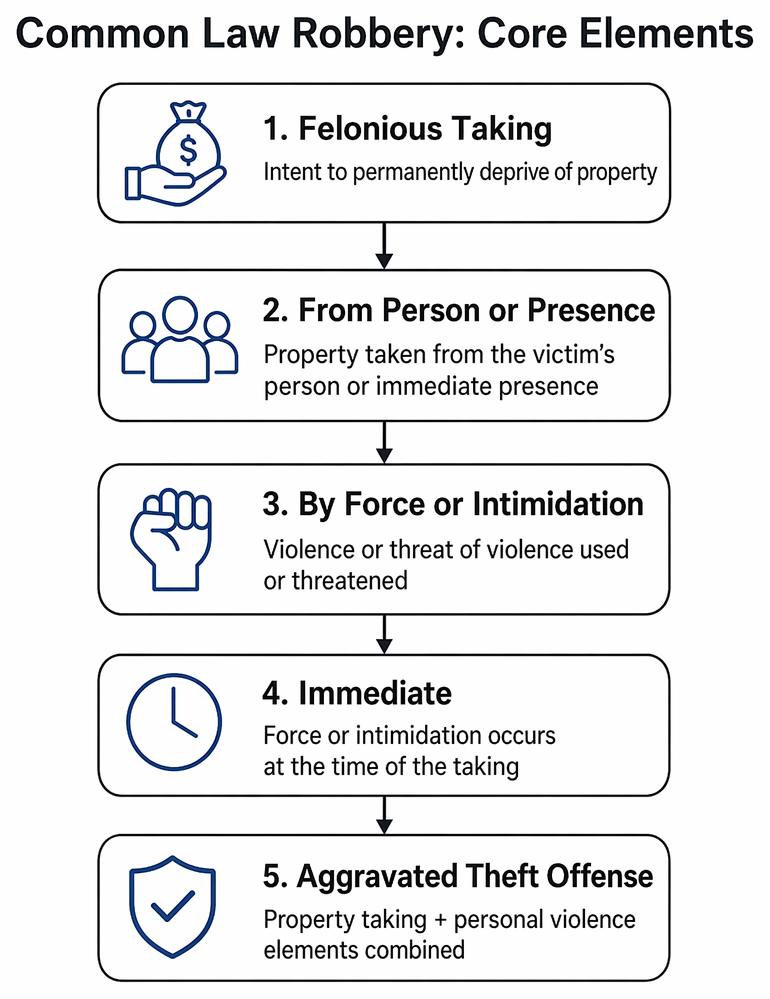
At common law, robbery can be broken into the elements of larceny plus an added force/intimidation requirement:
- A taking and carrying away (asportation)
- Of personal property
- Of another
- From the person or immediate presence of the victim
- Without the victim’s consent
- By use of force or intimidation (threat of immediate physical harm)
- With intent to permanently deprive the owner of the property
Key Term: Asportation
Asportation means any movement of the property, however slight, that is part of the taking; even minimal carrying away is enough. Key Term: Immediate Presence
Property is in the immediate presence of a victim if it is within their reach, control, or observation, such that they could retain possession if not overcome by force or fear, even if it is not physically on their person. Key Term: Force or Threat
Force or threat in robbery is the use of physical power or intimidation sufficient to overcome resistance or induce reasonable fear of immediate bodily harm, used to accomplish the taking or to prevent resistance.
Taking and carrying away
As with larceny, robbery requires a trespassory taking and slight movement of the property. The taking must interfere with the victim’s possessory rights.
- The defendant must obtain possession or control inconsistent with the victim’s rights.
- Any movement, however slight, completes asportation: pulling a purse an inch closer and then dropping it is enough.
- Some modern statutes relax or eliminate the asportation requirement, treating obtaining control as sufficient; the MBE typically assumes the common law requirement but does not test the difference aggressively.
Because robbery includes all of larceny’s elements, any detail you know for larceny (such as continuing trespass or mistaken delivery) can, in theory, arise in a robbery fact pattern. For example, if the defendant initially took property without the intent to steal, but then later decided to keep it and used force to prevent the owner from retrieving it, the timing of the intent and the force both become issues.
Property of another, without consent
The property must belong to someone other than the defendant, and the victim must not consent to the taking. Consent obtained through force or intimidation is not valid consent.
- If the victim hands over a wallet because a gun is pointed at them, the “consent” is coerced and does not negate robbery.
- Similarly, fraud-based consent (e.g., false pretenses, larceny by trick) may negate “trespassory taking” for larceny but does not negate the use of force or intimidation if those are present.
Key Term: Claim of Right
A claim of right is a genuine belief, even if unreasonable, that the defendant is entitled to the specific property taken; this can negate the intent to steal and therefore the mens rea for larceny and robbery.
If the defendant honestly believes the property is theirs (a claim of right), they lack the intent to steal. On the MBE:
- This defense can apply even if the belief is unreasonable, because specific intent is subjective.
- It applies only to specific property claimed as one’s own, not to a generalized belief that one is “owed money.” Using force to collect a debt is still robbery, because the defendant is not entitled to that particular wallet or item.
From the person or immediate presence
Robbery requires a close connection between the victim and the property.
- From the person: Property on the victim’s body, in clothing, or in something being held (purse, bag, phone in hand).
- From the presence: Property in the victim’s vicinity, under their control, or in an area they could reach or protect if not restrained by force or fear (e.g., cash register in the room where a clerk is standing; purse on the chair next to the victim; safe in the same office).
If the property is far away or not in the victim’s vicinity, the crime may instead be larceny or extortion, but not robbery.
Some jurisdictions have a separate offense of “larceny from the person” for stealthy takings from the victim’s person without force (e.g., pickpocketing an unaware victim). For MBE purposes, however, treat this as larceny, not robbery, because the defining feature of robbery—force or intimidation—is missing.
By violence or intimidation
The hallmark of robbery is that the taking is accomplished by:
- actual physical force against the victim, or
- threats of immediate physical harm that place the victim in reasonable fear.
The victim must generally be aware of the force or threat at the time of the taking. If the victim is entirely unaware (for example, in a stealthy pickpocket scenario), the crime is usually larceny, not robbery.
Key Term: Intimidation
Intimidation is the use of words, gestures, weapons, or conduct that would place a reasonable person in fear of immediate bodily harm and that actually induces the victim to part with property.
Key points for intimidation:
- The threat must relate to immediate physical harm.
- The victim’s fear must be reasonable under the circumstances (e.g., a toy gun that appears real can suffice if the victim reasonably believes it is real).
- Threats can be implicit—e.g., silently brandishing a knife, or making a menacing gesture while reaching for the victim’s purse.
Intent to permanently deprive
The mens rea is the same as for larceny: intent to permanently deprive the owner of the property.
- If the defendant merely intends to borrow and then return the property, the specific intent for robbery is lacking (although other offenses may apply under modern statutes).
- Intent is evaluated at the time of the taking. A later change of heart does not erase an earlier intent to steal.
Because robbery is a specific intent crime:
- Voluntary intoxication can, in theory, be raised to show the defendant lacked the specific intent to permanently deprive, but only if the facts support substantial impairment.
- An honest mistake of fact about ownership (claim of right) can be a defense even if unreasonable.
Robbery as “Larceny Plus Force”
A useful equation for the exam is:
- Robbery = Larceny + Force or Intimidation:
Everything that must be proved for larceny (trespassory taking, asportation, property of another, intent to permanently deprive) must be present, plus:
- the additional requirement that the taking be from the person or presence, and
- that it be accomplished by force or threat of immediate physical harm.
Because robbery includes all the elements of larceny, larceny is a lesser-included offense of robbery. A defendant cannot be convicted of both larceny and robbery based on the same taking; the larceny merges into the robbery.
Key Term: Lesser-Included Offense
A lesser-included offense is a crime whose elements are entirely contained within a greater offense; conviction of the greater offense bars separate conviction of the lesser based on the same act.
On the MBE, this can affect:
- whether the defendant can be convicted of both offenses, and
- whether a jury could rationally convict of only the lesser offense (e.g., if the evidence of force is weak).
Timing of Force or Threat
The timing of the force or intimidation is a common MBE issue. The force or threat must be used either:
- to obtain possession of the property, or
- to retain possession of the property immediately after the taking, during a continuous transaction.
Key Term: Continuous Transaction
A continuous transaction is a series of events, close in time and place, beginning with the taking and extending through immediate flight, so that the theft and the use of force are treated as one ongoing occurrence.
If force is used only after the theft is complete and after the thief has reached a point of temporary safety, it is not robbery (though it may be an assault or battery plus larceny).
Examples of a continuous transaction:
- The thief grabs items from a store and, while running out, shoves a security guard to escape.
- The thief pickpockets a wallet; when the victim grabs the thief’s arm within seconds, the thief punches the victim and runs off.
In such cases, courts treat the force as being used to retain the property and prevent immediate apprehension, so the offense is robbery.
Contrast that with force used after the thief has safely escaped:
- The thief steals a bike from a rack while no one is around. Ten minutes later, a neighbor confronts the thief several blocks away, and the thief punches the neighbor to get away. The larceny is complete, and the later assault is a separate offense; the two acts are not one continuous robbery because the thief had reached a point of temporary safety.
The line between “immediate flight” and “temporary safety” is fact-dependent, but on the MBE, look for clues like:
- elapsed time,
- change of location, and
- opportunity for the thief to dispose of or secure the property.
Degree of Force Required
Any physical force, however slight, that overcomes the victim’s resistance or causes the victim to give up the property in fear is sufficient.
- Actual injury is not required.
- The force need not be extreme or painful.
- Even a shove or tug that causes the victim to stumble can be enough.
By contrast, mere snatching—a quick grab of property with no struggle and no injury—usually is only larceny, not robbery, unless there is evidence that the defendant used more than the minimal force involved in the taking (for example, ripping something away from a firm hold).
Consider the following continuum (from least to most):
- Stealthy removal from pocket with no awareness: larceny.
- Quick snatch of a purse from a table while the victim is distracted: larceny.
- Snatch of a purse from the victim’s shoulder, causing the strap to break and the victim to lose balance: likely robbery.
- Snatch accompanied by pushing, hitting, or threatening words: robbery.
The key is whether the defendant’s conduct overcame resistance or created immediate fear.
Threats
A threat for robbery must involve immediate physical harm:
- Threats of immediate death or serious bodily injury, or
- Threats of immediate physical harm to the victim, the victim’s family, or someone in the victim’s presence.
Threats of future harm, or threats to harm property (other than, in many jurisdictions, threatening to burn the victim’s dwelling), are generally not sufficient for robbery.
Key Term: Extortion
Extortion (modernly often called blackmail) is obtaining, or attempting to obtain, property by means of certain threats—often threats of future harm, harm to property, or harm to reputation—rather than by immediate physical force or threats of immediate bodily harm.
Extortion is usually a separate statutory crime and differs from robbery in two key ways:
- The threat need not be of immediate physical harm; threats of future physical harm, property damage, or reputational harm can suffice.
- The property need not be taken from the victim’s person or presence; the crime may be complete when the threat is made with the intent to obtain property.
On an MBE fact pattern, it is common to see a defendant both use a future threat (supporting extortion) and then resort to immediate physical force (supporting robbery). In such a case, both crimes may be present, or at least attempted extortion plus completed robbery.
Distinguishing Robbery from Larceny and Burglary
Key Term: Larceny
Larceny is the trespassory taking and carrying away of personal property of another, without consent, with intent to permanently deprive the owner, but without force or threat. Key Term: Burglary
At common law, burglary is the breaking and entering of the dwelling of another at night with the intent to commit a felony inside; modernly, it is often defined as unlawful entry into a building or structure with intent to commit a felony or theft inside.
Robbery vs. larceny
- Robbery: taking from person/presence by force or intimidation.
- Larceny: wrongful taking without force or intimidation, even if from the person or presence.
Common exam twists:
- A stealthy pickpocket is larceny, not robbery, because the victim is unaware and no force or fear is used.
- But if the victim resists and a struggle ensues (e.g., grabbing the defendant’s hand, being shoved or struck), the offense can escalate to robbery.
Another common issue is a change in facts over time:
- If the defendant initially steals by stealth (larceny) but then uses force immediately when confronted, many courts treat the entire episode as robbery under the continuous transaction doctrine.
- If the confrontation occurs much later, the crimes remain separate (larceny plus assault).
Robbery vs. burglary
- Burglary focuses on the unauthorized entry with criminal intent; there is no requirement of a completed theft or use of force against a person.
- Robbery focuses on the taking from a person or their presence by force or intimidation; it does not require unlawful entry.
A single fact pattern can support both burglary (for the break-in) and robbery (for the violent taking inside):
- A defendant breaks into a home at night intending to steal (burglary).
- Once inside, the homeowner confronts the defendant, who then threatens or injures the homeowner and takes a wallet (robbery).
Burglary does not merge into robbery; they protect different interests and may both be charged.
Robbery vs. extortion
- Robbery: immediate force or threat of immediate physical harm, property taken from person or presence.
- Extortion: threats (often of future or non-physical harm such as exposing secrets), property need not be near the victim, and under many statutes the crime is complete upon making the threat with intent to obtain property.
A tricky variation:
- A defendant threatens to expose embarrassing information unless paid next week (extortion).
- When the victim refuses, the defendant grabs the victim’s bag and runs, using force (robbery).
Here, you may have attempted extortion plus completed robbery.
Accomplices, Attempted Robbery, and Aggravated Robbery
Accomplice liability
Key Term: Accomplice
An accomplice is a person who, with the intent that the crime be committed, aids, counsels, or encourages the principal before or during the crime.
An accomplice who aids, encourages, or facilitates a robbery with the required intent can be convicted of robbery even if they never touch the victim or property.
- A getaway driver who knowingly assists a planned robbery is liable as an accomplice.
- A lookout who signals when the victim approaches can be liable for robbery if they share the intent to steal by force or intimidation.
If the principal uses more force than expected (for example, a gun instead of mere pushing), the accomplice is usually still liable if that level of force was reasonably foreseeable.
The accomplice must share the specific intent that the property be stolen:
- Merely knowing that a friend “might cause trouble” is not enough without purposefully assisting the crime.
- However, if the accomplice knows the plan is to steal and still provides significant assistance (e.g., providing a weapon or transportation), the intent to facilitate the theft will usually be inferred.
Attempted robbery
Key Term: Attempt
Attempt is an inchoate offense requiring specific intent to commit a crime plus a substantial step toward its commission that goes beyond mere preparation.
Attempt liability arises where the defendant:
- has the specific intent to commit robbery, and
- takes a substantial step toward its commission (such as brandishing a weapon and demanding money, even if the victim refuses or no property is actually taken).
Examples of attempted robbery:
- The defendant points a gun at a cashier and demands money, but the cashier triggers a silent alarm and the defendant flees without money.
- The defendant struggles with a victim trying to take a purse but is unsuccessful and runs away.
If force or intimidation is used but the defendant does not succeed in obtaining the property, the correct charge is typically attempted robbery, plus possibly assault or battery.
Remember:
- There is no merger between conspiracy and the completed robbery (both may be charged).
- Attempt does merge into the completed offense, so a defendant cannot be punished for both robbery and attempted robbery for the same incident.
Aggravated robbery
Many jurisdictions recognize aggravated robbery as a more serious form of robbery, typically when:
- a deadly weapon is used or displayed,
- serious bodily injury is inflicted, or
- the victim is particularly vulnerable (e.g., elderly or young).
Key Term: Deadly Weapon
A deadly weapon is any instrument used or intended to be used in a manner capable of causing death or serious bodily injury; firearms are classic examples, but other objects may qualify depending on use. Key Term: Aggravated Robbery
Aggravated robbery is a statutory form of robbery in which additional factors, such as use of a deadly weapon, infliction of serious bodily injury, or targeting especially vulnerable victims, increase the seriousness and potential punishment of the offense.
On the MBE, you are usually not asked to label the degree of robbery, but weapon use, injuries, and vulnerability may appear as facts to:
- emphasize the gravity of the scenario,
- support related charges (e.g., assault with a deadly weapon, felony murder), or
- test whether an accomplice is liable for an aggravating factor that was foreseeable.
Robbery and Felony Murder
Robbery is one of the traditional inherently dangerous felonies that can serve as the predicate felony for felony murder.
Key Term: Felony Murder
Felony murder is a form of homicide in which a killing that occurs during the commission or attempted commission of certain felonies (such as robbery) is treated as murder, even absent an intent to kill, so long as the death is a foreseeable result.
Exam implications:
- If a death occurs during a robbery (or attempted robbery), the defendant may be guilty of felony murder if the other requirements (e.g., causation, temporal proximity) are met.
- Accomplices in a robbery can also be liable for felony murder if the killing was a foreseeable result of the robbery.
The robbery must generally be ongoing (not fully completed) at the time of the killing, which dovetails with the continuous transaction concept discussed earlier.
Worked Example 1.1
A thief approaches a woman on the street, points a fake gun at her, and demands her purse. She hands it over in fear. Is this robbery?
Answer:
Yes. The thief took property from the woman's immediate presence by threat of immediate force (the apparent gun), with intent to permanently deprive her. It does not matter that the gun was fake; what matters is that the victim reasonably believed she faced immediate physical harm.
Worked Example 1.2
A pickpocket stealthily removes a wallet from a victim’s coat without the victim noticing. Is this robbery?
Answer:
No. There was no force or threat used, and the victim was unaware of the taking. This is larceny, not robbery, because the key element of force or intimidation is missing.
Worked Example 1.3
During a shop theft, a store clerk confronts the thief, who then shoves the clerk aside and escapes with the goods. Is this robbery?
Answer:
Yes. The force was used to retain the property immediately after the taking, and the entire incident is treated as a continuous transaction. Using force to prevent immediate apprehension and keep the stolen goods satisfies the force element for robbery.
Worked Example 1.4
D grabs a woman’s purse off a café table while she is turned away speaking to a friend. She does not see or feel anything until she notices the purse is gone several minutes later. There was no struggle and no threat. What crime has D committed?
Answer:
D is guilty of larceny, not robbery. The purse was within the victim’s presence, but no force or intimidation was used and she was unaware of the taking at the time. Mere snatching without awareness or resistance is insufficient for robbery.
Worked Example 1.5
X tells V, “Wire me $5,000 next week or I will send your boss embarrassing photos of you.” V, fearing for her job, wires the money the next day. Is this robbery?
Answer:
No. This is extortion, not robbery. X used a threat of future harm to V’s reputation, not a threat of immediate physical harm, and the property was not taken from V’s person or presence by force or intimidation at the moment of the taking.
Worked Example 1.6
A and B agree that A will enter a store, show a gun, and take cash while B waits outside in a running car to help A escape. A does so and completes the robbery. What is B’s liability?
Answer:
B is guilty of robbery as an accomplice. By knowingly acting as a getaway driver for a planned armed theft, B intentionally aided the commission of the robbery and shares liability for the completed offense.
Worked Example 1.7
T quietly lifts a wallet from V’s pocket in a crowded subway. V feels something and grabs T’s arm. T pulls away hard, breaking V’s fingernail, and runs off with the wallet. What crime has T committed?
Answer:
T is guilty of robbery. The initial taking was stealthy, but when V resisted, T used physical force to retain the property and escape. Because the force occurred immediately during the continuous transaction and overcame V’s resistance, the offense escalates from larceny to robbery.
Worked Example 1.8
R, angry that a coworker owes him money, confronts the coworker and says, “You owe me $500. Give me your watch right now or I’ll break your arm.” The coworker hands over the watch in fear. R honestly believes the coworker owes him $500 but has no legal claim to the watch itself. What result?
Answer:
R is guilty of robbery. A claim of right defense requires an honest belief in a right to the specific property taken, not merely a belief that the victim owes a debt. Because R is not entitled to that particular watch and uses a threat of immediate physical harm to obtain it, the elements of robbery are satisfied.
Worked Example 1.9
D enters a jewelry store during business hours and, without any threats or force, slips a ring into his pocket. He walks out undetected and goes home. That evening, a police officer visits D’s home to question him. D panics and punches the officer, then flees. Is D guilty of robbery?
Answer:
No. D committed larceny when he took the ring, and later committed battery on the officer, but the larceny was complete and D had reached a place of temporary safety before the force occurred. The force was not used to obtain or immediately retain the property in a continuous transaction, so the elements of robbery are not satisfied.
Worked Example 1.10
S walks into a bank with a ski mask and an unloaded gun that appears real. S points the gun at a teller and demands money. The teller freezes and does not hand over any money before security guards tackle S. What crime(s) has S committed?
Answer:
S is guilty of attempted robbery. S had the specific intent to commit robbery and took a substantial step by entering the bank, brandishing what appeared to be a deadly weapon, and demanding money. The fact that no money was actually obtained means the robbery was not completed, but attempt liability is clear. The unloaded status of the gun is irrelevant because the apparent threat to the teller was of immediate physical harm.Exam Warning: On the MBE, mere snatching of property without overcoming resistance is usually larceny, not robbery. Look for facts showing a struggle, a shove, a weapon, or explicit threats of immediate bodily harm. Also pay close attention to whether the force was used to obtain the property or only after the thief had escaped.
Additional common pitfalls:
- Confusing threats of future harm (extortion) with threats of immediate harm (robbery).
- Assuming any taking during a break-in is robbery; remember that burglary does not require a completed theft or force against a person.
- Overlooking the victim’s awareness; if the victim never perceived the threat or force, robbery may not be established.
- Forgetting that larceny merges into robbery and cannot be separately punished for the same taking.
Revision Tip: Always check:
-
Did the taking occur from the victim’s person or presence?
-
Was there force or intimidation, and was the victim aware of it?
-
Did the force or threat occur before or during the taking, or immediately after to retain the property?
- If the force happened only after the theft was complete and after the thief reached a point of safety, robbery is not established.
-
Is there any plausible claim of right that might negate the specific intent to steal?
-
Are there facts suggesting accomplice or attempt liability, or supporting related doctrines such as felony murder?
Summary
Robbery is theft accomplished by force or threat of immediate physical force, from a person or their presence, with intent to permanently deprive the owner. It is essentially larceny combined with assault or intimidation. The force or threat must be used to obtain the property or to retain it immediately after the taking as part of a continuous transaction.
For MBE purposes:
- Distinguish robbery from larceny (no force or threat), burglary (unauthorized entry with criminal intent), and extortion (threats of future or non-physical harm).
- Remember that robbery is a specific intent crime and a lesser-included offense relationship exists between robbery and larceny.
- Recognize accomplice liability, attempt, and statutory aggravators (such as use of a deadly weapon or infliction of serious injury).
- Pay attention to timing and degree of force, the nature of the threat, the victim’s awareness, and the location of the property relative to the victim.
- Keep in mind robbery’s role as an inherently dangerous felony for felony murder analysis.
A careful, element-by-element approach will usually identify whether the facts support robbery, another property offense, or some combination.
Key Point Checklist
This article has covered the following key knowledge points:
- Robbery combines larceny with force or intimidation against a person.
- The property must be taken from the victim’s person or immediate presence, without valid consent.
- The force or threat must involve immediate physical harm and must be used to obtain or immediately retain the property as part of a continuous transaction.
- The victim must generally be aware of the force or threat at the time of the taking.
- Mere stealth or snatching without resistance is larceny, not robbery.
- Robbery is distinct from larceny (no force), burglary (entry with criminal intent), and extortion (threats of future or non-physical harm).
- Larceny is a lesser-included offense of robbery; they cannot both be charged for the same taking.
- A genuine claim of right to the specific property can negate the intent to steal and defeat a robbery charge.
- Accomplices who aid or encourage a robbery with the required intent are liable for robbery and, potentially, for aggravating circumstances that are reasonably foreseeable.
- Attempted robbery requires specific intent plus a substantial step, even if no property is obtained.
- Many jurisdictions recognize aggravated robbery where a deadly weapon is used, serious bodily injury results, or a particularly vulnerable victim is targeted.
- Robbery is an inherently dangerous felony that can serve as the predicate for felony murder.
Key Terms and Concepts
- Robbery
- Specific Intent Crime
- Asportation
- Immediate Presence
- Force or Threat
- Claim of Right
- Intimidation
- Lesser-Included Offense
- Continuous Transaction
- Accomplice
- Attempt
- Deadly Weapon
- Aggravated Robbery
- Felony Murder
- Larceny
- Burglary
- Extortion