Learning Outcomes
This article examines Federal Rule of Evidence 412 (“Rape Shield”) and related doctrines in the MBE context, including:
- Identifying when FRE 412 applies—types of proceedings, who counts as an "alleged victim," and how broadly "sexual misconduct" is construed on the exam.
- Stating and applying the general rule barring evidence of a victim’s other sexual behavior or sexual predisposition, even when offered as impeachment or bias.
- Distinguishing "sexual behavior" from "sexual predisposition" in tricky fact patterns, and classifying borderline evidence that only incidentally involves sex.
- Applying the three criminal-case exceptions, with particular focus on source-of-physical-evidence, prior sex with the accused to prove consent, and the constitutional-rights catch‑all.
- Applying the civil reverse‑403 balancing test, including the special limits on reputation evidence and when a plaintiff places sexual reputation in controversy.
- Differentiating FRE 412 (victim-focused rape shield) from FRE 413–415 (defendant’s other sexual assaults or child molestations) and selecting the correct rule in multiple‑choice questions.
- Executing the required procedural steps—timely written motion, notice, and in camera hearing—and understanding how offers of proof preserve FRE 412 issues for appeal.
- Using limiting instructions (Rule 105) and evidence sanitization to confine admitted sexual‑history evidence to its proper, narrow purpose.
- Spotting and avoiding common exam traps involving prior false accusations, “bias” theories, mixed sexual/non‑sexual evidence, and misuse of general character rules in place of FRE 412.
MBE Syllabus
For the MBE, you are required to understand privileges and other policy exclusions relating to the past sexual conduct of an alleged victim, with a focus on the following syllabus points:
- Identifying when FRE 412 applies (types of proceedings and who qualifies as an “alleged victim”), and how broadly “sexual misconduct” is construed.
- Stating the general rule excluding evidence of an alleged victim's sexual behavior or sexual predisposition and what counts as each.
- Recognizing the specific exceptions allowing such evidence in criminal cases (source of semen/injury, prior sexual behavior with the accused to prove consent, and constitutional‑rights catch‑all).
- Applying the special balancing test for admitting such evidence in civil cases, including the “reverse 403” standard and reputation evidence limits.
- Distinguishing between evidence of the victim’s past sexual conduct (FRE 412) and evidence of the defendant’s past sexual misconduct (FRE 413–415).
- Explaining and applying the procedural requirements for offering evidence under FRE 412 (motion, notice, in camera hearing).
- Understanding how limiting instructions (Rule 105) interact with rape shield rulings when evidence is admitted for a narrow, non‑propensity purpose.
Test Your Knowledge
Attempt these questions before reading this article. If you find some difficult or cannot remember the answers, look more closely at that area during your revision.
-
In a federal prosecution for sexual assault, the defendant offers evidence that the alleged victim had consensual sex with three other men in the week prior to the alleged assault. The defendant claims this evidence shows the victim's propensity to consent to sex. Is this evidence likely admissible?
- a) Yes, because it is relevant character evidence offered by the accused.
- b) Yes, if its probative value substantially outweighs the danger of unfair prejudice.
- c) No, because FRE 412 generally bars evidence of an alleged victim's other sexual behavior to prove character or propensity.
- d) No, unless the victim first "opens the door" by testifying about her past sexual conduct.
-
In a civil action for sexual harassment, the defendant seeks to introduce evidence of the plaintiff's manner of dress and flirtatious behavior in the workplace, arguing it shows the plaintiff welcomed the defendant's advances. Is this evidence likely admissible under FRE 412?
- a) Yes, because FRE 412 applies only in criminal cases.
- b) Yes, if the court determines its probative value substantially outweighs the danger of harm to the plaintiff and unfair prejudice.
- c) No, because evidence of an alleged victim's sexual predisposition is never admissible in civil cases.
- d) No, unless the plaintiff first offers evidence about her own sexual behavior or predisposition.
-
Which of the following is a recognized exception under FRE 412 allowing evidence of specific instances of an alleged victim's sexual behavior in a criminal case?
- a) To prove the victim's motive to fabricate the charges.
- b) To prove that someone other than the defendant was the source of semen or injury.
- c) To generally attack the victim's character for truthfulness.
- d) To show the victim had previously made similar false accusations.
Introduction
Federal Rule of Evidence 412, often referred to as the "Rape Shield Law," is a central example of a policy-based exclusion that overrides ordinary relevance and character rules. It governs evidence about an alleged victim’s past sexual conduct in any civil or criminal proceeding that involves alleged sexual misconduct (for example, sexual assault prosecutions, civil sexual‑harassment suits, sex‑trafficking claims).
The rule responds to historic practices in which complainants in sexual cases were subjected to intrusive and often irrelevant inquiries into their sexual history. For many years, defendants routinely offered evidence that the complainant was “promiscuous,” “unchaste,” or engaged in sex work, urging juries to infer that such a person was more likely to consent or less worthy of belief. The modern policy judgment is that such inquiries frequently add little probative value, strongly risk unfair prejudice and humiliation, and chill reporting and prosecution of sexual offenses. FRE 412 therefore starts from a strong presumption of exclusion.
At the same time, the rule cannot be applied mechanically. Defendants retain constitutional rights to confront witnesses and present a defense. In some narrow situations, a victim’s sexual behavior is genuinely necessary to explain physical evidence, to prove consent with the accused, or to expose a powerful bias or motive to fabricate. The rule balances these competing interests through carefully drafted exceptions and strict procedures.
Key Term: Rape Shield Law
A statute or rule, such as FRE 412, that presumptively bars evidence of an alleged victim's past sexual behavior or sexual predisposition in cases involving alleged sexual misconduct, subject to narrow exceptions. Key Term: Sexual Misconduct Proceeding
For FRE 412, any civil or criminal case in which a claim or charge of sexual assault, attempted sexual assault, sexual abuse, sexual trafficking, or sexual harassment is an element of a claim, charge, or defense. Key Term: Sexual Misconduct
For purposes of FRE 412, a broad category of unwanted or abusive sexual conduct, including completed and attempted sexual assaults, non‑consensual contact, sexual abuse of children, and harassment or exploitation with a sexual component.
Historical Background and Policy Goals
Historically, common law treated complainants in rape cases very differently from other crime victims. Courts sometimes required corroboration, warned juries that rape charges were “easy to make and hard to defend,” and allowed broad cross‑examination about prior sexual behavior to attack both consent and credibility. The combined effect was:
- To shift focus from the defendant’s conduct to the complainant’s sexual morality.
- To deter reporting by victims who feared public shaming.
- To invite juries to reason from improper character and propensity inferences.
FRE 412 is one piece of the modern reform package (alongside changes to corroboration rules, marital-rape rules, and prompt‑complaint requirements). Its core policy goals are:
- Protecting alleged victims from harassment and embarrassment.
- Steering fact‑finders away from illegitimate moral judgments about sexual character.
- Encouraging reporting and prosecution of sexual offenses.
- Maintaining fairness to defendants through targeted exceptions and constitutional safeguards.
Key Term: Propensity Inference
An inference that because a person behaved a certain way in the past, they have a character trait and therefore likely acted in conformity with that trait on the occasion in question.
FRE 412 in the Evidence Framework
FRE 412 operates alongside, and often overrides, several other evidence rules:
- Rule 401–403 (relevance and prejudice).
- Rule 404 (character evidence).
- Rule 608–609 (impeachment).
- Rule 611 (court’s control over mode and order of interrogation).
- Rule 103 (preserving and reviewing evidentiary error).
- Rule 105 (limiting instructions).
The key idea is that even if sexual‑history evidence is relevant in the ordinary sense, and even if it might be admissible under general character or impeachment rules, 412 may still bar it unless a specific exception is satisfied.
On the exam, once you recognize that the evidence concerns the victim’s sexual behavior or sexual disposition in a sexual‑misconduct case, you should immediately think “Rule 412 first.” Only if an exception applies do you return to Rule 403 or other rules.
Key Term: Other Sexual Behavior
Under FRE 412, “other sexual behavior” includes any sexual acts or conduct of the alleged victim other than the sexual behavior at issue in the case, such as prior or subsequent intercourse, use of contraceptives, sexual conversations, or sexual touching. Key Term: Sexual Predisposition
“Sexual predisposition” refers to evidence suggesting that the victim has a particular sexual character or inclination—often based on reputation, opinions of promiscuity, sexual orientation, manner of dress, or lifestyle—rather than specific acts.
FRE 412 applies whether the evidence is offered substantively or for impeachment. The fact that the defense labels evidence as “impeachment,” “bias,” or “credibility” does not automatically take it outside the rule; courts look at what the evidence actually concerns. If the content is the victim’s past sexual behavior or predisposition, FRE 412 is triggered and its framework must be applied.
Key Term: Alleged Victim
Any person who is claimed to be the target of the alleged sexual misconduct in the case, whether or not they are formally named as a “complainant” and regardless of whether the misconduct is charged as a crime or alleged as a civil wrong.
Note that FRE 412 is a victim‑protective rule. It does not limit what the defendant can offer about their own sexual behavior (for example, to explain DNA transfer) and does not limit what the prosecution can offer under Rules 413–415 about the defendant’s other sexual assaults or child molestations. One common exam trap is to assume that any “sex‑related” evidence is subject to 412. Only evidence about the alleged victim’s sexual behavior or sexual predisposition is governed by 412.
Exam Warning: If the question says the prosecution offers evidence that the defendant previously raped someone else, FRE 412 is not the starting point. Think FRE 413–415 plus Rule 403, not rape shield.
On the MBE, most FRE 412 questions test:
- Whether you correctly recognize that the evidence is about the victim’s sexual history, and
- Whether you can pick the single narrow exception that might apply, or else recognize that none apply.
Keeping this orientation in mind will help you avoid distractor answers that invoke general relevance or character rules but ignore 412’s more specific requirements.
FRE 412 and Judicial Gatekeeping
The judge decides the preliminary question whether FRE 412 applies and whether an exception is satisfied. That determination is made under Rule 104(a), and the judge can consider any relevant information (not just admissible evidence). Only if the judge finds that an exception applies will the jury ever hear the sexual‑history evidence, and even then, Rule 105 limiting instructions and Rule 403 balancing remain in play.
Because rape shield issues are sensitive and error can be highly prejudicial, judges often use motions in limine—pretrial rulings on admissibility—to resolve FRE 412 questions before the witness testifies.
Key Term: Motion in Limine
A pretrial motion asking the court to admit or exclude specific items of evidence in advance, so counsel and witnesses know the boundaries of permissible questioning before trial begins.
General Rule of Exclusion
FRE 412(a) sets out the broad prohibition:
- In any civil or criminal proceeding involving alleged sexual misconduct,
- Evidence offered to prove that an alleged victim engaged in other sexual behavior, or
- Evidence offered to prove an alleged victim’s sexual predisposition,
- Is not admissible.
Key Term: General Rule of Exclusion (FRE 412(a))
The baseline rule that in sexual‑misconduct cases, evidence of the victim’s other sexual behavior or sexual predisposition is inadmissible for any purpose, unless a specific exception in 412(b) applies.
This general rule has several key features that are frequently tested:
- It applies in both criminal and civil cases, as long as the case involves alleged sexual misconduct.
- It protects “alleged victims” of the sexual misconduct. It does not restrict evidence about the defendant’s sexual acts—that is the domain of FRE 413–415.
- It reaches evidence offered for any purpose if the content is sexual behavior or predisposition, including:
- Substantive use (for example, to prove consent, to prove the victim “really wanted” sex).
- Impeachment use (for example, “she lied about how many sexual partners she had”).
- “Bias” or “motive” theories that are in substance about the victim’s sexual conduct.
Key Term: Sexual Behavior Evidence
Evidence that describes or implies specific sexual acts or conduct by the alleged victim, such as intercourse, oral sex, use of sex toys, viewing pornography, or exchanging explicit photos. Key Term: Sexual Predisposition Evidence
Evidence about the alleged victim’s sexual character or general sexual inclinations (for example, “promiscuous,” “chaste,” sexual orientation, dress, online persona), not tied to particular sexual acts.
Note that 412(a) is phrased broadly: the evidence is inadmissible “in a civil or criminal proceeding involving alleged sexual misconduct” when it is “offered to prove” a victim’s other sexual behavior or sexual predisposition. On exams, defendants often argue that they are not offering the evidence “to prove sexual behavior,” but rather “to impeach” or “to show bias.” The correct approach is to ask:
- What does the evidence describe? (If sexual behavior/predisposition, 412 applies.)
- What inference is the proponent asking the jury to draw? (If the inference depends on a sexual‑character assumption, 412 applies.)
If both are true, you must go to the 412(b) exceptions; you cannot simply apply 404 or 608 and ignore 412.
Exam Warning: Be suspicious whenever an answer choice says, “Admissible to impeach the victim’s credibility,” but the facts show the impeachment is really about sexual behavior (affairs, partners, pornography). FRE 412 almost certainly governs.
Scope of “Proceeding Involving Alleged Sexual Misconduct”
“Sexual misconduct” is interpreted broadly. FRE 412 applies to:
- Criminal prosecutions for sexual assault, attempted sexual assault, rape, child sexual abuse, or sex trafficking.
- Civil suits for sexual battery, sexual harassment (for example, under Title VII), hostile work environment based on sex, and similar claims where unwanted sexual conduct is alleged.
- Cases involving attempts or conspiracies to commit sexual offenses.
It does not apply just because sex is mentioned in passing. For example:
- A robbery case where the defendant stole money from someone he was dating is not a sexual‑misconduct case; evidence about their relationship is treated under ordinary relevance and character rules, not FRE 412.
- A defamation suit about a false allegation of adultery typically does not trigger FRE 412, because the tort at issue is reputational, not sexual assault or harassment.
- A divorce case, custody dispute, or contract case with background references to the parties’ sexual relationship ordinarily falls outside 412 unless one party asserts a claim of sexual assault or similar misconduct as part of a tort or criminal allegation.
Thinking clearly about whether the cause of action or charge itself involves sexual misconduct is your first step in deciding whether 412 applies.
Typical Examples of Evidence Squarely Barred
Examples that fall squarely within the FRE 412(a) ban include:
- Prior sexual encounters with people other than the defendant, offered to show promiscuity or a propensity to consent.
- Evidence that the complainant works in the sex industry, offered to imply consent, moral unworthiness, or lack of credibility.
- Clothing, social media posts, or lifestyle evidence used to suggest that the complainant “asks for” or “welcomes” sexual advances.
- Evidence that the victim posts sexually suggestive photos online, offered to prove that they were likely to agree to sex with the defendant.
- Evidence that the complainant has had abortions, uses birth control, or carries condoms, offered to imply a tendency to engage in casual sex.
Remember: Rule 412 preempts other rules that might otherwise allow such evidence. For example:
- Even though Rule 404(a)(2)(B) normally allows a criminal defendant to offer evidence of a victim’s relevant character trait, the rape shield overrides this for sexual character traits. The defendant cannot offer evidence that the victim is “sexually adventurous” as victim‑character evidence.
- Even though Rule 608(b) allows cross‑examination about specific acts bearing on truthfulness, you cannot use 608(b) to smuggle in sexual acts that are really propensity evidence against the victim. “Didn’t you lie to your husband about having an affair?” is improper if the only real relevance is that the victim had an affair.
A good exam technique is: if the proposed question or exhibit mentions partners, affairs, contraception, sexual lifestyle, or sexual reputation and concerns the victim, assume 412 is triggered and ask whether any 412(b) exception applies.
Evidence That May Fall Outside FRE 412
Some evidence about the victim may not be treated as “sexual behavior” or “sexual predisposition” at all, and thus may fall outside FRE 412:
- Evidence that the victim previously made false accusations of sexual assault is generally treated as bearing on honesty, not sexual behavior, and is analyzed under impeachment rules (for example, Rule 608(b)) and Rule 403, not FRE 412.
- Evidence that the victim’s pregnancy existed before the alleged assault, offered solely to disprove causation (that is, the assault could not have caused the pregnancy), might be framed as medical or temporal evidence rather than “sexual predisposition.”
- Evidence that the victim has a close personal relationship (for example, romantic or familial) with another witness may be admissible to show bias, so long as the details of sexual activity are not explored.
Key Term: Prior False Accusations
Allegations by the victim in earlier incidents that are shown (or offered to be shown) to be false. These are generally treated as credibility evidence, not sexual behavior, and often analyzed outside FRE 412.
On the MBE, prior false accusations are often tested as outside FRE 412, though courts still apply ordinary relevance and prejudice limits.
However, even here, courts require a serious showing that the prior allegations were likely false before permitting such cross‑examination; otherwise, the inquiry itself risks becoming a back‑door assault on the victim’s sexual history. When in doubt on the exam, if the fact pattern emphasizes falsity or a good‑faith basis to believe falsity, 412 probably does not bar the evidence.
The classification is highly fact‑specific. Whenever the content is sexual and relates to the victim, you should first ask: “Is this sexual behavior or predisposition?” If yes, FRE 412 governs unless the evidence is solely about truthfulness or some genuinely non‑sexual issue such as timing, identity, or motive.
Exceptions in Criminal Cases
FRE 412(b)(1) creates three narrow exceptions in criminal cases. Unless one of these applies (or exclusion would violate the Constitution), sexual‑history evidence about the victim stays out.
Key Term: Specific Instances of Sexual Behavior
Under FRE 412, particular, concrete acts of the victim’s past sexual behavior (for example, a specific intercourse event, a specific incident of oral sex), as opposed to generalized reputation or character evidence.
The three criminal exceptions are:
- Evidence of specific instances of sexual behavior to prove someone else was the source of physical evidence.
- Evidence of specific instances of sexual behavior with the accused, to prove consent (or when offered by the prosecutor).
- Evidence whose exclusion would violate the defendant’s constitutional rights.
All three exceptions are subject to Rule 403. Even when an exception applies, the court may still exclude or limit the evidence if its probative value is substantially outweighed by unfair prejudice, confusion, or waste of time.
Key Term: Source-of-Physical-Evidence Exception
The FRE 412(b)(1)(A) exception allowing specific sexual behavior of the victim with someone other than the defendant to show an alternative source of semen, injury, pregnancy, or other physical evidence. Key Term: Prior-Sex-with-Accused Exception
The FRE 412(b)(1)(B) exception allowing specific sexual behavior between the victim and the defendant to prove consent (when offered by the defendant) or for any relevant purpose (when offered by the prosecutor).
1. Source of Physical Evidence
Evidence of specific instances of the victim’s sexual behavior is admissible:
- If offered to prove that someone other than the defendant was the source of semen, injury, pregnancy, or other physical evidence.
This is FRE 412(b)(1)(A). It reflects the reality that in many cases there is physical evidence (for example, semen, DNA, injuries) that could have multiple causes. Without some sexual‑history evidence, the jury might incorrectly attribute all physical findings to the defendant.
Common uses include:
- Explaining semen or DNA from another person found on the victim.
- Explaining sexually transmitted disease, pregnancy, or genital injuries in ways consistent with consensual sex with a third party.
- Showing that blood or bruising is more consistent with consensual rough sex with another person than with the alleged offense.
The evidence must truly be aimed at source of physical evidence, not at suggesting promiscuity or general propensity to consent. Courts will often limit the extent of the inquiry: the defense may be allowed to show that the victim had intercourse with a specific third party within a narrow time window, but not to explore that relationship in detail.
Worked Example 1.1
Defendant is charged with sexual assault. Medical examination shows semen from two different men in the victim’s vaginal swab. The defendant wants to introduce evidence that the victim had consensual intercourse with Man X the night before the alleged assault, to explain one of the semen samples.
Answer:
The evidence is likely admissible, but only for a narrow purpose. This is a criminal sexual‑assault prosecution, so FRE 412 applies to any evidence about the complainant’s sexual behavior. The proffered evidence is a specific instance of sexual intercourse between the victim and Man X, a third party, and is offered to show that semen found in the victim could have come from Man X rather than from the defendant. That fits squarely within the source‑of‑physical‑evidence exception in FRE 412(b)(1)(A). The court must still perform Rule 403 balancing: the probative value is high because it explains objective forensic evidence that might otherwise be misattributed to the defendant. The unfair‑prejudice risk is mitigated if the court limits the details (for example, allowing only testimony that the victim had intercourse with Man X at a specific time) and instructs the jury that they may consider the evidence only in deciding the source of the semen, not as proof of promiscuity or a tendency to consent. With those safeguards, the evidence should be admitted.
A frequent exam twist is that there is no physical evidence in dispute; in that situation, the source‑of‑evidence exception does not apply. If there is no semen, pregnancy, or injury whose source must be explained, you should not stretch this exception.
2. Prior Sexual Behavior With the Accused (Consent)
Evidence of specific instances of sexual behavior between the alleged victim and the defendant is admissible:
- If offered by the defendant to prove consent, or
- If offered by the prosecutor, for any relevant purpose (for example, to rebut a defense claim about the relationship).
This is FRE 412(b)(1)(B).
The key assumption is that prior consensual sexual relations between the same two people can sometimes be probative of whether a later encounter was consensual. But several cautions apply:
- The mere existence of a prior sexual relationship does not automatically prove consent at the time charged; it is just one piece of circumstantial evidence.
- The court remains free to limit or exclude the evidence under Rule 403 if its probative value is substantially outweighed by unfair prejudice, confusion, or waste of time.
- Courts may limit the evidence to a more recent or similar pattern of sexual behavior, rather than admitting extensive, graphic details or long‑past conduct.
Communications between the victim and the defendant can also fall within this exception when they clearly reflect sexual behavior between the two—such as explicit text messages arranging sex on or near the date of the alleged assault.
Worked Example 1.2
Defendant and the alleged victim dated for six months and had frequent consensual sex. The relationship ended a year before the alleged assault. Defendant seeks to introduce testimony from the victim’s friend that the victim previously told her, “I love having sex with [Defendant]; we’re very compatible.”
Answer:
The offered evidence describes specific prior sexual behavior between the victim and the defendant and is offered by the defendant to support a consent defense. That fits the prior‑sex‑with‑accused exception in FRE 412(b)(1)(B). The judge must then conduct Rule 403 balancing. The probative value is real but not overwhelming: prior consensual sex makes current consent somewhat more likely, but the relationship ended a year earlier, and people can withdraw consent even in ongoing relationships. On the other side, graphic or cumulative sexual‑history testimony can distract and embarrass. A typical ruling would admit the evidence in a limited form—perhaps allowing the friend to testify simply that the victim reported having consensual sex with the defendant during their relationship—while excluding more detailed or salacious descriptions. The court should also consider giving a limiting instruction explaining that prior consensual sex does not, by itself, prove consent on the charged occasion. On an exam, the correct choice will usually state that the evidence is admissible under 412(b)(1)(B), subject to 403.
By contrast, evidence that the victim had sex with third parties cannot be admitted under this consent exception; it must either fit the source‑of‑evidence exception or the constitutional‑rights exception, or it will be barred.
3. Constitutional Rights Catch‑All
FRE 412(b)(1)(C) provides that, in a criminal case, evidence of the victim’s sexual behavior or predisposition is admissible if excluding it would violate the defendant’s constitutional rights—typically the Sixth Amendment rights to confront witnesses and present a defense.
Key Term: Constitutional‑Rights Exception (FRE 412(b)(1)(C))
A safety‑valve that permits admission of otherwise barred victim‑sexual‑history evidence if exclusion would infringe the defendant’s constitutional rights, usually by preventing effective confrontation or presentation of a critical defense theory.
This is not a free‑floating “fairness” exception. It applies where:
- The evidence is central to a specific defense theory (often bias, motive to fabricate, or a key inconsistency), and
- There is no adequate alternative way to present that theory without referencing the sexual behavior.
Common scenarios include:
- Evidence that the victim had a strong motive to fabricate the accusation to protect another sexual relationship (for example, a secret affair that would be exposed).
- Evidence that the victim has a romantic or sexual relationship with another witness, giving them a powerful bias to corroborate the victim.
- Evidence that the victim told someone else a sexual‑behavior account inconsistent with trial testimony, where the inconsistency cannot be shown without mentioning sexual detail.
Courts carefully confine such evidence to what is necessary to protect constitutional rights and often sanitize the description (for example, describing a relationship as “intimate” rather than detailing sexual acts).
Worked Example 1.3
Defendant is charged with raping V. Defendant’s theory is that V falsely accused him to protect her ongoing secret affair with her married boss, who was present at the party and left with her shortly after the time of the alleged assault. Defendant seeks to introduce evidence of V’s sexual relationship with the boss to show her motive to lie (to deflect suspicion from the boss and avoid consequences at work and at home).
Answer:
On its face, this is evidence of the victim’s sexual behavior with a third party, so FRE 412 applies. The evidence does not fit the source‑of‑physical‑evidence exception—there is no semen, pregnancy, or injury to explain—and it does not involve prior sex with the defendant. The only possible route is the constitutional‑rights exception in 412(b)(1)(C). Here, the defense theory is that the affair gave V a strong, specific motive to fabricate: if she admitted consensual sex with her boss, she could face workplace discipline, damage to her reputation, and the boss’s marital fallout. The affair thus arguably underpins the entire defense theory of fabrication. If there is no way for the defendant to present this motive without mentioning the sexual nature of the relationship, then excluding the evidence would substantially impair the Sixth Amendment right to confront and cross‑examine V. A court could therefore conclude that 412(b)(1)(C) requires admission, perhaps in sanitized form (“romantic relationship” rather than detailed sexual acts) and with a limiting instruction. On an exam, watch for facts showing that the sexual relationship is the only realistic way to explain bias; that is your signal to invoke the constitutional exception.
On the MBE, any “constitutional‑rights” fact pattern will typically stress that:
- The evidence is central to show bias or motive to fabricate.
- The defendant has no way to present that theory without mentioning sexual behavior.
- The trial judge can still cabin the evidence with a limiting instruction under Rule 105.
If the defense could make the same point without sexual details (for example, by showing financial bias, prior inconsistent statements, or non‑sexual close friendship), courts will often exclude the sexual details and 412(b)(1)(C) will not apply.
Evidence Clearly Outside the Exceptions
In contrast, some proposed evidence is clearly inadmissible under FRE 412, even if the defense labels it as “bias” or “credibility”:
-
“She often has one‑night stands with strangers from bars; therefore she is likely lying about being raped.” – This is pure propensity reasoning based on sexual predisposition.
-
“She posted explicit photos online; jurors should know this to assess her credibility.” – This is not tied to bias, motive, or the source of physical evidence; it is merely character assassination.
The fact that counsel attaches the word “credibility” to evidence does not change its substance. On exam questions, look for whether the evidence really attacks truthfulness (for example, prior false accusations, perjury, deceit) or instead attacks sexual morality.
Worked Example 1.4
Defendant is charged with sexual assault. He offers testimony that the victim has had many sexual partners and often goes home with strangers from bars. He argues this shows she “is the kind of person who would make up rape allegations when she regrets consensual sex.”
Answer:
This is exactly the sort of evidence that FRE 412 is designed to exclude. The prosecution is a sexual‑assault case, so 412 applies. The evidence concerns the victim’s prior sexual behavior with third parties and is offered to invite a propensity inference: because she allegedly has many partners and one‑night stands, she is more likely to consent and more likely to lie about non‑consensual encounters. That is classic “sexual predisposition” reasoning. The evidence does not show an alternative source of semen or injury, does not involve prior sex with the accused, and is not tied to any specific bias or motive that would trigger the constitutional‑rights exception. The only real purpose is to portray the victim as promiscuous and untrustworthy. Under 412(a), the evidence is barred, and there is no applicable exception in 412(b). It would also fail Rule 403, given minimal probative value and high risk of unfair prejudice and confusion. On the MBE, when you see “she often has one‑night stands” or similar language, the safest response is: inadmissible sexual‑predisposition evidence under 412.
Borderline Criminal‑Case Issues
Several tricky issues sometimes arise in criminal cases:
- Impeachment by contradiction: If the victim testifies, “I am extremely conservative about sex,” the defense might seek to introduce contrary evidence. Because this contradicts a broad sexual‑character statement, most courts treat the rebuttal evidence as sexual predisposition and apply FRE 412. The constitutional exception may allow narrow rebuttal if the victim’s voluntary testimony would otherwise mislead the jury.
- “Opening the door”: If the victim voluntarily testifies in detail about her past sexual behavior, the court may permit limited rebuttal evidence to prevent the jury from being misled. But there is no blanket rule that a victim “waives” rape shield protections simply by mentioning sex; courts still apply the text of FRE 412 and its exceptions.
- Mixed sexual and non‑sexual evidence: Sometimes evidence has both sexual and non‑sexual components (for example, the victim’s cohabitation with someone who pays her rent). Courts may admit the non‑sexual aspects (financial dependence) to show bias, while excluding explicit sexual details.
Key Term: Impeachment by Contradiction
Attacking a witness’s testimony by introducing evidence that a specific factual assertion the witness made is false. When the subject is sexual behavior, attempted impeachment by contradiction may trigger FRE 412. Revision Tip: When a fact pattern mentions that the victim “testified she was sexually inexperienced” or “always lived a morally conservative life,” immediately ask whether the defense’s rebuttal is sexual‑history evidence. If so, analyze it under 412, not just 607–608.
When analyzing such problems on the exam, ask:
- Did the victim’s own testimony create a misleading picture that requires limited contradiction?
- Can the contradiction be framed in non‑sexual terms (for example, romantic relationship, close personal relationship) rather than explicit sexual detail?
If the answer to either is yes, courts may allow narrowly tailored evidence with a limiting instruction.
Exception in Civil Cases
FRE 412(b)(2) governs civil cases involving alleged sexual misconduct (for example, civil sexual harassment, civil sexual assault, sex‑trafficking suits). The starting point is still exclusion, but the standard is phrased differently.
Evidence of a victim’s sexual behavior or sexual predisposition is admissible in a civil case only if:
- Its probative value substantially outweighs the danger of harm to any victim and of unfair prejudice to any party.
This is often called a “reverse 403” test.
Key Term: Reverse 403 Balancing Test
In civil cases under FRE 412(b)(2), evidence of a victim’s sexual behavior or predisposition is admissible only if its probative value substantially outweighs the danger of harm to the victim and unfair prejudice—flipping the usual Rule 403 presumption.
Key points:
- Under ordinary Rule 403, relevant evidence is admissible unless its probative value is substantially outweighed by the danger of unfair prejudice. The default is admissibility.
- Under FRE 412(b)(2), sexual‑history evidence in civil cases is inadmissible unless probative value substantially outweighs harm and prejudice. The default is exclusion; the proponent bears a heavy burden.
- The rule instructs courts to consider harm to the victim, not just abstract prejudice. Embarrassment, invasion of privacy, and victim‑blaming are expressly relevant.
- Reputation evidence of the victim’s sexual predisposition is admissible only if the victim has placed it in controversy.
Key Term: Reputation Evidence (FRE 412(b)(2))
Evidence about the victim’s general sexual character in the community. In civil sexual‑misconduct cases, it is admissible only if the victim first puts their own sexual reputation at issue (for example, by claiming a chaste reputation as an element of damages).
Application of the Reverse‑403 Test
Courts are very cautious about admitting sexual‑history evidence in civil cases. Typical results:
- Evidence that the plaintiff flirts at work, dresses provocatively, or has consensual sex with others is usually viewed as having modest probative value on whether particular conduct was “unwelcome,” but very high potential for embarrassment and unfair victim‑blaming. It is often excluded.
- Evidence that directly contradicts the plaintiff’s own statements about sexual experience or reputation—especially when tied to damages or credibility—may be highly probative and may satisfy the reverse‑403 standard.
- When the plaintiff has themselves introduced evidence of sexual behavior or predisposition (for example, to show the severity of harm or their prior sexual naiveté), the court may find that probative value of rebuttal evidence substantially outweighs prejudice.
Key Term: Welcomeness
In sexual‑harassment law, whether the plaintiff subjectively and objectively welcomed or invited the sexual conduct at issue. FRE 412 limits the use of sexual‑history evidence to prove “welcomeness.”
Worked Example 1.5
Plaintiff sues her supervisor and employer, claiming that the supervisor created a hostile work environment through unwanted sexual advances. Defendants seek to introduce evidence that Plaintiff frequently posted explicit photos of herself on a public social media account and often discussed her sexual experiences with coworkers. They argue this shows she welcomed sexual attention.
Answer:
This is a civil sexual‑harassment case, so FRE 412(b)(2) governs any evidence about the plaintiff’s sexual behavior or predisposition. The explicit photos and conversations are classic sexual predisposition evidence: they are not about the specific incidents with the supervisor but about plaintiff’s general sexual expression and comfort with sexuality. The defense says the evidence proves that the supervisor’s conduct was “welcomed.” The probative value is limited. A person may be sexually expressive online but still find a particular supervisor’s advances unwelcome, especially in a workplace power dynamic. The potential harm and unfair prejudice are substantial: embarrassment, invasion of privacy, and risk that the jury will punish plaintiff for her sexual expression rather than focus on the supervisor’s conduct. Under the reverse 403 test, probative value must substantially outweigh harm and prejudice, not merely balance them. That high threshold is not met here. The court should exclude the evidence. On the MBE, when you see lifestyle or social‑media evidence offered to show “welcomeness,” the best answer usually says: inadmissible under 412(b)(2) because probative value does not substantially outweigh harm and prejudice.
By contrast, consider a plaintiff who affirmatively puts their sexual experience in issue.
Worked Example 1.6
In a civil battery case alleging nonconsensual sexual contact, the plaintiff claims severe emotional distress and testifies that she had never been sexually active before the assault. The defendant offers evidence (medical records and prior admissions) that plaintiff had multiple consensual partners before the incident.
Answer:
Again, this is a civil case involving alleged sexual misconduct, so FRE 412(b)(2) applies. The plaintiff has herself injected her prior sexual behavior into the case by testifying that she was sexually inexperienced. That testimony goes to both damages (emotional impact) and, potentially, credibility. The defense’s proffer—medical records and admissions showing multiple prior partners—is specific sexual‑behavior evidence offered to contradict plaintiff’s assertion. Its probative value is high: it directly impeaches a material assertion and may significantly affect both liability (if her story depends on her inexperience) and damages. Harm and prejudice remain real, but because plaintiff chose to make her prior sexual experience a central element of her claim, courts are more willing to find that probative value substantially outweighs prejudice. Under 412(b)(2), the judge would likely admit the evidence, possibly in a limited, non‑graphic form, and might allow reputation evidence to the extent plaintiff placed her sexual reputation in controversy. On the exam, when the plaintiff voluntarily makes sexual experience part of the story, rebuttal evidence is more likely to clear the reverse‑403 hurdle.
Additional Civil‑Case Considerations
Some further points important for exam analysis:
- FRE 412(b)(2) applies even if both parties seek to admit the sexual‑history evidence. The parties cannot stipulate around the rule; the court must still apply the reverse‑403 test.
- The rule protects “any victim,” which can include non‑party alleged victims (for example, a non‑party employee allegedly harassed in a pattern that includes the plaintiff). Evidence of that non‑party’s sexual behavior or predisposition is subject to 412.
- Courts may be more willing to admit sexual‑history evidence when:
- The case turns heavily on “welcomeness” or the plaintiff’s expectations (as in some harassment cases).
- The plaintiff is seeking significant reputational or emotional‑distress damages tied to sexual innocence or prudence.
- The sexual behavior occurred in the same workplace or context and is tightly connected to the alleged misconduct (for example, consensual sexual jokes between the same two individuals).
Still, the bar remains high, and on the MBE you should rarely find such evidence admissible unless the facts strongly stress its central probative value and the victim’s own placement of the issue in controversy.
Procedure to Offer Evidence
FRE 412(c) imposes strict procedural safeguards before any evidence falling under the rule may be admitted. These procedures help protect the victim’s privacy and ensure thoughtful judicial review.
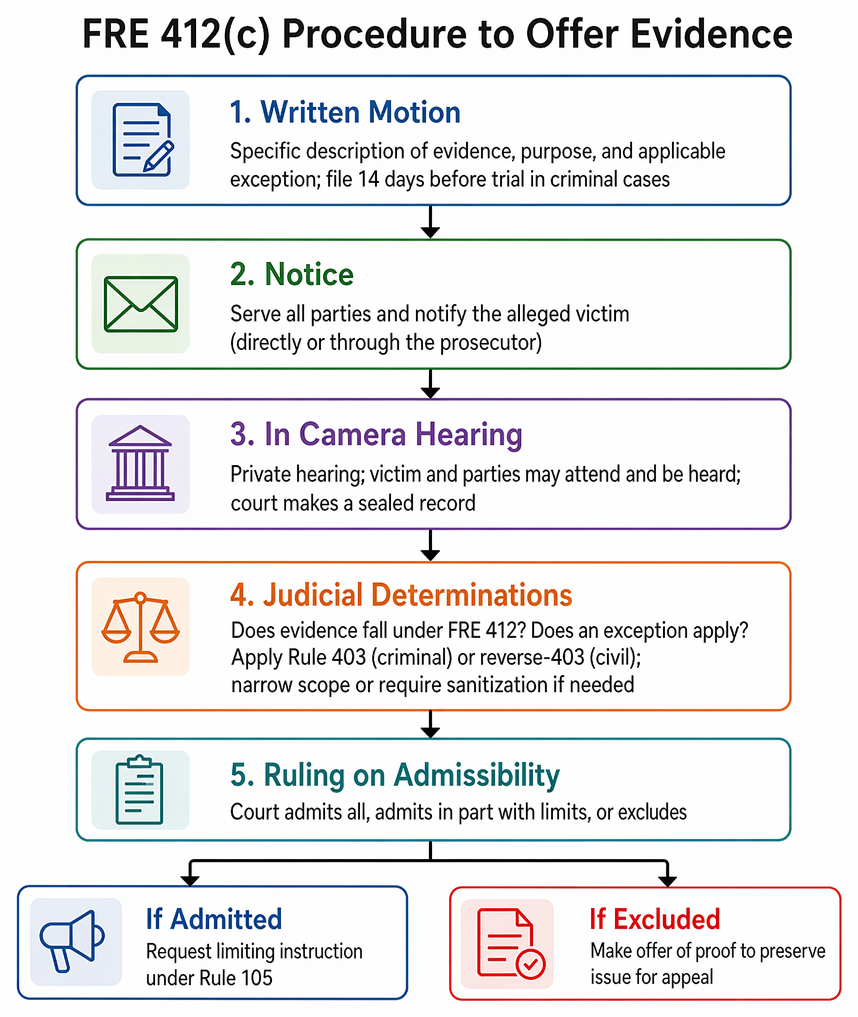
Specific-instance evidence may be admitted for source of semen or injury, prior conduct with the accused, or constitutional necessity.
Key Term: In Camera Hearing
A court proceeding held in private (typically in the judge’s chambers or a closed courtroom) outside the presence of the jury and public, used to decide sensitive evidentiary issues such as FRE 412 motions.
1. Written Motion
The party seeking to introduce the evidence must file a written motion:
- The motion must specifically describe the evidence and state the purpose for which it is offered.
- In criminal cases, the motion must be filed at least 14 days before trial unless the court, for good cause, sets a different time (for example, newly discovered evidence mid‑trial).
- In civil cases, the rule does not specify a deadline, but courts typically expect prompt filing once the need for the evidence is apparent.
- The motion should tie the evidence to a particular exception (for example, source of semen, prior sex with the accused, constitutional rights) or to the civil reverse‑403 standard.
Vague references to “sexual history” are not enough; specificity is required so that the court and victim can assess the proposed evidence.
Key Term: Good Cause
A flexible standard allowing the court to alter normal timing or procedural requirements when the moving party shows a legitimate, case‑specific reason—such as late discovery of relevant information or circumstances beyond counsel’s control.
2. Notice
The motion must be:
- Served on all parties, and
- The party must also notify the alleged victim, either directly or through the prosecutor (in criminal cases).
The victim has a right to be heard on the admissibility of their sexual history. Failure to provide notice can itself be grounds for exclusion, and it may delay the trial if the court must reopen the issue.
3. In Camera Hearing and Findings
Before admitting the evidence, the court must conduct an in camera hearing:
- The hearing is held outside the presence of the jury and, typically, the public.
- The victim and the parties are entitled to attend and argue, and the victim may be represented by counsel.
- The court must make a record of the hearing, which is usually sealed to protect privacy, but preserved for appellate review.
At the hearing, the judge:
- Determines whether the evidence falls within FRE 412 and, if so, whether any exception applies.
- Applies Rule 403 (in criminal cases) or the reverse‑403 standard (in civil cases).
- May narrow the scope of admissible evidence, exclude portions, or require use of sanitized descriptions.
- May decide to admit only part of what the proponent seeks, based on necessity and the least intrusive alternative that protects the defendant’s rights.
Key Term: Offer of Proof
A proffer by counsel, usually outside the jury’s presence, explaining what excluded evidence would show and why it should be admitted. It preserves an evidentiary issue for appeal if the judge excludes the evidence.
When the judge excludes FRE 412 evidence, the proponent should make an offer of proof during the in camera hearing, describing the excluded evidence and its relevance. This preserves the issue for appeal; without an offer of proof, appellate review is limited and the error is usually evaluated only for “plain error.”
Key Term: Plain Error
A clear and obvious legal error that affects substantial rights and seriously impacts the fairness, integrity, or public reputation of judicial proceedings, reviewed on appeal even if no timely objection or offer of proof was made. Exam Warning: On the MBE, a choice that says “inadmissible for failure to comply with FRE 412’s procedural requirements” can be the correct answer even if an exception substantively applies. Do not ignore the motion‑notice‑hearing steps.
Worked Example 1.7
In a rape prosecution, the defense learns during trial that the victim had consensual intercourse with another man the day before the alleged assault, which could explain the presence of semen. Defense counsel immediately seeks to question the victim on cross‑examination without having filed any prior motion.
Answer:
The defense has discovered potential source‑of‑semen evidence, which, substantively, could fit the 412(b)(1)(A) exception. However, FRE 412(c) imposes mandatory procedures that apply regardless of when the evidence comes to light. Counsel cannot simply begin cross‑examining in front of the jury. Instead, the defense must ask the court for leave to file a 412 motion out of time, showing “good cause” (recent discovery), must provide notice to the prosecutor and the alleged victim, and must request an in camera hearing. At that hearing, the court evaluates whether the evidence truly relates to the source of semen and whether its probative value is substantially outweighed by prejudice under Rule 403. Only if the court grants the motion may counsel cross‑examine the victim about the other intercourse in the jury’s presence. Defense counsel should also make a detailed offer of proof at the hearing to preserve any adverse ruling for appeal. On an exam, the best answer will stress that compliance with 412(c)’s motion‑notice‑hearing requirements is a prerequisite to any courtroom questioning.
Failure to follow these procedures can be an independent ground for exclusion, even if the evidence might otherwise meet an exception. Courts treat these requirements as mandatory, not optional.
Timing and Appellate Review
A few additional procedural points, drawn from general evidence principles:
- Objections and motions should be timely. If a party fails to invoke FRE 412 and evidence is admitted without challenge, the issue is usually reviewed only for plain error on appeal—a demanding standard.
- If the judge admits or excludes evidence after an in camera hearing, the opponent should:
- If evidence is admitted, request a limiting instruction under Rule 105.
- If evidence is excluded, ensure the offer of proof clearly captures what the evidence would have shown and why it matters.
Key Term: Harmless Error
An error that occurred at trial but did not affect the outcome or substantial rights of the parties; appellate courts will not reverse for harmless error, even if a rule such as FRE 412 was technically violated.
This preserves the record for appellate courts to decide whether any error affected substantial rights.
Limited Admissibility and Limiting Instructions
Sometimes evidence covered by FRE 412 is admissible for a limited, non‑propensity purpose (for example, alternative source of semen) but would be improper if used to show promiscuity or propensity to consent. In these situations, Rule 105 (limited admissibility) becomes important.
Key Term: Limited Admissibility (Rule 105)
When evidence is admissible for one purpose or against one party but not for another, the court, on request, must instruct the jury to consider the evidence only for the permissible purpose or as to the permissible party.
In a rape shield context, the judge might:
- Admit evidence of the victim’s prior sex with a third person solely to explain semen or injury.
- Forbid any argument that this shows promiscuity or a general willingness to have sex.
- Instruct the jury that they may consider the evidence only as to the narrow issue (for example, source of physical evidence or specific bias).
Courts presume that jurors follow limiting instructions, and such instructions help preserve the integrity of FRE 412 while still allowing constitutionally required evidence.
Worked Example 1.8
Defendant in a sexual assault case is allowed to introduce evidence that the victim had consensual intercourse with her boyfriend the night before, solely to explain semen. Defense counsel wants to argue in closing, “She slept with her boyfriend last night—she obviously consents to sex easily.”
Answer:
The court properly admitted the boyfriend‑intercourse evidence under 412(b)(1)(A) to explain the source of semen. That admissibility is strictly limited. Using the same evidence to argue that the victim has a sexual predisposition to consent—“she obviously consents to sex easily”—violates both the spirit and letter of FRE 412(a). The judge should prohibit such argument and, if necessary, remind counsel of the earlier ruling. The appropriate tool is a limiting instruction under Rule 105, given either at the time of admission or before deliberations, telling the jury they may consider the evidence only on the semen‑source issue and for no other purpose. If defense counsel persists in improper argument, the court may strike the argument, admonish the jury to disregard it, and in extreme cases consider sanctions or even a mistrial. On an exam, look for an answer that combines “admit the evidence for the narrow purpose” with “give a limiting instruction and forbid propensity argument,” rather than one that either allows broad use or excludes the evidence entirely.
If a party fails to request a limiting instruction, the trial judge has discretion to give one, but is not required to. On the exam, if a FRE 412 exception clearly applies but the evidence is dangerous, look for an answer choice that combines admission plus a limiting instruction rather than simple exclusion.
Distinction From Defendant's Conduct (FRE 413–415)
It is important on the MBE to distinguish:
- FRE 412 – limits evidence about the victim’s sexual behavior and predisposition; versus
- FRE 413–415 – expand admissibility of evidence about the defendant’s prior sexual assaults or child molestations.
Key Term: Other Sexual Assaults by Defendant (FRE 413–415)
Rules that allow, in sexual‑assault and child‑molestation cases, evidence that the defendant committed other sexual assaults or molestations, even to show propensity, subject to Rule 403.
Under FRE 413–415:
- In certain sexual‑assault or child‑molestation cases, the prosecution may introduce evidence that the defendant committed other sexual assaults or molestations, even for propensity purposes (to show that the defendant has a character trait for sexual violence).
- The usual character‑evidence ban of Rule 404(a) is relaxed for defendants; Rule 403 still applies, but the standard is generous to the proponent.
FRE 412 works in the opposite direction:
- It tightens admissibility rules for the victim’s sexual history, regardless of which party offers the evidence.
On an exam:
- If the fact pattern involves prior sexual acts of the defendant, think FRE 413–415 (plus Rule 403).
- If it involves sexual acts or reputation of the complainant, immediately think FRE 412 and its restricted framework.
Do not confuse these rules. A common distractor choice will mention FRE 412 when the evidence is actually about the defendant’s earlier sexual assaults; that evidence is typically governed by 413–415, not blocked by rape shield. Conversely, defense counsel cannot invoke 413–415 to admit a victim’s sexual history.
Common Exam Pitfalls and Borderline Issues
Several recurring issues appear in MBE fact patterns. Being able to classify them quickly is important.
1. Prior False Accusations
As noted earlier, evidence that the victim previously made false accusations of sexual assault is generally treated as going to truthfulness, not sexual behavior.
- Many courts (and bar examiners) analyze this under FRE 608(b) and Rule 403, not FRE 412.
- However, if the defense cannot show falsity (or at least a good‑faith factual basis for falsity), courts may treat the questioning as an attack on the victim’s sexual history and apply FRE 412.
On the MBE, such evidence is typically treated as not barred by 412, but it may still be excluded under Rule 403 if confusing, prejudicial, or lacking a solid basis. Look for facts indicating:
- A prior allegation was demonstrably false (for example, the accused had an airtight alibi, or the victim recanted under oath), or
- The defense has specific evidence suggesting falsity, not mere speculation.
If the fact pattern says only that the victim “previously made similar accusations,” with no suggestion they were false, FRE 412 likely applies and the evidence is barred.
2. Non‑Sexual Motive Evidence With Incidental Sexual Content
Some evidence incidentally involves sexual conduct but is offered for a clearly non‑sexual purpose, such as showing:
- The victim’s financial stake in a civil case.
- The victim’s bias due to a romantic relationship with a key witness.
- The victim’s fear or emotional state.
For example, suppose the victim is testifying against her former boyfriend and the defense seeks to show she is involved in a new relationship with the prosecutor. The core relevance is bias; the sexual element may be sanitized (for example, “romantic relationship with the prosecutor”) without explicit sexual details.
Courts still carefully consider FRE 412, but if the sexual aspect is tangential and the probative value on bias or motive is strong, the constitutional‑rights catch‑all may require admission (in criminal cases). In civil cases, the reverse‑403 test still applies, and courts will often admit a limited, non‑sexual description of the relationship while excluding explicit details.
3. Impeachment by Contradiction vs. Sexual Predisposition
As mentioned earlier:
- When the victim makes sweeping claims like “I am extremely conservative about sex and would never engage in casual sex,” the defense may seek to contradict that with specific sexual acts.
- This is still sexual‑predisposition evidence and triggers FRE 412.
In civil cases, the victim may have “placed reputation in controversy,” making reputation evidence more admissible under 412(b)(2). In criminal cases, only the constitutional exception is realistically available, and courts often admit only narrowly tailored contradiction evidence if necessary to prevent the jury from being misled.
On the MBE, when the victim has volunteered far‑reaching sexual‑character claims, the best answer often notes:
- FRE 412 applies.
- The court may allow limited contradiction evidence only if exclusion would seriously mislead the jury or significantly impair the defense.
4. Scope of “Proceeding Involving Alleged Sexual Misconduct”
Points to remember:
- FRE 412 applies broadly to any case where sexual misconduct is alleged as part of a claim or defense—not just criminal rape trials.
- It does not apply in:
- Pure property or contract disputes that happen to mention sex.
- Tort cases involving non‑sexual physical injuries where sex is irrelevant except as background.
- Civil rights cases where the misconduct at issue is non‑sexual, even if sexual insults were used in passing.
You may see exam questions where a plaintiff alleges excessive force by police and the defense wants to introduce the plaintiff’s sexual history to attack credibility; FRE 412 does not apply because there is no sexual misconduct claim, but Rule 403 and ordinary character rules will almost certainly exclude the evidence.
5. Interaction With Other Evidence Rules
A few important intersections:
- Rule 404(a): FRE 412 overrides the normal ability of criminal defendants to offer character evidence of a victim’s relevant trait when the trait is sexual in nature. The defendant cannot avoid 412 by labeling the evidence as victim‑character evidence under 404.
- Rule 404(b): Defendants sometimes try to admit a victim’s prior sexual conduct as “other‑acts” evidence to show motive, opportunity, or plan. FRE 412 still applies and will usually bar such evidence unless the constitutional exception is triggered.
- Rule 608 and 609: General character for truthfulness (608(a)) and prior convictions (609) may be used to impeach the victim like any other witness, as long as the specific facts introduced are about honesty or crime, not sexual behavior. A prior conviction for prostitution, for example, might be excluded under 412 if offered to imply sexual predisposition rather than truthfulness.
- Rule 611: The court’s power to control the mode and order of interrogation is often used to protect the victim from harassment or undue embarrassment, alongside FRE 412. Leading questions or repetitive, invasive questioning about sexual matters may be curtailed even when some evidence is admitted.
6. State Law vs. Federal Rules
The MBE uses the Federal Rules of Evidence. Many states have their own rape shield statutes, which may:
- Be broader or narrower than FRE 412.
- Include additional exceptions (for example, for pattern evidence of consent).
- Apply slightly different balancing tests.
For exam purposes, apply FRE 412 as written unless the question explicitly says otherwise. If a question describes a “state rape shield statute” that differs from 412, follow the statute as stated in the problem.
Worked Example 1.9
In a federal sexual‑assault prosecution, the victim testifies on direct examination, “I am very religious and have always lived a morally conservative life. I would never have sex outside marriage.” The defense seeks to introduce evidence that, two months before the incident, the victim had consensual sex with a boyfriend she was not married to, purely to contradict her statement.
Answer:
This is a criminal sexual‑assault case, so FRE 412 applies. The victim’s sweeping statement about never having sex outside marriage is a broad claim about her sexual morality. The defense proffer—consensual sex with an unmarried boyfriend—is specific sexual‑behavior evidence with a third party. It is offered solely to contradict her assertion and thus is sexual‑predisposition evidence within 412(a). It does not fit the source‑of‑evidence exception (no semen or injury is at issue) and is not prior sex with the accused. The defense’s only possible route is the constitutional‑rights exception in 412(b)(1)(C), arguing that without contradiction the jury will be badly misled about her credibility. Courts are divided. Some would allow narrowly tailored contradiction evidence, reasoning that V voluntarily put her sexual character at issue and that complete exclusion could undermine the truth‑finding function. Others would exclude the evidence, noting that the inconsistency relates to collateral sexual morality and is not central to any defense theory like consent or bias. On the MBE, the safest choice usually says: 412 applies; any admissibility would depend on 412(b)(1)(C) and would be restricted and carefully limited, not a free‑for‑all on sexual history.
Worked Example 1.10
In a civil wrongful‑termination suit, the plaintiff alleges she was fired after rejecting her boss’s sexual advances. The employer offers evidence that, months after her termination, she began a consensual romantic relationship with a different supervisor at another company, arguing this shows she is not offended by workplace relationships.
Answer:
This is a civil case involving alleged sexual misconduct (quid pro quo harassment leading to termination), so FRE 412(b)(2) applies. The employer’s proffer concerns plaintiff’s later sexual relationship with a different supervisor at a different job. That is specific sexual behavior and sexual predisposition evidence. The asserted relevance is to “welcomeness” or sincerity of her distress. The probative value is low: a consensual relationship in a later, different workplace says little about whether earlier advances from her former boss were unwanted or coercive, especially when the earlier boss controlled her job and the later supervisor might not. The risk of harm and unfair prejudice is high—the jury might reason that because she later dated a supervisor, she could not have been harassed earlier. Under the reverse 403 test, the evidence is admissible only if probative value substantially outweighs harm and prejudice. Here, it plainly does not, so the evidence should be excluded. On an exam, focus on the weak logical link between the later relationship and the earlier alleged harassment.
Additional Constitutional and Procedural Considerations
Beyond the text of FRE 412, several constitutional and procedural themes recur in case law and make good exam fodder.
Constitutional Tension and Representative Patterns
The central constitutional tension is between:
- The Confrontation Clause and Due Process rights of the accused to cross‑examine witnesses and present a defense; and
- The state’s interest in protecting victims and the integrity of sexual‑assault prosecutions.
Courts generally uphold FRE 412 as a valid, content‑neutral rule of evidence. However, when application of 412 would effectively block a key defense theory, courts are more likely to find that the rule must give way.
Typical patterns where constitutional concerns are strongest include:
- Bias/alternative culprit theories – Where the only way to show that someone else had a strong motive to lie or commit the crime is to reference a sexual relationship.
- Impeachment of critical factual assertions – For example, when the victim’s narrative of events cannot be effectively challenged without referring to sexual behavior that is tightly intertwined with the version of events.
- Restrictions so broad they prevent meaningful cross‑examination – For example, forbidding any mention of a relationship between the victim and a key witness, even in sanitized terms, such that the jury hears a wholly incomplete story.
In these scenarios, courts often stress that FRE 412 must be interpreted in a way that avoids categorical bars on relevant defense evidence. For exam purposes, when a fact pattern emphasizes that the defense has no other route to present a core theory, think 412(b)(1)(C).
Error Preservation and Appellate Review
Rape shield issues frequently arise on appeal. Understanding how errors are reviewed can help you choose the right answer when multiple rules are implicated.
- If a party timely objected or made a proper offer of proof and the trial court ruled definitively, the appellate court reviews the ruling for abuse of discretion.
- If the party failed to object or comply with 412(c), the appellate court usually applies plain error review and will reverse only if:
- The error was clear and obvious under current law.
- It affected substantial rights (likely changed the outcome).
- It seriously affected the fairness or integrity of the proceedings.
When a court admits or excludes sexual‑history evidence improperly, appellate courts distinguish between:
- Harmless error – For example, a technical misapplication of 412 where the same facts were otherwise properly before the jury or the evidence was cumulative.
- Prejudicial error – For example, extensive evidence of the victim’s past sexual partners admitted to suggest promiscuity, when no exception applied and the defense emphasized that theme in closing.
On the MBE, you may see an answer choice that acknowledges a 412 violation but concludes that reversal is not required because the error was harmless. That choice may be correct if the fact pattern stresses overwhelming evidence of guilt and minimal reliance on the improper material.
Motions in Limine and Trial Management
Because FRE 412 issues are sensitive, counsel often raise them via motions in limine before trial:
- Prosecutors move to exclude anticipated sexual‑history evidence.
- Defendants move for pre‑approval of particular lines of questioning.
These motions allow:
- The judge to decide 412 issues at a time when the jury is not present.
- The victim to be notified and, in some jurisdictions, to obtain counsel.
- Both sides to plan direct and cross‑examination without risking inadvertent violations in front of the jury.
Key Term: Motion in Limine
A pretrial request that certain evidence be ruled admissible or inadmissible in advance, reducing the risk of prejudice or surprise at trial and clarifying the boundaries of permissible questioning.
If a motion in limine is denied, counsel must still object at trial when the evidence is offered unless the ruling was explicit and definitive. Failure to object may transform a preserved issue into one reviewed only for plain error.
Sanitizing Evidence and Narrow Tailoring
Even when sexual‑history evidence is admitted, courts prefer to sanitize it to limit unnecessary detail.
Key Term: Sanitizing Evidence
The practice of admitting only the minimum level of detail necessary to convey the relevant point, while omitting graphic or highly private sexual specifics, often by using neutral terms like “relationship” rather than describing particular acts.
Examples of sanitization include:
- Describing an affair as a “romantic relationship” without specifying the number or nature of sexual acts.
- Stating that the victim “was intimate with A during the relevant month,” rather than detailing explicit conduct.
- Allowing the jury to learn that semen could have come from a third party without exploring the circumstances of that sexual encounter.
On exam questions, if you see a court faced with a genuine constitutional need for sexual‑history evidence, the best answer often involves admitting a sanitized version plus a limiting instruction.
Special Contexts: Child Victims and Trafficking Cases
In cases involving child victims or sex trafficking, FRE 412 still applies, but several practical considerations arise:
-
Child victims – Courts are particularly protective of young complainants. They may more readily exclude marginal sexual‑history evidence and tightly control cross‑examination under Rule 611.
-
Prior abuse – Evidence that a child has previously been abused may be relevant to explain medical or psychological findings; courts then must distinguish between:
- Admissible evidence of prior abuse (not sexual behavior by the child, but criminal acts by others).
- Inadmissible suggestions that the child is “damaged” or predisposed to fabricate.
-
Trafficking – In trafficking cases, defense counsel might seek to show that the victim previously engaged in sex work voluntarily. FRE 412 typically bars such evidence when offered to suggest consent or predisposition, although there may be narrow relevance to damages or specific defenses.
In all these contexts, the core FRE 412 analysis remains the same; the heightened vulnerability of the victim mainly affects the harm and prejudice side of the balancing.
Advanced Exam Strategy for FRE 412 Questions
Because FRE 412 questions often combine multiple evidence concepts, having a structured approach is very important.
Step 1: Identify the Target of the Evidence
Ask first: Whose conduct is at issue?
- Victim’s sexual history or character → start with FRE 412.
- Defendant’s prior sexual assaults → think FRE 413–415.
- Third party’s sexual behavior unrelated to victim → likely outside 412; analyze under general rules.
Incorrectly starting with 412 when the evidence concerns the defendant is a common exam trap.
Step 2: Confirm That the Case Involves Sexual Misconduct
Look for allegations of:
- Sexual assault or attempted assault.
- Non‑consensual sexual contact.
- Sexual abuse of minors.
- Sex trafficking or exploitation.
- Sexual harassment or hostile environment in civil suits.
If the claim at issue is something else (battery unrelated to sex, contract dispute, defamation about adultery), FRE 412 likely does not apply.
Step 3: Classify the Evidence
Determine whether the evidence is:
- Other sexual behavior – specific acts, use of birth control, sexual communications.
- Sexual predisposition – general reputation for promiscuity, sexual orientation, style of dress, online persona.
If the answer is yes, and the evidence concerns the alleged victim, 412(a) presumptively bars it.
Step 4: Check Which Side of the “Criminal vs. Civil” Line You Are On
- In criminal cases, ask whether the evidence fits one of the three 412(b)(1) exceptions.
- In civil cases, apply the reverse‑403 test and check whether reputation evidence has been put in issue by the victim.
Remember that different standards apply; do not apply the criminal exceptions in a civil harassment problem.
Step 5: Look for Physical Evidence, Prior Sex With Accused, or Constitutional Necessity
For a criminal case, ask three focused questions:
-
Is there semen, injury, pregnancy, or other physical evidence that could plausibly be explained by sex with a third person? → If yes, consider 412(b)(1)(A).
-
Is the evidence about prior sex between victim and defendant, offered to support or rebut a consent defense? → If yes, consider 412(b)(1)(B).
-
Is the evidence essential to show bias, motive, or an alternative theory, with no non‑sexual route available? → If yes, consider 412(b)(1)(C).
If you cannot honestly answer yes to any of these, the correct exam answer will almost always be “inadmissible under 412.”
Step 6: Overlay Rule 403 and Rule 105
Even if a 412(b) exception applies:
- Ask whether the evidence is still subject to Rule 403 in criminal cases or reverse 403 in civil cases.
- Consider whether a limiting instruction under Rule 105 is appropriate.
- Watch for answer choices that combine admission plus limiting instruction—these often reflect the “best” judicial response when rights and prejudice collide.
Step 7: Mind the Procedure
Finally, check whether:
- A written motion was filed.
- Notice was given to the victim.
- An in camera hearing was held.
If a party tries to spring sexual‑history evidence during trial without following these steps, a correct exam answer may focus on procedural noncompliance rather than the substance of the exception.
Key Term: Sexual Misconduct
A broad category of unwanted or abusive sexual conduct that triggers FRE 412 when alleged as part of a charge, claim, or defense, including assaultive acts and harassment with a sexual component. Key Term: Good Cause
A sufficient, case‑specific justification—such as late discovery of evidence or an unexpected development at trial—that allows a court to relax or modify timing and procedural requirements under FRE 412(c). Key Term: Harmless Error
A trial error that did not affect the outcome or substantial rights; even if FRE 412 was misapplied, an appellate court will not reverse if the error was harmless. Key Term: Plain Error
A clear, obvious error that affects substantial rights and seriously impacts the fairness of the proceedings, reviewable on appeal even without a proper objection or offer of proof. Key Term: Sanitizing Evidence
The practice of admitting only minimally necessary and neutrally framed sexual‑history evidence while omitting graphic or unnecessary details, in order to reduce prejudice and protect privacy.
These concepts are not always named in FRE 412 itself, but they shape how courts apply it and often appear indirectly in exam questions.
Key Point Checklist
This article has covered the following key knowledge points:
-
FRE 412 (Rape Shield Law) applies in civil and criminal proceedings involving alleged sexual misconduct and protects alleged victims, not defendants.
-
The general rule excludes evidence of an alleged victim's other sexual behavior and sexual predisposition, whether offered substantively or for impeachment, and regardless of which party offers it.
-
“Sexual behavior” involves specific sexual acts; “Sexual predisposition” covers sexual reputation, character, and general sexual tendencies, including lifestyle and expressive conduct.
-
Evidence offered to show that the victim is “the kind of person” who consents or lies about rape is classic propensity inference and is squarely barred by 412(a).
-
In criminal cases, specific exceptions exist for:
- Sexual behavior showing an alternative source of semen, injury, pregnancy, or physical evidence (412(b)(1)(A)).
- Prior sexual behavior with the accused, when offered to prove consent (or by the prosecutor for another relevant purpose) (412(b)(1)(B)).
- Evidence whose exclusion would violate the defendant's constitutional rights, particularly the right to confront witnesses and present a defense (412(b)(1)(C)).
-
In civil cases, evidence of the victim’s sexual behavior or predisposition is admissible only under a reverse 403 balancing test, where probative value must substantially outweigh harm to the victim and unfair prejudice; reputation evidence is allowed only if the victim places it in controversy.
-
FRE 412 requires strict procedural compliance: a written motion, notice to the parties and victim, and an in camera hearing with a sealed record.
-
Failure to comply with 412(c) can itself justify exclusion, even when an exception might otherwise apply.
-
Parties should make an offer of proof during the in camera hearing if evidence is excluded, to preserve the issue for appeal under Rule 103.
-
When FRE 412 evidence is admitted for a narrow purpose, limited admissibility and Rule 105 instructions are critical to prevent improper propensity use and to cabin counsel’s arguments.
-
FRE 412’s protections for the victim differ from FRE 413–415, which make the defendant’s prior sexual offenses more admissible, including for propensity; do not confuse these distinct frameworks.
-
Prior false accusations are generally treated as credibility evidence rather than sexual behavior and are usually analyzed outside FRE 412, though they remain subject to Rules 608(b), 403, and constitutional constraints.
-
Courts may admit otherwise barred evidence under FRE 412(b)(1)(C) when necessary to protect constitutional rights, but this exception is narrow and fact‑specific, often requiring that no non‑sexual alternative exists to present the defense theory.
-
Evidence that merely incidentally involves sex but is offered to prove bias or a non‑sexual fact may be admitted in a sanitized form, especially when constitutional rights are implicated.
-
FRE 412 can override the normal operation of Rules 404 and 608 when the evidence is sexual‑character based, but it does not displace impeachment evidence clearly aimed at truthfulness rather than sexual conduct.
-
On the MBE, be alert to distractors that misapply FRE 412 to evidence about the defendant or that ignore the reverse‑403 standard in civil cases, and always check whether any 412(b) exception truly fits the proffered evidence.
-
Exam fact patterns often hinge on whether there is physical evidence to explain (source‑of‑evidence exception), prior sex with the defendant, or a concrete defense theory (like bias) that cannot be told without limited sexual‑history evidence.
-
Motions in limine and in camera hearings are the main tools for handling rape shield issues before trial; failure to use them can forfeit objections or narrow the scope of review.
-
Appellate courts distinguish between harmless error and prejudicial misapplications of FRE 412, and will apply plain error review when the issue was not properly preserved.
-
Courts routinely sanitize evidence to admit only minimal sexual‑history details necessary for a valid exception, often combined with strong limiting instructions to protect the victim and confine the jury’s use of the evidence.
Key Terms and Concepts
- Rape Shield Law
- Sexual Misconduct Proceeding
- Sexual Misconduct
- Other Sexual Behavior
- Sexual Predisposition
- Alleged Victim
- General Rule of Exclusion (FRE 412(a))
- Sexual Behavior Evidence
- Sexual Predisposition Evidence
- Prior False Accusations
- Specific Instances of Sexual Behavior
- Source-of-Physical-Evidence Exception
- Prior-Sex-with-Accused Exception
- Constitutional‑Rights Exception (FRE 412(b)(1)(C))
- Reverse 403 Balancing Test
- Reputation Evidence (FRE 412(b)(2))
- In Camera Hearing
- Motion in Limine
- Good Cause
- Offer of Proof
- Limited Admissibility (Rule 105)
- Harmless Error
- Plain Error
- Sanitizing Evidence
- Other Sexual Assaults by Defendant (FRE 413–415)
- Impeachment by Contradiction
- Propensity Inference
- Welcomeness