Learning Outcomes
This article explains the constitutional rules governing appointment and removal of federal officials in an exam-focused way, including:
- How the Appointments Clause structures federal personnel power and why it is exclusive.
- How to distinguish principal officers, inferior officers, and mere employees using supervision, duties, and tenure tests.
- Which constitutional actors (President, Senate, courts of law, and department heads) may appoint different categories of officers, and which actors may not.
- How to evaluate congressional attempts to influence appointment, such as vesting appointment in legislative officers or private actors.
- How the President’s removal power operates for purely executive officials versus independent agencies, and when for-cause protection is constitutionally permissible.
- How impeachment, legislative veto devices, and other congressional “control” mechanisms interact with separation of powers and why most direct congressional removal tools are invalid.
- How to approach common MBE-style fact patterns by spotting who is appointing, who is removing, what powers the official exercises, and whether Congress has aggrandized itself.
MBE Syllabus
For the MBE, you are required to understand appointment and removal of federal officials within the separation of powers framework, with a focus on the following syllabus points:
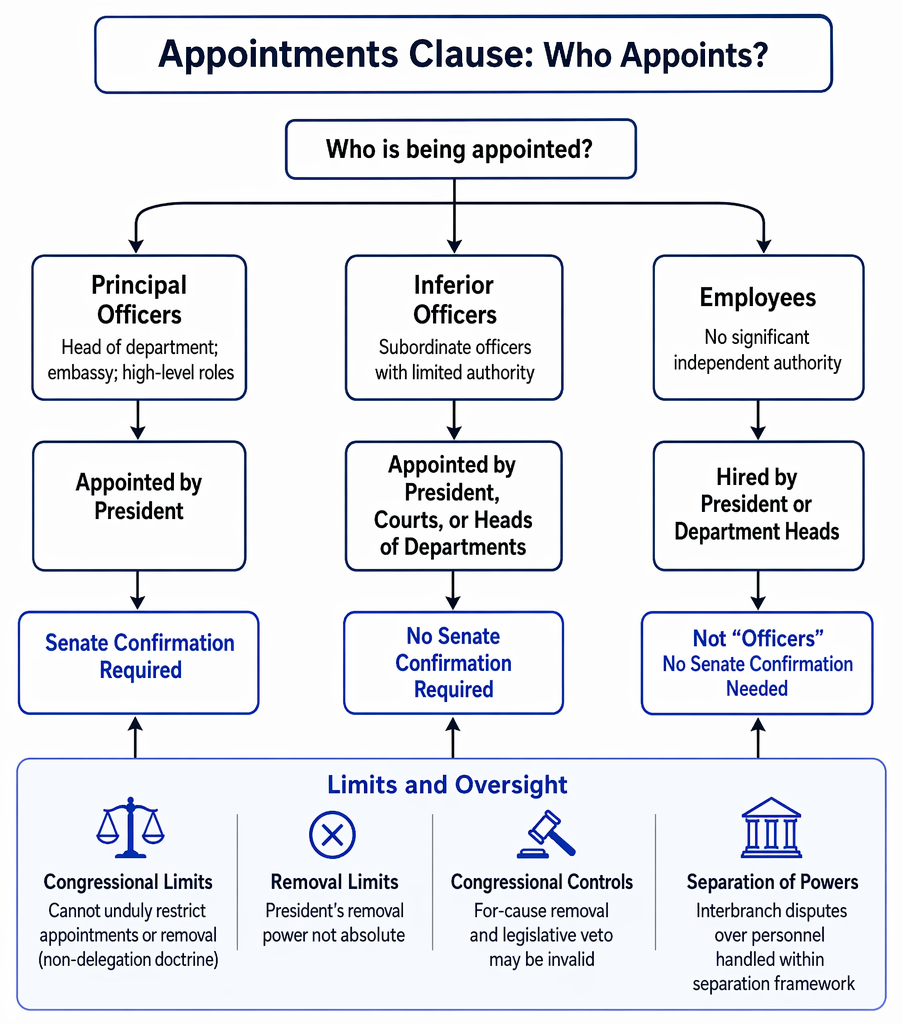
Federal appointment rules classify positions and specify valid appointing authorities, recess appointments, and the prohibition on congressional appointment of officers.
- The Appointments Clause: who appoints principal and inferior officers.
- The difference between principal officers, inferior officers, and employees.
- The process for Senate confirmation and the President’s appointment powers.
- Congressional limits on appointment and removal (including the non-delegation doctrine).
- The President’s removal power and its limits.
- Congressional attempts to restrict or control removal (e.g., for-cause removal, legislative veto).
- The role of separation of powers in interbranch disputes over personnel.
Test Your Knowledge
Attempt these questions before reading this article. If you find some difficult or cannot remember the answers, look more closely at that area during your revision.
-
Under the Appointments Clause, who must confirm the President’s nomination of a federal cabinet secretary?
- a) The House of Representatives
- b) The Senate
- c) The Supreme Court
- d) The President alone
-
Which of the following is true regarding Congress’s power to remove executive officials?
- a) Congress may remove any executive official by simple resolution.
- b) Congress may remove executive officials only through impeachment.
- c) Congress may remove inferior officers by statute.
- d) Congress may remove principal officers by majority vote.
-
The President’s power to remove executive officials is:
- a) Unlimited for all federal officials.
- b) Limited by Congress for certain independent agencies.
- c) Subject to Senate approval in all cases.
- d) Only available for judicial officers.
-
Congress passes a law giving itself the power to appoint members of a new federal regulatory commission. Is this constitutional?
- a) Yes, if the commission is independent.
- b) Yes, if the commission is part of the legislative branch.
- c) No, because Congress cannot appoint executive officers.
- d) No, unless the President consents.
Introduction
The U.S. Constitution separates governmental power among three branches. The appointment and removal of federal officials is a core area where these powers intersect and sometimes conflict. Article II’s Appointments Clause sets out who may appoint “Officers of the United States,” while removal rules have been developed largely through Supreme Court decisions and structural separation-of-powers principles.
On the MBE, questions in this area typically ask whether a particular appointment or removal scheme is constitutional, or which branch may control a given officer. That analysis almost always turns on three things:
- Whether the person is a principal officer, an inferior officer, or merely an employee.
- Which constitutional actors (President, Senate, courts, department heads, Congress) are involved.
- Whether Congress has intruded into executive appointment or removal in ways the separation of powers does not permit.
Why Appointment and Removal Matter for Separation of Powers
Appointment and removal are not just technical personnel questions. They determine:
- Who controls the exercise of federal power.
- Which branch is politically accountable for federal action.
- Whether Congress has tried to aggrandize its own power by controlling those who execute the laws.
If Congress can both create an office and control who fills it (or when the occupant leaves), it effectively blends legislative and executive power. The Court has repeatedly treated that as inconsistent with the Constitution’s structure.
For MBE purposes, knowing the doctrinal labels and cases helps, but you mainly need clean rules of thumb:
- Only the President (and limited designees) may appoint and remove executive officers.
- Congress may structure offices and limit removal in narrow ways, but it may not appoint executive officers or reserve a continuing control power such as a legislative veto or removal by resolution.
- The Senate’s advice and consent power is approval or disapproval, not a power to appoint or to share in removal.
Constitutional Framework and the Appointments Clause
Article II, Section 2 provides:
“[The President] shall nominate, and by and with the Advice and Consent of the Senate, shall appoint Ambassadors, other public Ministers and Consuls, Judges of the Supreme Court, and all other Officers of the United States, whose Appointments are not herein otherwise provided for, and which shall be established by Law: but the Congress may by Law vest the Appointment of such inferior Officers, as they think proper, in the President alone, in the Courts of Law, or in the Heads of Departments.”
This text yields several exam-tested concepts.
Key Term: Appointments Clause
The Article II provision that governs how “Officers of the United States” are appointed, distinguishing principal from inferior officers and specifying who may appoint each. Key Term: Officer of the United States
A federal official who exercises significant authority under federal law and must be appointed in a manner consistent with the Appointments Clause.
Two structural points to remember:
- The Appointments Clause is exclusive: if someone is an “officer,” they must be appointed in one of the constitutionally prescribed ways. Congress cannot invent alternative mechanisms (e.g., appointment by committee chairs or by a single House of Congress).
- Congress creates offices by statute (deciding that an office exists and defining its powers), but Congress does not fill them. Filling them is an executive or judicial function governed by Article II.
Principal Officers, Inferior Officers, and Employees
The Constitution itself distinguishes “principal” and “inferior” officers, but not “employees.” The Supreme Court has supplied functional tests to distinguish these categories.
Principal Officers
Key Term: Principal Officer
A high-level federal official (e.g., cabinet secretary, ambassador, Supreme Court Justice) who answers only to the President and must be appointed by the President with Senate confirmation.
Principal officers typically:
- Exercise significant authority under federal law.
- Are supervised only by the President (no intermediate supervisor).
- Often have nationwide responsibilities or ultimate decision-making power within an area.
Classic examples:
- Cabinet secretaries (e.g., Secretary of State, Attorney General).
- Ambassadors and other high-ranking diplomats.
- Federal judges (including Supreme Court Justices and lower federal court judges).
- Many agency heads (e.g., the Director of the FBI, the Administrator of the EPA).
The Court has emphasized that principal officers must be appointed by presidential nomination plus Senate confirmation. Congress may not re-label a principal officer as “inferior” merely to avoid Senate involvement.
Inferior Officers
Key Term: Inferior Officer
A federal official who is subordinate to at least one other officer and may have limited duties, limited jurisdiction, or limited tenure. Congress may authorize their appointment by the President alone, a court, or a department head.
In deciding if an officer is “inferior,” the Court looks at several factors (no single factor is dispositive):
- Is the officer directed and supervised by higher officers who were appointed by the President and confirmed by the Senate?
- Does the officer have limited duties (rather than broad policymaking authority)?
- Is the officer’s jurisdiction limited (geographically or functionally)?
- Does the officer have limited tenure (e.g., appointed for a finite term, to complete a particular task)?
Examples commonly treated as inferior officers:
- U.S. magistrate judges.
- Certain administrative law judges.
- Independent or special counsels with limited mandates.
- Some deputy or regional directors within federal agencies.
On the MBE, if the person is clearly supervised and does not set nationwide policy, they are usually treated as an inferior officer.
Employees
Key Term: Employee
A federal worker who does not exercise significant authority under federal law. Employees are hired under ordinary personnel rules and are not subject to the Appointments Clause.
Employees:
- Perform ministerial or support tasks.
- Do not make binding decisions on behalf of the United States.
- Need not be appointed by the President, courts, or department heads. They may be hired through civil-service systems.
Examples: file clerks, mailroom staff, most policy analysts, many line attorneys.
The key Supreme Court formulation is that “officers” exercise significant authority under federal law; employees do not. If the person can issue binding decisions, enter final orders, or wield coercive government power, they are more likely an officer.
On the MBE, if a question says that someone is “an officer of the United States,” assume the Appointments Clause applies. If the position is described in routine terms with no decision-making authority (e.g., file clerk, staff analyst), it is more likely an employee.
Who May Appoint Whom
Under the Appointments Clause:
- Principal officers must be:
- Nominated by the President, and
- Confirmed by the Senate (the “advice and consent” role).
Key Term: Advice and Consent
The Senate’s power to approve or reject the President’s nominations of principal officers. It is a veto or approval power, not a power to appoint directly.
Congress cannot change this formula for principal officers. It may:
- Decide which positions count as principal officers by structuring them with broad, final authority.
- Decide whether to create a particular office at all.
But once an office is of principal status, the appointment path is fixed: presidential nomination and Senate confirmation.
- Inferior officers may be:
- Appointed by the President with Senate confirmation (default rule), or
- If Congress so provides by statute, appointed by:
- The President alone,
- The “Courts of Law,” or
- The “Heads of Departments.”
Key Term: Department Head
The leader of an executive department (e.g., Secretary of State, Attorney General) who may be given statutory power to appoint inferior officers. Key Term: Executive Officer
A federal officer who executes or enforces federal law on behalf of the United States; only such officers may exercise executive power, and their appointment and removal are constrained by Article II.
Important limits for MBE purposes:
- Congress chooses which of the three permissible appointers (President alone, courts, department heads) may appoint a particular inferior officer.
- Congress may not itself appoint either principal or inferior executive officers.
- Congress may not assign appointment to persons who are not the President, a court of law, or a department head (e.g., committee chairs, the Speaker, or private organizations).
So a statute that says “the Speaker of the House shall appoint the members of the Federal Energy Enforcement Board” is unconstitutional, even if the Board is described as “independent.”
Congress’s Limits: Who Cannot Appoint
Congress may:
- Create offices by statute.
- Define duties, jurisdiction, and tenure of new offices.
- Decide where to vest appointment of inferior officers (President alone, courts, department heads).
Congress may not:
- Appoint principal officers.
- Appoint inferior officers exercising executive power.
- Give appointment power to its own officers (e.g., Speaker, President pro tempore) for executive or judicial positions.
- Give appointment power to private entities.
The Court has invalidated structures where Congress attempted to appoint members of bodies exercising significant executive power, emphasizing that only constitutionally specified actors may appoint officers.
Just as important, Congress may not give executive power (enforcement, prosecution, or rule implementation) to any officer whom Congress can hire or fire. If Congress can remove an official (other than by impeachment), that official may not wield executive power.
This reflects the broader separation-of-powers principle: those who execute the laws must remain within the executive branch, under presidential control.
Appointment of Employees
Employees do not fall under the Appointments Clause. They are typically:
- Hired by agencies under civil-service laws.
- Not subject to presidential nomination or Senate confirmation.
- Removable under civil-service rules, not constitutional removal rules.
However, exam questions sometimes mislabel an “employee” as an “officer” to force you into Appointments Clause analysis. If the question calls someone an officer, treat them as such for Appointments Clause purposes unless facts clearly indicate otherwise.
Senate’s Role and the Recess Appointment Power
The Senate’s role is limited to:
- Giving or withholding advice and consent on the President’s nominees for principal offices.
- It has no power to appoint or remove executive officers, and no continuing control over them beyond the initial confirmation.
The Senate may:
- Reject nominees.
- Delay or refuse to hold hearings on nominees.
But it may not:
- Insist on sharing in removal decisions.
- Condition confirmation on unconstitutional terms (e.g., “we confirm, but only if you agree not to remove this officer without our consent”).
Recess Appointments
Key Term: Recess Appointment
A temporary presidential appointment made while the Senate is in recess; it lasts until the end of the Senate’s next session and does not require immediate Senate confirmation.
If the Senate is in recess, the President may make recess appointments:
- To fill vacancies that exist during a Senate recess.
- Recess appointees may serve without Senate confirmation until the end of the next Senate session.
Limitations for exam purposes:
- Recess appointments are temporary and cannot be used to permanently bypass Senate confirmation.
- Once the Senate returns and the recess term expires, the President must submit the nominee through the regular advice-and-consent process for them to continue in office.
- Modern case law narrows what counts as a “recess” but the MBE typically uses the simple model: if the Senate is genuinely away, the power is available.
Recess appointments are a safety valve for vacancies, but they do not alter the basic rules for principal and inferior officers.
The President’s Removal Power
The Constitution is silent about removal, but separation-of-powers principles supply a default rule:
- The President must have adequate control over those who execute the laws to fulfill the Article II “take care” duty.
Key Term: Take Care Clause
The Article II provision requiring the President to “take Care that the Laws be faithfully executed,” which supports a general presidential power to supervise and remove executive officers.
From this, the Court has inferred:
- The President generally may remove executive officers he appoints.
- For purely executive principal officers (e.g., cabinet secretaries), Congress may not significantly restrict the President’s removal power (no for-cause restrictions).
- For certain independent agencies performing quasi-legislative or quasi-judicial functions (e.g., multi-member commissions), Congress may protect members with “for-cause” removal provisions, so long as the President retains sufficient ability to ensure faithful execution of the laws.
Key Term: For-Cause Removal Protection
A statutory rule allowing removal of an official only for specified reasons such as inefficiency, neglect of duty, or malfeasance. Key Term: Independent Agency
A regulatory body typically headed by a multi-member commission whose members may enjoy for-cause removal protection; they often perform quasi-legislative or quasi-judicial functions.
For MBE purposes, apply these simplified rules:
-
Purely executive principal officers (cabinet-level positions and similar):
- President may remove at will.
- Congress may not limit removal, other than via impeachment.
-
Members of independent regulatory commissions (multi-member boards performing quasi-legislative or quasi-judicial functions):
- Congress may grant for-cause removal protection.
- President must show statutory cause to remove.
-
Inferior officers:
- May be given for-cause protection where doing so does not excessively insulate them from presidential control.
- Double insulation (officer protected by for-cause removal from another officer who is himself for-cause protected) raises serious constitutional problems.
Congress’s power here is limited: removal restrictions must not so insulate officers that the President cannot ensure faithful execution of the laws. On the exam, if an officer exercises substantial executive authority and is separated from the President by multiple layers of for-cause protection, the structure is likely unconstitutional.
Congressional Limits on Removal
Congress may:
- Provide for-cause protection for certain independent agencies and some inferior officers.
- Structure offices and define terms, duties, and procedures.
- Use impeachment to remove federal officers for serious misconduct.
Congress may not:
- Directly remove executive officials by resolution or ordinary statute.
- Share in removal decisions (e.g., require Senate consent for removal).
- Give a congressional committee or a single House the power to veto removals or require removal of particular officials.
- Place executive power in officials who are removable by Congress outside impeachment.
Key Term: Impeachment
A process by which the House, by majority vote, formally accuses a federal officer of treason, bribery, or other high crimes and misdemeanors, followed by a Senate trial requiring a two-thirds vote to convict and remove.
In more detail:
-
Impeachment in the House:
- Simple majority vote to impeach (i.e., to accuse).
-
Trial in the Senate:
- Two-thirds vote required to convict.
- Effect of conviction: removal from office (and possible disqualification from future office); no additional criminal penalty.
Congress has no other constitutional mechanism to remove Article II officers. Any attempt to create a legislative removal process short of impeachment (e.g., removal by joint resolution, removal by a committee) violates separation of powers.
Legislative Veto and Related Devices
Congress sometimes tries to retain ongoing control over executive action by “legislative veto” provisions.
Key Term: Legislative Veto
A statutory device by which Congress purports to overturn or block executive actions by resolution, often by one House or a committee, without passing a new law through bicameralism and presentment.
Legislative vetoes are unconstitutional because they allow Congress to alter legal rights and obligations without:
- Passage by both Houses (bicameralism), and
- Presentment to the President for signature or veto.
If Congress wants to override executive action, it must:
- Pass new legislation, and
- Present it to the President, who may sign or veto it.
This applies equally to:
- Vetoes of appointments.
- Vetoes of removals.
- Vetoes of regulations or specific agency decisions.
A statute saying, “Any rule issued by the Department of Labor shall take effect unless disapproved by resolution of either House,” is unconstitutional. Congress must instead pass a new law changing or rescinding the rule.
Congressional Attempts to Control Appointment or Removal
Congress may not:
-
Reserve the right to approve or disapprove individual appointments beyond the Senate’s advice-and-consent role.
- Example: a statute requiring approval by a joint committee of Congress for each appointment is invalid.
-
Condition appointment on compliance with ongoing congressional directives (e.g., “the officer serves at the pleasure of the Senate Judiciary Committee”).
-
Reserve for itself any role in removal other than impeachment.
-
Create executive officers who are removable at will by Congress.
Congress also may not give executive power to legislative officers whom it appoints or can remove. For example:
- A board composed of members appointed by the Speaker and President pro tempore cannot be given power to enforce federal law.
- A legislative officer like the Comptroller General (removable by Congress) cannot be assigned core executive functions such as implementing budget cuts.
These arrangements effectively give Congress control over execution of the laws, which Article II assigns to the President.
Exam Warning: Any statute that allows:
- Appointment of executive officers by Congress or its agents, or
- Removal of executive officers by Congress or its agents outside impeachment,
is almost certainly unconstitutional, even if the agency is labeled “independent.”
Worked Example 1.1
Congress creates a new federal consumer protection agency and provides that its five commissioners will be appointed by the Speaker of the House and the President pro tempore of the Senate. Is this appointment scheme constitutional?
Answer:
No. Congress cannot appoint executive officers or members of agencies exercising executive power. The Appointments Clause allows appointment only by the President (with Senate confirmation for principal officers), the courts of law, or department heads (for inferior officers, if Congress so provides). Appointment by legislative officers is invalid.
Worked Example 1.2
Congress passes a law stating that the President may remove the head of an independent agency only for “inefficiency, neglect of duty, or malfeasance in office.” Is this restriction valid?
Answer:
Yes. For certain independent agencies that perform quasi-legislative or quasi-judicial functions, Congress may limit the President’s removal power by requiring “for-cause” removal. Such protection is valid so long as it does not unduly interfere with the President’s ability to ensure faithful execution of the laws.
Worked Example 1.3
Congress passes a law allowing itself to remove the director of a federal agency by simple majority vote. Is this constitutional?
Answer:
No. Congress may remove executive officials only through the impeachment process (House majority to impeach, Senate two-thirds to convict). Any attempt to remove officials by resolution, simple statute, or committee order outside of impeachment violates the separation of powers.
Worked Example 1.4
A statute provides that the President may remove the Secretary of Defense only with “the advice and consent of the Senate.” The President fires the Secretary without Senate approval. The Secretary sues for reinstatement. How should a court rule?
Answer:
The court should reject the suit and treat the President’s removal as valid. Cabinet secretaries are purely executive principal officers. Congress may not condition their removal on Senate consent or otherwise limit the President’s at-will removal power (apart from impeachment). The statute’s removal restriction is unconstitutional.
Worked Example 1.5
Congress creates the office of independent counsel to investigate high-ranking executive officials. By statute, independent counsels are appointed by a panel of federal judges and can be removed by the Attorney General only for good cause. Is this appointment and removal scheme permissible?
Answer:
Yes, as a matter of basic MBE doctrine. Independent counsels are inferior officers: they have limited duties, limited jurisdiction, and limited tenure, and they are supervised by higher-ranking officials. Congress may vest appointment in the courts and may impose for-cause removal by an executive officer (here, the Attorney General), so long as the President retains sufficient control through his subordinates.
Worked Example 1.6
The President nominates and the Senate confirms a Director of a new agency. Later, while the Senate is in recess, the Director resigns. The President appoints a replacement without seeking Senate confirmation, relying on the recess appointment power. The appointee serves for two years, through one full Senate session. A litigant challenges the appointee’s authority. What is the best constitutional analysis?
Answer:
The recess appointment is valid but temporary. The President may make recess appointments that last until the end of the Senate’s next session. Once that session ends, the office must once again be filled using the normal Appointments Clause process (nomination and Senate confirmation) for a permanent appointment to continue in office.
Worked Example 1.7
Congress creates the Office of Budget Enforcement and provides that its Director shall “execute mandatory budget cuts pursuant to formulas in the statute.” The Director is removable at will by a joint resolution of Congress. Is this structure constitutional?
Answer:
No. The Director is exercising core executive power—implementing the law by ordering budget cuts. Yet the Director is removable by Congress outside impeachment. Congress may not both (1) grant executive power to an officer, and (2) retain at-will removal over that officer. That combination violates separation of powers.
Worked Example 1.8
Congress creates a new financial regulation agency headed by a single Director appointed by the President with Senate confirmation. The statute states that the Director “may be removed by the President only for inefficiency, neglect of duty, or malfeasance.” The Director has broad authority to bring enforcement actions and issue binding rules. Is this removal restriction constitutionally sound for MBE purposes?
Answer:
Treat it as invalid on the exam. A single-head agency exercising significant executive power is a purely executive principal office. Congress may not shield such an officer from at-will removal by the President, because that unduly interferes with the President’s ability to ensure faithful execution of the laws.
Worked Example 1.9
A statute provides that “any regulation issued by the Environmental Safety Administration shall take effect 60 days after publication unless either House of Congress passes a resolution of disapproval.” The agency issues a rule; the House alone votes to disapprove it. The agency continues to enforce the rule. A regulated company challenges enforcement, pointing to the House resolution. What result?
Answer:
The House resolution has no legal effect. The one-House legislative veto is unconstitutional because it bypasses bicameralism and presentment. Congress must pass a new law (approved by both Houses and presented to the President) to change legal rights. The regulation remains in force unless altered by valid legislation.
Worked Example 1.10
By statute, administrative law judges (ALJs) at a federal agency issue binding decisions in enforcement proceedings. ALJs are appointed by the agency’s chief ALJ instead of by the agency head, and they enjoy for-cause removal protection. A party argues that the ALJ who decided its case was unconstitutionally appointed. How should a court analyze this on the MBE?
Answer:
ALJs who issue binding decisions are “officers,” not mere employees, because they exercise significant federal authority. As inferior officers, they must be appointed by the President, a court of law, or a department head, not by another inferior officer such as a chief ALJ. Appointment by the chief ALJ violates the Appointments Clause, so the ALJ’s decisions are invalid unless ratified by a proper appointing authority.
Exam-Oriented Observations
Some recurring patterns and shortcuts:
- If a question describes an officer “appointed by the Speaker” or “removable by congressional resolution,” the scheme almost always violates the Appointments Clause or separation of powers.
- When a question describes an independent commission (multi-member) whose members enjoy for-cause removal protection, that structure is generally treated as valid; when the same protection is applied to a single-head cabinet-level or enforcement agency, it is generally invalid.
- When Congress tries to give itself a veto over executive action (appointments, removals, or regulations) by resolution or committee vote, the problem is the legislative veto—the action is invalid because it bypasses bicameralism and presentment.
- If an officer is under the control or removal of Congress (outside impeachment) and exercises executive power, the arrangement is invalid. Either the officer’s powers must be non-executive (e.g., purely advisory) or the removal scheme must be changed.
Always ask:
-
Who is appointing?
- President? Senate? Congress? Court? Department head?
-
Is the officer principal or inferior?
- Is there supervision? Limited duties? Limited tenure?
-
Who is removing, and under what standard?
- At will by the President? For cause by the President or a subordinate? By Congress outside impeachment?
If Congress is doing more than creating the office and choosing among the constitutionally permitted appointing authorities for inferior officers, there is likely a separation-of-powers problem.
Revision Tip: Remember: Principal officers require presidential nomination and Senate confirmation. Congress may restrict removal for some multi-member independent agencies, but not for cabinet-level purely executive officials. Legislative vetoes and congressional removal mechanisms other than impeachment are unconstitutional.
Key Point Checklist
This article has covered the following key knowledge points:
- The Appointments Clause requires presidential nomination and Senate confirmation for principal officers; Congress may vest appointment of inferior officers in the President alone, courts, or department heads.
- “Officers of the United States” exercise significant federal authority; employees do not, and are not subject to the Appointments Clause.
- Principal officers are unsupervised (other than by the President); inferior officers are supervised, have limited duties, or limited tenure.
- Congress may create offices and structure them but cannot appoint executive officers or give executive power to officers under its direct removal control.
- The Senate’s “advice and consent” role is an approval power, not a power to appoint or to remove, and cannot be extended into ongoing control of officers.
- The President generally may remove purely executive officials at will; Congress may grant for-cause removal protection to members of some independent, multi-member agencies.
- For-cause removal protection is valid for independent agencies but not for cabinet-level or similar single-head purely executive officers.
- Congress may not participate in removal except through impeachment; any attempt to remove officers by simple resolution, statute, or committee vote outside impeachment is unconstitutional.
- Legislative vetoes and congressional committee vetoes of appointments, removals, or executive actions are unconstitutional because they bypass bicameralism and presentment.
- Recess appointments allow temporary filling of vacancies during Senate recesses but do not permanently circumvent the Senate’s advice-and-consent role.
- Giving executive authority to officers who are appointed or removable by Congress (outside impeachment) violates separation of powers.
- Inferior officers must be appointed by the President, a court of law, or a department head; appointment by other inferior officers or legislative agents violates the Appointments Clause.
- Separation-of-powers analysis on the MBE always turns on who appoints, who removes, and whether Congress has exceeded its limited role.
Key Terms and Concepts
- Appointments Clause
- Officer of the United States
- Principal Officer
- Inferior Officer
- Employee
- Executive Officer
- Department Head
- Advice and Consent
- Recess Appointment
- Take Care Clause
- Independent Agency
- For-Cause Removal Protection
- Impeachment
- Legislative Veto