Learning Outcomes
This article explains the division of war, defense, and foreign affairs powers between Congress and the President, including:
- The constitutional text, structure, and leading cases that allocate war, defense, and foreign affairs authority among the branches
- How Congress’s war, defense, and spending powers constrain or support presidential action as commander‑in‑chief in typical MBE hypotheticals
- The domestic legal status of treaties and executive agreements, including the later‑in‑time rule, preemption of state law, and limits on overriding federal statutes
- The operation of military courts and commissions, who may be tried in each, and why civilian U.S. citizens generally cannot be subjected to military trial while Article III courts remain open
- How federalism and separation of powers limit state participation in foreign affairs and restrict both Congress and the President in structuring national security policy
- How courts review national security measures, apply the Youngstown framework, and use justiciability doctrines—especially the political question doctrine—in war and foreign affairs disputes
- Common MBE pitfalls involving declarations of war, authorizations for use of military force, troop deployments, military tribunals, and conflicts between treaties, executive agreements, and statutes
MBE Syllabus
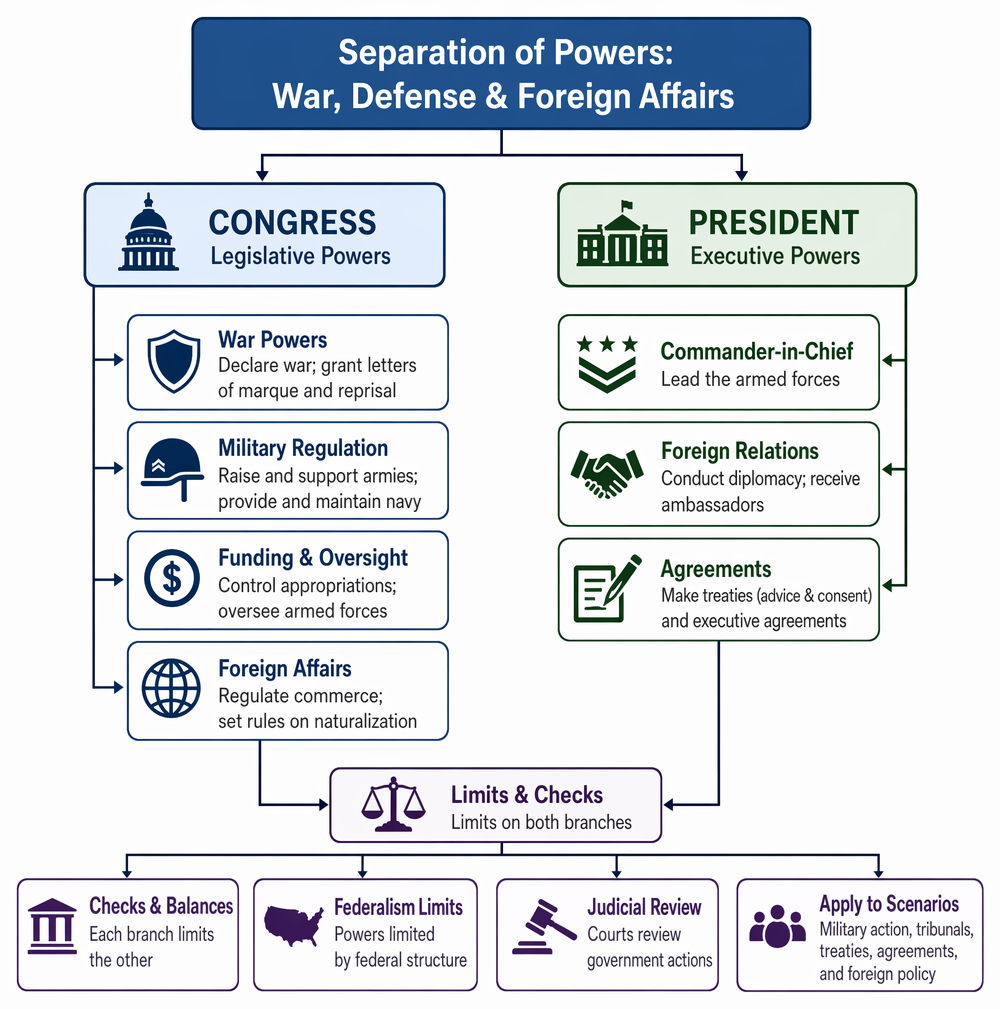
For the MBE, you are required to understand how the Constitution allocates war, defense, and foreign affairs powers between Congress and the President, with a focus on the following syllabus points:
Treaties and executive agreements are compared by formation method, Senate involvement, preemption rules, and priority relative to statutes.
- Identify Congress’s powers relating to war, military regulation, and foreign affairs
- Explain the President’s powers as commander-in-chief and as the nation’s representative in foreign relations
- Distinguish between treaties and executive agreements, and their domestic legal effects
- Recognize limits on both branches, including checks and balances, federalism limits, and judicial review
- Apply separation of powers doctrine to scenarios involving military action, military tribunals, treaties, executive agreements, and foreign policy
Test Your Knowledge
Attempt these questions before reading this article. If you find some difficult or cannot remember the answers, look more closely at that area during your revision.
-
Which branch of government has the exclusive power to declare war under the U.S. Constitution?
- a) The President
- b) Congress
- c) The Supreme Court
- d) The Secretary of Defense
-
The President’s power as commander-in-chief allows the President to:
- a) Declare war without congressional approval
- b) Direct military operations and deploy U.S. forces
- c) Ratify treaties without the Senate
- d) Enact military appropriations
-
A valid treaty between the United States and another country requires:
- a) The President’s signature only
- b) Approval by a majority of the House of Representatives
- c) Approval by two-thirds of the Senate
- d) Approval by the Supreme Court
-
Congress’s power to limit the President’s military actions is primarily exercised by:
- a) The power to appoint generals
- b) The power of the purse (appropriations)
- c) The power to issue executive orders
- d) The power to grant pardons
-
Congress passes a statute authorizing military trial by court-martial of U.S. citizens who are civilians, even when Article III courts are open. The statute is:
- a) Valid, because Congress has broad war powers
- b) Valid, because the President is commander-in-chief
- c) Invalid, because Congress cannot subject civilian citizens to military trial while civilian courts operate
- d) Invalid, because only the states may create criminal courts
-
A treaty conflicts with an earlier federal statute. Under U.S. law, which of the following is correct?
- a) The treaty always prevails
- b) The statute always prevails
- c) The later-in-time instrument—treaty or statute—prevails
- d) State law determines which prevails
Introduction
The Constitution deliberately splits control over war, defense, and foreign affairs between Congress and the President. The framers wanted energy in the executive but also collective judgment and control from the legislature, especially when the nation goes to war or enters binding international commitments. On the MBE, these questions often test whether you can distinguish:
- What Congress must do (e.g., declare war, fund the military, approve treaties)
- What the President may do alone (e.g., direct battlefield tactics, conclude certain executive agreements)
- What neither branch may do (e.g., court-martial civilian citizens while Article III courts are open)
Constitutional Sources of Power
Several provisions allocate war, defense, and foreign affairs powers.
Congressional Powers
Key provisions in Article I include:
- The power to declare war (Art. I, §8, cl. 11)
- The power to raise and support armies and provide and maintain a navy (Art. I, §8, cls. 12–13)
- The power to make rules for the government and regulation of the armed forces (Art. I, §8, cl. 14)
- The power to provide for calling forth, organizing, arming, and disciplining the militia (Art. I, §8, cls. 15–16)
- The power to regulate commerce with foreign nations (Art. I, §8, cl. 3)
- The power to tax and spend for the common defense and general welfare (Art. I, §8, cl. 1)
- The Senate’s power to advise and consent to treaties by a two‑thirds vote (Art. II, §2, cl. 2)
Key Term: Declare War Power
Congress’s exclusive authority to formally place the nation in a state of war. Key Term: War Powers
The cluster of congressional authorities related to war and defense, including declaring war, raising and funding the military, making rules for the armed forces, and calling forth the militia.
Congress’s war powers are broad. During war (and to some extent in the post‑war period), Congress may adopt extensive economic and regulatory measures to support the war effort, subject to constitutional rights such as the Bill of Rights.
Congress also has important authority over military justice:
- It can provide for military discipline of U.S. military personnel
- It can provide for military trial of enemy combatants and enemy civilians
- It cannot provide for military trial of U.S. citizens who are civilians while the regular courts are open
Presidential Powers
The President’s core war and foreign affairs powers are in Article II:
- Commander-in-Chief of the Army and Navy and of the militia when called into federal service (Art. II, §2, cl. 1)
- Power to make treaties with the advice and consent of two-thirds of the Senate (Art. II, §2, cl. 2)
- Power to appoint ambassadors (with Senate consent) and to receive ambassadors (Art. II, §2–3)
- Duty to “take Care that the Laws be faithfully executed” (Art. II, §3)
Key Term: Commander-in-Chief
The President’s constitutional role as head of the U.S. armed forces, giving authority to direct military operations and tactics, but not to declare war or appropriate funds. Key Term: Treaty Power
The shared authority under which the President negotiates treaties and the Senate, by a two‑thirds vote, approves them, making the treaties binding federal law. Key Term: Executive Agreement
An international agreement made by the President that does not require Senate ratification. It can be based on the President’s own foreign affairs powers or on prior statutory or treaty authority.
In practice, the President:
- Commands and deploys the armed forces
- Responds to sudden attacks or emergencies
- Represents the nation in diplomacy and foreign policy
But the President’s power is not unlimited. It is strongest when Congress authorizes or supports the President’s actions, and weakest when the President acts contrary to congressional will.
Key Term: Youngstown Framework
The three-part test from Youngstown Sheet & Tube Co. v. Sawyer, classifying presidential power as at its maximum when acting with Congress, in a “twilight zone” when Congress is silent, and at its “lowest ebb” when acting against Congress’s expressed will.
Division and Limits of War and Defense Powers
Congress’s Role
Congress has the exclusive power to declare war, but wars have often been fought without formal declarations. Instead, Congress frequently uses more tailored authorizations.
Key Term: Authorization for Use of Military Force (AUMF)
A statute by which Congress authorizes specific or general use of military force without issuing a formal declaration of war.
Congress can:
- Formally declare war
- Pass an AUMF authorizing limited or ongoing hostilities
- Regulate the armed forces through the Uniform Code of Military Justice and other statutory rules
- Use its spending power to fund or effectively terminate military operations (“power of the purse”)
- Conduct investigations and oversight into military and foreign policy
Congress’s power to raise and support armies is subject to a two‑year limit for appropriations, reinforcing regular legislative control over the military.
Congress also cannot commandeer state governments to administer federal military programs. For example, Congress may not require state legislatures to enact specific military regulations or force state officials to implement federal gun‑background‑check systems; instead, Congress must either regulate directly or use conditional funding.
The President’s Role
As commander-in-chief, the President:
- Makes tactical and operational decisions
- Chooses targets, strategy, and overall conduct of military campaigns
- May deploy troops to repel sudden attacks or meet urgent threats
The Constitution does not expressly say when the President may initiate hostilities without a prior declaration or AUMF. In practice, presidents have engaged in limited uses of force under their commander‑in‑chief and foreign affairs powers, and Congress has often acquiesced by funding the operations.
Congress attempted to structure this dynamic in the War Powers Resolution (requiring reporting and limiting unauthorized deployments), but detailed War Powers Resolution mechanics are rarely tested on the MBE. You should know conceptually:
- Congress can require reporting and may limit or terminate unauthorized hostilities
- Courts frequently treat War Powers Resolution disputes as political questions not suitable for judicial resolution
Key Term: Political Question Doctrine
The principle that certain constitutional disputes—often involving foreign affairs or war—are committed to the political branches and are not suitable for judicial resolution.
Military Courts, Tribunals, and Detention
Congress’s power to “make Rules for the Government and Regulation of the land and naval Forces” supports a system of military justice.
Key Term: Court-Martial
A military court created by Congress to try members of the armed forces for offenses under military law. Key Term: Military Commission
A special military tribunal, usually for enemy combatants or enemy civilians, authorized by Congress to try offenses against the law of war.
Key exam points:
- Service members may be tried by court-martial for offenses, even if the offense is not “service connected.”
- Enemy soldiers and enemy civilians may be tried by military commissions for offenses against the laws of war.
- Civilian U.S. citizens may not be tried by court‑martial or military commission while Article III courts are open and functioning; Congress lacks power to authorize such trials.
Congress and the President also interact over detention of enemy combatants:
- Congress may authorize detention of enemy combatants in connection with its war powers
- Neither Congress nor the President can completely strip the courts of habeas corpus review for detainees without providing a meaningful substitute process
Treaties and Executive Agreements
Treaties and executive agreements are central to foreign affairs questions on the MBE.
Treaties
- Negotiated by the President
- Require approval by two‑thirds of the Senate
- Once ratified, they have the force of federal law and are part of the “supreme Law of the Land”
Domestic effect:
- A ratified treaty overrides conflicting state law
- If a treaty conflicts with a federal statute, the later‑in‑time instrument controls
- Some treaties are self‑executing (operate directly as domestic law); others require implementing legislation by Congress
Executive Agreements
Executive agreements do not require Senate approval. They may be:
- Based solely on the President’s foreign affairs powers
- Based on prior congressional authorization
- Used to implement an existing treaty or statute
Domestic effect:
- An executive agreement prevails over conflicting state law
- It cannot override a federal statute or the Constitution
- Congress can authorize, limit, or override executive agreements by statute
This hierarchy is important on the MBE:
- Constitution
- Federal statute and ratified treaty (later‑in‑time prevails between them)
- Executive agreement
- State law
Federalism and Foreign Affairs
Some powers over foreign affairs are exclusively federal. States cannot:
- Declare war
- Enter treaties
- Take actions that seriously interfere with the federal government’s conduct of foreign policy
Even without a conflicting statute or treaty, state laws that intrude too far into foreign affairs—such as state laws conditioning inheritance on foreign governments’ conduct, or state laws interfering with federal Holocaust settlement agreements—can be preempted as inconsistent with the federal government’s foreign affairs powers.
Judicial Review and Political Questions
Courts can review:
- Whether Congress or the President has exceeded constitutional limits
- The domestic effect of treaties, statutes, and executive agreements
- The lawfulness of military tribunals or detentions
But courts often decline to decide:
- Challenges to the wisdom or necessity of military operations
- Pure disputes between Congress and the President over war initiation that lack clear judicial standards
On the MBE, when you see “who controls?” questions about war or foreign policy, think:
- Is there a clear textual allocation of power?
- Has Congress acted, and if so, is the President acting with or against Congress?
- Is the question one courts normally treat as justiciable (e.g., validity of a statute, validity of a military tribunal) or as a political question (e.g., whether a conflict is really a “war” requiring a declaration)?
Worked Examples
Worked Example 1.1
Congress passes a statute authorizing the President to use “all necessary and appropriate force” abroad to protect U.S. citizens, but does not declare war. The President orders airstrikes in a foreign country under this statute. A taxpayer sues, claiming the President cannot constitutionally use force without a formal declaration of war.
Answer:
The action is constitutional. Congress may authorize the use of military force without a formal declaration of war, for example via an AUMF. The President, as commander-in-chief, may direct military operations pursuant to such authorization. A taxpayer generally lacks standing to challenge such use of force, and in any event courts tend to view operational decisions and the necessity of a formal declaration as political questions.
Worked Example 1.2
The President signs a treaty with another country reducing tariffs, but the Senate refuses to approve it by a two‑thirds vote. The President announces that the United States will treat the treaty as binding anyway and reduces tariffs by executive order. An importer sues to force the government to apply the lower treaty rates.
Answer:
The importer loses. A treaty negotiated by the President does not become binding domestic federal law without approval by two‑thirds of the Senate. The President cannot unilaterally give the treaty the status of law. Unless Congress separately authorizes tariff reductions, existing statutes governing tariffs remain controlling.
Worked Example 1.3
Congress passes a law requiring state legislatures to enact specified regulations for organizing their state militias in accordance with federal standards. A state refuses to comply and is sued by the United States.
Answer:
The law is unconstitutional to the extent it commandeers state legislatures. Congress may regulate the armed forces directly and may provide for calling forth and disciplining the militia, but it may not force state legislatures to enact specific regulations. Congress must either legislate directly or use its spending power to encourage state action.
Worked Example 1.4
Congress authorizes by statute the creation of military commissions to try non‑citizen enemy combatants for war crimes. The same statute also authorizes those commissions to try U.S. citizens who are civilians, even though federal courts are open. A civilian citizen is captured abroad and tried before such a commission.
Answer:
The authorization is invalid as applied to civilian U.S. citizens while Article III courts remain open. Congress may provide for military trial of enemy combatants and enemy civilians, but it cannot subject civilian U.S. citizens to military trial when ordinary courts are functioning. The citizen must be tried in an Article III court with full constitutional protections.
Worked Example 1.5
A state enacts a statute requiring all companies doing business in the state to disclose any business dealings with a foreign country that is currently the subject of federal sanctions, and authorizes state officials to pressure such companies to cut ties with that country. The federal executive has negotiated a delicate sanctions and diplomatic regime with that foreign nation.
Answer:
The state law is likely preempted. Foreign affairs are primarily a federal responsibility. Even without a directly conflicting federal statute, a state law that interferes with the federal government’s conduct of foreign policy—especially in a sensitive area such as sanctions and diplomacy—is invalid under the Supremacy Clause and the exclusivity of federal foreign affairs powers.
Worked Example 1.6
Congress enacts a statute stating that any future executive agreement with a foreign country that touches trade will be null and void unless approved by a majority vote of both houses. The President enters an executive agreement reducing certain trade barriers without seeking congressional approval and instructs customs officials to follow it.
Answer:
Congress may regulate the domestic legal effect of executive agreements through statutes under its commerce and foreign affairs powers. An executive agreement cannot override an existing federal statute. Customs officials must follow the statute, not the conflicting executive agreement. The agreement may still bind the United States internationally, but domestically the statute controls.
Checks and Balances
Key checks include:
- Congress’s control over appropriations, military organization, and military justice
- Senate’s advice and consent role in treaty-making and high‑level appointments
- Congress’s power to investigate and, when appropriate, to impeach and remove executive officers, including the President
- The President’s veto power over statutes, subject to a two‑thirds override in each house
- Judicial review of the constitutionality of war, defense, and foreign affairs legislation and executive action, subject to standing and political question limits
Exam Warning: On the MBE, do not confuse:
- The power to declare war (Congress alone)
- The power to direct military operations and deploy troops (President as commander‑in‑chief)
A choice that says the President may “declare war” is almost always wrong. Similarly, an answer suggesting that an executive agreement can override a contrary federal statute is incorrect.
Revision Tip: Remember:
- Treaties require Senate approval by two‑thirds and, once ratified, have the force of federal law.
- Executive agreements do not require Senate approval, but they are subordinate to treaties and federal statutes.
- If a federal statute and a treaty conflict, the one adopted later in time prevails.
- Both treaties and executive agreements override conflicting state law, but not the Constitution.
Key Point Checklist
This article has covered the following key knowledge points:
- Congress alone can declare war and has broad war powers to raise, support, and regulate the armed forces.
- Congress controls military funding and can limit or end military engagements through appropriations and substantive legislation.
- Congress may authorize the use of force through AUMFs without issuing a formal declaration of war.
- Congress may provide for military trial of enemy combatants and enemy civilians, but not for court‑martial or commission trial of civilian U.S. citizens while Article III courts are open.
- The President, as commander‑in‑chief, directs military operations and may deploy troops, especially to repel sudden attacks or pursuant to congressional authorization, but cannot declare war or appropriate funds.
- The President leads foreign relations, negotiates treaties, and concludes executive agreements, subject to constitutional limits and congressional control.
- Treaties require negotiation by the President and approval by two‑thirds of the Senate; once ratified, they override conflicting state law and interact with statutes under the later‑in‑time rule.
- Executive agreements do not require Senate approval, take precedence over conflicting state law, but are subordinate to treaties and federal statutes.
- States may not intrude on federal foreign affairs powers, for example by conducting their own foreign policies or enacting laws that interfere with national diplomacy.
- Congress cannot commandeer state legislatures or executives to implement federal military or foreign policy programs.
- Courts review the constitutionality of war, defense, and foreign affairs actions but often treat the conduct, wisdom, or necessity of hostilities as political questions.
Key Terms and Concepts
- Declare War Power
- War Powers
- Commander-in-Chief
- Treaty Power
- Executive Agreement
- Youngstown Framework
- Authorization for Use of Military Force (AUMF)
- Court-Martial
- Military Commission
- Political Question Doctrine