Learning Outcomes
This article explains the President’s role as chief executive and the constitutional “take care” duty within the separation‑of‑powers framework, including:
- How Article II’s Executive Power and Take Care Clauses define the scope and limits of presidential authority to enforce federal law.
- How to distinguish mandatory statutory duties from genuine enforcement discretion, and why that distinction controls most Take Care Clause questions.
- How prosecutorial discretion, prioritization, and case‑by‑case judgments differ from unconstitutional blanket non‑enforcement or suspension of statutes.
- How impoundment works, when refusal to spend appropriated funds violates the Constitution, and how discretionary “may” or “up to” language affects the analysis.
- How to analyze executive orders in relation to statutes, the Constitution, and the Youngstown framework, particularly when orders attempt to displace existing law.
- What tools Congress can use to structure, direct, or limit executive enforcement, and why legislative veto devices are unconstitutional on the MBE.
- When courts will review executive action or inaction, focusing on ministerial duties, standing, political questions, and limits on challenges to enforcement choices.
- How to apply these doctrines to MBE‑style fact patterns efficiently, spot common traps, and select the answer that best reflects faithful execution principles.
MBE Syllabus
For the MBE, you are required to understand the constitutional powers and limits of the President as chief executive, with a focus on the following syllabus points:
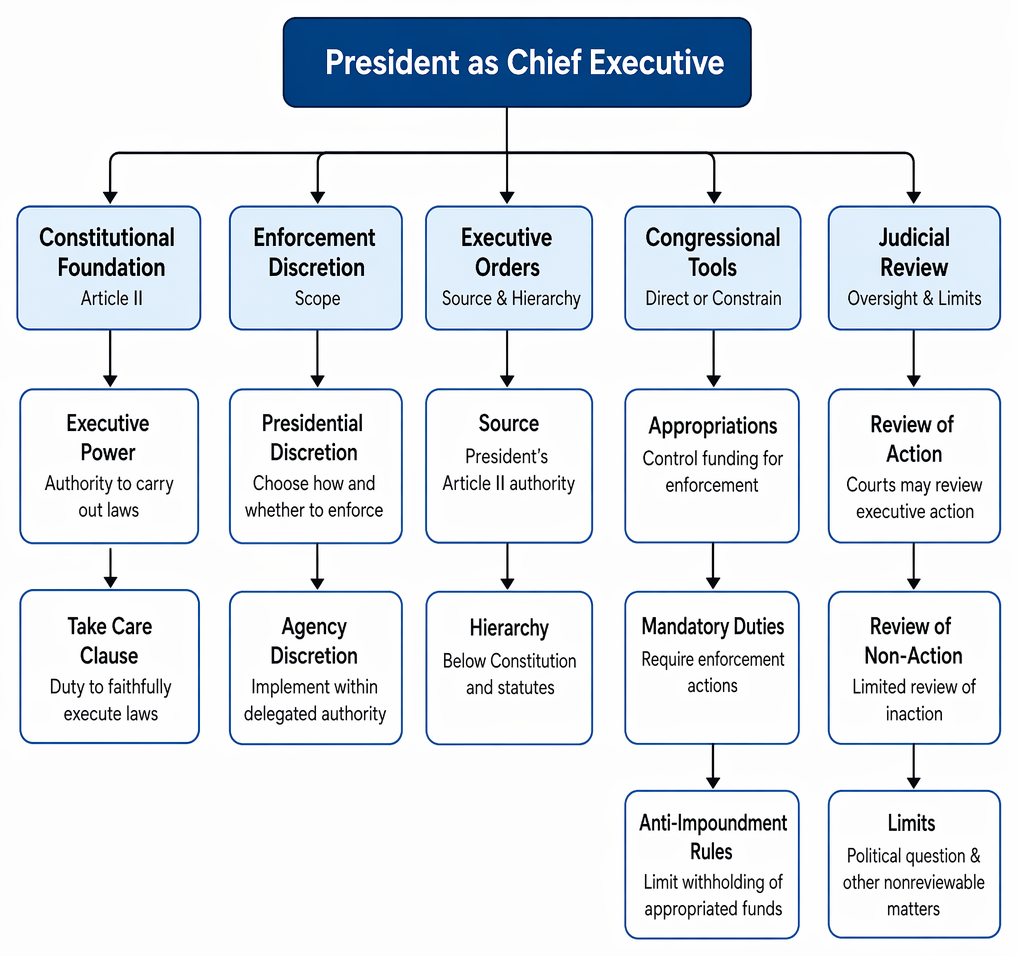
Executive-order analysis turns on constitutional and statutory consistency: conflicts with federal law invalidate the order; authorized, lawful directives stand.
- Article II “executive Power” and the President’s duty to “take Care that the Laws be faithfully executed”
- The scope of presidential and agency enforcement discretion
- Executive orders: source of authority and hierarchy relative to statutes and the Constitution
- Congressional tools to direct or constrain executive enforcement (appropriations, mandatory duties, anti‑impoundment rules)
- Judicial review of executive action and non‑action, including political question and reviewability limits
Test Your Knowledge
Attempt these questions before reading this article. If you find some difficult or cannot remember the answers, look more closely at that area during your revision.
-
The “take care” clause in Article II of the U.S. Constitution requires the President to:
- a) Propose new laws to Congress.
- b) Faithfully execute the laws of the United States.
- c) Interpret the Constitution for the courts.
- d) Approve all state laws.
-
If Congress passes a statute requiring the President to spend appropriated funds for a specific purpose, the President:
- a) May refuse to spend the funds if he disagrees with the policy.
- b) Must spend the funds as directed by Congress.
- c) May use the funds for any executive branch activity.
- d) May veto the statute after signing it.
-
Which of the following is true regarding executive orders?
- a) They can override federal statutes.
- b) They must be consistent with existing law.
- c) They require approval by the Supreme Court.
- d) They are binding on state governments.
-
Congress enacts a statute authorizing (but not requiring) the President to spend “up to $5 billion” on a grant program. The President decides to spend nothing. Which is the best analysis?
- a) This is unconstitutional impoundment.
- b) This is permissible if the statute gives genuine discretion.
- c) It is a legislative veto problem.
- d) It violates the Take Care Clause whenever funds are not spent.
Introduction
The Constitution divides federal power among three branches: Congress makes the law, the President executes it, and the federal courts interpret it. As chief executive, the President sits at the center of this separation-of-powers design.
Article II opens by vesting the “executive Power” in the President and then specifies, in Article II, Section 3, that the President “shall take Care that the Laws be faithfully executed.” Together, these provisions define both the source and the limits of presidential enforcement authority.
Key Term: Executive Power Clause
The opening sentence of Article II: “The executive Power shall be vested in a President of the United States of America.” It is the textual source of the President’s general authority to execute federal law. Key Term: Take Care Clause
The provision in Article II, Section 3 requiring the President to ensure that federal laws are faithfully executed, rather than ignored, suspended, or selectively nullified. Key Term: Chief Executive Power
The President’s authority under Article II to supervise the executive branch, enforce federal law, and direct subordinate officers, subject to the Constitution and valid statutes.
On the MBE, questions on presidential power often hinge on whether the President is (1) enforcing a statute as written, (2) acting with delegated statutory authority, or (3) acting without or against congressional authorization. This is where the Take Care Clause and the broader separation-of-powers framework matter most.
Constitutional Basis: Execute, Not “Make or Break,” the Law
Exam materials emphasize a simple but powerful idea: the President has the power to execute the law, not to make or break it. Lawmaking belongs to Congress; judicial review belongs to the courts. The President’s enforcement authority is at its maximum when Congress has authorized or directed action by statute, and it is at its lowest when the President acts against congressional limits.
Key Term: Youngstown Framework
A three‑category way of analyzing presidential power:
- Category 1: The President acts with Congress’s authorization.
- Category 2: Congress is silent (“zone of twilight”).
- Category 3: The President acts against Congress’s expressed will.
Applied to enforcement and executive orders:
- Category 1: Congress directs or authorizes the enforcement action; the President enforces with strong constitutional footing.
- Category 2: No statute directly addresses the situation; the President may rely on independent executive power, but courts scrutinize carefully.
- Category 3: Congress has spoken in one direction and the President moves the other way; courts are most likely to strike down the action.
For domestic enforcement questions on the MBE, presidential action usually falls into Category 1 or 3.
Article II Domestic Powers and Separation of Powers
Most of the President’s domestic power is derivative: it comes from statutes that assign duties and discretion to the executive branch. Only a few powers are exclusively executive and not subject to statutory control.
Key Term: Appointment and Removal Power
The President’s authority to appoint and (subject to limited statutory limits) remove executive officers. Senior officers often require Senate confirmation, but only the President (or those he authorizes) may hire or fire executive officers.
Key points for the exam:
- The President has the power to enforce federal law, not to rewrite it.
- The power to enforce is greatest when authorized by statute.
- Congress can usually structure, direct, or limit domestic executive power through legislation.
- A few powers are essentially exclusive:
- Pardon power (for federal crimes, not impeachment, and not state offenses)
- Veto power (subject to congressional override by two‑thirds of each house)
- The core appointment/removal authority over executive officers
Most Take Care Clause questions involve areas where Congress has legislated and the President must either comply, use granted discretion, or claim that the statute itself is unconstitutional.
The President’s Duty to Enforce the Law
The Take Care Clause imposes a mandatory duty. The President must enforce all valid federal statutes, not just those he agrees with as a policy matter. A President cannot:
- Announce that a statute is “suspended”
- Declare an entire statutory scheme a “nullity”
- Refuse to implement statutory duties simply because he thinks the statute is unwise
Congress can, and frequently does, use mandatory language—“the Secretary shall do X,” or “the President shall distribute Y”—to require specific executive action.
Where that occurs:
- If the statute is constitutional, the President must comply.
- If the President believes the statute is unconstitutional, the proper response is to seek judicial review, not to unilaterally ignore the statute.
Key Term: Ministerial Duty
A clear, specific statutory duty that leaves no discretion about whether to act, only about routine details of how to carry out the duty.
If Congress has imposed a ministerial duty—such as “pay this claimant $10,000 on July 1”—the executive must comply unless a court invalidates the statute.
Appointments, Removal, and Control of Execution
Faithful execution happens through people—officers and employees of the executive branch.
Key Term: Executive Officer
Any federal officer who exercises significant authority under U.S. law (e.g., cabinet secretaries, heads of agencies, U.S. attorneys). Executive officers are part of the executive branch and ultimately answer to the President.
Key structural rules drawn from bar materials:
- Only the President (or his authorized subordinates) can appoint or remove executive officers.
- Senior officers (cabinet members, ambassadors, federal judges) require Senate confirmation.
- Congress has a confirmation role but no direct appointment role for executive officers.
- Once Congress controls an officer’s appointment or removal, it cannot give that officer executive power.
MBE trap:
- If a question describes an officer hired or removable by Congress (e.g., the Speaker of the House, a congressional committee appointee), any attempt to give that officer executive power—like enforcing or administering federal law—is unconstitutional.
This structure highlights the Take Care duty: the President is responsible for overseeing those who execute the laws, and Congress may not itself execute the law or directly control those who do.
Executive Discretion and Enforcement Limits
The fact that the President must faithfully execute the laws does not mean every conceivable violation must be pursued or every dollar appropriated must be spent. Enforcement inevitably involves judgment and prioritization.
Key Term: Prosecutorial Discretion
Executive branch authority to decide whether, when, and how to enforce a law against particular individuals or in particular cases, especially in the criminal context.
The key distinction for exam purposes:
-
Permissible discretion:
- Case‑by‑case decisions: whether to bring a particular prosecution or enforcement action
- Priority‑setting: focusing on serious offenses or high‑impact violations because of limited resources
- Discretionary statutes: where Congress says the President “may” act, or an agency “is authorized” to act
-
Impermissible non‑enforcement:
- Blanket refusal to enforce an entire statute or category of statutes that Congress has clearly required to be enforced
- Systematic non‑implementation of mandatory duties expressed in “shall” language
- Attempts to effectively repeal or suspend a statute by refusing to enforce it, without any constitutional basis
In other words, the executive may prioritize within the bounds of the law, but may not nullify the law.
Prosecutorial Decisions and Judicial Review
Case‑by‑case decisions whether to prosecute or enforce are often treated as:
- Committed to executive discretion, and
- Not subject to judicial review (they are often considered non‑justiciable or lacking a judicially manageable standard).
However, when Congress has imposed a ministerial duty—such as issuing a payment, printing a report, or implementing a specific program—courts are more willing to enforce that duty.
Key Term: Political Question Doctrine
A set of limits under which federal courts decline to decide certain disputes—often involving foreign affairs, war powers, or internal congressional procedures—because the Constitution commits them to other branches or there are no judicially manageable standards.
Two exam‑relevant ideas:
- Non‑enforcement in individual cases is usually treated as political or discretionary and is not reviewable.
- Non‑activation of clear, specific statutory duties may be reviewable and can violate the Take Care Clause.
Budget, Appropriations, and Impoundment
Congress controls the purse. When Congress appropriates money for a program, it can either mandate or permit its expenditure.
Key Term: Impoundment
The executive practice of withholding or refusing to spend funds that Congress has appropriated and clearly required to be spent for designated purposes.
From the bar materials:
- If a statute clearly requires that specified funds be spent for a particular purpose, the President has no power to impound those funds.
- If a statute genuinely gives discretion—appropriating “up to” a sum, or authorizing but not requiring a program—the President may decide to spend less or nothing.
This distinction is heavily tested:
- “The Secretary shall spend $10 billion on X” → no discretion; impoundment violates the Take Care Clause.
- “There is hereby authorized to be appropriated up to $10 billion” and “the Secretary may award grants” → genuine discretion; choosing to spend nothing is typically constitutional.
Executive Orders and Statutes
Key Term: Executive Order
A written directive issued by the President to manage operations of the federal executive branch. Executive orders must rest on constitutional or statutory authority and cannot contradict valid statutes.
Executive orders are a frequent MBE fact pattern. To analyze them, track the hierarchy of laws:
- The Constitution is supreme.
- Valid federal statutes and treaties come next.
- Executive orders must be consistent with both.
Therefore:
- An executive order cannot override or amend a federal statute.
- If a statute and an executive order conflict, the statute prevails.
- Congress can preclude, authorize, or override executive orders via legislation (subject to presidential veto and possible override).
Common uses of executive orders include:
- Organizing the executive branch (reassigning responsibilities among agencies)
- Directing how agencies will exercise granted discretion (e.g., enforcement priorities)
- Implementing statutes that authorize the President to “prescribe regulations” or “take such measures as necessary” to carry out a program
On the MBE, when you see an executive order, ask:
- Is there a statute on point?
- Does the order implement or contradict that statute?
- Has Congress clearly given the President discretion, or has it imposed a specific duty?
If the order contradicts a clear statutory command, it falls into Youngstown Category 3 and is likely invalid.
Congressional Control and the Take Care Clause
Congress cannot execute the laws itself; it cannot hire or fire executive officers or direct day‑to‑day enforcement. It can, however, structure and limit executive enforcement through:
- Mandatory duties: “The agency shall…”
- Spending conditions: Congress may attach conditions to federal funds, as long as those conditions are constitutional and clearly stated.
- Appropriations: Congress can cut off or reduce funding, thereby limiting what the executive can practically do.
From exam materials:
- If a statute gives the President discretion to spend or withhold funds, he may do so.
- But if the statute unambiguously requires that certain funds be spent for certain purposes, the President has no power to refuse to spend the funds.
Congress sometimes tries to retain ongoing control of executive implementation through a legislative veto.
Key Term: Legislative Veto
A statutory device purporting to let one house of Congress, or a committee, cancel or block executive action without following the full lawmaking process (bicameralism plus presentment). Legislative vetoes are unconstitutional.
On the MBE, any attempt by Congress to reserve to itself a simple‑majority veto of future executive action is invalid. If Congress wants to change or override executive implementation, it must:
- Pass a new law, and
- Present it to the President, who may sign or veto it (with possible override).
Impeachment as an Ultimate Check
Key Term: Impeachment
A formal accusation by the House (by simple majority), followed by a trial in the Senate where a two‑thirds vote is required for conviction and removal from office.
Extreme, systematic refusal to faithfully execute the laws could be treated by Congress as “high Crimes and Misdemeanors” and addressed through impeachment. The President’s power to pardon federal offenses does not extend to impeachment; a President cannot use the pardon power to stop impeachment proceedings against any officer.
Judicial Checks: Reviewability, Standing, and Political Questions
Courts can review many executive actions and inactions to ensure they comply with statutes and the Constitution. Typical MBE‑relevant forms of review include:
- Determining whether an executive order exceeds statutory authority
- Ordering an officer to comply with a clear, ministerial statutory duty
- Enjoining executive enforcement that violates the Constitution (e.g., equal protection or First Amendment)
Limits on review include:
- Political question doctrine: Some issues—especially involving foreign affairs, war powers, or internal congressional procedures—are non‑justiciable.
- Standing: Plaintiffs must show personal injury, causation, and redressability. General complaints about “non‑enforcement of the law” often fail this test.
In Take Care Clause fact patterns, review is most realistic when:
- A statute confers a clear entitlement on a plaintiff (e.g., a benefit), and
- The executive refuses to carry out a ministerial duty needed to deliver that benefit.
Courts are much less likely to:
- Second‑guess decisions not to prosecute particular defendants, or
- Order the executive to adopt particular enforcement priorities.
Worked Example 1.1
Congress passes a law requiring the President to distribute disaster relief funds to states affected by hurricanes. The statute states: “The Secretary shall allocate $10 billion to eligible states within 60 days of certification.” The President disagrees with the policy and instructs the executive branch not to distribute the funds.
Answer:
The President’s refusal violates the Take Care Clause. Congress has imposed a clear, mandatory duty to spend funds. The President cannot impound those funds based solely on policy disagreement; he must execute the statute as written, unless a court holds it unconstitutional.
Worked Example 1.2
The President issues an executive order directing federal agencies to ignore a federal environmental statute that imposes emission limits on federal facilities. Congress has not repealed or amended the statute.
Answer:
The executive order is invalid. An executive order cannot contradict a valid statute. The Take Care Clause requires the President to enforce the environmental law; he cannot suspend or nullify it by ordering agencies to disregard its requirements.
Worked Example 1.3
Congress enacts a statute providing: “There is hereby authorized to be appropriated up to $5 billion for cybersecurity grants. The Secretary may award grants to eligible entities.” The President decides to spend none of the money and directs the Secretary not to establish a grant program.
Answer:
This is likely permissible. The statutory language is discretionary (“may” and “up to”), not mandatory. Because Congress has authorized but not required spending, the President can, consistent with the statute, decide not to spend funds, and this does not violate the Take Care Clause.
Worked Example 1.4
Congress passes a statute requiring the Attorney General to “bring civil enforcement actions against any company that violates the statute’s reporting requirements.” The Department of Justice announces a policy that it will not enforce the statute at all, citing limited resources and other priorities.
Answer:
A complete, announced refusal to enforce a statute that Congress has made mandatory is constitutionally suspect. Prioritizing individual cases is permissible, but categorical non‑enforcement of a valid statute conflicts with the duty to faithfully execute the laws. A court might, however, treat the matter as non‑justiciable or find the duty insufficiently specific to enforce, depending on the statutory context and standing.
Worked Example 1.5
Congress enacts a statute providing that a particular class of veterans “shall receive a $5,000 payment within 90 days after filing a complete application.” A veteran files a complete application and is clearly eligible, but the responsible agency refuses to issue the payment because the President has ordered a “pause” while he reconsideres the policy.
Answer:
The duty to pay the veteran is ministerial and mandatory. The agency’s refusal, based solely on presidential policy disagreement, violates the statute and the Take Care duty. A court is likely to order the payment, because:
- The veteran has a clear entitlement,
- The statutory duty is specific, and
- The remedy (issuing the payment) is judicially manageable.
Worked Example 1.6
Congress creates a new regulatory scheme and provides: “The Secretary may, in her discretion, bring civil enforcement actions as she deems appropriate to enforce this Act.” A regulated firm sues, claiming that the Secretary must bring an action against its competitor and that refusal to do so violates the Take Care Clause.
Answer:
The challenge is unlikely to succeed. The statute confers broad discretion (“may…as she deems appropriate”). Deciding whether to bring an action against a competitor is core prosecutorial discretion. Absent specific statutory limits, courts will usually treat this as non‑reviewable executive judgment, not a Take Care violation.
Worked Example 1.7
Congress passes a statute authorizing the President to “issue such regulations and executive orders as are necessary and proper to protect federal facilities from cyberattacks.” The President issues an executive order requiring all federal agencies to adopt specific cybersecurity standards, consistent with other federal law. An employee challenges the order as an unconstitutional exercise of executive power.
Answer:
The challenge will fail. Congress has expressly authorized the President to act, placing the order in Youngstown Category 1. The order implements the statute and does not contradict any other federal law. It falls squarely within the President’s chief executive power to manage the executive branch and enforce statutes.
Worked Example 1.8
Congress passes a statute requiring an agency to submit quarterly enforcement reports to a particular congressional committee. The President asserts executive privilege and orders the agency not to submit any reports, claiming that the requirement intrudes on executive power and violates the Take Care duty.
Answer:
The Take Care Clause does not give the President power to disregard valid oversight statutes. Congress may require non‑privileged information necessary for legislative and oversight functions. Although executive privilege can sometimes protect specific categories of sensitive information, a blanket refusal to comply with a valid reporting requirement is likely unconstitutional. The dispute might, however, be resolved through political negotiation rather than judicial intervention, and standing/jurisdiction issues could limit court involvement.Exam Warning: The President’s enforcement discretion does not extend to suspending or refusing to enforce entire statutes that Congress has clearly required to be enforced. On MBE questions, look for mandatory statutory language (“shall,” fixed amounts, specific deadlines). Blanket non‑enforcement of such laws is unconstitutional unless the law itself is invalid.
Revision Tip: In any separation‑of‑powers question involving the President:
- Identify whether there is a statute directly governing the situation.
- Ask whether the statute is mandatory or discretionary.
- Determine whether the President is enforcing, implementing with discretion, or contradicting that statute.
- Apply the hierarchy: Constitution → Statutes/Treaties → Executive Orders.
- Place the President’s action in the Youngstown framework: Category 1, 2, or 3.
Key Point Checklist
This article has covered the following key knowledge points:
- The Take Care Clause creates a mandatory duty: the President must faithfully execute valid federal statutes and cannot suspend or nullify them for policy reasons.
- The President’s domestic power is strongest when acting with statutory authorization and weakest when acting against Congress’s expressed will.
- A few powers—such as the pardon power, veto, and appointment/removal of executive officers—are largely exclusive to the President and not subject to ordinary statutory control.
- The President has enforcement discretion when statutes genuinely grant discretion or when prioritizing among cases, but not to categorically refuse to enforce laws that Congress has made mandatory.
- Impoundment is unconstitutional where Congress has clearly required funds to be spent; discretionary spending authorizations (“may,” “up to”) allow the President to spend less or nothing.
- Executive orders are subordinate to statutes and the Constitution; they may implement but cannot override congressional enactments.
- Congress cannot exercise a legislative veto to overturn executive actions by simple resolution; it must legislate through bicameralism and presentment.
- Congress may influence enforcement through mandatory duties, conditions on appropriations, and structural design of agencies, but may not itself execute the laws or control executive officers.
- Courts may review many executive actions for statutory and constitutional compliance, but some disputes—especially about enforcement priorities or foreign affairs—may be treated as political questions or as committed to executive discretion.
- Standing and justiciability often limit challenges to executive non‑enforcement, but specific, ministerial duties imposed by statute are more likely to be judicially enforceable.
Key Terms and Concepts
- Executive Power Clause
- Take Care Clause
- Chief Executive Power
- Youngstown Framework
- Appointment and Removal Power
- Executive Officer
- Ministerial Duty
- Prosecutorial Discretion
- Impoundment
- Executive Order
- Legislative Veto
- Impeachment
- Political Question Doctrine