Learning Outcomes
This article explains Congress’s enforcement powers under the 13th, 14th, and 15th Amendments and their interaction with separation of powers, including:
- Tracing the textual enforcement clauses of each Civil War Amendment and how they differ in scope, state action requirements, and reach over private conduct.
- Clarifying the distinction between remedial enforcement legislation and impermissible attempts to redefine substantive constitutional rights, using leading Supreme Court cases such as City of Boerne, Morrison, Kimel, Hibbs, and Shelby County.
- Explaining when Congress may regulate state conduct, private conduct, or both, and how the 13th Amendment’s “badges and incidents of slavery” doctrine supports federal laws targeting private racial discrimination.
- Detailing the “congruence and proportionality” test, including what counts as a sufficient record of constitutional violations and how prophylactic legislation can be upheld or struck down.
- Demonstrating how Congress can validly abrogate Eleventh Amendment immunity when enforcing the Civil War Amendments, and when such abrogation fails.
- Providing a structured approach for answering MBE-style questions that ask you to identify the correct constitutional basis for federal civil rights statutes and to assess whether Congress has stayed within its enforcement authority.
MBE Syllabus
For the MBE, you are required to understand how the separation of powers shapes Congress’s ability to enforce civil rights through the 13th, 14th, and 15th Amendments, with a focus on the following syllabus points:
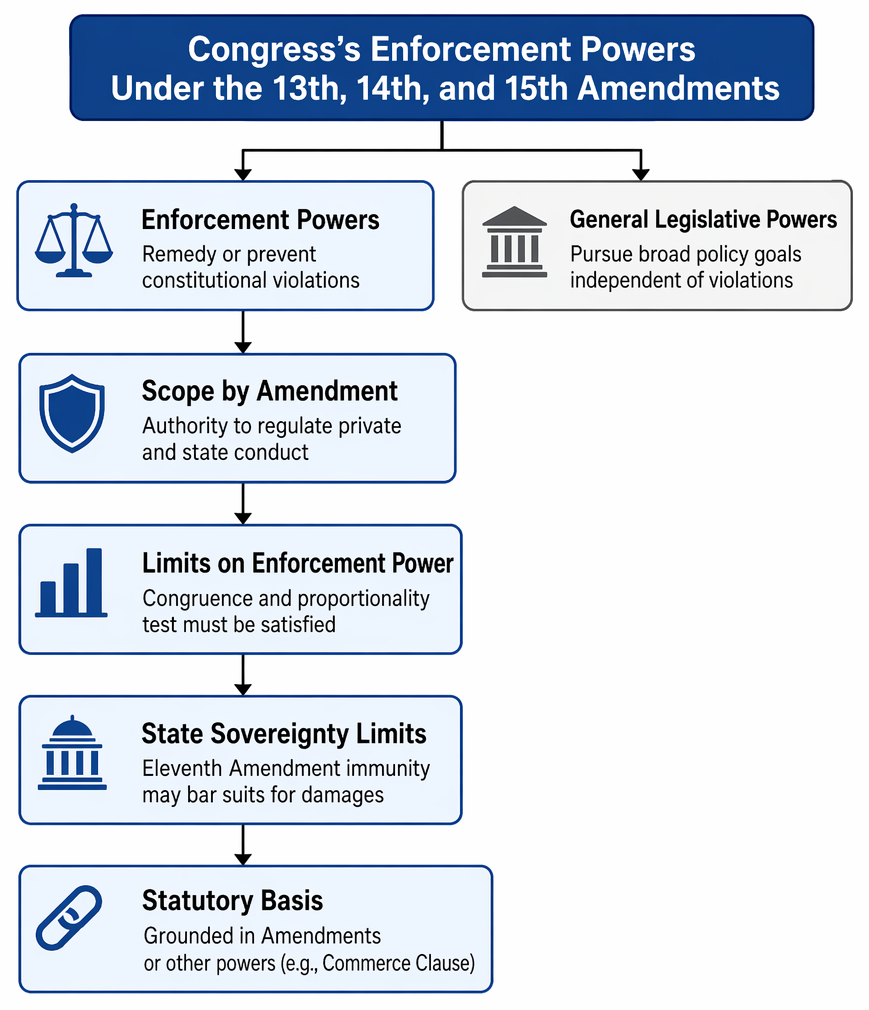
Congressional enforcement power depends on private versus state conduct, voting rights coverage, and congruent, proportional remedies for constitutional violations.
- The distinction between Congress’s enforcement powers and its general legislative powers.
- The scope of Congress’s authority to regulate private and state conduct under each Amendment.
- The limits on Congress’s enforcement powers, including the “congruence and proportionality” test.
- The relationship between federal enforcement statutes and state sovereignty, including Eleventh Amendment immunity.
- How federal civil rights statutes may be grounded in the Civil War Amendments versus other powers (e.g., Commerce Clause).
Test Your Knowledge
Attempt these questions before reading this article. If you find some difficult or cannot remember the answers, look more closely at that area during your revision.
-
Which Amendment allows Congress to prohibit private racial discrimination directly?
- a) 13th Amendment
- b) 14th Amendment
- c) 15th Amendment
- d) 10th Amendment
-
Under the 14th Amendment, Congress may:
- a) Redefine the scope of constitutional rights by statute
- b) Enact only remedies that are congruent and proportional to proven constitutional violations by states
- c) Regulate purely private conduct
- d) Override Supreme Court interpretations of constitutional rights
-
Which of the following best describes the “congruence and proportionality” requirement?
- a) Congress may enact any law it deems necessary to protect civil rights
- b) Congress’s remedies must closely fit the pattern and scope of state violations as defined by the courts
- c) Congress may regulate all state and private conduct equally
- d) Congress may only act if the President consents
-
The 15th Amendment’s enforcement power allows Congress to:
- a) Prohibit all forms of discrimination
- b) Enact laws to prevent racial discrimination in voting
- c) Regulate state court procedures generally
- d) Amend the Bill of Rights
Introduction
The Civil War Amendments—the 13th, 14th, and 15th—dramatically expanded federal power to protect civil rights. Each contains an enforcement clause empowering Congress to “enforce” the Amendment “by appropriate legislation.” These clauses are an important exception to the usual limits on congressional power and are heavily tested in the separation-of-powers portion of Constitutional Law on the MBE.
At the same time, the Supreme Court has insisted that:
- The judiciary, not Congress, has the last word on what the Constitution means; and
- Congress’s enforcement role is remedial, not substantive—Congress may prevent or remedy violations, but may not redefine constitutional rights.
Understanding this interplay—Congress’s broad but not unlimited enforcement power, judicial review, and state sovereignty—is essential for answering MBE questions about federal civil rights statutes, state immunity, and private discrimination.
Key Term: Enforcement Clause
The section of the 13th, 14th, or 15th Amendment that gives Congress power to pass laws to implement that Amendment’s guarantees.
- 13th Amendment §2: “Congress shall have power to enforce this article by appropriate legislation.”
- 14th Amendment §5: “The Congress shall have power to enforce, by appropriate legislation, the provisions of this article.”
- 15th Amendment §2: “The Congress shall have power to enforce this article by appropriate legislation.”
Key Term: Section 5 Power
Shorthand for Congress’s power under Section 5 of the 14th Amendment to enforce the Amendment’s substantive guarantees (such as due process and equal protection) by “appropriate legislation.” Key Term: Remedial Legislation
Federal legislation that targets and prevents or redresses actual or likely constitutional violations as the Supreme Court has defined them. It enforces existing rights. Key Term: Substantive Legislation
Federal legislation that attempts to change the meaning or scope of constitutional rights as defined by the Supreme Court, rather than merely enforcing them. Key Term: Prophylactic Legislation
Enforcement legislation that goes somewhat beyond the precise set of unconstitutional acts, in order to prevent likely violations (for example, banning some conduct that is itself constitutional because it is too difficult to distinguish it in practice from unconstitutional conduct).
A recurring MBE theme is: Which Amendment, if any, authorizes the statute described in the fact pattern, and is Congress using that power within constitutional limits? The answer usually turns on:
- Whether the conduct regulated is state action or private action.
- Whether the right involved is protected by one of the Civil War Amendments.
- Whether the statute is remedial or substantive.
- Whether the remedy is congruent and proportional to a documented pattern of violations.
Textual structure and state action
Before turning to each Amendment, it helps to see how they differ textually:
-
13th Amendment: Prohibits “slavery [and] involuntary servitude” everywhere in the United States. It does not say “No State shall…”, so it directly binds private individuals as well as governments, and its enforcement clause lets Congress reach private conduct.
-
14th Amendment: Section 1 begins: “No State shall…” This makes clear that the 14th Amendment regulates state action, not private conduct, and Section 5 allows Congress to enforce those limits on states.
-
15th Amendment: Provides that neither the United States nor any State may deny or abridge the right to vote “on account of race, color, or previous condition of servitude.” This again targets governmental action concerning voting.
Key Term: State Action
Conduct by state or local governments (or their officials) that is required for most constitutional rights to apply. Because the 14th and 15th Amendments restrict “State” or government conduct, Section 5 and the 15th Amendment cannot be used to reach purely private behavior.
The 13th Amendment is the outlier: it needs no state action, and its enforcement power extends to private conduct. The 14th and 15th require state (or governmental) action and confer only an enforcement, not a redefinition, power.
The 13th Amendment: Abolishing Slavery and Its Incidents
The 13th Amendment prohibits slavery and involuntary servitude throughout the United States. Unlike most constitutional provisions, it applies directly to private individuals as well as governments. Its enforcement clause gives Congress unusually broad power.
Key Term: Badges and Incidents of Slavery
Forms of discrimination or oppression that are considered remnants or consequences of slavery, which Congress may target under the 13th Amendment.
Key points for the MBE:
- Congress may legislate directly against both slavery and the badges and incidents of slavery.
- Congress may regulate both state and private conduct under the 13th Amendment.
- No state action is required; purely private acts of racial discrimination may be prohibited.
The Supreme Court has interpreted this broadly. In Jones v. Alfred H. Mayer Co., the Court upheld a federal ban on private racial discrimination in selling property as a valid 13th Amendment measure, deferring to Congress’s judgment about what counts as a badge or incident of slavery so long as that judgment is rational.
Examples of valid 13th Amendment enforcement legislation include:
- Statutes guaranteeing all citizens equal rights to purchase, lease, and convey property regardless of race (e.g., 42 U.S.C. § 1982).
- Statutes criminalizing private conspiracies to deny people work, education, or housing on racial grounds, when those patterns are seen as continuing the subordination associated with slavery.
- Federal prohibitions on forced labor and human trafficking (18 U.S.C. §§ 1589–1594).
Because the 13th Amendment itself bans slavery nationwide, most of the case law about “congruence and proportionality” has developed under the 14th Amendment’s Section 5 rather than under the 13th. On the exam, it is enough to know that:
- Congress has very broad latitude under the 13th Amendment to define and prohibit badges and incidents of slavery, especially where racial subordination or forced labor is involved.
- The 13th Amendment does not authorize Congress to regulate every form of private discrimination (for example, private gender discrimination) – it must be plausibly tied to the legacy of slavery.
On the exam, when you see federal regulation of private racial discrimination and the question asks for the best constitutional basis, the 13th Amendment’s enforcement power (often alongside the Commerce Clause) is a strong candidate.
The 14th Amendment: Equal Protection, Due Process, and Section 5
The 14th Amendment protects against certain forms of state action that deprive persons of due process or equal protection. Section 1 of the 14th Amendment binds states, not private parties. Section 5 gives Congress power to “enforce” those guarantees.
Congress’s Section 5 power is significant but limited in three important ways.
Key Term: Congruence and Proportionality Test
The requirement, announced in City of Boerne v. Flores, that Congress’s remedial legislation under Section 5 of the 14th Amendment must be closely tailored to remedy or prevent actual constitutional violations, as defined by the Supreme Court. There must be a reasonable “fit” between the pattern of state violations and the scope of the federal remedy.
- State action is required
- Section 1 of the 14th Amendment says: “No State shall…”
- Congress therefore may not use Section 5 to reach purely private conduct.
- When Congress wants to regulate private discrimination, it must rely on other powers (e.g., the Commerce Clause or the 13th Amendment).
A classic illustration is the Civil Rights Cases (1883): The Court invalidated a federal law that banned racial discrimination in privately owned inns and theaters under the 14th Amendment, holding that the 14th reaches only state action. Later, similar public-accommodations statutes were upheld under the Commerce Clause, not Section 5.
- Congress cannot redefine substantive rights
- The Supreme Court has held that it—not Congress—defines the content of 14th Amendment rights.
- Congress’s Section 5 power is enforcement only. Congress may not:
- Create new constitutional rights; or
- Expand existing rights beyond what the Court has recognized.
This principle is central to City of Boerne v. Flores, which struck down the Religious Freedom Restoration Act (RFRA) as applied to state and local governments.
Key Term: City of Boerne Framework
The framework under which the Court asks whether Section 5 legislation is truly remedial (enforcing rights as the Court has defined them) and whether there is congruence and proportionality between the injuries to be prevented or remedied and the means adopted.
Under Boerne, RFRA was invalid as Section 5 legislation because:
- The Court had already held (in Employment Division v. Smith) that neutral, generally applicable laws may be applied even if they burden religious exercise.
- RFRA tried to impose a stricter standard—requiring governments to justify such laws under strict scrutiny in all cases.
- That was not enforcing the Free Exercise Clause as interpreted by the Court; it was overruling the Court, which Congress cannot do via Section 5.
- Remedies must be “congruent and proportional”
- Enforcement legislation must be remedial: it must reasonably respond to a documented pattern of unconstitutional state conduct.
- The Court asks:
- Has Congress identified a history of state violations of the relevant constitutional right?
- Are the statutory remedies congruent and proportional to that pattern of violations (i.e., not wildly overbroad)?
Key Term: Prophylactic Legislation
Section 5 legislation that prohibits some conduct that is not itself unconstitutional, in order to prevent or detect likely constitutional violations. It is permissible only if it passes the congruence and proportionality test.
If the statute:
- Targets state actors;
- Protects a right already recognized by the Court; and
- Imposes remedies calibrated to a pattern of actual or likely violations,
then it is more likely to be sustained under Section 5.
Conversely, Section 5 statutes have been struck down where Congress swept more broadly than the Court’s understanding of the relevant right, or where Congress failed to show a significant pattern of unconstitutional state conduct. For example:
-
United States v. Morrison: Congress created a federal civil damages remedy for gender-motivated violence. The Court held:
- The statute could not be justified under the Commerce Clause (non-economic intrastate activity).
- Nor under Section 5, because it regulated private action and did not target state actors.
-
Kimel v. Florida Board of Regents: Congress attempted to subject states to damages suits under the Age Discrimination in Employment Act. The Court held that:
- Age discrimination by states is subject only to rational basis review.
- The statute prohibited far more conduct than the Constitution itself forbids.
- The remedy was not congruent and proportional, so Congress could not abrogate state immunity under Section 5.
By contrast, Section 5 legislation has been upheld when Congress demonstrated a significant record of state constitutional violations and tailored the remedy accordingly:
- Nevada Department of Human Resources v. Hibbs: Congress validly subjected states to damages suits for violating the family-care provisions of the Family and Medical Leave Act, given the documented history of gender-based leave discrimination by states.
- Tennessee v. Lane: Title II of the Americans with Disabilities Act validly authorized suits against states, as applied to access to courts, because there was a history of states denying disabled people meaningful access to judicial proceedings—a violation of due process and equal protection.
Section 5 and state sovereign immunity
Key Term: Abrogation of State Sovereign Immunity
Congress’s power, when validly enforcing the 13th, 14th, or 15th Amendments, to subject states to suits for damages in federal court despite Eleventh Amendment immunity. Key Term: Eleventh Amendment Immunity
The principle that states generally may not be sued for money damages in federal court by private parties without their consent. Congress may override this immunity only when acting pursuant to a valid power under the post–Civil War Amendments.
Because the Civil War Amendments were adopted after the 11th Amendment, Congress may abrogate state sovereign immunity when acting within its enforcement powers, including Section 5. But if Congress exceeds those limits (e.g., by regulating private conduct or creating new substantive rights), attempted abrogation of immunity fails.
Important exam distinctions:
- Congress cannot abrogate state immunity when acting solely under its Article I powers (e.g., Commerce Clause) – see Seminole Tribe v. Florida.
- Congress can abrogate immunity when it validly enforces the 13th, 14th, or 15th Amendments, provided the legislation passes the Boerne “congruence and proportionality” test.
Also remember: even when damages suits are barred, private parties may often sue state officials for prospective injunctive relief under the Ex parte Young doctrine. That is a separate route and does not depend on abrogation.
Section 5, RFRA, and the federal–state divide
The RFRA example is particularly exam-relevant.
Congress enacted RFRA in response to Smith, declaring that any law substantially burdening religious exercise must satisfy strict scrutiny—even if it is neutral and generally applicable. As discussed, RFRA was struck down as applied to states and localities because it was not properly remedial under Section 5.
However:
- RFRA remains valid as applied to the federal government, because Congress may impose stricter standards on its own actions when acting under its enumerated powers (e.g., over federal territories, the military, or federal agencies).
- States are free to adopt their own versions of RFRA as a matter of state law, but Congress may not force them to do so under Section 5.
On an MBE question, this means:
- A statute modeled on RFRA that binds state and local governments is likely beyond Congress’s Section 5 power.
- The same statute applied only to federal actions may be valid as an exercise of Congress’s general legislative powers.
The 15th Amendment: Voting Rights and Racial Discrimination
The 15th Amendment provides that neither the United States nor any state may deny or abridge the right to vote “on account of race, color, or previous condition of servitude.” Its enforcement clause empowers Congress to protect against racial discrimination in voting.
Key Term: Voting Rights Act
A collection of federal statutes, most importantly the Voting Rights Act of 1965, enacted under the 14th and 15th Amendments to prohibit racial discrimination in voting and, in some provisions, to require special review of voting changes in certain jurisdictions. Key Term: Preclearance
A mechanism (formerly used under Section 5 of the Voting Rights Act) requiring certain jurisdictions with a history of discriminatory voting practices to obtain federal approval before changing their voting laws.
Key features of the 15th Amendment’s enforcement power:
- Targets state and federal governmental action relating to voting.
- Like the 14th, it requires state action when Congress legislates under its enforcement power.
- The protected interest is narrower: freedom from racial discrimination in voting, not all voting regulations.
Congress may, for example:
- Ban literacy tests and other devices historically used to disenfranchise racial minorities.
- Require bilingual ballots or assistance where racial minorities faced language-based obstacles connected to past discrimination.
- Impose preclearance or other oversight mechanisms on jurisdictions with a history of racially discriminatory voting practices, so long as the remedy is congruent and proportional to the documented pattern.
The Supreme Court has upheld strong voting-rights legislation under the 15th Amendment (and often also under the 14th), particularly in the early cases:
- South Carolina v. Katzenbach: Upheld the Voting Rights Act’s ban on literacy tests and its preclearance regime as a valid exercise of the 15th Amendment’s enforcement power.
- Katzenbach v. Morgan: Upheld a federal ban on English literacy requirements for certain voters educated in Puerto Rico, as a valid exercise of Section 5 of the 14th Amendment.
More recently, in Shelby County v. Holder, the Court struck down the coverage formula used to determine which jurisdictions were subject to preclearance, reasoning that it was based on outdated data and thus no longer congruent and proportional to current conditions. The Court did not invalidate the basic idea that Congress can use preclearance-type remedies; it held only that any such remedy must be justified by current evidence of discrimination.
For exam purposes:
- Congress may still enact race-focused voting protections under the 15th Amendment, including strong prophylactic remedies.
- Those remedies must be tailored to current conditions and must genuinely target racial discrimination in voting, not general election administration.
The Court evaluates 15th Amendment enforcement statutes under a similar logic to the 14th Amendment: Congress may respond robustly to proven racial discrimination in voting, but may not use the 15th Amendment to regulate vote-related matters that are unrelated to race.
Key Term: Private Conduct
Actions by private individuals or entities that are not attributable to the state; generally outside the scope of the 14th and 15th Amendments, but reachable under the 13th Amendment (for racial issues) or other powers such as the Commerce Clause.
Worked Example 1.1
Scenario: Congress passes a law making it a federal crime for any private business to refuse service to customers based on race.
Answer:
This law is valid under the 13th Amendment, which allows Congress to prohibit private racial discrimination as a “badge or incident” of slavery. No state action is required. (It might also be supported by the Commerce Clause if the businesses affect interstate commerce, but the question’s focus is on enforcement power.)
Worked Example 1.2
Scenario: Congress enacts a statute requiring states to provide religious exemptions from generally applicable laws, even when the Supreme Court has held that such exemptions are not constitutionally required.
Answer:
This statute is likely unconstitutional as applied to the states under the 14th Amendment. Congress cannot expand the substantive rights recognized by the Supreme Court; it may only enact remedies that are congruent and proportional to actual constitutional violations by states. Here, Congress is attempting to elevate the level of protection for religious exercise beyond what the Court has required, which is substantive, not remedial, legislation.
Worked Example 1.3
Scenario: Congress passes a law barring states from using literacy tests as a condition for voting in state elections.
Answer:
This law is valid under the 15th Amendment’s enforcement power, as it targets state practices that historically have been used to deny voting rights based on race. Given the documented history of discriminatory use of literacy tests, such a prohibition is congruent and proportional to the pattern of 15th Amendment violations.
Worked Example 1.4
Scenario: Congress authorizes private damages suits in federal court against state employers who intentionally discriminate on the basis of race in hiring and promotion.
Answer:
This statute can be justified as a valid exercise of Congress’s Section 5 power under the 14th Amendment and as an abrogation of state sovereign immunity. Racial discrimination by state employers violates equal protection, and a damages remedy against states is congruent and proportional to that constitutional violation. Because Congress is enforcing, not expanding, an existing right subject to strict scrutiny, it may subject states to damages suits notwithstanding Eleventh Amendment immunity.
Worked Example 1.5
Scenario: Congress passes a statute allowing private suits in federal court against private universities (with no state ties) that engage in gender discrimination, and it cites the 14th Amendment as the source of authority.
Answer:
As an exercise of 14th Amendment enforcement power, this statute is invalid. The 14th Amendment requires state action; purely private universities are not state actors. Congress cannot use Section 5 to regulate private conduct. If the universities receive federal funds, Congress might be able to reach them under the Spending Power or Commerce Clause, but not as enforcement of the 14th Amendment.
Worked Example 1.6
Scenario: Congress enacts a detailed federal code governing all aspects of state election administration—polling hours, ballot design, voter ID procedures—for all elections, and defends it as 15th Amendment enforcement legislation.
Answer:
This is constitutionally suspect insofar as it goes beyond preventing racial discrimination in voting. The 15th Amendment empowers Congress to prevent racial discrimination in voting, not to federalize all election procedures. To the extent the statute regulates aspects of elections unrelated to race, it is not congruent and proportional to 15th Amendment violations and cannot be justified as enforcement legislation.
Worked Example 1.7
Scenario: Congress amends the Age Discrimination in Employment Act (ADEA) to allow state employees to sue their state employer for money damages in federal court whenever they suffer age discrimination, and it invokes Section 5 of the 14th Amendment as its authority.
Answer:
This abrogation of state sovereign immunity is likely invalid under Section 5. Age discrimination by states is subject only to rational basis review, and many age-based employment policies are constitutionally permissible. A blanket damages remedy for all age discrimination is not congruent and proportional to the relatively narrow set of unconstitutional age classifications. Following Kimel v. Florida Board of Regents, Congress lacks Section 5 authority to subject states to damages suits under the ADEA.
Worked Example 1.8
Scenario: Congress enacts a statute requiring all state employers to provide up to 12 weeks of unpaid leave to care for a seriously ill family member, and authorizes private damages suits against states that violate the statute. Congress cites Section 5 of the 14th Amendment as its authority and documents a history of states providing leave in a way that favored male over female employees.
Answer:
This statute is likely a valid exercise of Section 5 power, as in Nevada Department of Human Resources v. Hibbs. The Court treats sex-based classifications as quasi-suspect and applies intermediate scrutiny. Congress compiled evidence that states engaged in unconstitutional gender discrimination in leave policies. A gender-neutral family-care leave requirement aimed at combating that discrimination was deemed a congruent and proportional remedy, so Congress could validly abrogate state sovereign immunity in this context.Exam Warning: The Supreme Court has struck down federal statutes that attempt to redefine constitutional rights or regulate private conduct under the 14th or 15th Amendments. Always ask:
- Is Congress addressing state action or private conduct?
- Is Congress enforcing a right the Court has recognized, or attempting to expand it?
- Is the remedy congruent and proportional to a demonstrated pattern of state violations?
- Is Congress relying on the correct Amendment for the conduct at issue (13th for slavery’s badges, 14th for state deprivations of due process or equal protection, 15th for racial discrimination in voting)?
If the answer to these questions points toward private conduct or new rights, Section 5 (or the 15th Amendment) is likely an invalid basis.
Revision Tip: Remember: Only the 13th Amendment allows Congress to regulate private conduct directly in this area. The 14th and 15th Amendments require state action and provide remedial enforcement power. When you see a federal statute targeting private discrimination, ask whether it can be tied to the 13th Amendment or another enumerated power such as the Commerce Clause.
Also:
- Be alert to Eleventh Amendment issues. If Congress purports to allow damages suits against states, ask whether it is validly enforcing the 13th, 14th, or 15th Amendments and whether the statute passes the congruence and proportionality test.
- Distinguish between federal and state defendants. RFRA-like statutes are invalid as applied to states under Section 5, but may be valid constraints on federal actions under Congress’s Article I powers.
Summary
Congress’s enforcement powers under the Civil War Amendments operate against a backdrop of separation of powers and federalism.
-
Under the 13th Amendment, Congress may reach both state and private conduct involving slavery and its badges and incidents. No state action is required, and the Court has given Congress broad leeway to define what counts as a badge of slavery, particularly in the context of racial discrimination and forced labor.
-
Under the 14th Amendment, Congress’s Section 5 power is more constrained. It can regulate only state action, not private conduct; it may enforce but not redefine constitutional rights; and its remedies must be congruent and proportional to a documented pattern of state violations. Within those limits, Congress may also abrogate state sovereign immunity and permit damages suits against states.
-
Under the 15th Amendment, Congress may enact strong remedies against racial discrimination in voting by state and federal actors. Those remedies must similarly be tailored to preventing or remedying race-based voting discrimination, not to redesigning election procedures across the board.
On the MBE, you will often be asked to identify:
- The correct constitutional source of congressional power; and
- Whether Congress’s statute fits within or exceeds its enforcement authority.
Focus on the actor (state vs. private), the right involved, the level of scrutiny the Court applies to that right, and whether the statute is a remedial response to real constitutional violations.
Key Point Checklist
This article has covered the following key knowledge points:
- Each Civil War Amendment contains an enforcement clause giving Congress power to pass “appropriate legislation.”
- Congress’s 13th Amendment enforcement power extends to private conduct and badges and incidents of slavery; no state action is required.
- The 14th and 15th Amendments allow Congress to remedy, but not redefine, constitutional rights as interpreted by the Supreme Court.
- State action is required for Congress to legislate under the 14th and 15th Amendments; private conduct is not covered by those enforcement powers.
- Under Section 5 of the 14th Amendment, Congress’s enforcement legislation must be congruent and proportional to actual or threatened constitutional violations by states.
- Congress may abrogate state sovereign immunity when it validly enforces the 13th, 14th, or 15th Amendments, but attempted abrogation fails if Congress exceeds its enforcement authority.
- The 15th Amendment’s enforcement power is limited to preventing racial discrimination in voting; it does not authorize federal control over all aspects of elections.
- RFRA-type statutes are generally unconstitutional as applied to states under Section 5 but may validly bind the federal government.
- When regulating private discrimination in areas like public accommodations, Congress must rely on the 13th Amendment and/or other powers such as the Commerce Clause, not the 14th or 15th Amendments.
- On MBE questions, the key analytic steps are: identify the actor (state vs. private), identify the right involved, choose the correct Amendment, and test whether the statute is remedial and congruent and proportional.
Key Terms and Concepts
- Enforcement Clause
- Section 5 Power
- Remedial Legislation
- Substantive Legislation
- Prophylactic Legislation
- Badges and Incidents of Slavery
- State Action
- Congruence and Proportionality Test
- City of Boerne Framework
- Eleventh Amendment Immunity
- Abrogation of State Sovereign Immunity
- Voting Rights Act
- Preclearance
- Private Conduct