Learning Outcomes
This article explains the constitutional process for enacting federal legislation, including:
- How bicameralism and the presentment requirement structure federal lawmaking and why both steps are indispensable to a statute’s validity on the MBE
- The president’s options when a bill is presented: signing, vetoing, or withholding action, and how each choice triggers different constitutional consequences
- How veto overrides work and how pocket vetoes differ from regular vetoes, including which can be overridden and the significance of congressional adjournment
- Why legislative veto devices are unconstitutional under Article I and how to spot them in multiple‑choice fact patterns that involve agency action
- The limits on Congress’s and the president’s roles in the legislative process, including the ban on a line‑item veto and on impoundment, and how these limits protect separation of powers
- How pocket vetoes, inaction while Congress is in session, and attempted conditional approvals or partial signings affect whether a bill becomes law for exam purposes
- How impoundment differs from a valid exercise of spending discretion and how it relates to the president’s duty to take care that the laws are faithfully executed
- How to analyze common exam hypotheticals involving joint resolutions, concurrent resolutions, committee approvals, and other mechanisms that attempt to bypass bicameralism and presentment
MBE Syllabus
For the MBE, you are required to understand the separation of powers between Congress and the president in the federal lawmaking process, with a focus on the following syllabus points:
- Article I, Section 7: bicameralism and the presentment requirement
- The president’s veto power, including veto overrides and pocket vetoes
- The unavailability of a federal line‑item veto
- The prohibition on legislative vetoes and similar devices that bypass presentment
- Limits on congressional control of executive action (including impoundment)
- The difference between valid delegations of power and unconstitutional circumventions of presentment
Test Your Knowledge
Attempt these questions before reading this article. If you find some difficult or cannot remember the answers, look more closely at that area during your revision.
-
Which of the following is required for a bill to become federal law?
- a) Passage by either house of Congress and signature by the president.
- b) Passage by both houses of Congress and presentment to the president.
- c) Passage by both houses of Congress, presentment to the president, and the president’s signature or a two-thirds override of a veto.
- d) Passage by both houses of Congress and approval by a congressional committee.
-
If the president vetoes a bill, how can Congress enact it into law?
- a) By a simple majority vote in both houses.
- b) By a two-thirds vote in both houses.
- c) By a two-thirds vote in either house.
- d) By a joint resolution of both houses.
-
Congress passes a law reserving to itself the right to disapprove future executive actions by a simple majority vote of either house. Is this constitutional?
- a) Yes, because Congress retains oversight of executive actions.
- b) Yes, if the president consents.
- c) No, because it violates the presentment requirement and bicameralism.
- d) No, unless the Supreme Court approves.
Introduction
The U.S. Constitution divides lawmaking authority between Congress and the president. For a federal statute to be valid, it must comply with two structural requirements:
- Bicameralism: passage by both the House of Representatives and the Senate
- Presentment: submission of the resulting measure to the president
Congress cannot bypass the president’s role in the legislative process, and the president’s power to veto or withhold action is tightly cabined by Article I. These structural rules are heavily tested on the MBE in questions about:
- How a bill becomes law
- Whether a particular “veto‑like” mechanism is valid
- Whether Congress or the president has overstepped their constitutional role
Key Term: Presentment Requirement
The constitutional rule that every bill, and every order, resolution, or vote having the force of law, that has passed both houses of Congress (other than adjournment) must be presented to the president for approval or veto before it can take effect.
These rules are not technicalities: they enforce separation of powers by ensuring that both political branches participate whenever federal law is created, amended, or repealed.
Test Tip: When revising The presentment requirement and the president’s power to veto or to withhold action, connect each definition, method, or rule to the kind of question the assessment is likely to ask.
The Presentment Requirement
Article I, Section 7 has two key parts for MBE purposes:
- Clause 2: governs “every Bill” that has passed both houses
- Clause 3: covers “every Order, Resolution, or Vote” requiring concurrence of both houses (except adjournment), treating it as if it were a bill for purposes of presentment
Together, they ensure that any congressional action that changes binding legal rights outside Congress must go through bicameral passage and presidential presentment.
Key Term: Bicameralism
The constitutional requirement that both the House of Representatives and the Senate must approve identical legislative text before it can be presented to the president.
What Has to Be Presented
For MBE purposes, assume the following must be presented (and therefore must go through both houses and the president):
- Bills that create, amend, or repeal statutory law
- Joint resolutions that have the force of law (e.g., most uses of joint resolutions other than proposing constitutional amendments)
- Any “order, resolution, or vote” that purports to alter legal rights or obligations outside Congress (for example, canceling an executive action)
By contrast, internal congressional matters do not require presentment, such as:
- Rules of procedure of either house
- Simple resolutions expressing the views of one house
- A concurrent resolution setting the date of adjournment
The exam often turns on whether an act is really legislative (changing law or legal rights outside Congress) or merely internal. If it is legislative, bicameralism and presentment are required.
The President’s Options After Presentment
Once both houses agree on the final text and a bill (or equivalent measure) is presented, the president has three, and only three, options:
- Sign the bill – It becomes law.
- Veto the bill – It is returned to the house of origin with written objections.
- Do nothing – Inaction has different consequences depending on whether Congress is in session.
If the president signs, the bill becomes law. If the president vetoes, Congress may attempt an override (discussed below). If the president does nothing, Article I, Section 7 provides:
- If the president does not sign or return the bill within 10 days (excluding Sundays) and Congress is in session, the bill becomes law without the president’s signature.
- If Congress adjourns during that 10‑day period in a way that prevents the bill’s return and the president does not sign it, the bill does not become law. This is a pocket veto.
Key Term: Pocket Veto
The president’s power to prevent a bill from becoming law by neither signing nor returning it when Congress adjourns within 10 days (excluding Sundays) of presentment, thereby making it impossible to return the bill with objections.
A pocket veto cannot be overridden because there is no bill returned to Congress; the process simply ends.
Practical MBE Tips on Presentment
On the exam, watch for:
- Measures labeled “resolution” or “order” that nonetheless change legal rights outside Congress – these must be presented.
- Actions by one house only that purport to alter legal rights of persons outside Congress – these almost always violate bicameralism/presentment.
- Bills that the president neither signs nor returns within 10 days while Congress remains in session – those become law automatically.
The President’s Veto Power
The veto is one of the president’s core executive powers and an important check on Congress.
Key Term: Veto Power
The president’s authority to refuse to sign a bill into law and return it to Congress with objections within 10 days (excluding Sundays) of presentment.
The key features of the veto power:
- The president may veto any bill presented, for any reason or no stated reason.
- The veto must be accompanied by written objections and returned to the house in which the bill originated (House or Senate).
- Congress can respond by revising the bill and passing a new version, or by attempting to override the veto.
Veto Overrides
Congress can override a presidential veto only by:
- A two‑thirds vote in both the House and the Senate of the members present (assuming a quorum), voting to pass the bill notwithstanding the veto.
If both houses achieve the two‑thirds threshold, the bill becomes law without the president’s approval.
If either house fails to reach two‑thirds, the veto stands and the bill dies, unless Congress later passes a new bill and sends it through presentment again.
Worked Example 1.1
Congress passes a bill and presents it to the president. The president vetoes the bill and returns it to the House of Representatives with objections. The House votes 70% in favor, but the Senate votes 60% in favor. Does the bill become law?
Answer:
No. Both the House and the Senate must override the veto by a two‑thirds vote. Here, the Senate did not reach the two‑thirds threshold, so the bill does not become law.
Limits on the Veto: No Line‑Item Veto
The president’s veto power is all‑or‑nothing. The president must accept or reject the bill as a whole.
Key Term: Line-Item Veto
The power to approve parts of a bill and reject others. The president does not have this power; only a full veto is allowed.
Congress once attempted to create a federal line‑item veto by statute, authorizing the president to “cancel” specific spending items after signing a bill. The Supreme Court held this unconstitutional because:
- It effectively allowed the president to amend or repeal parts of duly enacted statutes unilaterally, bypassing bicameralism and presentment.
For MBE purposes, remember:
- Any device that lets the president unilaterally cancel or rewrite parts of a bill after it becomes law is invalid.
- The president must either sign the entire bill or veto the entire bill.
The Prohibition on Legislative Vetoes
Congress often delegates authority to executive agencies to implement statutes. But Congress may not retain a “legislative veto”—a power to overturn specific executive actions without going through the full Article I process.
Key Term: Legislative Veto
A congressional attempt to overturn executive actions by a vote of one or both houses (or by a committee) without following the constitutional process of bicameral passage and presentment to the president.
Common forms of legislative veto schemes include:
- A provision allowing either house to disapprove an agency rule by a simple resolution
- A provision allowing both houses, by concurrent resolution not presented to the president, to block an executive action
- A provision giving a committee the power to approve or disapprove particular executive decisions
The Supreme Court has held such devices unconstitutional because:
- Any action by Congress that changes legal rights or obligations outside the legislative branch is effectively legislation.
- Legislation must always satisfy bicameralism and presentment.
Congress can still control executive action, but only through constitutionally proper means, such as:
- Amending or repealing the governing statute through bicameralism and presentment
- Using the appropriations power to cut or condition funding
- Conducting hearings and oversight
Worked Example 1.2
Congress passes a law delegating authority to an executive agency but reserves the right to disapprove any agency regulation by a resolution of either house. Is this reservation constitutional?
Answer:
No. Congress cannot reserve the right to overturn executive actions by a resolution of one house. Any such action must be passed by both houses and presented to the president. This is an unconstitutional legislative veto.
A Two‑House “Veto” Without Presentment
Sometimes Congress tries to make a legislative veto look more formal by requiring approval from both houses, but without presentment to the president. This is still unconstitutional.
Worked Example 1.3
A statute authorizes the Environmental Protection Agency (EPA) to issue pollution standards but provides: “Any standard issued under this section shall have no force or effect if disapproved by a concurrent resolution of Congress passed by a majority of both houses.” The statute does not mention presentment of the concurrent resolution to the president. EPA issues a standard, and both houses pass a concurrent resolution disapproving it. Is the standard valid?
Answer:
Yes, the standard remains valid. The concurrent resolution purporting to nullify the standard is itself an exercise of legislative power and therefore must satisfy bicameralism and presentment. Because it was not presented to the president, the attempted “veto” is unconstitutional.Exam Warning: Legislative vetoes are a common MBE trap. If Congress tries to control executive actions by:
- A vote of only one house; or
- A vote of both houses without presentment; or
- A vote of a committee instead of the full houses,
this violates the presentment requirement and is unconstitutional.
The President’s Power to Withhold Action
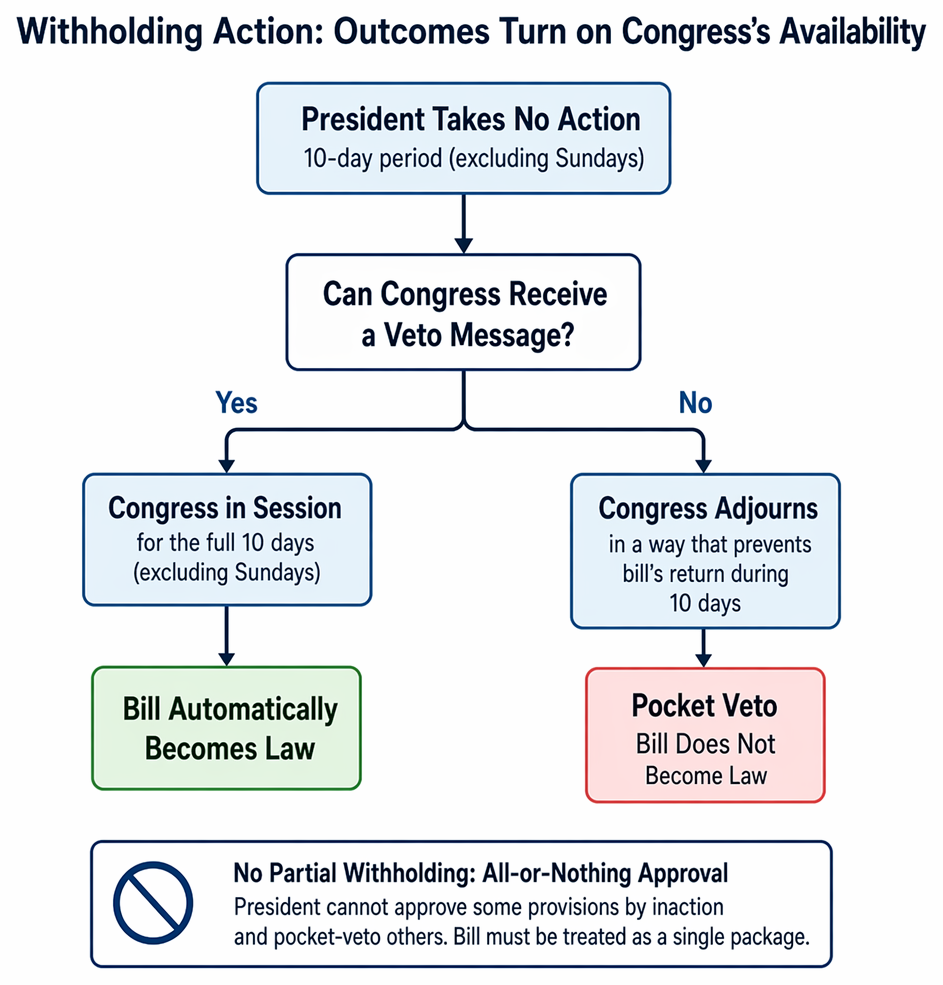
The president can also exercise power by doing nothing. As noted above, inaction can lead either to:
Congressional control over executive action requires bicameralism and presentment; one-house, concurrent-resolution, and committee-disapproval mechanisms are unconstitutional.
- The bill becoming law without the president’s signature; or
- A pocket veto, killing the bill.
The outcome turns entirely on whether Congress is in a position to receive a veto message during the 10‑day period.
-
Congress in session for the full 10 days (excluding Sundays):
- Presidential inaction → bill automatically becomes law.
-
Congress adjourns in a way that prevents the bill’s return during those 10 days:
- Presidential inaction → pocket veto → bill does not become law.
The president cannot change these outcomes by trying to “condition” inaction or by purporting to delay the effective date of a law beyond what Congress provided.
No Partial Withholding: All‑or‑Nothing Approval
The no‑line‑item‑veto principle also applies to withholding action:
- The president cannot treat some provisions as “approved” (by letting them take effect after 10 days) and others as “disapproved.”
- The presentment clause requires treating the bill as a single package.
Worked Example 1.4
Congress passes an omnibus spending bill and presents it to the president. The president announces that he will “allow” most of the bill to become law by taking no action but will “pocket veto” a few disfavored spending items within the bill. Congress stays in session for the full 10‑day period (excluding Sundays). What is the legal effect?
Answer:
The entire bill becomes law. If Congress remains in session and the president neither signs nor returns the bill within 10 days (excluding Sundays), the bill becomes law in full. The president cannot pocket‑veto particular provisions within a bill.
Impoundment and the Duty to Execute the Laws
A different kind of “withholding” sometimes tested on the MBE is impoundment—the president’s refusal to spend funds that Congress has appropriated.
Key Term: Impoundment
The president’s refusal to spend funds that Congress has appropriated. Where a statute clearly requires that funds be spent for specified purposes, the president has no constitutional power to withhold (impound) those funds.
Key points:
- If a statute gives the president discretion to spend (“may spend up to $X”), the president may choose to spend less or nothing.
- But if a statute unambiguously requires that funds be spent on specified purposes (“shall spend $X for Y”), the president must carry out that command.
- The president has no general constitutional power to refuse to enforce or fund duly enacted laws.
On the MBE, a statute that mandates spending and a president who refuses to spend, solely for policy reasons, present an unconstitutional impoundment, not a valid exercise of veto power. The proper course would have been to veto the bill at the presentment stage.
Congressional and Executive Limits in the Legislative Process
Both branches are hemmed in by the textual requirements of Article I and the structural principle of separation of powers.
Limits on Congress
Congress may not:
-
Enact binding legal changes by:
- One‑house resolutions
- Two‑house resolutions that bypass presentment
- Committee approvals or disapprovals
-
Give executive power to officers it controls (e.g., officers appointed and removable by Congress), then use that structure to bypass the president.
-
Bind the president prospectively by saying “future laws on this topic will be made by resolution” or “future agency actions will be effective only with committee approval.”
Congress may:
- Delegate broad discretion to executive agencies, so long as it provides at least minimal “intelligible principles” for exercise of that discretion.
- Amend or repeal prior delegations, or cut off funding, but only through bicameralism and presentment.
Limits on the President
The president may not:
- Create, amend, or repeal statutes unilaterally.
- Exercise a line‑item veto over portions of bills.
- Treat signing statements or executive orders as substitutes for statute.
- Impound funds when a statute clearly requires expenditure.
The president may:
- Veto entire bills, subject to override.
- Use executive orders to execute existing statutes and constitutional executive powers.
- Decline to spend when statutes give discretion rather than imposing a duty to spend.
On MBE problems, any presidential device that has the practical effect of amending a statute without going through bicameralism and presentment is suspect.
Key Point Checklist
This article has covered the following key knowledge points:
- Valid federal statutes require bicameral passage and presentment to the president.
- Once presented, the president may sign, veto, or withhold action; inaction results in either a law without signature or a pocket veto, depending on congressional adjournment.
- A regular veto can be overridden only by a two‑thirds vote in both houses.
- A pocket veto occurs when Congress adjourns within the 10‑day period in a way that prevents the bill’s return; it cannot be overridden.
- The president has no line‑item veto; bills must be accepted or rejected in their entirety.
- Legislative vetoes—attempts by one house, both houses without presentment, or committees to overturn executive action—are unconstitutional.
- Congress cannot evade bicameralism and presentment by labeling a measure an “order” or “resolution” if it has the force of law.
- The president cannot unilaterally impound funds that a statute clearly requires to be spent; the duty is to “take care that the laws be faithfully executed.”
Key Terms and Concepts
- Presentment Requirement
- Bicameralism
- Pocket Veto
- Veto Power
- Legislative Veto
- Line-Item Veto
- Impoundment