Learning Outcomes
This article explains treaty and foreign affairs powers within the separation of powers framework, including:
- The constitutional sources of foreign affairs authority and how power is divided and sometimes shared between Congress and the President.
- The step-by-step process for negotiating, consenting to, and ratifying treaties, and how to identify when a treaty is self-executing or requires implementing legislation.
- The domestic status of treaties as federal law, the last-in-time rule for conflicts with statutes, and why no treaty can override the U.S. Constitution.
- The forms, purposes, and limits of executive agreements, including how they compare to treaties on exams and how they interact with federal statutes and state law.
- The scope of the President’s recognition, Commander-in-Chief, and related foreign affairs powers, and which of these powers are exclusive versus subject to congressional control.
- Key congressional checks on presidential action—appropriations, commerce and war powers, treaty implementation, and oversight—and what Congress may not do (such as legislative vetoes over foreign policy).
- The constitutional prohibitions and preemption principles that restrict state participation in foreign relations, foreign commerce, and recognition of foreign governments.
- Common MBE-style fact patterns involving treaties, executive agreements, and conflicting federal or state law, and practical strategies for selecting the correct answer choice.
MBE Syllabus
For the MBE, you are required to understand treaty and foreign affairs powers as part of separation of powers and federalism, with a focus on the following syllabus points:
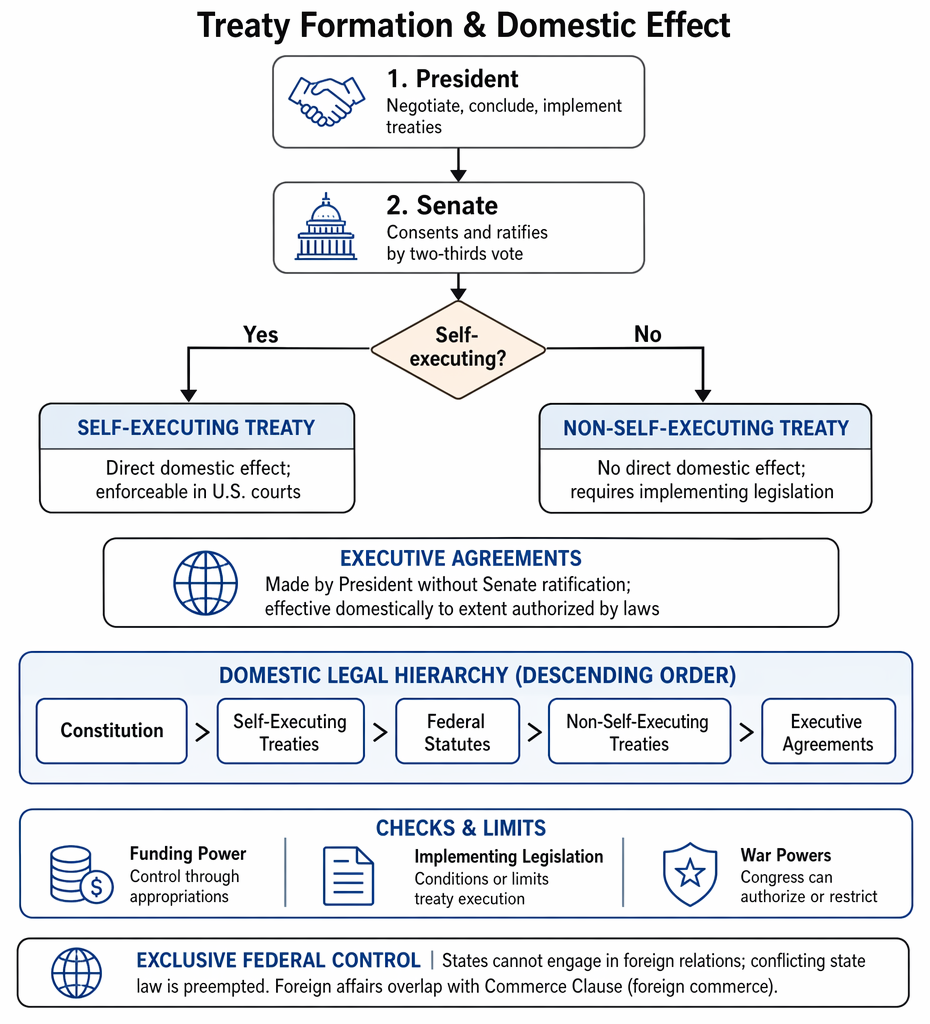
Foreign affairs hierarchy identifies constitutional supremacy, last-in-time treatment of treaties and statutes, and executive agreements' relation to federal and state law.
- The President’s powers to negotiate, conclude, and implement treaties.
- The Senate’s role in consenting to and ratifying treaties.
- The concept of self-executing versus non-self-executing treaties.
- The President’s power to enter into executive agreements and their domestic effect.
- The relative hierarchy of treaties, executive agreements, federal statutes, and the Constitution.
- Congressional checks on presidential foreign affairs powers (funding, implementing legislation, and war powers).
- Exclusive federal control over foreign relations and limits on state involvement, including preemption of conflicting state law.
- The overlap between foreign affairs powers and the Commerce Clause (foreign commerce).
Test Your Knowledge
Attempt these questions before reading this article. If you find some difficult or cannot remember the answers, look more closely at that area during your revision.
-
Which of the following is required for a treaty negotiated by the President to become binding federal law?
- a) Approval by a majority of the House of Representatives.
- b) Approval by a two-thirds vote of the Senate.
- c) Signature by the President alone.
- d) Approval by a majority of both Houses of Congress.
-
If a valid treaty conflicts with a prior federal statute, which controls?
- a) The treaty.
- b) The statute.
- c) The one adopted later in time.
- d) The one approved by a larger vote.
-
Which of the following is true regarding executive agreements?
- a) They require Senate approval.
- b) They are not binding on the United States.
- c) They may override conflicting state law.
- d) They may override the U.S. Constitution.
-
Can a state enact a law that directly regulates foreign commerce or enters into an agreement with a foreign nation?
- a) Yes, if Congress consents.
- b) Yes, without restriction.
- c) No, states are always prohibited.
- d) Only if the President consents.
Introduction
The U.S. Constitution divides responsibility for foreign affairs between the political branches. The President is the “sole organ” in conducting diplomacy: negotiating treaties, concluding executive agreements, commanding the armed forces, appointing ambassadors, and recognizing foreign governments. Congress, however, controls key levers of foreign policy through its powers to declare war, regulate foreign commerce, fund the military and foreign programs, and give or withhold consent to treaties.
For MBE purposes, the most heavily tested issues in this area are:
- How treaties are made and what domestic legal effect they have.
- How executive agreements differ from treaties.
- What happens when treaties or executive agreements conflict with federal or state law.
- When state action in foreign affairs is preempted because foreign relations are an exclusively federal function.
Understanding these interactions is essential to spotting separation-of-powers problems, identifying preemption of state law, and choosing the correct hierarchy between competing federal sources of law.
Key Term: Treaty
A formal agreement between the United States and a foreign nation, negotiated by the President and, to become domestic federal law, requiring approval (advice and consent) by a two-thirds vote of the Senators present. Key Term: Executive Agreement
An international agreement made by the President with a foreign government that does not require Senate approval. It is usually used for more routine, short-term, or administrative matters. Key Term: Supremacy Clause
The constitutional provision (Article VI) making the U.S. Constitution, federal statutes, and treaties the “supreme Law of the Land,” overriding conflicting state constitutions and state statutes. Key Term: Foreign Affairs Power
The authority to conduct the nation’s relations with other countries, including negotiating treaties, entering executive agreements, appointing and receiving ambassadors, and recognizing foreign governments. Key Term: Self-Executing Treaty
A treaty that, once ratified, automatically has domestic legal effect and can be enforced by courts without any additional implementing legislation. Key Term: Non-Self-Executing Treaty
A treaty that expresses international commitments but requires Congress to pass implementing legislation before U.S. courts can enforce it domestically. Key Term: Commander in Chief
The role of the President as head of the armed forces, giving the President operational control over military decisions, subject to Congress’s powers to declare war and fund the military. Key Term: Recognition Power
The President’s power to determine which foreign governments the United States regards as legitimate and to decide such questions as what state a territory (e.g., a capital city) belongs to for diplomatic purposes. Key Term: Preemption
The doctrine under which valid federal law (including treaties and certain executive agreements) overrides conflicting state law. In foreign affairs, even federal executive policy can sometimes preempt state law if the state measure interferes with national foreign policy.
The President’s Treaty and Foreign Affairs Powers
The President is the primary representative of the United States in foreign relations. This includes negotiating treaties, entering executive agreements, appointing ambassadors (with Senate consent), recognizing foreign governments, and directing the military as Commander in Chief. These powers are substantial but not unlimited, and they are subject to important constitutional checks by Congress and the courts.
Treaty Power
Article II provides that the President “shall have Power, by and with the Advice and Consent of the Senate, to make Treaties, provided two thirds of the Senators present concur.” The typical sequence is:
- The President (usually through the State Department) negotiates the treaty and signs it.
- The Senate gives or withholds its consent by a two-thirds vote of Senators present.
- If the Senate consents, the President ratifies the treaty on behalf of the United States.
Once ratified, a treaty is federal law. Its precise domestic effect depends on whether it is self-executing.
- A self-executing treaty provides a rule of decision that courts can apply directly (for example, “Nationals of each party shall be given most-favored-nation treatment in customs duties.”).
- A non-self-executing treaty requires implementing legislation from Congress; until such a statute is enacted, the treaty binds the U.S. internationally but is not directly enforceable in U.S. courts.
On the MBE, if a question does not mention implementing legislation, you may assume the treaty is self-executing unless the fact pattern clearly signals otherwise.
Domestically, treaties have the same status as federal statutes:
- If a treaty and a federal statute conflict, the one adopted later in time prevails (the “last-in-time” rule).
- Both treaties and statutes are subordinate to the Constitution. A treaty cannot authorize the government to violate constitutional rights; if a treaty conflicts with the Constitution, the Constitution controls.
Treaties also interact with state law through the Supremacy Clause:
- A valid treaty (self-executing or implemented by statute) overrides conflicting state constitutions, statutes, and regulations, whether the state law came earlier or later.
- States cannot invoke their own law as a defense to noncompliance with a valid federal treaty obligation.
Exam Tip: When you see a conflict between a treaty and state law, do not balance interests. If the treaty is valid and applicable, it preempts the conflicting state law.
Worked Example 1.1
A President negotiates a treaty with Country X on environmental standards. The Senate approves the treaty by a two-thirds vote. Congress previously passed a statute with different environmental rules. Which law controls if there is a conflict?
Answer:
The treaty and the statute have equal status under federal law. Under the last-in-time rule, the one adopted later in time controls. If the statute was enacted after the treaty was ratified, the statute prevails; if the treaty was ratified after the statute, the treaty prevails.
Worked Example 1.2
The United States enters a treaty with Country Z that promises each country will not impose import quotas on the other’s goods. The treaty states that it “shall not have domestic legal effect absent implementing legislation.” Congress never enacts such legislation. A U.S. importer sues to block a federal quota on Country Z’s goods based solely on the treaty. Is the importer likely to succeed?
Answer:
No. The treaty is expressly non-self-executing. Without implementing legislation from Congress, U.S. courts will not treat the treaty as directly enforceable domestic law. Internationally the U.S. may be in breach, but the importer cannot invoke the treaty on its own in court.
Executive Agreements
The President may also enter into executive agreements with foreign nations. These can be:
- Sole executive agreements, based solely on the President’s own constitutional powers (for example, recognition of a government or routine military basing arrangements), or
- Congressional-executive agreements, authorized or implemented by statute (for example, trade agreements approved by majority votes in both houses).
Key MBE points about executive agreements:
- They do not require Senate approval.
- They are binding on the United States internationally.
- As a matter of domestic law, they:
- Can override conflicting state law.
- Cannot override the U.S. Constitution.
- Cannot override a conflicting federal statute; a valid statute can authorize, limit, or override them.
Themis captures this hierarchy: executive agreements can be authorized, precluded, or overridden by statute; they take precedence over conflicting state laws but do not have the same status as treaties.
Worked Example 1.3
The President enters into an executive agreement with Country Y to facilitate trade. A state passes a law that restricts trade with Country Y. Is the state law valid?
Answer:
No. Executive agreements, like treaties, preempt conflicting state law. The state law is invalid to the extent it conflicts with the executive agreement.
Worked Example 1.4
Congress enacts a statute prohibiting arms sales to Country Q. Later, the President concludes an executive agreement with Country Q promising to sell it certain weapons systems. An arms manufacturer sues, arguing it may not sell to Country Q because of the statute. Which controls?
Answer:
The federal statute controls. Executive agreements cannot override conflicting federal statutes or the Constitution. Congress validly exercised its foreign commerce and war-related powers to prohibit arms sales, and the President cannot unilaterally negate that statute through an executive agreement.
Recognition Power
The recognition power—deciding which foreign governments the United States recognizes and what territory belongs to which state—is exclusively executive. It is exercised through:
- Receiving or refusing to receive foreign ambassadors.
- Proclaiming recognition of new states or governments.
- Determining, for diplomatic purposes, which state certain cities or regions belong to.
Congress may not override the President’s recognition determinations by statute. For example, Congress may not require the State Department to list a birthplace on U.S. passports in a way that contradicts the President’s formal recognition position.
Worked Example 1.5
Congress passes a statute requiring that U.S. passports list the birthplace of citizens born in City J as “Country A.” The President has taken the official position that City J’s status is disputed and has not recognized it as part of Country A. The State Department refuses to implement the statute on passports. Is the statute constitutional?
Answer:
No. The statute intrudes on the President’s exclusive recognition power. Congress cannot force the President or the Executive Branch to take a position on the status of foreign territory that contradicts the President’s recognition determination.
Commander in Chief and War Powers
As Commander in Chief, the President has operational control over the armed forces: directing military operations, choosing tactics, and deploying forces. However:
- Only Congress can declare war, raise and support armies, and provide and regulate the Navy.
- Congress can limit or end military operations by cutting off or conditioning appropriations.
The MBE is unlikely to test the War Powers Resolution in detail; instead, focus on this allocation:
- Congress decides whether to fund or authorize major uses of force.
- The President directs how authorized force is used.
Foreign affairs questions sometimes combine war and treaty powers. For example, Congress might implement a mutual defense treaty by statute; the President then directs the use of forces consistent with both the statute and the treaty.
Congressional Checks
Congress can check the President’s foreign affairs powers by using several of its own powers:
- Spending power: refusing to appropriate funds for foreign initiatives or conditioning funds (for example, conditioning aid to a foreign nation on human rights benchmarks).
- Commerce power: regulating or restricting foreign commerce, such as sanctions or export controls.
- War powers: declaring war, setting limits on deployments through statutes, and regulating the armed forces.
- Impeachment: impeaching and removing executive officers (including the President) for “treason, bribery, or other high crimes and misdemeanors.”
- Implementing treaties: choosing whether and how to pass implementing legislation for non-self-executing treaties.
Congress may not:
- Exercise a “legislative veto” over specific executive foreign policy actions by simple resolution; any override must be through new legislation presented to the President for signature or veto.
- Appoint its own members to exercise executive power in foreign affairs.
Exam Tip: If you see Congress reserving the right to “disapprove” future executive foreign affairs decisions by one-house or committee resolution, that is an unconstitutional legislative veto.
Limits on State Power
Foreign affairs are an essentially national function. Several constitutional provisions limit state involvement:
-
States may not:
- Enter into treaties, alliances, or confederations with foreign nations.
- Coin money or impose duties on imports or exports (except in narrow circumstances).
- Directly regulate foreign commerce in a way that interferes with federal control.
- Recognize foreign governments or appoint ambassadors.
-
States may enter into limited agreements or compacts with foreign powers only if Congress consents.
Even when a state acts in an area of traditional state concern (such as probate or insurance), its law may be invalid if it interferes with the conduct of foreign relations. The Supreme Court has struck down:
- State probate laws that effectively punished heirs living in disfavored foreign countries because that intruded into foreign policy.
- State disclosure laws targeting foreign insurance policies where the federal executive had already negotiated an international agreement resolving those claims.
In addition, the Supremacy Clause and preemption doctrine apply strongly in the foreign affairs context:
- Where Congress has legislated extensively in a foreign relations area, or the President has concluded an executive agreement, state laws that conflict with that federal scheme are preempted.
- Even without a specific statute, a state law may be preempted if it stands as an obstacle to the President’s conduct of foreign policy (for example, state sanctions against a foreign country that conflict with an executive agreement normalizing relations).
Worked Example 1.6
A state legislature passes a law recognizing a breakaway region as an independent country and opens a state trade office there. Is this law constitutional?
Answer:
No. States cannot recognize foreign governments or conduct foreign relations. Such actions—recognition and formal diplomatic relations—are reserved to the federal government. The law is unconstitutional.
Worked Example 1.7
A state enacts a statute prohibiting insurers doing business in the state from paying Holocaust-era claims unless they disclose detailed information about European insurance policies issued between 1920 and 1945. The federal government has previously entered into executive agreements with several European countries creating a comprehensive claims process for Holocaust-era insurance. Insurers sue to enjoin the state law. Is the state statute valid?
Answer:
No. The state statute interferes with the federal government’s conduct of foreign relations and is preempted. The executive agreements and the federal policy they reflect occupy the field of resolving Holocaust-era claims; a conflicting state disclosure regime undermines that national policy and is invalid under the Supremacy Clause.
Worked Example 1.8
A state legislature passes a law barring the export of certain high-tech components to Country R, citing human rights concerns. Congress has not imposed any restrictions on trade with Country R, and the President is pursuing a policy of engagement through trade, but there is no treaty or executive agreement on point. A manufacturer in the state challenges the law. What is the best argument against the state law?
Answer:
That the law unconstitutionally interferes with the federal foreign affairs power. Even in the absence of a specific statute or executive agreement, states may not adopt measures that intrude into the field of foreign relations and undermine the nation’s ability to speak with one voice in foreign affairs. The state restriction on exports is likely preempted.Exam Warning: The President cannot unilaterally make binding federal law through executive agreements if Congress has legislated otherwise. Always check for conflicting federal statutes and remember that executive agreements cannot override either statutes or the Constitution.
Revision Tip: Remember: Treaties require a two-thirds Senate vote; executive agreements do not. Both preempt conflicting state law. Treaties and federal statutes are on the same level—the later in time prevails—while executive agreements are subordinate to statutes and the Constitution.
Summary
- The President negotiates treaties, but they do not become binding federal law unless two-thirds of the Senators present give their advice and consent and the President ratifies them.
- Treaties can be self-executing (direct domestic effect) or non-self-executing (requiring implementing legislation). Both kinds, once enforceable, override conflicting state law.
- Treaties and federal statutes have equal status; if they conflict, the later in time controls, but both are subordinate to the Constitution.
- Executive agreements are concluded by the President without Senate approval. They are binding internationally and preempt conflicting state law but cannot override the Constitution or valid federal statutes.
- The President has exclusive power to recognize foreign governments and control certain aspects of diplomacy; Congress cannot override recognition decisions.
- Congress checks presidential foreign affairs powers through appropriations, commerce and war powers, treaty implementation, and, in extreme cases, impeachment.
- States are prohibited from making treaties, recognizing foreign governments, or conducting their own foreign policy. State laws that interfere with federal foreign policy—whether treaties, executive agreements, or executive policies—are preempted.
Key Point Checklist
This article has covered the following key knowledge points:
- The President negotiates treaties, but Senate approval by a two-thirds vote of Senators present is required for ratification.
- Treaties may be self-executing or non-self-executing; only self-executing treaties (or those implemented by statute) are directly enforceable in U.S. courts.
- Treaties and federal statutes have equal status under federal law; if they conflict, the later in time governs, but neither can violate the Constitution.
- Executive agreements are made by the President without Senate approval. They bind the United States internationally and override conflicting state law but cannot override federal statutes or the Constitution.
- The President’s recognition power is exclusive; Congress may not compel recognition choices that contradict the President’s determination.
- As Commander in Chief, the President directs military operations, but Congress controls declarations of war, military funding, and regulation of the armed forces.
- Congress can check presidential foreign affairs powers through legislation, appropriations, and implementation (or non-implementation) of treaties.
- States cannot conduct foreign policy, recognize foreign governments, or enter into agreements with foreign nations without congressional consent, and their laws are preempted if they interfere with national foreign policy.
Key Terms and Concepts
- Treaty
- Executive Agreement
- Supremacy Clause
- Foreign Affairs Power
- Self-Executing Treaty
- Non-Self-Executing Treaty
- Commander in Chief
- Recognition Power
- Preemption