Learning Outcomes
After reading this article, you will be able to explain a lawyer’s responsibilities for safeguarding funds and property belonging to third persons, not just clients. You will understand the requirements for handling third-party property, the rules for trust accounts, and the correct procedures when property is subject to competing claims. You will be equipped to answer MPRE-style questions on this topic.
MPRE Syllabus
For the MPRE, you are required to understand the ethical rules governing a lawyer’s handling of funds and property belonging to third persons. This includes:
- Identifying when a lawyer holds property for a third person in connection with a representation.
- Explaining the duty to keep third-party property separate from the lawyer’s own property.
- Describing the requirements for notice, delivery, and accounting of third-party property.
- Applying the rules for handling disputed claims involving third-party property.
- Recognizing the consequences of improper handling of third-party funds or property.
Test Your Knowledge
Attempt these questions before reading this article. If you find some difficult or cannot remember the answers, look more closely at that area during your revision.
-
When a lawyer holds settlement funds that are claimed by both the client and a third party, the lawyer must:
- a) Disburse all funds to the client immediately.
- b) Disburse all funds to the third party immediately.
- c) Keep the disputed portion separate until the dispute is resolved.
- d) Split the funds equally between the client and third party.
-
A lawyer receives a check payable to a client and a third party. The client instructs the lawyer to ignore the third party’s claim. What should the lawyer do?
- a) Follow the client’s instructions.
- b) Disburse the funds to the third party.
- c) Hold the funds until the dispute is resolved.
- d) Return the check to the sender.
-
Which of the following is required when a lawyer receives property belonging to a third person in connection with a representation?
- a) Deposit it in the lawyer’s personal account.
- b) Notify the third person promptly.
- c) Use the property to pay the client’s debts.
- d) Ignore any third-party claims.
Introduction
Lawyers often hold funds or property not only for clients but also for third persons, such as lienholders, creditors, or others with a legal interest. The Model Rules impose strict duties on lawyers to safeguard such property, keep it separate from their own, and handle disputes properly. Failure to comply can result in discipline, civil liability, or both.
Key Term: Third Person Property
Property or funds held by a lawyer in connection with a representation that belong, in whole or in part, to someone other than the client.
Safekeeping Third Person Funds and Property
Lawyers must treat property of third persons with the same care as client property. This includes funds held in trust, documents, securities, or any tangible items.
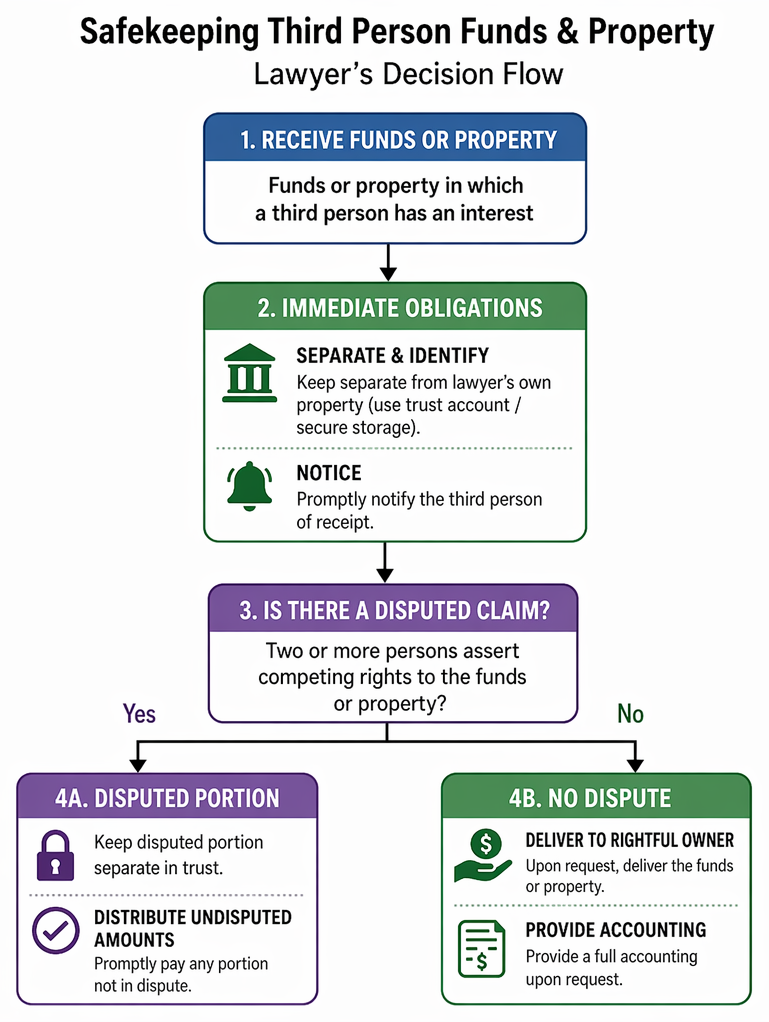
Third-person property safekeeping requirements move from receipt and segregation to notice and delivery, disputed-amount trust retention, and prompt distribution of undisputed amounts.
Separation and Identification
A lawyer must keep third-party property separate from the lawyer’s own property. This usually means placing funds in a designated trust account and storing physical items in a secure location.
Key Term: Trust Account
A separate account maintained by a lawyer for holding funds belonging to clients or third persons, not to be commingled with the lawyer’s own funds.
Notice and Delivery
When a lawyer receives funds or property in which a third person has an interest, the lawyer must promptly notify the third person. Upon request, the lawyer must deliver the property or funds to the rightful owner and provide a full accounting.
Key Term: Notice
The lawyer’s obligation to inform a client or third person promptly upon receiving funds or property in which they have an interest.
Handling Disputed Claims
If two or more persons (including the lawyer or client) claim an interest in property held by the lawyer, the lawyer must keep the disputed portion separate until the dispute is resolved. The lawyer must promptly distribute any portion not in dispute.
Key Term: Disputed Claim
A situation where two or more parties assert competing rights to funds or property held by a lawyer. Key Term: Safekeeping
The duty to protect, preserve, and properly account for funds or property belonging to clients or third persons.
Examples of Third Person Interests
Common examples include:
- Medical provider liens on settlement proceeds.
- Funds subject to a statutory or contractual lien.
- Property held for delivery to a third party as part of a transaction.
Worked Example 1.1
A lawyer settles a personal injury case and receives a check for $10,000. The client owes $2,000 to a medical provider who has notified the lawyer of a lien. The client instructs the lawyer to ignore the lien and pay all funds to the client. What should the lawyer do?
Answer:
The lawyer must promptly pay the client $8,000 (the undisputed portion) and hold the $2,000 in trust until the dispute between the client and the medical provider is resolved. The lawyer cannot simply follow the client’s instructions if aware of a valid third-party claim.
Worked Example 1.2
A lawyer holds a settlement check payable jointly to the client and a third party creditor. The client and creditor disagree about entitlement. The lawyer is unsure who should receive the funds.
Answer:
The lawyer must keep the disputed funds in the trust account and not disburse them to either party until the dispute is resolved. The lawyer should promptly distribute any portion not in dispute.Exam Warning: If a lawyer disburses disputed funds to the client while aware of a third party’s lawful claim, the lawyer may be subject to discipline—even if the client later resolves the dispute.
Revision Tip: Always ask: Is there a third party with a legal claim to funds or property held by the lawyer? If so, keep the disputed portion separate until the dispute is settled.
Summary
Lawyers must safeguard property and funds of third persons as carefully as those of clients. This includes keeping property separate, providing prompt notice, delivering property on request, and holding disputed property in trust until resolved. Ignoring third-party claims can lead to discipline.
Key Point Checklist
This article has covered the following key knowledge points:
- Lawyers must safeguard funds and property of third persons as well as clients.
- Third-party property must be kept separate from the lawyer’s own property.
- Prompt notice and delivery are required when a lawyer receives third-party property.
- Disputed claims must be kept in trust until resolved; undisputed portions must be distributed promptly.
- Improper handling of third-party property can result in discipline or civil liability.
Key Terms and Concepts
- Third Person Property
- Trust Account
- Notice
- Disputed Claim
- Safekeeping