Learning Outcomes
This article explains the fundamental documents used to start civil litigation in England and Wales: the claim form and the particulars of claim. After studying this material, you will understand their respective purposes, the required structure and content according to the Civil Procedure Rules (CPR), and the significance of key components like the statement of truth. This knowledge is essential for applying procedural rules correctly in SQE1 assessments involving the commencement of claims. You will also be able to identify the principal rules on issuing and serving claims, including the concept of deemed service and differences between service of the claim form and other documents; articulate how the statement of value influences allocation; distinguish what belongs in the “brief details of claim” on the claim form from the material facts that must be pleaded in the particulars of claim (including special matters such as fraud and misrepresentation); and explain the role of pre‑action protocols and sanctions for non‑compliance. In addition, you will understand how interest must be pleaded, when attachments (for example, a written contract or medical report) should accompany the particulars of claim, and the requirements and consequences associated with verification by a statement of truth.
SQE1 Syllabus
For SQE1, you are required to understand how claims are initiated and to identify the requirements for the claim form and particulars of claim in various scenarios, as governed by the CPR, with a focus on the following syllabus points:
- The distinct purposes of the claim form and the particulars of claim.
- The mandatory information required for a valid claim form under CPR Part 7 and PD 7A.
- The detailed requirements for the content and structure of particulars of claim under CPR Part 16 and PD 16.
- The significance and requirements of the statement of truth (CPR Part 22).
- The relationship between these documents and the initial stages of case management, including allocation.
- The rules for service within the jurisdiction and deemed service dates (CPR Part 6), including the difference between deemed service of the claim form (CPR 6.14) and of other documents (CPR 6.26).
- Time limits and extensions for serving the claim form and particulars of claim (CPR 7.5, 7.6; PD 7A).
- Service out of the jurisdiction and the six‑month service window (CPR 6.32–6.33; PD 6B para 3.1).
- Pleading interest (contractual and statutory) and particularising special matters (e.g., fraud, misrepresentation, illegality) required by PD 16.
Test Your Knowledge
Attempt these questions before reading this article. If you find some difficult or cannot remember the answers, look more closely at that area during your revision.
-
Which CPR Part primarily governs the content of the particulars of claim?
- a) Part 7
- b) Part 16
- c) Part 22
- d) Part 26
-
True or false? The claim form must always contain the full particulars of claim.
-
What is the purpose of the statement of truth on a claim form or particulars of claim?
-
Identify one key difference between the information required in the 'brief details of claim' section on the claim form and the 'detailed statement of facts' in the particulars of claim.
Introduction
Commencing legal proceedings formally requires adherence to specific procedural rules outlined in the Civil Procedure Rules (CPR). The initial stage involves drafting and issuing two foundational documents: the claim form and the particulars of claim. While the claim form officially starts the legal action, the particulars of claim provide the detailed substance of the claimant's case. Understanding the distinct roles, structure, and mandatory content of these documents is important for any prospective solicitor preparing for the SQE1 examination. This article breaks down these requirements as stipulated by the relevant CPR provisions.
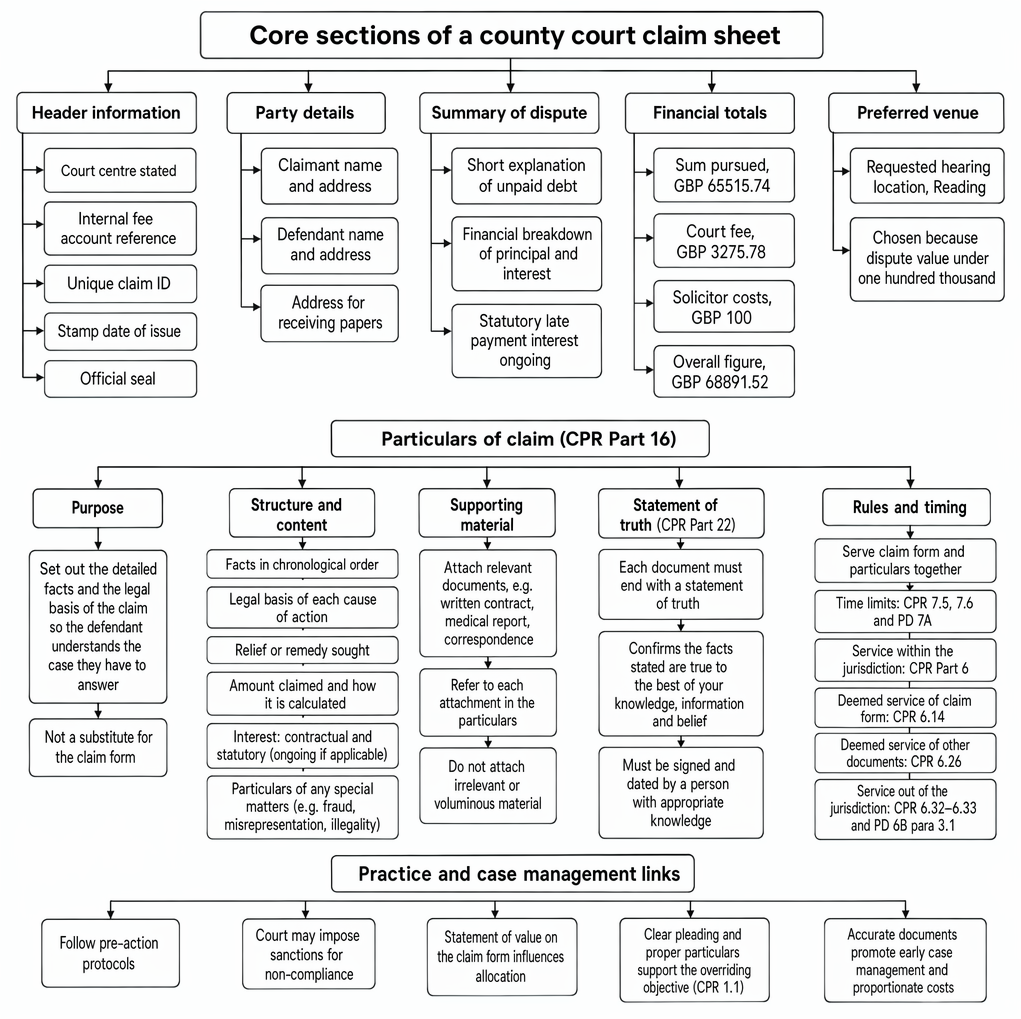
Core sections of a county court claim form, including party details, particulars of claim, sums claimed, and preferred hearing centre.
Key Term: Claim Form
The court document, governed primarily by CPR Part 7, that initiates legal proceedings when issued by the court. Key Term: Particulars of Claim
The statement of case detailing the factual and legal basis of the claimant's claim, governed primarily by CPR Part 16.
The overriding objective (CPR 1.1) underpins how the court manages all civil cases, requiring proportionate procedures, early identification of issues, and enforcement of compliance. Early and accurate completion of the claim form and particulars of claim supports the court’s active case management and reduces unnecessary cost and delay.
The Claim Form (CPR Part 7)
The claim form (usually Form N1) is the document that formally commences court proceedings when issued by the court (CPR 7.2). Its primary function is to notify the defendant(s) that a claim has been initiated against them and to provide the court and the defendant with essential preliminary information about the dispute. “Issuing” is the date the court seals the form and assigns a claim number; for limitation purposes, proceedings are considered “brought” when the court receives the claim form, though the date of issue appears on the sealed form.
Accuracy in completing the claim form is essential. Errors can lead to delays or even the court refusing to issue the claim, and they may later complicate service and allocation.
Key Components of a Claim Form (PD 7A)
The claim form must include specific information to be valid:
-
Parties' Details: Full names and addresses of both the claimant(s) and defendant(s) must be provided (PD 16 paras 2.1–2.5). Correct identification is essential, especially regarding the defendant's legal status (e.g., individual, company, partnership). For individuals trading under a business name, include the full personal name and the trading name (e.g., “John Smith trading as JS Autos”); for partnerships, the style “(A Firm)” is used when suing the firm name; for companies and LLPs, use the registered name including the suffix (Ltd, plc, LLP). A full postal address including postcode is required for both parties unless the court dispenses with it.
-
Brief Details of Claim: A concise statement of the nature of the claim and the remedy sought (CPR 16.2(1)(a)–(b)). This is not the place for detailed facts or evidence; rather, it signals to the court and the defendant the type of dispute (e.g., “Damages for breach of contract dated 1 May [Year]” or “Negligence arising from a road traffic accident on [date]”). The particulars of claim will later set out material facts.
-
Statement of Value: Where the claimant seeks money, they must indicate the value bracket (CPR 16.3). For specified claims (a fixed debt), state the precise amount claimed (excluding costs). For unspecified damages, select the appropriate bracket: “not more than £10,000,” “more than £10,000 but not more than £25,000,” or “more than £25,000,” or state you cannot say how much you expect to recover. In personal injury claims, the claimant must additionally state whether general damages for pain, suffering and loss of amenity exceed £1,000. The stated value informs track allocation under CPR Part 26 and the issue fee payable.
-
Preferred Hearing Centre: If issuing in the County Court Business Centres (including the County Court Money Claims Centre), name a preferred hearing centre. Contested cases are commonly transferred to a convenient local hearing centre, typically connected to the defendant’s residence or the parties’ stated preference.
-
Defendant's Address for Service: Insert the defendant’s own service address unless their solicitors have agreed in writing to accept service. Do not assume pre‑action correspondence equates to acceptance of service; specific written authority is needed (CPR 6.7, PD 6A).
-
Amount Claimed Summary: The financial summary box shows the amount claimed (or for unspecified claims, the estimate), the court fee, and any fixed commencement costs where applicable (see CPR Part 45 for fixed costs in specified money claims). For unspecified claims, “to be assessed” is appropriate for solicitor’s costs.
-
Statement of Truth: The claim form must be verified by a statement of truth signed by the claimant, their litigation friend, or their legal representative (CPR 22.1; PD 22). Verification confirms an honest belief in the accuracy of the content and carries potential contempt consequences if false.
-
Attachments and human rights issues (rare): Where the claim involves a written contract, PD 16 expects a copy to be attached or its essential terms to be identified in the particulars of claim (see below). The claim form also contains a box to indicate if Human Rights Act issues arise (uncommon in standard money claims).
Key Term: Statement of Truth
A statement confirming that the party putting forward the document believes the facts stated in it are true, made in accordance with CPR Part 22.
Issuing the Claim Form
Proceedings commence when the court issues the claim form at the claimant's request (CPR 7.2(1)). The date of issue is printed on the sealed form. From the date of issue, strict time limits apply to service (below). For limitation purposes, ensure the form reaches the court before the limitation expiry; issuing close to the deadline without prompt service may invite applications about extension or strike‑out if time limits are missed.
Service of the Claim Form: Methods, Time Limits, and Deemed Service
Once issued, the claim form must be served within the validity period (CPR 7.5):
- Within the jurisdiction, the claimant must complete the relevant step for service no later than midnight on the calendar day four months after the date of issue. Outside the jurisdiction, the period is six months (CPR 7.5, 6.32–6.33).
- The “relevant step” depends on method (CPR 7.5): posting by first‑class post or DX; completing transmission by fax or sending e‑mail (where agreed); personal service by leaving with the appropriate person; or leaving at a permitted address. The court can also authorise alternative methods (CPR 6.15).
Key Term: Deemed Service
The date on which a document is treated by the CPR as served regardless of when it is actually received.
Deemed service (CPR 6.14) of a claim form occurs on the second business day after the relevant step is taken. This differs from deemed service of other documents (including particulars of claim when served separately), which follows CPR 6.26 and the 4:30 p.m. rule, or the second day after posting depending on method. Always distinguish the deemed service rule for claim forms from that for subsequent documents.
If service cannot be achieved within the four-month window, apply for an extension of time before expiry under CPR 7.6(2). The court may grant an extension after expiry only if the court failed to serve the form (where the court undertook service) or if the claimant took all reasonable steps to serve but could not, and in either case acted promptly (CPR 7.6(3)). Parties may also agree limited extensions to serve particulars of claim (see below), but not for the claim form service itself.
Service out of the jurisdiction may require permission where no specific gateway applies (PD 6B para 3.1; CPR 6.36–6.37). If serving in Scotland or Northern Ireland or in certain foreign states under applicable instruments, additional procedural steps are involved, and local service rules may apply. The six‑month validity period remains critical.
Particulars of Claim (CPR Part 16)
While the claim form initiates the action, the particulars of claim set out the detailed factual and legal basis upon which the claimant relies (CPR 16.4). This document must provide sufficient detail for the defendant to understand the case and to plead a response.
The particulars can be endorsed on the claim form (if concise) or served separately. If served separately, they must be served either with the claim form or within 14 days after service of the claim form, and in any event within the claim form’s overall validity period (four months domestically, six months for service out) (CPR 7.4).
Key Term: Particulars of Claim
The statement of case detailing the factual and legal basis of the claimant’s claim, governed primarily by CPR Part 16.
Content Requirements for Particulars of Claim (CPR 16.4 & PD 16)
-
Concise Statement of Material Facts: Plead the material facts relied on, in numbered paragraphs and a logical chronology (CPR 16.4(1)(a)). This means pleading the elements of the cause of action (e.g., contract formation, terms, breach, causation, loss; or duty, breach, causation, damage in negligence). Avoid legal argument or evidence; facts are required.
-
Identify the Legal Basis: Make clear the cause(s) of action (e.g., “breach of contract,” “negligence,” “misrepresentation”), and for contractual claims involving written agreements, PD 16 expects you either to attach the contract or set out its material terms and the manner of incorporation. For oral contracts, state the words used, by whom, to whom, and when.
-
Special Matters: Certain allegations must be specifically pleaded with particulars, including fraud, illegality, misrepresentation, breach of trust, notice, and knowledge (PD 16 para 8.2). If exemplary or aggravated damages are sought, state that and the grounds (CPR 16.4(1)(c)).
-
Consequences and Causation: Explain the consequences of the breach or tort, connecting the pleaded acts to the loss via causation. If causation is in issue, plead the chain of events clearly.
-
Loss and Damage: Particularise loss. For specified sums, state precise amounts and how calculated. For unliquidated damages, list heads of loss (e.g., general damages for pain, suffering and loss of amenity; special damages such as lost earnings, medical expenses). In personal injury claims, it is common to attach a medical report or serve it later per court directions, and a schedule of past and future losses.
-
Interest: If interest is claimed, state the basis (contractual term or statutory). Statutory interest is claimed under s.35A Senior Courts Act 1981 (High Court) or s.69 County Courts Act 1984 (County Court). Specify the rate, period, total accrued to issue, and any daily rate for continuing interest where appropriate (CPR 16.4(2)).
-
Remedy Sought: Conclude with the relief sought (e.g., damages, specific performance, injunction, declaratory relief).
-
Statement of Truth: Verify the particulars with a statement of truth in the prescribed form (CPR 22.1; PD 22).
Key Term: Statement of Truth
A statement confirming that the party putting forward the document believes the facts stated in it are true, made in accordance with CPR Part 22.
Where appropriate, attach essential documents (e.g., the written contract, relevant notices). In claims for debt under a written agreement, appending the contract reduces dispute about terms and formation.
Worked Example 1.1
A claimant is suing for damages resulting from a breach of contract for the supply of defective goods worth £15,000. The claimant also incurred £2,000 in costs attempting to repair the goods. Where should the claimant state the detailed breakdown of these losses?
Answer:
The detailed breakdown of the £15,000 cost of goods and the £2,000 repair costs, explaining how these losses arose from the alleged breach, should be set out in the particulars of claim. The claim form would state the expected recovery value (likely “more than £10,000 but not more than £25,000”) and briefly mention “damages for breach of contract”.
Worked Example 1.2
A claimant serves a claim form indicating “Particulars of claim to follow”. The claim form was deemed served on Monday 4th March. What is the latest date the claimant can serve the separate particulars of claim?
Answer:
The claimant has 14 days after service of the claim form to serve the particulars of claim (CPR 7.4(1)(b)). Counting 14 “clear” days from 4th March (excluding the 4th), the latest date for service is Monday 18th March, provided this is within 4 months of the claim form's issue date.
Worked Example 1.3
A claimant seeks statutory interest on a £63,450 contract price from 27 March to the issue date (6 August), and continuing interest thereafter. How should interest be pleaded in the particulars of claim, and how is the daily rate calculated?
Answer:
Plead the statutory basis (s.35A Senior Courts Act 1981 or s.69 County Courts Act 1984) and specify the start date (27 March), rate (e.g., 8% per annum unless a different rate is justified), amount accrued to issue (number of days × daily rate), and the continuing daily rate until judgment. The daily rate is the principal sum × annual rate ÷ 365 (e.g., £63,450 × 0.08 ÷ 365 ≈ £13.90 per day).
Worked Example 1.4
A written contract underpins the claim. What must be included in the particulars of claim regarding the contract?
Answer:
Either attach a copy of the written contract or set out its material terms and the manner of incorporation (PD 16). Plead how the contract was made, the relevant express or implied terms, and precisely how the defendant breached those terms.
Worked Example 1.5
A claimant posts the particulars of claim (served separately from the claim form) at 5:15 p.m. on a Friday. When are the particulars deemed served?
Answer:
For documents other than the claim form, deemed service follows CPR 6.26. If posted first class, the document is deemed served on the second day after posting, provided that day is a business day; otherwise, the next business day. If posted on Friday, the second day is Sunday (not a business day), so deemed service is Monday.Exam Warning: Distinguishing between the function and content of the claim form and the particulars of claim is important. The claim form starts the action and gives basic details, while the particulars provide the full factual and legal case. Confusing their requirements is a common pitfall. Ensure you know which CPR Parts (7 and 16 primarily) govern each document. Also distinguish the deemed service rules: claim forms (CPR 6.14) versus other documents (CPR 6.26).
Relationship with Pre-Action Conduct
The facts and issues detailed in the particulars of claim should align with the matters raised and information exchanged during the pre‑action protocol period (PDPAC and any specific protocol). The particulars should reflect the claim foreshadowed in the Letter of Claim, and key documents should already have been disclosed pre‑action where proportionate. Failure to engage with pre‑action obligations may attract sanctions.
Key Term: Pre‑Action Protocol
A set of steps and information exchange the court expects parties to complete before issuing proceedings, promoting early settlement and efficient case management.
Non‑compliance with pre‑action requirements can lead to:
- A stay of proceedings to compel compliance.
- Adverse costs orders (including indemnity basis).
- Interest penalties (e.g., reduced interest for a claimant or increased interest against a defendant up to 10% above base rate for a specified period).
- Other case management sanctions, depending on prejudice caused.
Revision Tip: When drafting or analysing particulars of claim, ensure every element of the chosen cause of action (e.g., duty, breach, causation, loss for negligence) is addressed by the pleaded facts. A failure to plead a necessary element can be fatal to the claim or part of it.
The Statement of Truth (CPR Part 22)
Both the claim form and the particulars of claim must be verified by a statement of truth. This is a mandatory requirement and confirms the signer’s honest belief in the truth of the statements.
The prescribed wording (PD 22 para 2.1) is:
“[I believe] [The Claimant believes] that the facts stated in this [name document being verified] are true. [I understand] [The Claimant understands] that proceedings for contempt of court may be brought against anyone who makes, or causes to be made, a false statement in a document verified by a statement of truth without an honest belief in its truth.”
The statement of truth must be signed by the party, their litigation friend, or their legal representative. Where a legal representative signs, they do so in their own name (not the firm’s name) and are taken to confirm that the client authorised them to sign, that the client was warned of the consequences of false statements, and that the representative has explained the significance of verification (PD 22 paras 3.7–3.8). In the case of a company or corporation, a director or other authorised officer may sign. A litigation friend signs on behalf of a child or protected party.
Failure to verify a statement of case can lead to it being struck out or the party being unable to rely on it (CPR 22.2). Knowingly false statements verified by a statement of truth may result in contempt proceedings (CPR 32.14).
Summary
Commencing a claim involves two key documents governed by the CPR:
| Document | Primary CPR Rule | Purpose | Key Content Requirements | Service Deadline |
|---|---|---|---|---|
| Claim Form | Part 7 | Formally starts proceedings; notifies defendant | Parties' details, brief claim details, value, remedy sought, statement of truth. | Must be served within 4 months of issue (6 months if outside jurisdiction). |
| Particulars of Claim | Part 16 | Details the full factual and legal basis | Detailed facts, legal basis, causation, loss/damage particulars, interest claim details, remedy sought, statement of truth. | With claim form or within 14 days after claim form service (within 4/6 months). |
Both documents require careful drafting to comply with the CPR and effectively present the claimant's case. The statement of truth is a mandatory component verifying the factual assertions made.
Key Point Checklist
This article has covered the following key knowledge points:
- The claim form (CPR Part 7) formally commences proceedings and contains essential preliminary details.
- The particulars of claim (CPR Part 16) provide the detailed factual and legal basis of the claimant's case.
- Accurate identification of parties, value, and remedy is essential on the claim form; use correct naming conventions for individuals, firms, companies and LLPs.
- The statement of value informs track allocation and the court fee; personal injury claims must state whether general damages exceed £1,000.
- Particulars of claim must include a concise statement of material facts, establish the cause of action, detail loss and damage, and specify any interest claimed.
- Special matters such as fraud, misrepresentation or illegality must be expressly particularised (PD 16).
- Attachments such as written contracts (or their material terms) and personal injury schedules/medical reports should accompany or follow the particulars as appropriate.
- Claim forms are deemed served on the second business day after the relevant step (CPR 6.14); other documents follow CPR 6.26.
- Particulars of claim can be served with the claim form or within 14 days after service of the claim form (subject to the overall validity period of the claim form).
- Time limits to serve the claim form are strict: 4 months within the jurisdiction, 6 months out of jurisdiction; extensions require compliance with CPR 7.6.
- Both documents must be verified by a statement of truth (CPR Part 22); false verified statements may result in contempt proceedings.
- Pre‑action protocols (PDPAC and specific protocols) shape the content and may affect costs and interest if not followed.
Key Terms and Concepts
- Claim Form
- Particulars of Claim
- Statement of Truth
- Deemed Service
- Pre‑Action Protocol