Learning Outcomes
This article explains the rules and procedures for serving a claim form within the jurisdiction of England and Wales under CPR Parts 6 and 7. It explains the permitted methods of service, how to identify the correct address for individuals, companies, partnerships and solicitors, and who is responsible for serving and completing the certificate of service. It details the four-month validity period of a claim form, how to calculate the service deadline, and how deemed service dates are calculated for claim forms and for other documents. It outlines when and how the court may grant extensions of time or permit alternative methods of service, and the strict consequences of failing to serve in time or using an invalid method. It also highlights common exam traps, such as confusing CPR 6.14 and 6.26 or relying on electronic service without proper consent, so that you can analyse SQE1 problem questions accurately, identify defective service, and determine the correct procedural response.
SQE1 Syllabus
For SQE1, you are required to understand the practical requirements for serving a claim form within the jurisdiction after proceedings have been issued, including identifying appropriate methods of service, calculating deemed dates of service, and appreciating the consequences of failing to serve within the prescribed time limits, with a focus on the following syllabus points:
- The requirements of CPR Part 6 concerning service of documents within the jurisdiction.
- The permitted methods of service for a claim form (CPR 6.3).
- How to determine the correct place for service depending on the defendant's status (CPR 6.9).
- The time limit for serving a claim form (CPR 7.5).
- The rules for deemed service of a claim form (CPR 6.14) and other documents (CPR 6.26).
- The procedure for applying for an extension of time to serve the claim form (CPR 7.6).
- The possibility of service by an alternative method (CPR 6.15).
- Who serves (court or claimant), the need to include the response pack, and filing the certificate of service where applicable (CPR 6.17; PD 6A).
Test Your Knowledge
Attempt these questions before reading this article. If you find some difficult or cannot remember the answers, look more closely at that area during your revision.
-
A claim form is issued on Monday 1st June. Using first-class post, the claimant posts the claim form to the defendant's correct address on Wednesday 3rd June. On which date is the claim form deemed served?
- a) Thursday 4th June
- b) Friday 5th June
- c) Monday 8th June
- d) Wednesday 3rd June
-
What is the standard time limit for serving a claim form within the jurisdiction after it has been issued by the court?
- a) 14 days
- b) 28 days
- c) 4 months
- d) 6 months
-
Which CPR Part primarily governs the service of documents within the jurisdiction?
- a) Part 3
- b) Part 6
- c) Part 7
- d) Part 23
Introduction
Once a claimant has issued a claim form at court, the next essential step is to ensure it is correctly served on the defendant. Service is the formal process of bringing the proceedings to the defendant's attention. The Civil Procedure Rules (CPR) set out strict requirements for how and when service must occur within the jurisdiction (England and Wales). Failure to comply with these rules can have serious consequences, potentially invalidating the claim or leading to procedural delays and costs sanctions. This article details the key rules governing service of the claim form within the jurisdiction, focusing on methods, timing, deemed service provisions, and the practical responsibilities of both the court and the serving party.
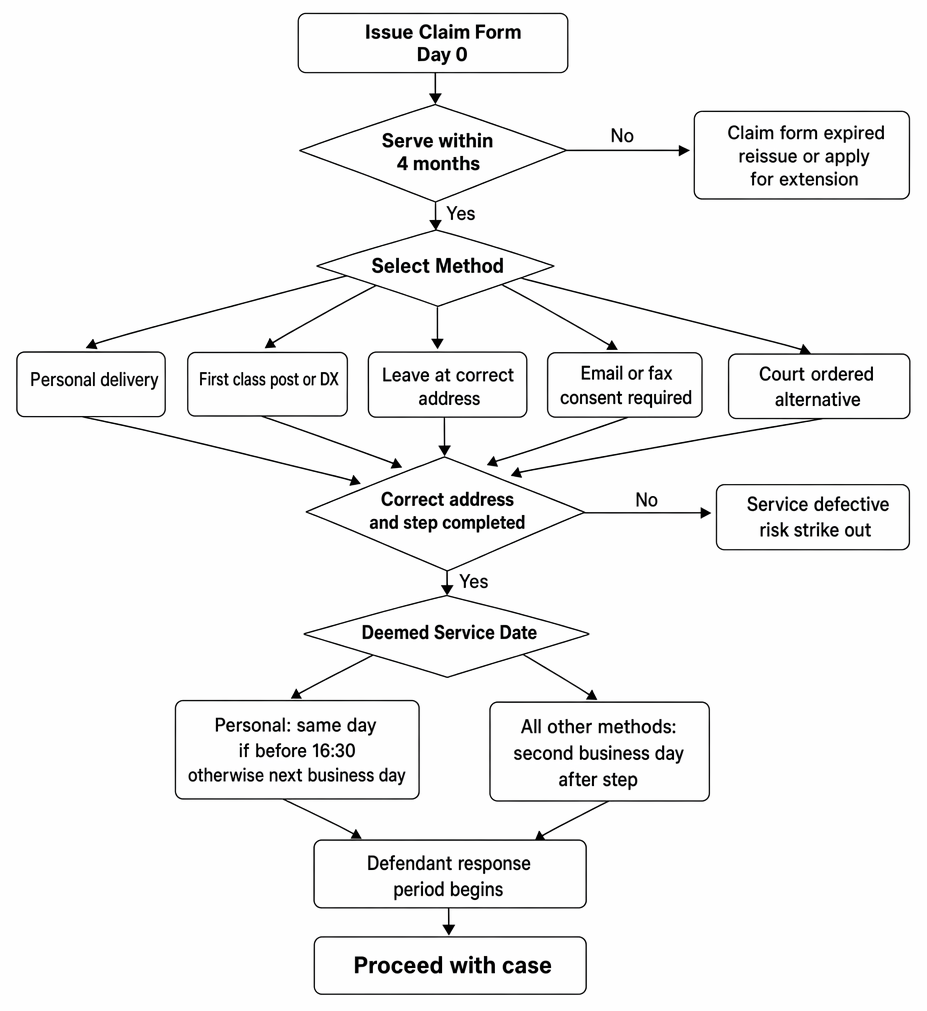
Issue, permitted methods, deemed service, and consequences of defective or late service of a claim form within the jurisdiction.
Key Term: Service
The formal process of delivering court documents, such as a claim form, to a party in legal proceedings, ensuring they are officially notified. Key Term: Jurisdiction
The territory (in this context, England and Wales) within which a court has the authority to hear cases and enforce its orders. Service rules differ for service within versus outside the jurisdiction. Key Term: Claim Form
The court document used by a claimant to commence legal proceedings against a defendant. Key Term: Response Pack
The standard set of forms (e.g., admission, acknowledgment of service, defence/counterclaim) enclosed with the claim form to enable the defendant to respond within the CPR time limits. Key Term: Certificate of Service
A formal statement filed at court confirming when, how, and where service was effected. If the claimant serves, a certificate of service must be filed within 21 days of service of the particulars of claim unless all defendants have filed acknowledgments of service.Test Tip: In SQE-style questions on Service of a claim form within the jurisdiction, identify the legal test, the triggering fact, and the consequence before choosing between similar answer options.
Methods of Service within the Jurisdiction (CPR Part 6)
CPR 6.3 specifies the methods by which a claim form may be served within the jurisdiction. The claimant (or the court, if requested) must use one of these permitted methods. The court will usually serve by first-class post unless the claimant has asked to serve themselves. If the claimant serves the claim form, they must ensure the correct documents are enclosed and file a certificate of service in accordance with CPR 6.17.
Personal Service (CPR 6.5)
This involves physically leaving the claim form with the defendant.
- Individual: Left with that individual.
- Company/Corporation: Left with a person holding a senior position (e.g., director, company secretary, chief executive).
- Partnership (sued in firm name): Left with a partner or a person controlling the business at its principal place of business.
Key Term: Personal Service
Direct physical delivery of court documents to the intended recipient or a person authorised to accept service on their behalf.
Personal service provides strong evidence of receipt but can be difficult or costly if the defendant is evasive. It is often used where speed or certainty is required or where other methods are impractical.
Service by Post (First Class or Equivalent)
Service can be effected by sending the claim form via first-class post or another service providing delivery on the next business day (including DX).
- The document must be sent to an appropriate address (see 'Where to Serve' below).
- Proof of posting should be retained (e.g., certificate of posting, DX manifest).
- The court typically serves by first-class post if the claimant requests court service.
Key Term: Document Exchange (DX)
A private, next-business-day delivery network commonly used by legal professionals. For CPR purposes, DX is treated similarly to first-class post for method and deemed service timing.
This method is common due to convenience but relies on the postal service and correct addressing. Errors in addressing or using a non-permitted postal class can invalidate service.
Leaving the Document at a Permitted Place
The claim form may be delivered to or left at a specific address associated with the defendant. The permitted addresses vary depending on the type of defendant (CPR 6.9). Delivery can be by a process server or by hand to the relevant address.
Service by Fax or Other Electronic Means (CPR 6.3(1)(d) and PD 6A)
Service by fax or email is permitted only if the recipient (or their solicitor) has previously indicated in writing their willingness to accept service by that method and has provided a fax number or email address expressly for service. PD 6A requires the serving party to confirm any technical limitations (acceptable formats, maximum attachment sizes) before effecting service.
- An email address on letterhead is not, by itself, consent to accept service by email.
- A fax number on a solicitor’s letterhead will usually be taken as consent to accept service by fax, but not for email unless expressly confirmed.
This is a frequent pitfall. Attempting electronic service without prior written consent will typically render service invalid.
Service by a Method Authorised by the Court (CPR 6.15)
If there is a good reason why service cannot be effected by the standard methods (e.g., the defendant is deliberately avoiding service, address uncertainty), the claimant can apply to the court under CPR 6.15 for an order permitting service by an alternative method or at an alternative place. Examples include service via social media, email without prior consent, SMS, or delivery to a relative or employer. The claimant must provide evidence that the chosen method is reasonably likely to bring the claim form to the defendant's attention.
Key Term: Alternative Method of Service
Court-authorised service using a method or at a place not listed in CPR 6.3, granted where there is a good reason and the method is likely to notify the defendant.
Who Serves and What Must Be Enclosed
- Court service: If the court serves, it will normally send the sealed claim form by first-class post and include the response pack, and, if provided, the particulars of claim and any annexes (e.g., medical report, schedule of loss).
- Claimant service: If the claimant serves, they must enclose the response pack and, where applicable, the particulars of claim or a clear indication that the particulars are to follow (and then serve them within the relevant time). A certificate of service must be filed within 21 days of service of the particulars of claim unless each defendant has filed an acknowledgment of service.
Failure to include the response pack when the claimant serves can lead to service being treated as ineffective.
Where to Serve the Claim Form (CPR 6.9)
The correct address for service depends on the defendant. Service may be effected on a solicitor authorised to accept service; if so, service must be on that solicitor at their business address.
| Defendant Type | Permitted Address(es) for Service |
|---|---|
| Individual | Usual or last known residence. |
| Individual sued in business name (Sole Trader) | Usual or last known residence; OR principal or last known place of business. |
| Company registered in England & Wales | Principal office; OR any place of business within the jurisdiction with a real connection to the claim; OR registered office (Companies Act 2006 s.1139). |
| Limited Liability Partnership (LLP) | Principal office; OR any place of business within the jurisdiction with a real connection to the claim. |
| Partnership (sued in firm name) | Principal or last known place of business of the firm. |
| Solicitor authorised to accept service | The business address of the solicitor. |
Key Term: Last Known Address
The address at which the server reasonably believes the defendant currently resides or last resided or traded. If there is reason to believe the defendant no longer resides or trades there, CPR 6.9(3) requires the server to take reasonable steps to ascertain the current address (e.g., trace agents, Companies House search) before serving at the last known address.
If a claimant has reason to believe the defendant no longer resides or trades at the last known address, they must take reasonable steps to ascertain the current address before serving there (CPR 6.9(3)). If, after reasonable steps, the current address cannot be identified, service at the last known address may still be valid.
Worked Example 1.1
A claimant knows the defendant moved from their former address in Leeds but has no new address. The claimant instructs a tracing agent, checks the electoral roll and Companies House (where relevant), and finds no updated residential address. They then serve at the last known address by first-class post. Is service valid?
Answer:
Yes, if the claimant had reason to suspect the defendant had moved and took reasonable steps to identify the current address but could not, CPR 6.9(3) permits service at the last known address. The deemed date will still be calculated under CPR 6.14.
Time Limit for Service: The Four-Month Rule (CPR 7.5)
Importantly, CPR 7.5(1) mandates that the claimant must complete the required step for service (e.g., posting the letter, handing over the document, leaving it at the permitted address, completing a fax transmission, sending an email when consent exists) before 12:00 midnight on the calendar day four months after the date the claim form was issued by the court.
Calculating the Deadline
The four-month period runs from the date of issue (the date stamped by the court). For example, if a claim form is issued on 10th March, the last day to complete the step required for service is 10th July (by 11:59 pm). Deemed service can occur later—what matters for CPR 7.5 is completion of the serving step within the four months.
Key Term: Business Day
Defined in CPR 2.8(1) as any day except Saturday, Sunday, a bank holiday, Good Friday or Christmas Day. It is relevant to deemed service but not to counting the four-month validity period, which is measured in calendar months.
Practical points
- The claim form’s validity is tied to completing the step in time, not the deemed service date.
- If particulars of claim are served separately, they must be served within 14 days after service (deemed) of the claim form and, in any event, within four months of issue (PD 7A).
- If the court is serving and fails to do so, an extension may be granted under CPR 7.6(3) (see below).
Consequences of Non-Compliance
Failure to complete the required step for service within this period means the claim form expires and loses its validity. The claimant would typically need to issue a new claim form, potentially facing problems if the limitation period has expired in the interim. Courts strictly enforce these rules.
Extension of Time (CPR 7.6)
A claimant can apply to the court for an extension of the four-month period.
- The application should ordinarily be made within the original four-month period (CPR 7.6(2)).
- An extension will only be granted if there is a good reason (e.g., genuine difficulties locating or serving the defendant despite reasonable steps).
- Applications made after the period has expired are possible but granted only in very limited circumstances (CPR 7.6(3)), such as where the court failed to serve the claim form or the claimant took all reasonable steps to serve but could not, and acted promptly in making the application.
The court will expect detailed evidence describing attempts to serve and explaining any delay.
Worked Example 1.2
A claim form is issued on 5 May. The claimant asks the court to serve but later discovers in late August that the court did not send the claim form due to an internal error. The four-month period expired on 5 September. Can time be extended?
Answer:
Yes, an application under CPR 7.6(3) can succeed where the court failed to serve the claim form and the claimant acts promptly once the failure is discovered. Evidence of the court’s failure and promptness is essential.
Deemed Service (CPR 6.14 and 6.26)
Deemed service rules establish the date on which service is legally considered to have taken place, regardless of when the defendant actually received the document. This date is critical for calculating subsequent deadlines, such as the time for the defendant to file an acknowledgment of service or defence.
Key Term: Deemed Service
The date on which the CPR states service is legally effective, irrespective of the actual date of receipt by the recipient.
Deemed Service of the Claim Form (CPR 6.14)
There is a specific, straightforward rule for the claim form:
- The claim form is deemed served on the second business day after the relevant step (posting, delivery to address, DX lodging/collection, fax/email transmission) was completed. There is no 4:30 pm cut-off for claim forms; the two-business-day rule applies regardless of the time of day the step was taken.
Exam Warning: A common mistake is confusing the deemed service rule for the claim form (CPR 6.14 – second business day) with the rule for other documents (CPR 6.26 – which varies and uses calendar days for postal service but is subject to business day cut-offs). For the claim form, always count two business days after the step required.
Worked Example 1.3
A claim form is issued on Monday 3rd August. The claimant posts it first-class to the defendant's registered office on Tuesday 4th August. Friday 7th August is a business day, as is Monday 10th August. When is the claim form deemed served?
Answer:
The step required (posting) was completed on Tuesday 4th August. The second business day after this is Thursday 6th August. Therefore, the claim form is deemed served on Thursday 6th August.
Worked Example 1.4
A claimant attempts personal service on an individual defendant on Friday 14th August at 6:00 pm. The defendant accepts the document. Monday 17th August is a business day. When is the claim form deemed served?
Answer:
Personal service was completed on Friday 14th August (the relevant step was leaving it with the individual). Under CPR 6.14, service is deemed to occur on the second business day after the step. The first business day after is Monday 17th. The second business day after is Tuesday 18th August. Service is deemed on Tuesday 18th August.
Worked Example 1.5
The claimant leaves the claim form at the principal office of an LLP at 2:00 pm on Thursday. When is the claim form deemed served?
Answer:
The relevant step (leaving at the permitted address) was completed on Thursday. Under CPR 6.14, the claim form is deemed served on the second business day after that step. If Friday and Monday are business days, deemed service is Monday.
Deemed Service of Other Documents (CPR 6.26)
Different deemed service rules apply to documents other than the claim form (e.g., particulars of claim if served separately, defences, application notices). These are governed by CPR 6.26 and vary depending on the method:
- Personal Service / Leaving at Address / Fax / Electronic Method: If completed before 4:30 pm on a business day, deemed served that day. Otherwise, deemed served on the next business day.
- First Class Post / DX / Other Next Business Day Service: Deemed served on the second day after posting/leaving, provided that day is a business day. If the second day is not a business day, service is deemed on the next business day after that.
Worked Example 1.6
Particulars of claim served separately by first-class post are posted on Friday at 5:15 pm. Monday is a bank holiday. When are they deemed served?
Answer:
Under CPR 6.26, for postal service, deemed service is the second day after posting provided that day is a business day. The second day after Friday is Sunday; this is not a business day, so deemed service rolls to the next business day, which is Tuesday (because Monday is a bank holiday).
Practical Steps and Pitfalls
Accuracy of party names and capacity
Serving the claim form at the correct address depends on the defendant’s legal status being accurately recorded in the claim form. Misdescribing a defendant (e.g., suing a trading name rather than the legal person) can lead to service at the wrong place and defectiveness. Before serving, confirm:
- Correct legal name (individual, company name with suffixes, LLP).
- Correct registered office for companies (Companies House search).
- Whether a solicitor is authorised to accept service (must be confirmed in writing).
Service on children and protected parties
Where the defendant is a child or a protected party (Mental Capacity Act 2005), CPR Part 21 requires a litigation friend. Service should be effected in accordance with CPR 21 and the litigation friend’s details included on the claim form and service documents.
If service goes wrong
If service is defective (e.g., wrong method or address, email without consent), the defendant may apply to set aside service or the claim form (CPR 11). The court can set aside the claim form or service, discharge any order made prior to service, and stay proceedings. Where service has failed and limitation risk exists, consider applying promptly for alternative service under CPR 6.15 or for an extension under CPR 7.6.
Counting time and business days
CPR 2.8 defines business days and explains how clear days are counted. For claim form deemed service, the “second business day” rule applies. For other documents, the 4:30 pm cut-off is important.
Particulars of claim served separately
Under PD 7A, if the particulars of claim are not included in the claim form, they may be served either at the same time as the claim form or within 14 days after service of the claim form, provided service occurs within four months after issue (or six months for service out of the jurisdiction). If particulars follow separately, the claim form must indicate that particulars will follow.
Worked Example 1.7
A claim form is issued on 12 March and posted first-class to the defendant’s registered office on 13 March. Particulars of claim are served separately and posted on 25 March. When must the defence be filed if the defendant acknowledges service?
Answer:
The claim form is deemed served on the second business day after 13 March. If that is 17 March, and the particulars of claim are deemed served under CPR 6.26 on 27 March (second day after posting, provided it is a business day), the defendant has 28 days from service of the particulars of claim to file a defence if an acknowledgment of service is filed. The defence deadline would be 24 April, unless extended by agreement under CPR 15.5.
Summary
Effective service is fundamental to commencing civil proceedings. Key aspects include:
- Using a permitted method under CPR 6.3 (personal, post/DX, leaving at a permitted address, electronic with consent, court-authorised alternative).
- Serving at the correct address as per CPR 6.9, taking reasonable steps if the last known address may be outdated.
- Ensuring either the court or claimant serves with the correct enclosures (response pack; particulars of claim if included) and filing a certificate of service where required.
- Completing the relevant step for service within 4 months of the claim form's issue date (CPR 7.5), noting deemed service may occur later.
- Understanding that the claim form is deemed served on the second business day after the relevant step (CPR 6.14).
- Recognising that different deemed service rules (CPR 6.26, with the 4:30 cut-off for many methods) apply to other documents.
- Knowing that extensions of time require a court application and good reason (CPR 7.6) and that alternative service can be authorised where a good reason exists (CPR 6.15).
Key Point Checklist
This article has covered the following key knowledge points:
- The overriding importance of correct service for the validity of proceedings and subsequent deadlines.
- The main methods of service within the jurisdiction permitted by CPR 6.3, including personal service, post/DX, leaving at a permitted place, electronic service with prior consent, and court-authorised alternative service.
- Who serves (court or claimant), the need to enclose the response pack, and filing the certificate of service when the claimant serves (CPR 6.17).
- How to identify the correct place for service based on the defendant's status under CPR 6.9 and the duty to take reasonable steps where a last known address may be out of date.
- The four-month time limit for completing the step required for service under CPR 7.5 and the strict consequences of failure.
- The possibility and requirements for obtaining an extension of time under CPR 7.6, including the limited circumstances for post-expiry extensions.
- The specific rule for deemed service of the claim form under CPR 6.14 (second business day).
- The distinction between deemed service for claim forms (CPR 6.14) and other documents (CPR 6.26) and the relevance of the 4:30 pm cut-off for non-claim-form documents.
- The availability of service by an alternative method under CPR 6.15 and the need to show that the method is likely to bring the proceedings to the defendant’s attention.
- Practical pitfalls and compliance steps: accurate party naming, correct address and capacity, solicitor authorisation, and limitations on electronic service.
Key Terms and Concepts
- Service
- Jurisdiction
- Claim Form
- Response Pack
- Certificate of Service
- Personal Service
- Document Exchange (DX)
- Alternative Method of Service
- Last Known Address
- Deemed Service
- Business Day