Learning Outcomes
This article explains damages-based agreements (DBAs) for SQE1 purposes, including:
- the statutory definition and legal basis (s 58AA Courts and Legal Services Act 1990 and the Damages-Based Agreements Regulations 2013) and how DBAs fit within wider funding options tested in FLK1;
- permitted and prohibited use of DBAs across civil, employment and personal injury litigation, and the exclusion of criminal and family proceedings;
- statutory fee caps (50% for general civil claims, 25% for personal injury, 35% for employment), what counts towards the cap (counsel’s fees and VAT) and what falls outside it (disbursements);
- methods for calculating the DBA payment and the client’s net recovery, including deduction of opponent’s costs and interaction with party–party and solicitor–client costs;
- the formal and regulatory requirements for a valid DBA, common drafting pitfalls, and the consequences of non-compliance, including total unenforceability and loss of any fee;
- ethical and professional conduct duties when advising on DBAs, such as transparency about costs, risk, and alternative funding and insurance options (including ATE and BTE cover);
- the appropriate use and limits of termination clauses, and what a solicitor may charge if the client ends the retainer before conclusion of the case;
- comparison of DBAs with CFAs and privately funded retainers in terms of risk allocation, costs recovery, and typical SQE1 exam traps and question styles.
SQE1 Syllabus
For SQE1, you are required to understand the main funding options for legal services, including damages-based agreements, with a focus on the following syllabus points:
- the definition and legal basis of DBAs
- the statutory and regulatory requirements for valid DBAs
- the fee caps and calculation of solicitor’s entitlement under a DBA
- the enforceability of DBAs and consequences of non-compliance
- ethical and professional conduct duties when advising on or entering into DBAs
- comparison of DBAs with other funding options (e.g., CFAs, private funding, legal aid)
- costs between the parties versus solicitor–client costs, and the impact of DBAs on costs recovery
- SRA Transparency Rules and cost information duties when proposing DBAs
Test Your Knowledge
Attempt these questions before reading this article. If you find some difficult or cannot remember the answers, look more closely at that area during your revision.
- What is the maximum percentage of damages a solicitor can recover as a fee under a DBA in a general civil claim?
- What are the key formal requirements for a valid DBA?
- If a DBA is unenforceable, what is the solicitor entitled to recover from the client?
- Can a DBA be used in a personal injury claim, and if so, what is the relevant cap?
Introduction
Damages-based agreements (DBAs) are a type of funding arrangement where a solicitor’s fee depends on the client obtaining a financial benefit, usually damages, in litigation. DBAs are regulated by statute and are subject to strict requirements. Understanding DBAs is essential for SQE1, as they are a key funding option in civil litigation and raise important regulatory and ethical issues.
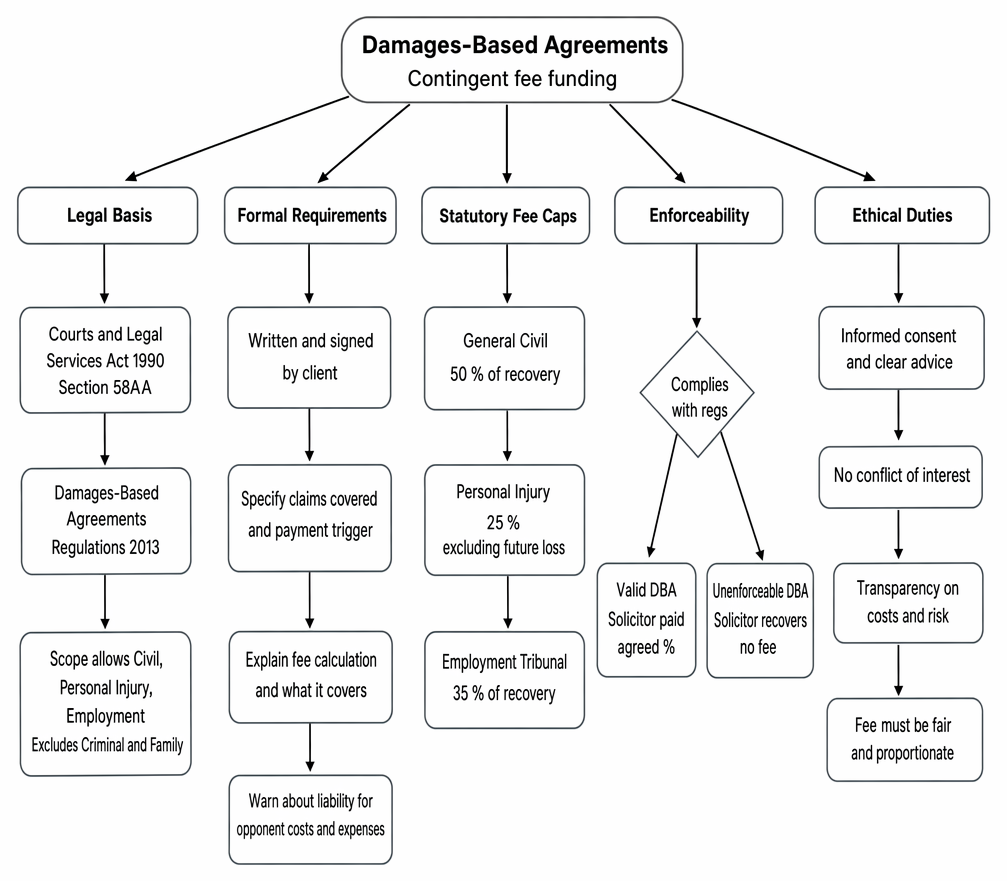
Damages-based agreements are summarised by reference to legal basis, scope, formal requirements, statutory fee caps, enforceability, and ethical duties.
DBAs sit alongside conditional fee agreements (CFAs) as permissible “no win, no fee” arrangements. Unlike CFAs, which apply an uplift to the solicitor’s base hourly fees, DBAs calculate the client’s liability by reference to a percentage of the damages or other specified financial benefit recovered. Because the DBA percentage is paid from the client’s damages, and only limited costs are recoverable from the opponent, advising clients properly on risks and alternatives (including legal expenses insurance) is a critical professional duty.
Key Term: Damages-based agreement (DBA)
A funding agreement where the solicitor’s fee is calculated as a percentage of the damages or financial benefit recovered by the client, payable only if the client succeeds. Key Term: Fee cap
The statutory maximum percentage of damages that a solicitor can recover as a fee under a DBA, set by regulation and varying by case type. Key Term: Enforceability
The legal validity of a DBA; if the agreement fails to comply with statutory requirements, it is unenforceable and the solicitor cannot recover any fee.
Regulatory Framework for DBAs
DBAs are governed by section 58AA of the Courts and Legal Services Act 1990 and the Damages-Based Agreements Regulations 2013 (SI 2013/609). These rules set out who can enter into a DBA, in what types of cases, and the requirements for a valid agreement.
Section 58AA allows “representatives” (including solicitors and advocates) to use DBAs for advocacy and litigation services, subject to the Regulations. DBAs are a statutory exception to the general prohibition on contingency fees in contentious business. The Regulations define the “payment” the client must make on success, prescribe caps by case type, and require specific information to be included in the agreement.
Types of Cases
DBAs are permitted in most civil litigation, including commercial and employment cases. They are also allowed in personal injury claims, but not in criminal or family proceedings.
DBAs may be used in Employment Tribunal claims (including appeals) and in general civil proceedings, where the client’s success yields a “specified financial benefit.” While damages are the most common benefit, in principle a DBA can be drafted to apply to other financial outcomes (for example, recovery of a debt, a negotiated financial settlement, or a quantified saving). Caution is required where relief is non-monetary (such as a pure injunction or declaration) because the DBA must clearly identify the financial outcome on which the percentage will operate. If no monetary benefit is obtained, the DBA payment is zero.
Formal Requirements
A valid DBA must:
- be in writing and signed by the client
- specify the claims or proceedings covered
- state the circumstances in which payment is due (i.e., what counts as success and the “specified financial benefit”)
- explain how the payment is calculated and what is included (e.g., counsel’s fees, VAT)
- set out the reasons for setting the fee at the agreed level
- inform the client about potential liability for opponent’s costs and disbursements
Failure to comply with these requirements renders the DBA unenforceable.
In drafting, precision matters. Define “success” and the “financial benefit” clearly (for example, whether includes settlement, interest, and interim payments). The agreement should identify whether counsel’s fees are included within the DBA payment (they usually are for the purposes of the statutory cap) and make clear that other disbursements (such as expert reports or court fees) are separate and payable by the client. Termination provisions must be fair and transparent. Following recent case law, a clause requiring payment for work done if the client terminates the DBA early can be compatible with the statutory regime, provided the payment is not a contingency fee and the clause is clearly drafted. Regardless, any non-compliance with the Regulations risks total unenforceability.
Statutory Fee Caps
The maximum fee a solicitor can recover under a DBA is capped by law:
- General civil litigation: 50% of the sums ultimately recovered by the client (including VAT and counsel’s fees)
- Personal injury: 25% of damages for pain, suffering, loss of amenity, and past pecuniary loss (excluding future loss)
- Employment tribunal: 35% of sums recovered
If the DBA sets a higher percentage, it is unenforceable.
The cap operates on the client’s “sums ultimately recovered.” In personal injury claims, the 25% cap applies only to general damages and past financial losses; future financial loss (including future care) is excluded from the base on which the percentage is calculated. Across case types, counsel’s fees and VAT are treated as part of the DBA “payment” and thus must fit within the cap; other disbursements (for example, court fees and expert reports) sit outside the cap and remain separately payable.
Key Term: Statutory fee cap
The maximum percentage of damages a solicitor can recover as a fee under a DBA, as set by the Damages-Based Agreements Regulations.
Payment and Costs
If the client wins, the solicitor receives the agreed percentage of the damages, less any costs recovered from the opponent. If the client loses, the solicitor receives no fee but the client may still be liable for disbursements and the opponent’s costs.
The DBA “payment” is calculated on the client’s financial recovery and then reduced by any inter partes costs the opponent is ordered to pay. Because the DBA payment is not recoverable from the opponent, clients should be advised that there is likely to be a shortfall between the opponent’s costs contribution and the DBA payment; that shortfall is paid from the damages. For risk management, clients often consider after-the-event (ATE) insurance to protect against having to pay the opponent’s costs if the claim fails. Before-the-event (BTE) cover under existing policies should also be checked. Advising on these options is part of the solicitor’s duty to ensure clients are able to make informed decisions about costs and risk.
Clients must also understand the distinction between solicitor–client costs (their contractual liability to their own solicitor under the DBA) and costs between the parties (amounts one party may be ordered to pay the other under the Civil Procedure Rules or Tribunal rules). A DBA does not alter the general principles governing party–party costs; it only changes how the client pays their own solicitor.
Enforceability and Consequences of Non-Compliance
If a DBA does not comply with the statutory requirements, it is unenforceable. The solicitor cannot recover any fee from the client, even for work done.
Non-compliance can arise in several ways: the agreement is not in writing or not signed; the covered proceedings are not specified; the calculation of the payment is unclear; the reasons for the fee level are omitted; the cap is exceeded; or the agreement fails to warn about liability for disbursements and opponent’s costs. Courts will not “read down” an unlawful percentage to save the agreement; exceeding the cap renders the DBA unenforceable in full. Where a DBA is unenforceable, the solicitor cannot recover fees under that DBA and cannot usually recover for work on any alternative basis. Careful compliance with the Regulations is therefore essential.
Key Term: Unenforceable DBA
A DBA that fails to comply with statutory requirements, meaning the solicitor cannot recover any fee from the client.
Worked Example 1.1
A solicitor enters into a DBA with a client for a commercial claim. The DBA sets the solicitor’s fee at 60% of the damages recovered. The client wins £100,000 in damages. What is the solicitor entitled to recover?
Answer:
The DBA exceeds the statutory cap of 50%. The agreement is unenforceable, so the solicitor cannot recover any fee from the client.
Worked Example 1.2
A client enters into a DBA for a personal injury claim. The solicitor’s fee is set at 25% of damages (excluding future loss). The client recovers £40,000, of which £10,000 is for future loss. What is the maximum fee the solicitor can recover?
Answer:
The fee is calculated on £30,000 (damages excluding future loss). The maximum fee is £7,500 (25% of £30,000).
Worked Example 1.3
A claimant brings an Employment Tribunal claim under a DBA set at 35%. They settle for £20,000 plus the respondent’s agreement to pay £3,000 towards costs. Counsel’s fees of £1,500 are included within the DBA payment. What does the solicitor receive?
Answer:
The DBA payment is 35% of £20,000 = £7,000. The opponent’s £3,000 costs contribution is deducted from the DBA payment, leaving £4,000 payable by the client from damages. Counsel’s £1,500 is within the £7,000 cap and does not increase the total payable. The client receives £16,000 net.
Worked Example 1.4
A commercial claim under a 20% DBA succeeds for £250,000. Party–party costs recovered are £30,000. Disbursements (court fee and expert) total £6,000. How is the client’s net recovery calculated?
Answer:
DBA payment = 20% of £250,000 = £50,000. Deduct £30,000 costs recovered, leaving £20,000 payable from damages. Disbursements of £6,000 are separate and also payable by the client. Net to client = £250,000 − £20,000 − £6,000 = £224,000.
Worked Example 1.5
A DBA is silent on what constitutes “success” and provides only that “payment is due if proceedings conclude favourably.” The client obtains only an injunction with no monetary award. Can the solicitor claim a percentage?
Answer:
No. A DBA must tie the percentage to a specified financial benefit. Without a financial recovery (and absent clear drafting to quantify a financial outcome), no DBA payment is due.
Worked Example 1.6
A client signs a DBA but later terminates the retainer before trial and instructs new solicitors. The DBA includes a clause allowing the original solicitor to charge for work done at hourly rates on termination. Is that clause enforceable?
Answer:
A properly drafted termination clause that charges for work already done (not a contingency percentage) can coexist with a DBA. If the clause is clear and fair, the solicitor may recover those charges despite no DBA payment being due.
Ethical and Professional Conduct Duties
Solicitors must ensure that DBAs are fair, transparent, and in the client’s best interests. They must:
- provide clear information about the agreement, costs, and risks
- avoid conflicts of interest (the solicitor’s financial interest must not override the client’s interests)
- ensure the client gives informed consent
- not overcharge or set fees above the statutory cap
Beyond these fundamentals, the SRA Code of Conduct obliges solicitors to give the best possible information about pricing at the outset and as the matter progresses, including an estimate and updates when it changes. Under the SRA Transparency Rules, firms must publish costs information for certain services and, in all retainers, explain the circumstances in which the client may need to make payments themselves, including from any damages received. Clients must be informed in writing of their right to complain and of any right to refer a complaint to the Legal Ombudsman. Overcharging breaches SRA Principles (acting in the client’s best interests and with integrity) and may attract regulatory action; costs can be reduced on assessment and serious reductions can trigger notification to the SRA.
Suitability is part of the ethical analysis. Under the Code, solicitors must consider the client’s attributes, needs and circumstances when discussing funding. This includes advising on alternative funding routes (e.g., CFAs, private retainers, legal aid where available) and legal expenses insurance (BTE/ATE), especially as DBAs do not cover disbursements or the opponent’s costs.
Exam Warning: If a DBA is unenforceable, the solicitor cannot recover any fee—even for work done. This is a common pitfall in SQE1 questions.
Revision Tip: Always check the statutory cap and formal requirements when advising on or drafting a DBA. Define “success” and the “specified financial benefit” precisely, confirm whether counsel’s fees and VAT are included, and warn the client about liability for disbursements and opponent’s costs. Consider recommending ATE where appropriate.
Comparison with Other Funding Options
| Feature | DBA | CFA (Conditional Fee Agreement) | Private Funding |
|---|---|---|---|
| Fee basis | % of damages | Uplift on hourly rate (success fee) | Hourly/fixed rate |
| Payment if lose | No fee | No fee (or reduced fee) | Pay all fees |
| Statutory cap | Yes | Yes (success fee cap) | No |
| Covers disbursements | No (client pays) | No (client pays) | Yes |
| Covers opponent’s costs | No (client pays if lose) | No (client pays if lose) | No |
While CFAs and DBAs both defer payment if the case is lost, they differ in how client liability is calculated on success. Under a CFA, the client pays base costs plus a success fee (capped and not recoverable from the opponent). Under a DBA, the client pays a percentage of damages, reduced by any costs recovered from the opponent. In both, disbursements and opponent’s costs remain risks the client must manage—often via insurance.
Key Point Checklist
This article has covered the following key knowledge points:
- DBAs are funding agreements where the solicitor’s fee is a percentage of damages, payable only if the client wins.
- DBAs are regulated by statute (s 58AA CLSA 1990 and the 2013 Regulations) and must comply with strict formal requirements.
- Statutory fee caps apply: 50% for general civil, 25% for personal injury (only on general damages and past losses), 35% for employment.
- The cap includes counsel’s fees and VAT within the DBA payment; other disbursements sit outside the cap and remain payable by the client.
- The DBA payment is reduced by any costs recovered from the opponent; shortfalls are paid from damages.
- If a DBA is unenforceable, the solicitor cannot recover any fee.
- Drafting must define “success” and the “specified financial benefit,” and include reasons for the fee level, cost warnings, and termination provisions.
- Solicitors must provide clear information, avoid conflicts of interest, and act in the client’s best interests, including advising on insurance and alternative funding.
- DBAs differ from CFAs and private funding in how fees are calculated and paid, and in costs recovery from the opponent.
Key Terms and Concepts
- Damages-based agreement (DBA)
- Fee cap
- Enforceability
- Statutory fee cap
- Unenforceable DBA