Nuisance and the rule in Rylands v Fletcher - Who can sue an…
Learning Outcomes
This article examines who can sue and be sued in private nuisance and under the rule in Rylands v Fletcher, including:
- the requirement for a proprietary interest and how this limits standing to sue in private nuisance and under Rylands v Fletcher
- identification of potential defendants, focusing on creators of the nuisance, occupiers who adopt or continue it, and landlords who authorise or knowingly permit nuisance‑causing uses
- recognition of when occupiers are liable for nuisances arising from natural occurrences, trespassers, visitors, or independent contractors, and what amounts to reasonable steps to abate risk
- analysis of unlawful interference, distinguishing physical damage from amenity interference and explaining the importance of locality and the “ordinary user” of land
- the key elements of liability under Rylands v Fletcher—bringing onto land, non‑natural use, escape, foreseeability, and limitation to property damage—and how the rule relates to private nuisance
- evaluation of principal defences (consent, prescription, statutory authority, necessity, act of a stranger or God, contributory negligence) and how courts select appropriate remedies, including damages, prohibitory and mandatory injunctions, and damages in lieu of injunctions, with attention to public benefit considerations in remedy choice
SQE1 Syllabus
For SQE1, you are required to understand the legal rules governing who can sue and be sued in private nuisance and under the rule in Rylands v Fletcher, with a focus on the following syllabus points:
- the requirement for a proprietary interest to sue in private nuisance and under Rylands v Fletcher
- who can be held liable for private nuisance (creators, occupiers who adopt/continue a nuisance, and landlords who authorise or knowingly let premises with an inevitable nuisance)
- the threshold for unlawful interference (substantial and unreasonable), including how physical damage and amenity interference are treated and the role of locality
- when an occupier may be liable for nuisances arising from natural occurrences or acts of third parties
- when independent contractors’ activities can render occupiers or landlords liable
- the elements and scope of the rule in Rylands v Fletcher (bringing onto land, non-natural use, escape, foreseeability of relevant damage, strict liability limited to property damage)
- the relationship between nuisance and strict liability for escapes, and key defences and limitations (prescription, statutory authority, necessity, act of a stranger, act of God, contributory negligence)
- available remedies, including damages and injunctions (and how public benefit may influence remedy)
Test Your Knowledge
Attempt these questions before reading this article. If you find some difficult or cannot remember the answers, look more closely at that area during your revision.
-
Who is eligible to bring a claim in private nuisance?
- a) Any occupier of land
- b) Any person affected by the nuisance
- c) Only those with a proprietary interest in the land
- d) Any family member living at the property
-
Which of the following may be liable for private nuisance?
- a) The creator of the nuisance
- b) The occupier who adopts or continues a nuisance
- c) A landlord who authorises a nuisance
- d) All of the above
-
What is a key requirement for liability under the rule in Rylands v Fletcher?
- a) The nuisance must be ongoing
- b) The defendant must have made a non-natural use of land
- c) The claimant must suffer personal injury
- d) The defendant must be negligent
-
True or false? A guest staying at a property can sue in private nuisance if they are disturbed by noise from a neighbouring factory.
Introduction
Private nuisance is a tort that protects the use and enjoyment of land from unlawful interference. “Unlawful” in this context means substantial and unreasonable interference judged by the ordinary usages of society; it is not confined to criminality. Interference can be by encroachment (e.g. tree roots), direct physical injury to land (e.g. corrosion, vibrations, smoke damage), or amenity interference (e.g. noise, smells, dust). Physical damage to property will almost always be actionable; for amenity interference, the character of the locality may be relevant.
The rule in Rylands v Fletcher is a related principle imposing strict liability for escapes of dangerous things from land in the course of a non‑natural use, subject to foreseeability of the relevant type of damage. It operates as a specialised form of private nuisance. For SQE1, it is important to be clear on who can sue and be sued in private nuisance, and when Rylands v Fletcher applies.
Test Tip: In SQE-style questions on Who can sue and be sued in private nuisance, identify the legal test, the triggering fact, and the consequence before choosing between similar answer options.
Who Can Sue in Private Nuisance?
To bring a claim in private nuisance, a claimant must have a proprietary interest in the affected land. This means the right to exclusive possession, such as a freehold owner, leaseholder, or tenant in occupation. A beneficial owner with a proprietary stake can also qualify; however, a mere licensee or lodger does not.
Key Term: proprietary interest
The legal right to exclusive possession of land, such as ownership, a lease or an equivalent proprietary estate. Only those with a proprietary interest can sue in private nuisance.
Family members, guests, licensees or lodgers without such an interest cannot sue, even if they are affected by the nuisance. This ensures the tort remains tied to rights in land and does not become a general tort for personal discomfort.
Amenity interference versus physical damage does not alter standing: the proprietary interest requirement applies to all forms of private nuisance. The right to sue is anchored in the claimant’s estate in land, not the nature of the interference.
Worked Example 1.1
Can a lodger bring a claim in private nuisance for smoke from a neighbour’s bonfire?
Answer:
No. A lodger does not have a proprietary interest in the property and therefore lacks standing to sue in private nuisance.
Worked Example 1.2
Question: A spouse lives at a property owned in the other spouse’s sole name. The couple have arranged their affairs so the occupying spouse has a registered beneficial interest. Persistent late‑night noise from the neighbouring premises prevents sleep. Can the occupying spouse sue?
Answer:
Yes, if the occupying spouse holds a proprietary interest (for example, a registered beneficial interest or equitable estate conferring exclusive possession). Standing depends on the proprietary interest, not simply residence.
Who Can Be Sued in Private Nuisance?
Liability for private nuisance is not limited to the person who creates the nuisance. The following may be sued:
- The creator of the nuisance (who causes the interference), even if they have since left the land
- The occupier of land who adopts or continues a nuisance, even if created by someone else (such as a trespasser, visitor or predecessor)
- A landlord, but only if they authorise the nuisance or let the property knowing at the time of letting that a nuisance is virtually inevitable; landlords may also be liable if they covenant to repair and fail to abate a nuisance arising from the state of the premises
Key Term: occupier
A person with sufficient control over land, such as an owner or tenant in possession. An occupier may be liable for a nuisance they adopt or continue. Key Term: creator of the nuisance
The person who directly causes the interference with the claimant’s use or enjoyment of land. Key Term: landlord liability
A landlord may be liable for nuisance only if they authorised it, participated in it, or let property knowing a nuisance was virtually certain to occur. Liability may also arise where the landlord retains repair obligations and fails to abate a nuisance.
Adoption or continuation arises where the occupier, knowing or having reason to know of the nuisance, either makes use of the thing causing it or fails to take reasonable steps to prevent or remove it. This can include natural hazards (for example, unstable trees or drainage defects) and nuisances introduced by trespassers or visitors. What is “reasonable” will depend on the risk and the occupier’s knowledge. For hazards arising naturally, the occupier’s resources and practicality of abatement may be considered.
Independent contractors: an occupier is generally not liable for a nuisance created by a competent independent contractor unless the nature of the work carried a special danger of creating a nuisance, or the occupier failed to take reasonable steps to select a competent contractor or to check non‑technical aspects of the work that could readily be assessed.
Physical damage versus amenity interference: where the claimant’s land suffers physical damage (e.g. corrosion of paintwork, dead plants, cracked walls), the interference is ordinarily unreasonable irrespective of locality. For amenity interference (noise, smells, dust), the character of the neighbourhood may be relevant to reasonableness.
Worked Example 1.3
Question: A tenant’s visitor builds a bonfire that causes smoke to drift onto a neighbour’s land. The tenant knows about the bonfire but does nothing. Who may be liable?
Answer:
The visitor (creator) and the tenant (occupier who adopts or continues the nuisance) may both be liable. The landlord is not liable unless they authorised the bonfire or knew it would occur.
Worked Example 1.4 (continued)
Question: A culvert installed without the occupier’s permission blocks with leaves and floods the neighbour’s garden. The occupier discovers the culvert, uses it for drainage, but does not install a guard or clear it. Is the occupier liable?
Answer:
Yes. By making use of the culvert and failing to take reasonable steps to prevent overflow once aware of the risk, the occupier has adopted/continued the nuisance. Landlords: authorisation can be express (letting for inherently noisy activities) or implied (letting for uses that inevitably generate nuisance, such as regular high‑powered racing). Simply granting planning permission or the existence of a licence does not immunise against nuisance liability.
The Rule in Rylands v Fletcher
The rule in Rylands v Fletcher imposes strict liability for damage caused by the escape of dangerous things brought onto land for a non‑natural use, provided the type of damage was reasonably foreseeable. It is best understood as a specialised form of private nuisance.
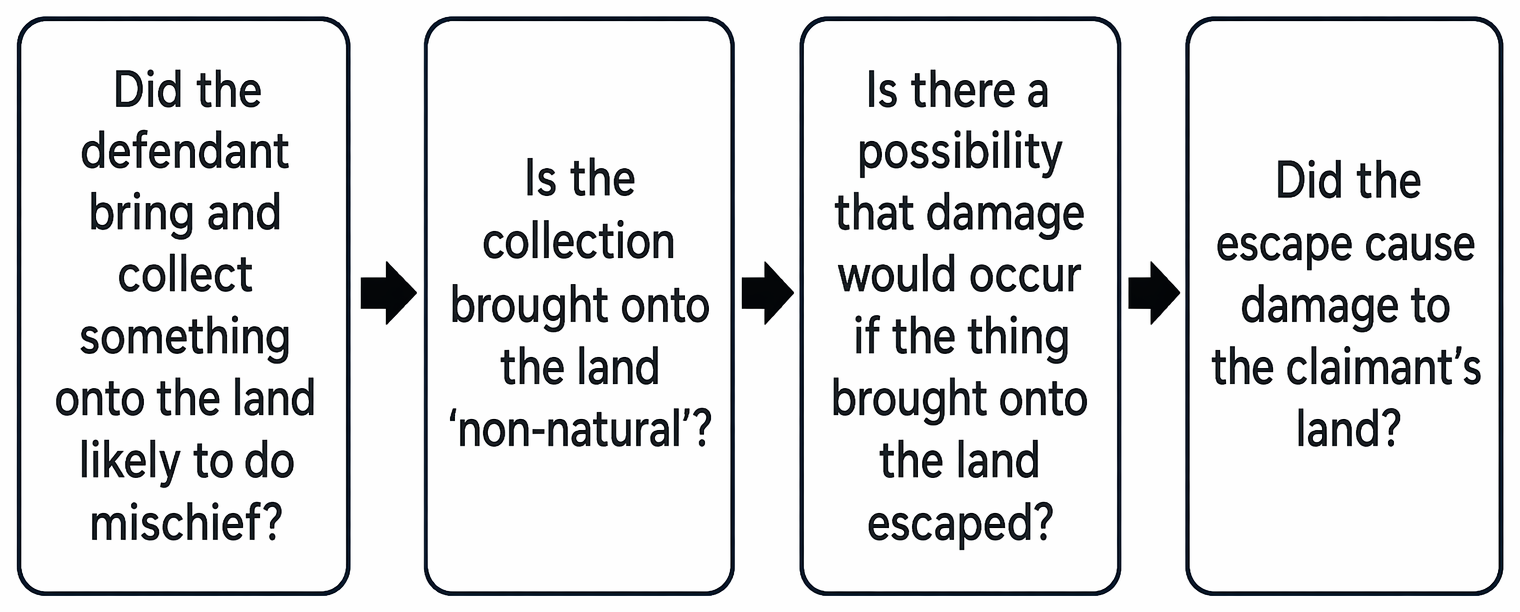
Private nuisance and the rule in Rylands v Fletcher are presented by reference to standing, defendants, liability elements, and defences.
Key Term: Rylands v Fletcher rule
A strict liability principle: a person who brings onto their land something likely to cause harm if it escapes is liable for damage caused by its escape from a non‑natural use, even without negligence, provided the relevant type of damage was foreseeable. Key Term: non-natural use
A use of land that is extraordinary or unusual judged by contemporary standards and creates an exceptionally high risk of danger upon escape; ordinary domestic or routine utility uses will not normally suffice. Key Term: escape
The movement of a thing from the defendant’s land to land outside their occupation or control, causing damage there.
To succeed under Rylands v Fletcher, the claimant must show:
- The defendant brought or collected something onto their land for their own purposes
- The use was non‑natural (extraordinary/unusual, presenting an exceptionally high risk of danger upon escape)
- The thing escaped to the claimant’s land (or land outside the defendant’s control)
- The escape caused foreseeable damage of the relevant type
Strict liability in Rylands v Fletcher is subject to modern limitations:
- Non‑natural use requires an exceptional risk; routine domestic water supply or ordinary business utilities are generally natural uses
- There must be an actual escape of the dangerous thing itself; the mere spread of fire from stored items may not suffice unless the stored substance escapes
- Foreseeability of the kind of damage is required; liability does not arise for unforeseeable types of harm
- The tort protects property interests; personal injury is not recoverable under Rylands v Fletcher
Only those with a proprietary interest in the affected land can sue under Rylands v Fletcher. The defendant is usually the occupier or person in control of the land from which the escape occurred.
Worked Example 1.4
Question: A factory stores chemicals in large tanks. Due to a leak, chemicals escape and damage a neighbour’s crops. The neighbour is a tenant farmer. Can the tenant sue, and who is liable?
Answer:
Yes, the tenant can sue because they have a proprietary interest. The factory owner (occupier) is liable under Rylands v Fletcher for the escape of chemicals from a non‑natural use, provided the type of damage (property loss) was foreseeable.
Worked Example 1.5
Question: A local authority’s water pipe under a housing estate leaks, eroding an embankment near a gas main. Emergency remediation is required to support the gas main. Does Rylands v Fletcher apply?
Answer:
No. Supplying water through pipes for domestic use is a routine utility function and not a non‑natural use. There is also no escape of a dangerous thing beyond the defendant’s control in the sense required; ordinary water escaping from a domestic supply is not the sort of exceptional risk contemplated.
Worked Example 1.6
Question: Tyres stored in a warehouse catch fire. The fire spreads to neighbouring premises and causes damage. Can the neighbour rely on Rylands v Fletcher?
Answer:
Usually no. The thing brought onto land was tyres, not fire. Rylands v Fletcher requires escape of the dangerous thing itself; tyres did not escape. A claim may lie in negligence or private nuisance, but Rylands v Fletcher would not typically apply on these facts.
Defences and Limitations
Certain defences may defeat or limit liability in private nuisance and under Rylands v Fletcher:
- Consent by the claimant (volenti): where the claimant agreed to the interference or common benefit arrangement
- Statutory authority: if the activity is expressly or impliedly authorised by statute and the nuisance is an inevitable consequence of that authority
- Prescription (private nuisance only): a long‑continued actionable nuisance (20 years or more) may establish a right; time runs from when the activity first became an actionable nuisance against the claimant
- Necessity: where reasonable steps were taken to avert imminent danger to life or limb, even if they create a nuisance
- Act of God: truly exceptional natural events (now narrowly construed) may be a defence
- Act of a stranger (particularly in Rylands v Fletcher): an unforeseeable act by a third party beyond the defendant’s control causing escape may exonerate liability
- Contributory negligence: may reduce damages where the claimant’s conduct contributed to the loss
Some arguments are not valid defences:
- Coming to the nuisance (claimant moved to the nuisance): not a defence, though it may influence remedy
- Planning permission: does not of itself authorise a nuisance, though it may be relevant to the locality assessment for amenity interference
- Public benefit: the usefulness of the defendant’s activity does not excuse liability, though it may affect whether an injunction is granted or damages awarded in lieu
Remedies in nuisance include damages (for physical damage and for loss of amenity) and injunctions (prohibitory, mandatory or tailored limitations). Courts balance the parties’ competing interests when shaping remedies; where harm is small, quantifiable, and damages are adequate, an injunction may be refused in favour of damages.
Exam Warning: For SQE1, remember that only those with a proprietary interest can sue in private nuisance or under Rylands v Fletcher. Family members or guests cannot bring a claim, even if affected.
Summary
| Who can sue? | Who can be sued? | Key requirements |
|---|---|---|
| Those with a proprietary interest in land (owners, tenants, leaseholders) | Creator of the nuisance, occupier who adopts/continues it, landlord who authorises it | Substantial and unreasonable interference with land use or enjoyment |
| Under Rylands v Fletcher: those with a proprietary interest in land | Occupier or controller of land from which the escape occurred | Non-natural use, escape, foreseeable damage (property damage only) |
Key Point Checklist
This article has covered the following key knowledge points:
- Only those with a proprietary interest in land can sue in private nuisance or under Rylands v Fletcher.
- The creator of the nuisance remains liable even if they leave the land; the occupier is liable where they adopt or continue a nuisance, including natural hazards and nuisances introduced by third parties, once aware or ought to be aware of the risk.
- A landlord is liable if they authorise the nuisance, or let with knowledge that a nuisance is virtually inevitable, or retain repair obligations and fail to abate a nuisance arising from the state of the premises.
- Physical damage to property will ordinarily be actionable irrespective of locality; for amenity interference (noise, smells, dust), locality may be relevant to reasonableness.
- Under Rylands v Fletcher, strict liability applies only where the defendant has brought onto land something likely to do mischief if it escapes, the use is non‑natural, the thing escapes, and the relevant damage is foreseeable; recovery is limited to property damage.
- Planning permission and public benefit are not defences to nuisance, though they may influence the remedy granted.
- Defences include consent, statutory authority, necessity, prescription (private nuisance), act of God and act of a stranger (for Rylands v Fletcher), and contributory negligence.
- Remedies include damages and tailored injunctions; damages may be awarded in lieu of injunctions where appropriate.
Key Terms and Concepts
- proprietary interest
- occupier
- creator of the nuisance
- landlord liability
- Rylands v Fletcher rule
- non-natural use
- escape