Pre-action considerations and steps - Preliminary considerat…
Learning Outcomes
This article explains the fundamental pre-action considerations relating to limitation periods and pre-action protocols required for the SQE1 assessment. It enables precise identification of the principal limitation periods for contract and tort (including personal injury, latent damage, fatal accidents, defamation and deeds), as well as related time limits affecting contribution claims and judgment enforcement, explains how to calculate when time starts and stops running for limitation purposes, and highlights how special rules apply to minors, protected parties, and in cases involving fraud, concealment, or mistake. It also clarifies what it means for proceedings to be ‘brought’ for limitation purposes, how protective issuing and service work, and the role of standstill agreements in managing imminent limitation deadlines. The article further sets out the purpose, core steps, and consequences of non-compliance under the Practice Direction on Pre-Action Conduct and Protocols, including typical features of specific protocols (such as Debt, Professional Negligence, and Personal Injury) and the availability of pre-action disclosure. It reinforces exam technique by focusing on common SQE1 pitfalls, such as miscalculating limitation dates or overlooking protocol sanctions, and encourages a structured approach to analysing multiple-choice questions and factual scenarios in civil litigation.
SQE1 Syllabus
For SQE1, you are required to understand pre-action limitation periods and pre-action protocols in civil litigation, with a focus on the following syllabus points:
- the statutory limitation periods applicable to claims in contract and tort, including personal injury claims, latent damage, and common specialties (e.g., deeds)
- how to calculate when a limitation period starts and expires, including the concept of ‘date of knowledge’ and the longstop
- the meaning of proceedings being ‘brought’ for limitation purposes and practical protection steps (issuing and service; CPR 7.6 extensions)
- special postponement rules (disability) and postponement for fraud, concealment, or mistake
- acknowledgment and part payment for debt claims and their effect on time
- the effect of limitation periods expiring before a claim is issued or properly brought
- the purpose and main steps outlined in the Practice Direction on Pre-Action Conduct and Protocols and typical features of specific protocols
- the consequences for parties who fail to comply with the relevant pre-action requirements, including costs and interest sanctions
- the availability and criteria for pre-action disclosure and how it fits within pre-action conduct
Test Your Knowledge
Attempt these questions before reading this article. If you find some difficult or cannot remember the answers, look more closely at that area during your revision.
-
What is the standard limitation period for bringing a claim for breach of contract?
- a) 1 year
- b) 3 years
- c) 6 years
- d) 12 years
-
True or False: If a claimant issues a claim form one day after the relevant limitation period has expired, the defendant must raise limitation as a defence for the claim to be potentially struck out.
-
Which of the following is NOT a primary aim of pre-action protocols and the Practice Direction on Pre-Action Conduct?
- a) To encourage early settlement of disputes.
- b) To ensure parties exchange sufficient information.
- c) To guarantee the claimant will win their case.
- d) To support the efficient management of proceedings if litigation cannot be avoided.
-
What is the typical first step a potential claimant should take under the Practice Direction on Pre-Action Conduct?
- a) Issue a claim form at court.
- b) Send a detailed letter before claim to the potential defendant.
- c) Apply for summary judgment.
- d) Arrange a mediation session.
Introduction
Before initiating court proceedings, solicitors must advise clients on several critical preliminary matters. Two fundamental considerations are limitation periods and pre-action conduct. Limitation periods impose strict deadlines for commencing claims, while pre-action protocols and the Practice Direction on Pre-Action Conduct outline the steps parties are expected to take to try and resolve disputes without resorting to litigation. Understanding these is essential for providing sound advice and conducting litigation effectively, forming a key part of the functioning legal knowledge required for SQE1. Failure to comply with these rules can have severe consequences, including the inability to pursue a valid claim or facing cost sanctions imposed by the court. It is also important to understand how limitation interacts with pre-action obligations, how to protect clients when the limitation date is imminent, and what tools exist pre-issue (such as standstill agreements and pre-action disclosure).
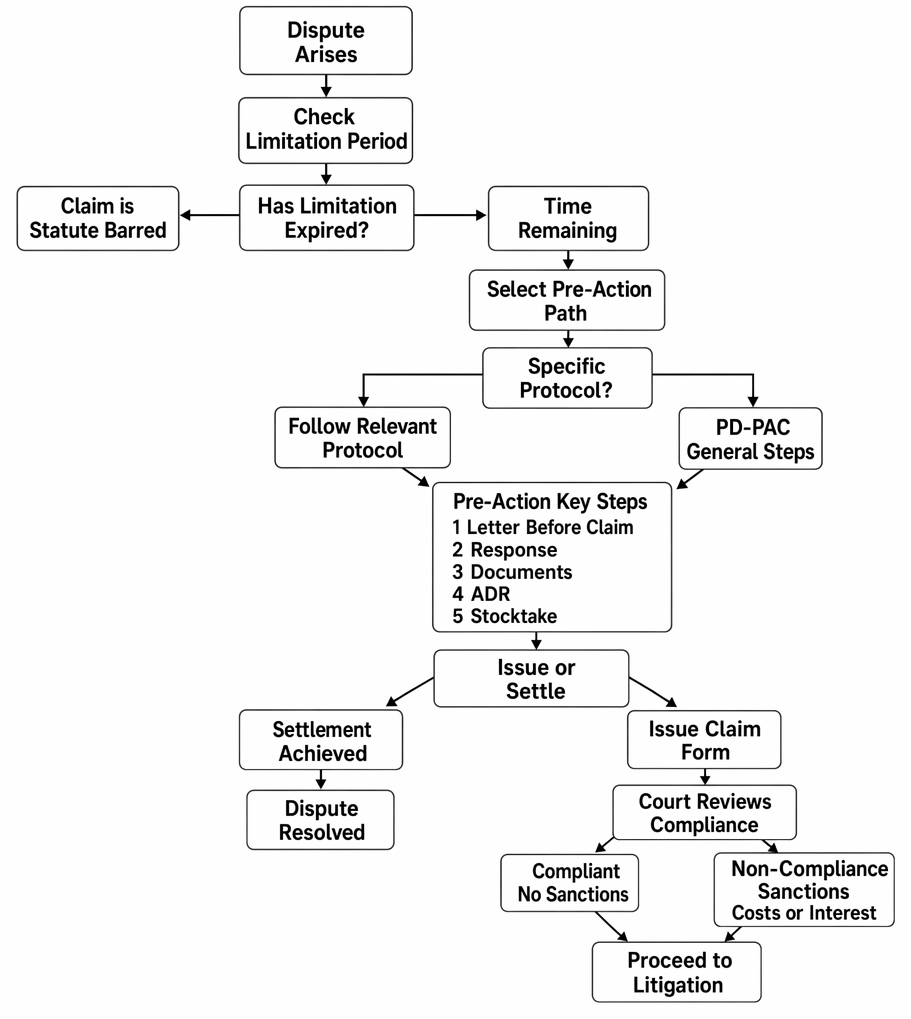
The sequence from limitation review and protocol selection to settlement, issue of the claim form, and compliance review is summarised.
Key Term: Limitation Period
A legally defined timeframe within which a party must commence court proceedings for a particular type of claim.
The relevant period depends on the cause of action: most contract and tort claims generally have six years, whereas personal injury claims usually have three years and defamation claims one year. In an exam scenario, classify the claim first, calculate the deadline from the triggering event, and then assess whether the pre-action protocol can be followed without missing it.
Test Tip: In SQE-style questions on Preliminary considerations: limitation and pre-action protocols, identify the legal test, the triggering fact, and the consequence before choosing between similar answer options.
Limitation Periods
The Limitation Act 1980 sets out statutory time limits within which legal proceedings must be commenced. These periods exist to ensure legal certainty, prevent defendants from facing indefinite threats of litigation, and address the difficulties of litigating claims where evidence may have become stale or lost over time.
The Purpose of Limitation Periods
Limitation periods serve several key purposes:
- Certainty: They provide finality for potential defendants.
- Evidence: They encourage claimants to bring claims while evidence is still reasonably fresh and available.
- Promptness: They push claimants to pursue their rights without undue delay.
Missing a limitation deadline typically means the claim is 'statute-barred', providing the defendant with a complete defence.
Key Term: Statute Barred
A claim that cannot be pursued in court because the relevant statutory limitation period has expired.
Key Limitation Periods
You must be familiar with the main limitation periods relevant to contract and tort claims for SQE1:
-
Contract Claims: The limitation period is six years from the date the cause of action accrued (s 5 Limitation Act 1980). The cause of action accrues on the date of the breach of contract, not necessarily when damage is suffered. Contracts made by deed (specialties) have a twelve-year limitation period (s 8).
-
Tort Claims (General): The limitation period is six years from the date the cause of action accrued (s 2 Limitation Act 1980). In negligence, the cause of action generally accrues when damage is suffered as a result of the breach of duty.
-
Personal Injury Claims (Negligence/Breach of Duty): A shorter period applies. The claim must be brought within three years from either:
- the date the cause of action accrued (the date the injury occurred); or
- the claimant's 'date of knowledge', if later (s 11 Limitation Act 1980, defined in s 14).
-
Latent Damage Claims (Negligence): For damage not discovered until later, the period is the later of six years from the damage occurring or three years from the claimant's date of knowledge, subject to an overriding fifteen-year longstop from the date of the negligent act or omission (ss 14A, 14B Limitation Act 1980). This regime applies to non-personal injury negligence claims (e.g., defective property).
-
Fatal Accident Claims: Claims under the Fatal Accidents Act 1976 must generally be brought within three years of the date of death or, if later, the date of knowledge of the person for whose benefit the action is brought (s 12 Limitation Act 1980).
-
Contribution Claims: A claim for contribution against another person who is or may be liable for the same damage must generally be brought within two years from the date the right to contribution accrued, usually when judgment is given or the amount to be paid is agreed in settlement.
-
Judgments and Enforcement: Post-judgment rules are distinct from limitation on the underlying cause of action. In broad terms, an action on a judgment is subject to a six-year limit, and enforcement steps taken after six years usually require the court’s permission.
-
Defamation and Malicious Falsehood: One year from the date of publication (s 4A Limitation Act 1980).
Key Term: Latent Damage
Damage that is not reasonably discoverable at the time it occurs and may come to light only later; limitation can run from the date of knowledge but is subject to a 15-year longstop.
The ‘Date of Knowledge’ Concept
The underlying cause of action may still arise before the problem is discovered: for example, a conveyancing solicitor’s missed title defect accrues at completion of the property purchase. In applying the extended period, the claimant need not know that the adviser was legally at fault; awareness of a real possibility that the advice caused a loss may be enough to start the relevant date-of-knowledge analysis.
Key Term: Date of Knowledge
For limitation purposes in personal injury and latent damage claims, the point at which the claimant first knew (or could reasonably have known) that they suffered significant injury or damage; that it was attributable to the act or omission of the defendant; and the identity of the defendant (s 14 Limitation Act 1980).
In personal injury, "significant" means more than negligible and sufficient to justify bringing proceedings (s 14(2)). Knowledge can be actual or constructive (what the claimant ought reasonably to have known, including through reasonable investigation). Knowledge of the precise legal fault is not required; awareness of the factual essence suffices.
Calculating Limitation Periods
Time generally starts running from the day after the cause of action accrues. For example, if a breach of contract occurs on 10 June 2023, the six-year limitation period starts on 11 June 2023 and expires at midnight on 10 June 2029.
Proceedings are 'brought' for limitation purposes when the court receives the claim form together with the appropriate court fee and request to issue, not when it is issued or served. If the limitation period expires on a day the court office is closed (e.g., a weekend or bank holiday), the claim form may be lodged on the next court business day without being out of time.
Practical points:
- Ensure the fee is paid and the claim form is properly completed; a failure here risks the court refusing to issue, meaning the claim has not been 'brought' in time.
- Issuing ‘protectively’ is common where evidence (e.g., medical report) is not ready but limitation is looming. Service can follow.
Effect of Expiry
If a claim is brought after the limitation period has expired, the claim is not automatically invalid. However, the defendant can raise limitation as a complete defence. If the defendant pleads limitation and the court agrees the claim is statute-barred, the claim will fail.
Extending Limitation Periods
In certain circumstances, the running of the limitation period may be postponed or extended:
- Disability: If the claimant is a child (under 18) or lacks mental capacity (as defined by the Mental Capacity Act 2005) when the cause of action accrues, the limitation period does not start until the disability ceases (s 28 Limitation Act 1980). For a child, this means the period starts on their 18th birthday. If capacity is lost later, time does not stop; it runs from accrual if the claimant had capacity at that time.
- Fraud, Concealment, or Mistake: Where the defendant has deliberately concealed relevant facts or the claim is based on fraud or mistake, the limitation period does not start until the claimant discovers the fraud, concealment, or mistake, or could have discovered it with reasonable diligence (s 32 Limitation Act 1980).
- Acknowledgment or Part Payment (Debt Claims): In claims for debt or other liquidated pecuniary sums, if the debtor acknowledges the debt in writing and signed, or makes a part payment, the limitation period restarts from the date of acknowledgment or payment (ss 29-31 Limitation Act 1980).
The court has a statutory discretion under s 33 Limitation Act 1980 to disapply the three-year limitation period for personal injury (and certain death claims) if it considers it equitable to do so, weighing the prejudice to each party. This discretion does not apply to general property damage claims, where limitation is strict subject to the latent damage provisions.
Issuing Protectively and Time for Service
Where limitation pressures require immediate issue:
- A claim form may be issued protectively and served later, allowing time to complete investigations and obtain evidence.
- The claim form must be served within four months of issue when serving within the jurisdiction (CPR 7.5). If service is required out of the jurisdiction, the period is six months (CPR 7.5, as modified by service-out rules).
- The court has power to extend the time for serving the claim form (CPR 7.6). Parties can consent to accept late service, but that consent does not, by itself, validly extend the CPR deadline; an application under CPR 7.6 is required if the four- (or six-) month period will be exceeded.
Worked Example 1.1
Anya entered into a contract with Ben Builders Ltd on 1 May 2018 for construction work to be completed by 1 September 2018. The work was completed late on 1 December 2018. Anya discovered defects in the work on 1 February 2024. When does the limitation period expire for a claim for breach of contract based on the defective work?
Answer:
The limitation period for breach of contract is six years from the date of breach. The breach regarding defective work likely occurred on the date of completion, 1 December 2018. The limitation period would therefore expire at midnight on 1 December 2024. The date of discovery of the defect is irrelevant for a contract claim's limitation period (unlike latent damage claims in tort).
Worked Example 1.2
BuildCo Ltd completed construction work for Client plc. Client plc refused to pay the final £50,000 invoice, alleging defects. BuildCo issued proceedings immediately without sending a letter before claim or attempting negotiation, citing urgency due to cash flow issues. Client plc defended the claim. At trial, BuildCo succeeds, but the judge finds their failure to follow pre-action steps was unreasonable. What order regarding interest might the court make?
Answer:
The court has discretion. As BuildCo (the claimant) failed unreasonably to comply with pre-action expectations, the court could order that BuildCo is deprived of some or all of the interest it would normally receive on the £50,000 judgment sum for a specified period, or award interest at a lower rate than usual, as a sanction for its non-compliance.
Worked Example 1.3
Paula suffered a back injury at work on 15 March 2021. She learned from an orthopaedic report received on 10 January 2023 that the injury was likely significant and attributable to poor manual handling training by her employer. When does her three-year personal injury limitation period expire?
Answer:
Time runs from the later of accrual (15 March 2021) or the ‘date of knowledge’. Paula’s date of knowledge is 10 January 2023, when she first knew the injury was significant and attributable to the employer’s act/omission. The three-year period therefore expires at midnight on 10 January 2026.
Worked Example 1.4
A claimant issues a claim form on 30 November just before limitation expires but cannot serve within four months due to awaited expert evidence. The defendant agrees to accept service on 15 April. Is an application needed?
Answer:
Yes. While a defendant may consent to late service, the validity of service beyond four months (or six months if serving out of the jurisdiction) requires the court’s permission under CPR 7.6. The claimant should apply to extend time for service.
Pre-Action Conduct
Before resorting to litigation, the Civil Procedure Rules (CPR) expect parties to engage constructively to try and resolve their disputes. This is guided by specific Pre-Action Protocols (PAPs) for certain claim types and the overarching Practice Direction on Pre-Action Conduct and Protocols (PD-PAC) for claims not covered by a specific PAP.
Key Term: Pre-Action Protocol (PAP)
A protocol, annexed to the CPR, setting out specific steps the court expects parties to take before commencing proceedings in particular types of civil claims (e.g., Personal Injury, Professional Negligence).
When a claim falls within a protocol, the parties should follow its prescribed sequence, commonly beginning with a letter of claim, an acknowledgement and a reasoned response. In a straightforward case, the response should normally be given within 14 days, whereas a very complex case may allow up to three months. If no protocol covers the dispute, the equivalent expectations are found in the PD-PAC, including exchanging key documents and considering ADR before issuing a claim.
Key Term: Practice Direction on Pre-Action Conduct and Protocols (PD-PAC)
A Practice Direction providing general guidance on pre-action conduct for civil claims where no specific Pre-Action Protocol applies.
The Overriding Objective and Pre-Action Steps
The requirement to follow pre-action steps aligns with the CPR's overriding objective (CPR 1.1) to deal with cases justly and at proportionate cost. Encouraging pre-action communication and settlement attempts helps achieve this by:
- Narrowing the issues in dispute.
- Allowing parties to understand each other's case.
- Encouraging early settlement, saving costs and court resources.
- Supporting efficient case management if litigation becomes necessary.
Courts actively encourage ADR. CPR 1.4 obliges the court to manage cases actively, including encouraging ADR. CPR 26.5 empowers the court to stay proceedings to enable ADR to take place, and PD 29 permits directions regarding ADR on the court’s own initiative.
Practice Direction on Pre-Action Conduct and Protocols (PD-PAC)
The PD-PAC applies where no specific PAP covers the dispute. Its core principles emphasize reasonable and proportionate steps:
- Litigation as a last resort: Parties must consider ADR.
- Information Exchange: Parties should exchange sufficient information to understand positions and make informed decisions.
- Settlement Attempts: Parties should try to settle without proceedings.
- Proportionality: Steps taken and costs incurred should be proportionate.
Key Term: Stocktake
The review undertaken by parties at the end of the pre-action process to assess positions and consider narrowing issues before proceedings, if settlement has not been achieved.
Key Steps in Pre-Action Conduct (PD-PAC)
The PD-PAC outlines a typical sequence:
- Claimant's Letter Before Claim: The potential claimant writes to the potential defendant setting out concise details: basis of claim, summary of facts, what is sought (including calculation if monetary), and enclosing/listing key documents.
- Defendant's Response: The defendant should respond within a reasonable time (e.g., 14 days straightforward, up to 3 months complex). The response should confirm if the claim is accepted (in whole/part), state reasons if disputed, identify disputed facts/parts of the claim, and state if a counterclaim is intended, enclosing key documents.
- Disclosure: Parties disclose key documents relevant to the issues in dispute.
- Experts: Parties should consider if expert evidence is needed and whether a single joint expert could be used.
- ADR/Settlement: Parties should actively consider negotiation or ADR.
- Stocktake: If the dispute remains unresolved, parties should review their positions before issuing proceedings.
Key Term: Letter Before Claim
A formal letter sent by a potential claimant to a potential defendant before court proceedings are issued, outlining the claim details as required by the relevant PAP or the PD-PAC.
The letter before claim is only the first step under the relevant pre-action protocol, and the court expects the parties to have exchanged sufficient information before proceedings are issued, as set out in paragraph 3 PDPACP. If the defendant fails to provide key documents requested in that correspondence, the claimant cannot simply wait and hope; the court has a power to order pre-action disclosure under CPR 31.16 to assist in disposing fairly of the anticipated claim or saving costs. Where a specific protocol exists, the parties must comply with it rather than relying only on the general practice direction.
Key Term: Pre-Action Disclosure
An application under CPR 31.16 for disclosure of documents before proceedings are started where criteria are met (likely parties; documents within standard disclosure scope; and disclosure desirable to fairly dispose of anticipated proceedings, assist resolution without proceedings, or save costs).
Pre-action disclosure can be a pragmatic tool if a key document will facilitate settlement discussions. The court will weigh proportionality and utility.
Specific Pre-Action Protocol Features
While many provisions mirror PD-PAC, certain protocols have tailored features:
- Debt Claims: Applies to business creditors pursuing an individual or sole trader debtor. The creditor should send a letter of claim with detailed information, including an up-to-date statement of account, interest and charges, how payment can be made, and annexed standard forms (Reply Form, Information Sheet, Financial Statement). Debtors should be given at least 30 days to respond, with additional time where debt advice is being sought.
- Professional Negligence: Typically begins with a Preliminary Notice to the professional, followed by a broad Letter of Claim. The professional acknowledges within 21 days and has up to three months to investigate and respond with a Letter of Response and, where appropriate, a Letter of Settlement. If not resolved, a stocktake is expected before issue.
- Personal Injury: Requires early exchange of accident circumstances and relevant documents (e.g., incident reports), with timetables for insurers’ liability responses.
The above illustrates the shared aim of informed early dialogue tailored to the claim type.
Consequences of Non-Compliance
While PAPs and the PD-PAC are not rigid rules in the same way as the CPR, failure to comply can have significant consequences if the matter proceeds to litigation. CPR 44.2(5)(a) explicitly states the court will consider compliance with pre-action conduct when making costs orders. Sanctions for unreasonable non-compliance can include:
- Costs Orders: The non-compliant party may be ordered to pay some or all of the other party's costs, potentially on the more punitive indemnity basis.
- Interest Penalties: A non-compliant claimant might be deprived of interest on damages awarded or awarded interest at a lower rate. A non-compliant defendant might be ordered to pay interest on damages at a higher rate (up to 10% above base rate).
- Stay of Proceedings: The court might stay (pause) the proceedings until the required pre-action steps are taken.
- Small Claims: Even on the small claims track, the court can order costs for unreasonable conduct (e.g., under CPR 27.14(2)(g)).
Key Term: Indemnity Basis
A costs assessment basis on which any doubt as to reasonableness is resolved in favour of the receiving party; proportionality is not a requirement.
For exam purposes, identify what should have happened before issue: the claimant should send concise details of the claim and calculation, while the defendant should respond within 14 days in a straightforward case or up to three months in a complex one, addressing any admission, denial or counterclaim. This chronology helps distinguish a genuine time constraint from a party that simply skipped the protocol, so explain the available procedural response rather than treating the deadline as a complete answer.
Exam Warning: Do not assume that limitation pressures automatically excuse non-compliance with pre-action protocols. While the court acknowledges the need to issue proceedings before limitation expires, it expects parties to consider applying for a stay immediately after issue to allow compliance or seek a 'standstill agreement' pre-issue. Unjustified failure to engage, even near a limitation deadline, can still attract sanctions.
In the textbook’s personal-injury example, where limitation expired in two weeks, the correct advice was to issue proceedings within time and immediately apply for a stay, rather than wait for the pre-action response period or seek a court extension. Where the defendant agrees that proceedings may be delayed safely, the parties can instead record that arrangement in a standstill agreement.
Key Term: Standstill Agreement
A contractual agreement between potential litigants to suspend or extend a statutory limitation period, typically to allow time for negotiation or compliance with pre-action protocols without the need to issue protective proceedings.
Standstill agreements are common in professional negligence and commercial disputes. They must be expressly agreed and carefully drafted; they do not extend CPR service deadlines post-issue.
Worked Example 1.5
A business creditor intends to recover a £7,500 unpaid invoice from a sole trader. They send a brief demand email giving seven days to pay. The debtor raises affordability issues and asks for a payment plan. The creditor issues proceedings the next day. What pre-action concerns arise and what sanctions are possible?
Answer:
The Debt PAP applies. The creditor should have sent a protocol-compliant letter of claim with information sheets and a Reply Form, allowed 30 days to respond, and considered a repayment plan. Unreasonable non-compliance may lead to adverse costs orders and interest sanctions, and the court may stay proceedings to permit proper pre-action engagement.
Worked Example 1.6
A claimant suspects a key contract amendment (pricing schedule) is held by the defendant and will determine whether there is any viable claim. Settlement discussions have stalled and no proceedings have been issued. What step could the claimant consider and on what basis?
Answer:
An application for pre-action disclosure under CPR 31.16. The claimant must show both parties are likely to be parties to subsequent proceedings, the document would fall within standard disclosure if proceedings were issued, and disclosure before proceedings would be desirable to fairly dispose of anticipated proceedings, assist resolution without proceedings, or save costs.
Summary
- Limitation periods (mainly under the Limitation Act 1980) set strict deadlines for commencing legal claims (e.g., six years for contract/general tort, three years for personal injury from accrual/knowledge, one year for defamation, and twelve years for deeds).
- The ‘date of knowledge’ can postpone time for personal injury and latent damage claims, but a 15-year longstop operates for latent damage in negligence (not personal injury).
- Proceedings are ‘brought’ for limitation when the court receives the claim form with the fee; if the office is closed on the deadline, the next business day suffices.
- Claim forms issued protectively must be served within CPR deadlines; the court can extend time for service (CPR 7.6). Parties’ consent alone does not extend the court’s service deadline.
- Limitation periods can be postponed where the claimant is under a disability, or the claim involves fraud, concealment, or mistake; for debts, signed acknowledgment or part payment can restart time.
- Contribution claims generally carry a two-year period from judgment or settlement fixing the amount paid, and judgment enforcement is subject to separate six-year post-judgment rules.
- Pre-action protocols and the Practice Direction on Pre-Action Conduct and Protocols (PD-PAC) aim to encourage early communication, information exchange, and settlement before litigation.
- Key pre-action steps generally include a Letter Before Claim, Defendant's Response, disclosure of key documents, consideration of experts (including single joint experts), ADR, and a stocktake.
- Unreasonable failure to comply with pre-action requirements can lead to court sanctions, primarily affecting costs and interest awards, and can result in a stay to enable compliance.
- Pre-action disclosure may be ordered where criteria are met and can facilitate early resolution.
Key Point Checklist
This article has covered the following key knowledge points:
- The purpose and effect of statutory limitation periods and why time limits exist.
- The main limitation periods for contract claims, tort claims, personal injury, latent damage, fatal accident claims, defamation, deeds, contribution claims, and key post-judgment enforcement limits.
- How to determine the start date and expiry date of limitation periods, including the ‘date of knowledge’ and longstop.
- The meaning of proceedings being ‘brought’ for limitation purposes and practical steps for protective issue and service.
- Circumstances where limitation periods may be postponed (disability) or postponed for fraud, concealment, or mistake; and the effect of acknowledgment/part payment in debt claims.
- The significance of the overriding objective in pre-action conduct and the court’s encouragement of ADR.
- The purpose and general steps required by the Practice Direction on Pre-Action Conduct and Protocols (PD-PAC) and typical features of key specific protocols.
- The potential sanctions for failing to comply with pre-action requirements, including indemnity costs and interest consequences.
- The availability and criteria for pre-action disclosure and its role in resolving or narrowing disputes pre-issue.
- The role of standstill agreements and the limits of their effect compared with CPR service timelines.
Key Terms and Concepts
- Limitation Period
- Statute Barred
- Latent Damage
- Date of Knowledge
- Pre-Action Protocol (PAP)
- Practice Direction on Pre-Action Conduct and Protocols (PD-PAC)
- Letter Before Claim
- Stocktake
- Indemnity Basis
- Pre-Action Disclosure
- Standstill Agreement