Learning Outcomes
This article provides a comprehensive understanding of the constitutional position of devolved institutions within the UK, equipping you to explain:
- the statutory foundations and legal framework governing devolution in Scotland, Wales, and Northern Ireland, including the key Acts of Parliament that define and restrict devolved powers;
- how powers are distributed between the UK Parliament (Westminster) and devolved legislatures, along with the mechanics and implications of "reserved," "excepted," and "transferred" matters;
- the principle of parliamentary sovereignty and its interaction with devolution, including legal and political constraints on Westminster’s legislative supremacy;
- the status, effect, and practical operation of constitutional conventions such as the Sewel Convention, especially in relation to legislative consent and political accountability;
- the processes by which legislative competence of devolved legislatures is determined, challenged, and policed by courts, including the final appellate jurisdiction of the UK Supreme Court in devolution disputes;
- the legal and political impact of major constitutional milestones (such as the Scotland Act 2016 and the Wales Act 2017) on the permanent character and practical limits of devolved institutions;
- the ongoing influence of Brexit, the redistribution of powers previously held at EU level, and the UK's internal market framework on the operation and status of devolution;
- the function of administrative and judicial review, the importance of statutory interpretation, and the balance between the rule of law and political realities in the devolution context.
SQE1 Syllabus
For SQE1, you are required to understand the constitutional framework and operation of devolution in the UK, with a focus on the following syllabus points:
- the statutory basis for devolution in Scotland, Wales, and Northern Ireland and relevant constitutional statutes;
- the specific division of legislative and executive powers between Westminster and devolved bodies;
- understanding of the Sewel Convention, its political import, and its non-justiciability;
- identification of reserved, excepted, and transferred matters and the consequences of exceeding devolved legislative competence;
- mechanisms for judicial challenge and Supreme Court determination of legislative competence;
- the ongoing operation of parliamentary sovereignty, including limitations and exceptions;
- the effects of devolution on public administration, law enforcement, and legal systems within the UK;
- the impact of significant constitutional events such as Brexit, the UK Internal Market Act 2020, and the Northern Ireland Protocol on devolved powers;
- the distinction between legal enforceability and political accountability in the context of devolution.
Test Your Knowledge
Attempt these questions before reading this article. If you find some difficult or cannot remember the answers, look more closely at that area during your revision.
- Which Act of Parliament established the Scottish Parliament and what model of legislative competence does it use?
- What is the Sewel Convention and is it legally enforceable?
- Can the UK Parliament legislate on devolved matters without the consent of the devolved legislature?
- What is the legal effect if a devolved institution passes legislation outside its competence?
- How does Brexit affect the distribution of powers between Westminster and devolved governments?
Introduction
Devolution in the United Kingdom refers to the statutory transfer of specific legislative and executive powers from the UK Parliament (Westminster) to separate institutions in Scotland, Wales, and Northern Ireland. This process, underpinned by a series of major constitutional statutes, has granted a degree of self-government while maintaining the overarching sovereignty of the UK Parliament. Devolved authorities operate within the legal framework established by Westminster and are subject to constitutional limits, judicial supervision, and review.
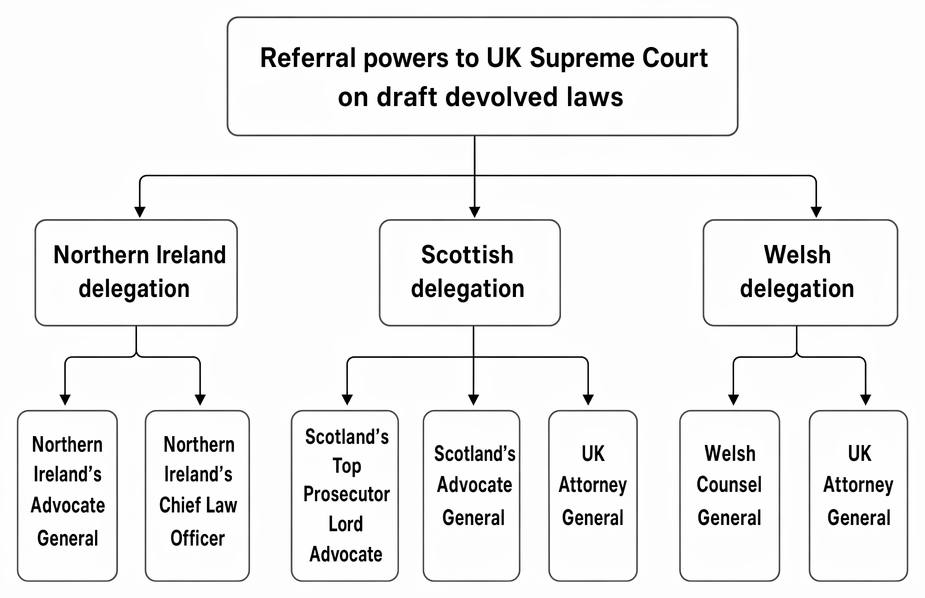
Referral powers to the UK Supreme Court over draft devolved legislation and the relevant law officers in Northern Ireland, Scotland, and Wales.
Key Term: devolution
The statutory transfer of specified legislative and executive powers from the UK Parliament to new institutions in Scotland, Wales, and Northern Ireland.
The UK remains a unitary state—even after devolution—because all devolved powers derive from, and can ultimately be reclaimed by, Parliament. This is distinct from the federal arrangement in countries like the USA or Germany, where the regions retain sovereignty by right.
Test Tip: In SQE-style questions on Devolution in the UK, identify the legal test, the triggering fact, and the consequence before choosing between similar answer options.
Exam Warning: Do not rely on a familiar phrase from Devolution in the UK alone; check whether the facts satisfy every condition, exception, and timing requirement.
The Statutory Basis of Devolution
Devolution is not a product of a written constitution but of a patchwork of constitutional statutes governing the devolution settlements in Scotland, Wales, and Northern Ireland. These statutes assign (and constrain) legislative and executive competences and create mechanisms for resolving disputes over these boundaries.
Scotland
Devolution in Scotland is governed principally by the Scotland Act 1998 (as amended). This Act established both the Scottish Parliament and the Scottish Government, setting out a "reserved powers" model: the Scottish Parliament can legislate on all matters except those expressly reserved to Westminster. Reserved matters include the constitution, foreign affairs, defence, immigration, and most aspects of the economy.
This model was further entrenched by the Scotland Act 2016, which confirmed that the Scottish Parliament and the Scottish Government "are a permanent part of the United Kingdom’s constitutional arrangements" and cannot be abolished except on the basis of a referendum in Scotland. Despite this, these provisions are ultimately political, as the legal doctrine of parliamentary sovereignty dictates that Westminster could, as a matter of law, override even these "permanency" clauses.
Key Term: reserved powers model
All legislative matters are devolved except those specifically listed or reserved to the UK Parliament.
For the Scottish Parliament to legislate effectively, it must operate within the competence prescribed by the 1998 Act. An Act of the Scottish Parliament is "not law" so far as it exceeds those powers—for example, by dealing with a reserved matter, relating to foreign affairs, or conflicting with the European Convention on Human Rights (ECHR) or, prior to Brexit, EU law.
Wales
Devolution in Wales originally followed a weaker model, with the Government of Wales Act 1998 conferring limited powers on the then National Assembly for Wales. Subsequent reforms—the Government of Wales Act 2006, the Wales Act 2014, and the Wales Act 2017—transformed the settlement, providing the Assembly (now Senedd Cymru/Welsh Parliament) with primary lawmaking powers and shifting to a reserved powers model in 2017, similar to that of Scotland.
The Senedd can make laws on devolved areas (e.g., health, education, social care, local government), provided these are not reserved to Westminster. However, more matters remain reserved to Westminster in Wales than in Scotland—most notably criminal justice and policing, which remain UK responsibilities.
Like its Scottish equivalent, the Senedd’s existence is declared permanent in statute, and any abolition would require a referendum in Wales. The boundaries of devolved and reserved matters are enumerated in detail, and like the Scottish Parliament, the Senedd’s laws can be struck down if they exceed the powers set out in the Government of Wales Act 2006 (as amended).
Northern Ireland
The Northern Ireland Act 1998—enacted to implement the Good Friday (Belfast) Agreement—established the Northern Ireland Assembly and Executive. This settlement is unique in the UK, reflecting the region's political realities. Here, powers are categorised as "transferred" (devolved), "reserved" (not currently devolved but capable of being devolved in future), or "excepted" (remaining permanently at Westminster).
Key Term: excepted matters
Areas of law in Northern Ireland that are permanently under UK Parliamentary control (e.g., the constitution, defence, international relations, nationality, and immigration).
The Assembly legislates on transferred matters (e.g., health, education, agriculture, justice), but may not deal with excepted matters, nor reserved matters unless Westminster agrees to devolve them. In addition, the legal framework is complicated by the region’s mandatory power-sharing system and the constant requirement for cross-community support on many decisions.
The Principle of Parliamentary Sovereignty
Despite the statutory and political safeguards, the UK Parliament remains legally sovereign and retains the power to legislate upon any matter, whether reserved or devolved. While the statutes make express provision for devolved institutions (and in Scotland and Wales, declare them permanent), the legal position is clear: Parliament cannot bind its successors, and therefore, all devolved powers ultimately continue by virtue of Westminster’s legislative authority.
Key Term: parliamentary sovereignty
Parliament can make or unmake any law, and no person or body has the legal right to override or set aside Parliament’s statutes.
However, the political reality, especially since the Scotland Act 2016 and Wales Act 2017, is such that the abolition or substantial curtailment of devolution without the democratic consent of the relevant populations would cause a significant constitutional crisis.
Westminster's legislative supremacy is carefully balanced by important conventions, political accountability, and, increasingly, judicial review.
The Sewel Convention
A central political convention in the devolution framework is the Sewel Convention, named after Lord Sewel, who articulated the principle that the UK Parliament "will not normally legislate with regard to devolved matters without the consent" of the relevant devolved legislature. This convention is now given statutory recognition (e.g., Scotland Act 1998 s.28(8); Government of Wales Act 2006 s.107(6)), but crucially is not legally binding or justiciable.
Key Term: Sewel Convention
A constitutional convention that Westminster will not normally legislate on devolved matters without the consent of the relevant devolved legislature. Key Term: Legislative Consent Motion (LCM)
The formal mechanism by which a devolved legislature grants consent to Westminster to legislate on a devolved matter.
The Sewel Convention plays an important role in managing relations between the UK Government and devolved administrations, providing a mechanism (via Legislative Consent Motions) for cooperation when UK-wide provision is practical or necessary. Consent is usually granted in technical/administrative matters but has on occasion been withheld in significant constitutional moments—for example, during Brexit and the passage of the European Union (Withdrawal) Acts, when all devolved legislatures refused consent and Westminster nevertheless legislated.
It is important to emphasise that, as confirmed by the Supreme Court in R (Miller) v Secretary of State for Exiting the European Union [2017] UKSC 5, statutory recognition of the Sewel Convention does not convert it into a legal rule; it remains a political principle only. The courts will acknowledge its existence but will not enforce it.
Worked Example 1.1
The UK Parliament enacts a law altering social security rules, which are devolved in Scotland, without a corresponding Legislative Consent Motion being passed by Holyrood. The Scottish Government protests, claiming Westminster has acted unlawfully.
Answer:
As a matter of law, Parliament's action is valid. Despite political and constitutional controversy, the Sewel Convention is a political constraint, not a legal bar, and is ultimately unenforceable by courts.
Legislative Competence and Limits
Devolved legislatures operate within defined limits of competence, set out by their founding Acts. Their legislative power is strictly "conferred"—they may only enact laws within their allocated domain. If a devolved institution legislates beyond this ("ultra vires"), e.g., on a reserved or excepted matter, or inconsistently with the ECHR, that law is "not law" and has no legal effect.
Key Term: legislative competence
The legal authority of a devolved legislature to enact laws within the boundaries defined by statute.
It is the responsibility of the devolved government minister introducing a Bill, as well as the respective Presiding Officer/Speaker, to certify that a proposed Bill is within legislative competence before introduction. Both stages offer important procedural and constitutional scrutiny.
Controversies about the scope of legislative competence often arise, particularly where the distinction between reserved and devolved matters is not clear cut or where a Bill arguably impacts on more than one area of law. The courts and ultimately the Supreme Court serve as the final arbiter in such disputes.
Judicial review of devolved legislation operates similarly to review of secondary legislation, with a focus on whether the relevant institution acted within its statutory powers (intra vires) or has acted outside them (ultra vires).
Worked Example 1.2
The Senedd (Welsh Parliament) enacts an Act to regulate the energy market in Wales. The Secretary of State, believing energy is a reserved matter, refers the Act to the Supreme Court.
Answer:
The Supreme Court would examine whether the provision "relates to" a reserved matter. If so, the relevant sections would be beyond the Senedd's legislative competence and thus "not law." If a court finds part or all of devolved legislation to be ultra vires, it may strike down, disapply, or require amendment to the offending provision before granting Royal Assent.
Worked Example 1.3
A Bill before the Scottish Parliament includes provisions on immigration policy.
Answer:
Immigration is expressly reserved to Westminster. Scottish Parliament cannot legislate on immigration. If it passes such a provision, it would be outside competence and the court would declare the affected section void.
The Role of the UK Parliament
While devolution is politically entrenched, Parliament retains the right to legislate in all areas, including those devolved, with legal supremacy. By convention and statute, Westminster seeks the consent of the devolved institution (via the Sewel Convention) before enacting laws on devolved matters. Refusal of consent does not invalidate Westminster legislation.
It is worth noting that Westminster’s supremacy operates as a legal backstop and as a safeguard against unconstitutional behaviour by devolved legislatures (for example, attempting to legislate for independence without proper process or competence), and ensures the ongoing coherence of the UK's legal framework.
Occasionally, Westminster uses its supremacy to intervene where there is political deadlock or a breakdown in devolved government, as historically witnessed in periods of direct rule in Northern Ireland.
Worked Example 1.4
The UK Parliament passes an Act relating to the structure of local councils in Wales, a devolved matter, without Senedd consent.
Answer:
The Act is valid as a matter of law. However, it raises political and constitutional concerns and may generate political fallout and a loss of trust between governments.
Judicial Review and Statutory Interpretation
Courts play a critical role in policing the boundaries of devolved competence. Disputes can arise as to whether particular legislation "relates to" a reserved or excepted matter or breaches other statutory limits (such as ECHR compliance). These questions can be raised before Royal Assent or once a Bill becomes law, and any "devolution issue" can be referred to the Supreme Court for determination.
In considering such challenges, courts will interpret the relevant parent Act strictly and, applying judicial review principles, will scrutinise the legislative intent, the substance as well as the form of the relevant devolved provision, and the coherence of the scheme as a whole.
Devolved Acts are subject to judicial challenge broadly in the same way as secondary legislation: lack of statutory authority will render a provision void. However, the courts are deferential to the democratic will of devolved legislatures within their competence, and will not strike down legislation on the basis of irrationality unless the breach is egregious and fundamental.
The issues of statutory interpretation are also central—courts will read devolved statutes in light of the parent Act, constitutional principles, and, where questions of human rights arise, the need for compatibility with the ECHR.
Worked Example 1.5
A provision in a Northern Ireland Assembly Act is challenged as indirectly relating to nationality, an excepted matter.
Answer:
The Supreme Court would examine the purpose and effect of the provision, and if it is found to engage an excepted matter, it would be declared outside competence and "not law."
Brexit and Devolution
The UK's withdrawal from the European Union has reshaped the devolution framework. Powers previously exercised at EU level and relevant to devolved subjects have become "repatriated." This triggered debate and disputes about whether such powers should flow directly to devolved bodies or be subject to new UK-wide common frameworks.
The UK Internal Market Act 2020 instituted overarching rules to ensure barriers do not develop within the UK for goods or services, even where devolved regulators introduce divergent policies and standards. Many devolved governments have raised the concern that this framework significantly constrains the practical ability of devolved legislatures to set their own rules, thereby curtailing the autonomy of devolution in practice.
Key Term: UK Internal Market Act 2020
Legislation design to guarantee seamless trade in goods and services across the UK's nations, imposing market access principles that limit divergence in devolved regulatory regimes.
The legacy of direct effect and supremacy of EU law has ended, but the division of regulatory responsibilities post-Brexit remains a contentious constitutional issue, frequently resulting in intergovernmental disputes and tension.
Key Term: northern ireland protocol
A protocol to the Brexit Withdrawal Agreement that keeps Northern Ireland in alignment with aspects of the EU's single market to avoid a hard border with the Republic of Ireland, creating a unique legal status for Northern Ireland distinct from the rest of the UK.
The Northern Ireland Protocol
The Northern Ireland Protocol to the Brexit Withdrawal Agreement addresses the need to avoid a hard border on the island of Ireland. Northern Ireland, uniquely, continues to comply with specific EU rules on goods, customs, and regulatory alignment to maintain borderless trade with the Republic of Ireland. This arrangement, while ensuring cross-border peace and compliance with the Good Friday Agreement, introduces regulatory divergence between Northern Ireland and Great Britain, and grants the Protocol's rules primacy in certain areas. This complex arrangement has major constitutional implications for devolution, requiring ongoing management of regulatory and political relationships between Northern Ireland, the UK, and the EU.
The Future of Devolution
The framework of devolution is not fixed. Ongoing constitutional debate surrounds further devolution of powers, proposals for additional referendums on independence, the potential for federalization, and challenges around balancing regional self-government with the coherence and effectiveness of UK-wide governance. While the legal scaffolding of devolution relies on constitutional statutes and political conventions, the balance between legal and political accountability continuously shapes and redefines the practical operation of devolved government in the UK.
Key Point Checklist
This article has covered the following key knowledge points:
- The statutory basis for devolution in Scotland, Wales, and Northern Ireland is set by Acts of Parliament, which define reserved, excepted, and transferred powers.
- Devolved institutions have restricted legislative competence; any Act or provision outside this competence is void and "not law."
- The UK Parliament remains legally sovereign and can legislate in any area, including devolved matters, without legal impediment.
- The Sewel Convention serves as a critical political constraint on Westminster's legislation in devolved areas but is not legally enforceable.
- The Supreme Court is the ultimate judicial authority on questions of devolved competence and adjudicates devolution disputes.
- Brexit has led to significant legal and constitutional tension, particularly over the return and allocation of formerly EU-held powers, the UK Internal Market, and regulatory divergence.
- The Northern Ireland Protocol establishes a distinct legal regime for Northern Ireland, integrating aspects of EU law to uphold commitments under the Good Friday Agreement and to avoid a hard border.
Key Terms and Concepts
- devolution
- reserved powers model
- excepted matters
- parliamentary sovereignty
- Sewel Convention
- Legislative Consent Motion (LCM)
- legislative competence
- UK Internal Market Act 2020
- northern ireland protocol