Learning Outcomes
This article explains the legal basis, constitutional status, and practical operation of devolved governments in the United Kingdom, including:
- The historical and statutory development of devolution settlements, highlighting key Acts and their constitutional significance.
- The institutional structures, electoral systems, and primary law-making processes of the Scottish Parliament, Senedd Cymru, and Northern Ireland Assembly.
- The classification of reserved, devolved, and excepted matters, with emphasis on how schedules and statutory tests allocate competence.
- The concept of legislative competence, the main statutory limits (territorial scope, human rights, protected enactments, and—pre-Brexit—EU law), and how they are applied in practice.
- The operation, wording, and limits of the Sewel Convention and legislative consent motions, contrasted with legally enforceable constraints.
- The continuing doctrine of parliamentary sovereignty, its interaction with constitutional statutes, and its practical impact on devolved autonomy.
- The role of the Supreme Court and other courts in resolving devolution issues, including pre-enactment references, post-enactment challenges, and the "pith and substance" approach.
- Common SQE1-style problem scenarios involving the validity of devolved Acts, potential ultra vires challenges, and typical issues arising from Brexit and the UK Internal Market.
SQE1 Syllabus
For SQE1, you are required to understand the status, powers, and functions of devolved governments within the UK constitutional framework, with a focus on the following syllabus points:
- the creation and legal basis of devolved governments in Scotland, Wales, and Northern Ireland, including key statutes (Scotland Act 1998 and 2016, Government of Wales Acts 1998, 2006, 2017, Wales Act 2014 and 2020, Northern Ireland Act 1998)
- the distinction between reserved, devolved, (and excepted) matters
- legislative competence of devolved legislatures and its statutory boundaries
- the political and constitutional relationship between devolved institutions and the UK Parliament, with reference to the Sewel Convention and legislative consent
- parliamentary sovereignty and its effect on devolution (and any legal limitations)
- the mechanisms and principles for judicial scrutiny of devolved Acts and their enforcement, including the specific role of the Supreme Court
Test Your Knowledge
Attempt these questions before reading this article. If you find some difficult or cannot remember the answers, look more closely at that area during your revision.
- What is the difference between a reserved matter and a devolved matter in the context of UK devolution?
- Can the Scottish Parliament amend an Act of the UK Parliament? If so, under what conditions?
- What is the Sewel Convention, and is it legally enforceable?
- Who decides whether a devolved legislature has acted within its legislative competence?
Introduction
Devolution in the United Kingdom refers to the statutory disaggregation of powers from the UK Parliament at Westminster to regional legislatures in Scotland, Wales, and Northern Ireland. The UK remains a unitary state—sovereignty is vested in the Westminster Parliament—but devolved institutions are empowered by statute to make primary legislation in certain areas. This distribution is not simply practical, but grounded in constitutional law. It is necessary to understand how devolved roles are structured, the legal boundaries of devolved competence, and how sovereignty and parliamentary supremacy are preserved.
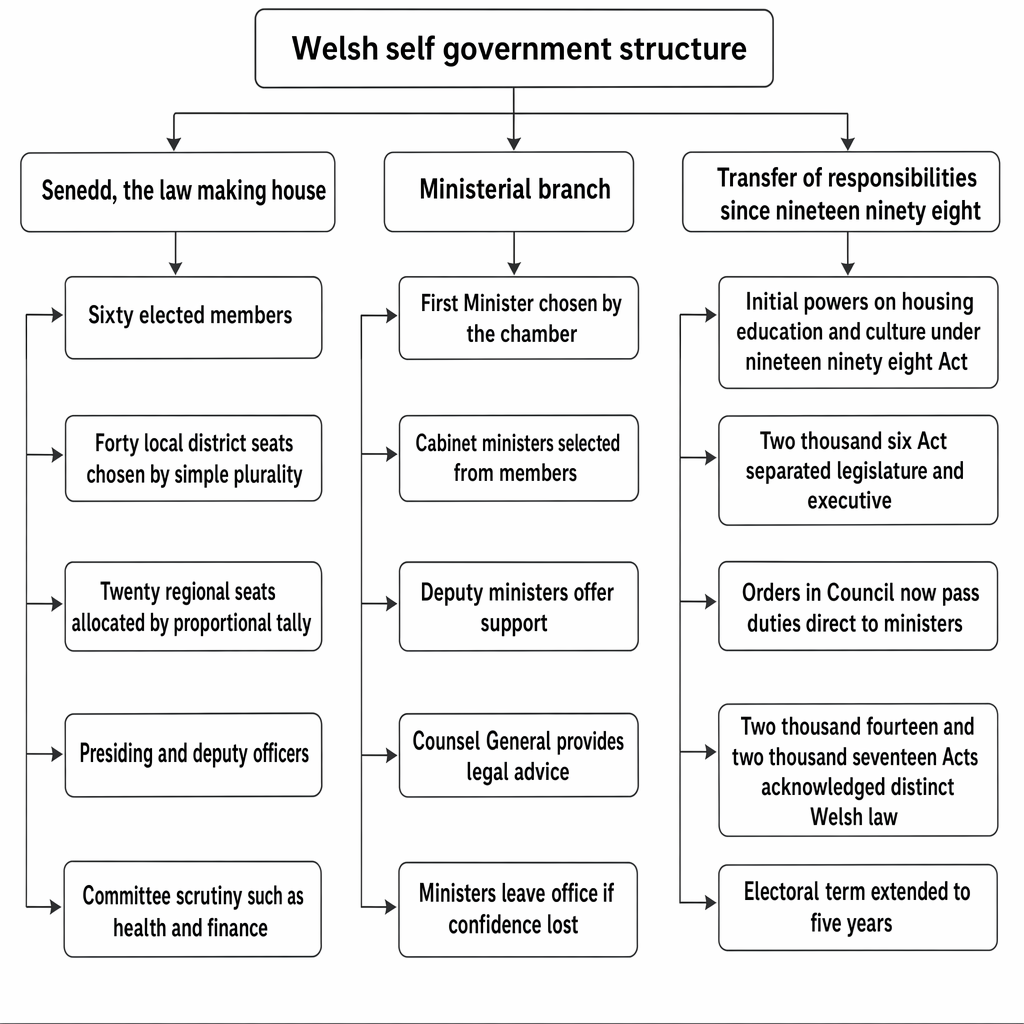
Welsh devolution settlement: the Senedd’s composition and scrutiny role, the Welsh Government’s ministerial structure, and principal statutory developments since 1998.
Key Term: devolved institution
A body, such as the Scottish Parliament, Senedd Cymru, or Northern Ireland Assembly, established by statute and granted powers to legislate and govern in certain areas.Test Tip: In SQE-style questions on Powers and functions of devolved governments, identify the legal test, the triggering fact, and the consequence before choosing between similar answer options.
The Legal Basis of Devolution
The UK Parliament holds plenary legislative power by virtue of the doctrine of parliamentary sovereignty. However, modern constitutional statutes, such as the Scotland Act 1998 (amended by the Scotland Act 2016), the Government of Wales Acts 1998 and 2006 (as reformed by subsequent Wales Acts), and the Northern Ireland Act 1998, created statutory frameworks for devolved governments. These Acts—often treated as constitutional statutes due to their foundational nature—set out the structures, electoral arrangements, law-making powers, limitations, and protocols for alteration and abolition. Notably:
- Scotland: Scotland Act 1998 (substantially amended in 2016), explicitly establishing the Scottish Parliament and Government, including provisions recognising the permanent status of these institutions (but, legally, not making them immune from repeal).
- Wales: Government of Wales Act 1998 (conferring initial, limited powers), Government of Wales Act 2006 (granting primary legislative capacity in certain areas), and further Wales Acts (2014 and 2017) shifting Wales to a reserved powers model.
- Northern Ireland: Northern Ireland Act 1998 (incorporating the terms of the Good Friday Agreement, enabling power-sharing government).
These statutes are not entrenched (i.e., not given specially protected status above other statutes)—the UK Parliament could, in law, repeal or amend them by ordinary legislative process. Nevertheless, they generally reflect political promises, constitutional conventions, and the principle of democratic legitimacy (e.g., referendums have preceded fundamental changes).
Reserved and Devolved Matters
A central feature is the demarcation of law-making authority between Westminster and the devolved bodies.
Key Term: reserved matter
An area of law or policy that remains under the exclusive authority of the UK Parliament and cannot be legislated on by devolved legislatures. Key Term: devolved matter
An area of law or policy for which legislative and executive authority has been transferred to a devolved institution.
Scotland and Wales: Reserved Powers Model
The reserved powers model, embedded in the Scotland Act 1998 (as amended) and, for Wales, the Government of Wales Act 2006 (as revised by the Wales Act 2017), provides that the devolved legislature has authority to legislate on any matter not explicitly reserved to Westminster. Reserved matters are listed in Schedules to the devolution statutes and generally include:
- the constitution, the Crown, the Union, and the UK Parliament
- foreign affairs
- defence, armed forces, and national security
- immigration and nationality
- fiscal, economic, and monetary policy (with exceptions for certain taxes in Scotland and Wales)
- employment rights, consumer protection, intellectual property, and certain aspects of criminal law
All other policy areas—such as education, health, housing, local government, most aspects of justice in Scotland, and culture—are devolved.
Notably, financial powers and the ability to vary or set certain taxes have expanded in recent years—for example, Scotland controls income tax rates (excluding savings/dividends), land and buildings transaction tax, and landfill tax. Wales controls land transaction tax and landfill disposals tax, and as of 2019, aspects of income tax.
Northern Ireland: Three-way Division
The Northern Ireland Act 1998 creates a three-tier scheme:
- Excepted matters: Always retained by Westminster (e.g., royal succession, foreign affairs, defence, international relations, and currency).
- Reserved matters: Could potentially be devolved in future, with the consent of both Parliament and the Assembly (e.g., policing and criminal justice, until this was devolved in 2010; other areas include prisons and civil defence).
- Transferred matters: Routinely devolved (e.g., health, education, social policy, agriculture).
The Assembly may legislate on transferred matters, and reserved matters only if authority is given in particular cases.
Legislative Competence of Devolved Legislatures
Devolved legislatures can enact primary legislation—Acts of the Scottish Parliament, Acts of the Senedd Cymru, Acts of the Northern Ireland Assembly—provided they act within their legislative competence.
Key Term: legislative competence
The legal authority of a devolved legislature to make laws in specified areas, as defined by the relevant devolution statute.
Limits on Legislative Competence
Devolved bodies cannot:
- legislate on reserved (or in Northern Ireland, excepted) matters, unless express permission is granted in the case of reserved matters in Northern Ireland
- bind courts outside their territorial remit or legislate extraterritorially (subject to some exceptions)
- act contrary to the European Convention on Human Rights (ECHR)—incompatibility renders an Act invalid (s 29(2)(d) Scotland Act 1998, s 94 GOWA 2006, s 6 NI Act 1998)
- before Brexit, legislate contrary to EU law (this limitation was diminished by the UK’s departure from the EU; now, the role of retained EU law is clarified in the Withdrawal Act 2018)
- modify certain "protected enactments" (such as the Human Rights Act 1998, certain elements of the devolution Acts themselves, and provisions relating to the UK Supreme Court)
Certain officeholders (e.g., the Lord Advocate in Scotland) are specifically protected from removal or fundamental changes by devolved Acts.
If an Act or a provision is found to be ultra vires—outside the competence conferred by statute—it is of no legal effect.
Who Decides Competence?
Disputes regarding the extent of devolved competence can be referred directly to the Supreme Court (previously, the Judicial Committee of the Privy Council) under specific statutory routes. Before Royal Assent, certain Law Officers (e.g., Advocate General for Scotland, Attorney General, Counsel General for Wales) may refer devolved Bills to the Supreme Court. Legislation can also be challenged after enactment in proceedings by anyone with standing, if relevant to the case.
When interpreting the competence of devolved bodies, courts look at both the purpose and effect of the provision, considering the broader context and practical outcome, rather than adopting a purely formalistic view.
Worked Example 1.1
A bill passed by the Scottish Parliament amends a UK Act relating to education. Is this within the Scottish Parliament’s competence?
Answer:
Yes, provided the subject matter (education) is devolved and not reserved. The Scottish Parliament can amend UK Acts on devolved matters.
The "Pith and Substance" Doctrine
The courts will consider the main purpose ("pith and substance") of the legislation to assess whether a provision encroaches on a reserved matter. If a provision is only incidentally related to a reserved matter but primarily touches upon a devolved matter, it may be deemed within competence.
The Sewel Convention
The Sewel Convention is a constitutional convention first articulated by Lord Sewel during the passage of the Scotland Act 1998, now referenced in statute for Scotland (s 28(8), Scotland Act 1998) and for Wales (s 107(6), Government of Wales Act 2006, as amended). It states:
Key Term: Sewel Convention
A political convention that Westminster will not normally legislate on devolved matters without the consent of the devolved legislature.
The Sewel Convention has political, not legal, force. Legislative Consent Motions (LCMs) are the procedural vehicles through which devolved legislatures give or withhold consent. However, as affirmed by the Supreme Court in R (Miller) v Secretary of State for Exiting the EU [2017] UKSC 5, neither the statutory reference to the Sewel Convention nor the convention itself is legally enforceable. Westminster can, in law, legislate on devolved matters, even when consent is refused. The courts will not intervene to uphold a convention.
Worked Example 1.2
Parliament passes an Act affecting health policy in Scotland without the consent of the Scottish Parliament. Is this Act valid?
Answer:
Yes. The Sewel Convention is a political, not legal, constraint. The UK Parliament remains legally sovereign and can legislate on devolved matters, even without consent.
Relationship Between Devolved Institutions and UK Parliament
The UK Parliament is constitutionally sovereign. All devolved legislative bodies derive their existence and powers from statutes of the UK Parliament. While the Scotland Act 2016, the Wales Act 2017, and the Northern Ireland Act 1998 include references to the permanence of devolved institutions and/or the expectation of democratic consent for abolition, these are not legal fetters on Parliament's authority (parliamentary sovereignty remains intact).
Devolved legislatures:
- are not sovereign or supreme
- act only within statutory limits
- cannot entrench legislation against alteration by Westminster
The UK Parliament can, in principle, override or even repeal devolved arrangements, although this would carry significant political consequences and, in the case of Northern Ireland, implications for international agreements.
Key Term: parliamentary sovereignty
The doctrine that Parliament has authority to make or unmake any law; no court or body may override or set aside legislation of Parliament.Exam Warning: The Sewel Convention is not legally binding. Even if a devolved legislature refuses consent, the UK Parliament can still legislate on devolved matters. Do not confuse political conventions with legal limits.
Judicial Resolution of Devolution Disputes
Where there is a challenge to the competence of a devolved Act or provision, courts—primarily the UK Supreme Court—have the final say. This litigation may arise as:
- a pre-enactment reference by a Law Officer
- an action in civil or criminal proceedings post-enactment, where the validity of a devolved provision is in issue
The Supreme Court will interpret the relevant devolution statute and apply the "pith and substance" doctrine, seeking to identify whether the main purpose and practical effect of a provision is within a devolved area.
Courts can declare a provision outside competence to be "not law", rendering it void and unenforceable. They may also provide for "reading down" or severance—interpreting or excising limited provisions to render the Act compliant where possible.
Worked Example 1.3
The Welsh Parliament passes an Act on tourism. Tourism is not listed as a reserved matter. Can this Act be challenged as outside competence?
Answer:
No. Under the reserved powers model, the Senedd can legislate on any matter not reserved. If tourism is not reserved, it is within competence. In Northern Ireland, many devolution disputes and dissensions regarding legislative competence have also been heard, including jurisdictional conflict over "cross-community" voting and reserved matters.
Impact of Brexit on Devolution
Brexit fundamentally altered the distribution of powers. Before 2020, devolved bodies were unable to legislate contrary to EU law (s.29(2)(d) Scotland Act 1998; s.80 Government of Wales Act 2006; s.6 Northern Ireland Act 1998). Following withdrawal:
- The European Union (Withdrawal) Act 2018 incorporated relevant EU law as "retained EU law"
- Some powers previously held by the EU reverted to Westminster (even where, arguably, they would naturally revert to devolved institutions, such as agriculture, food standards, and fisheries)
- The UK Internal Market Act 2020 provides protections for trade and movement of goods/services across the UK, but has been criticised by devolved governments for constraining devolved legislative autonomy (e.g., imposing "market access principles" and mutual recognition)
- The post-2022 intergovernmental framework now provides structured ministerial forums to manage divergence within the UK's internal market
Disputes regarding the division of powers post-Brexit are ongoing, with the courts continuing to arbitrate between devolved and UK governments over UKIM Act provisions and legislative overlaps.
The Wider Constitutional Context: Parliamentary Scrutiny and Conventions
Although statutory devolution is not constitutionally entrenched (as in a codified constitution), political constraints, public sentiment, and international treaties (e.g., the Good Friday Agreement in Northern Ireland) act as significant checks on Westminster intervention.
Practically, regular intergovernmental mechanisms exist through the post-2022 Intergovernmental Relations framework, including the Interministerial Standing Committee and subject-specific interministerial groups. The older Joint Ministerial Committee is now best understood as the historical predecessor to that structure. These mechanisms remain political, not legally enforceable, constraints.
The balance between legal enforceability (courts will strike down ultra vires Acts, but will not enforce conventions) and political legitimacy is central to the devolution settlement.
Key Term: convention
A binding but non-legal rule of political or constitutional practice, such as the Sewel Convention, recognising practical limits on the legal authority of Parliament.
Examples of Devolved and Reserved Areas
- Reserved (Westminster-retained): Constitution, defence, foreign affairs, immigration, monetary policy, most areas of employment and social security, general criminal law in England and Wales.
- Devolved: Education, health and social services, housing, transport (in varying degrees), agriculture, fisheries, local government, culture, some taxes (e.g., Scottish income tax, certain Welsh taxes).
Participation in International Matters
Though devolved governments may pursue international relations in areas of devolved competence (e.g., trade promotion), formal treaty-making, foreign policy, and international negotiations remain the exclusive preserve of Westminster (the Crown-in-Parliament), consistent with the prerogative powers and constitutional principle of a unitary state.
Non-Departmental Public Bodies and Agencies
Many public functions are also exercised through non-departmental public bodies ("quangos"), both at UK and devolved levels. These bodies are typically accountable to their "parent" government, and constitutional statutes set out their relationship with Ministers and (where appropriate) to the devolved governments or UK Parliament, reflecting constitutional norms regarding scrutiny and accountability.
Rights of Audience and Role of the Judiciary
Key Term: Supreme Court
The final appellate court in the UK for civil and (except Scotland) criminal matters, and the ultimate authority in interpreting devolution statutes and constitutional disputes arising under them.
Judges of the UK Supreme Court ensure consistency in interpretation between devolved and UK law, provide oversight to ensure legislative competence, and resolve constitutional controversies, safeguarding the rule of law and the respective constitutional positions of all organs, consistent with the Constitutional Reform Act 2005.
Key Point Checklist
This article has covered the following key knowledge points:
- Devolved governments in Scotland, Wales, and Northern Ireland are established by UK statutes and exercise powers within defined areas; their existence and authority are conferred, but not entrenched, by constitutional statutes.
- Reserved matters remain under the control of the UK Parliament and government; devolved matters are legislated on by the respective devolved institutions within statutory boundaries.
- Legislative competence is defined by statute and is policed by the judiciary; Acts or provisions outside competence are "not law" and have no legal effect.
- Supreme Court scrutiny includes reference proceedings before Royal Assent and post-enactment challenges during litigation.
- The Sewel Convention is a political convention, not a legal rule; it restrains Westminster primarily by political pressure, not by legal enforceability.
- Parliamentary sovereignty is preserved—the UK Parliament remains legally free to legislate in all areas, but its continued sovereignty is checked by practical, political, and, in some areas, international factors.
- Brexit has recalibrated the boundaries of devolved power, particularly in areas previously under EU competence, and has introduced new challenges regarding the UK internal market and retained EU law.
- The courts vigorously uphold either statutory restrictions or the rule of law in policing devolution settlements but will not enforce non-legal conventions or intervene in political disputes.
- Non-departmental and public bodies operate within the constitutional frameworks of their respective governments, providing additional context for administrative law principles relevant to devolution.
- Rights of audience and senior court appeal mechanisms are equally applicable to devolved and non-devolved matters, with final jurisdiction always resting with the Supreme Court (subject to exceptions in Scottish criminal cases).
Key Terms and Concepts
- devolved institution
- reserved matter
- devolved matter
- legislative competence
- Sewel Convention
- parliamentary sovereignty
- convention
- Supreme Court