Learning Outcomes
This article examines the structure, jurisdictions, appellate routes, and precedent of the Court of Appeal, including:
- Structure and constitution of the Court of Appeal, including the roles of the Lord Chief Justice and the head of the Civil Division within the Criminal and Civil Divisions
- Appellate and supervisory jurisdictions over criminal and civil matters and their interrelation with the High Court, Crown Court, County Court, and certain tribunals
- Civil and criminal appellate routes to and from the Court of Appeal, including procedural prerequisites such as grounds for permission and tests for appellate review
- The doctrine of precedent at the Court of Appeal, including when it is bound by its own decisions
- The Young v Bristol Aeroplane Co Ltd exceptions and recent developments in their scope for both Civil and Criminal Divisions
- The interplay between Court of Appeal and Supreme Court precedents and resolution of conflicting lines of authority
- Conditions under which binding effect, distinguishing, and overruling occur at appellate and subordinate levels
SQE1 Syllabus
For SQE1, you are required to understand the Court of Appeal’s structure, jurisdiction, appellate routes, and role in the doctrine of precedent, with a focus on the following syllabus points:
- the structure, composition, and powers of the Court of Appeal: Civil Division and Criminal Division
- appellate and supervisory jurisdiction over criminal and civil matters
- the procedural routes of appeal to and from the Court of Appeal—including leave/permission requirements and appeal tests
- the Court of Appeal’s function in the doctrine of precedent, including stare decisis both vertically and horizontally
- the binding effect of Court of Appeal decisions, limits on its ability to depart from precedent, and the Young v Bristol Aeroplane Co Ltd exceptions
- the influence of Court of Appeal authority on lower courts and tribunals
- distinctions between the Court of Appeal (Civil Division) and (Criminal Division) regarding precedent and flexibility
- the relationship of Court of Appeal precedent to other sources such as the Supreme Court, Privy Council, and courts of equivalent jurisdiction
Test Your Knowledge
Attempt these questions before reading this article. If you find some difficult or cannot remember the answers, look more closely at that area during your revision.
- What are the two divisions of the Court of Appeal, and what types of cases does each hear?
- In what circumstances can the Court of Appeal depart from its own previous decisions?
- Are decisions of the Court of Appeal binding on the High Court and County Court?
- What is the effect of a Court of Appeal decision that conflicts with a later Supreme Court decision?
Introduction
The Court of Appeal is one of the most senior courts in the legal structure of England and Wales, immediately below the Supreme Court in the judicial hierarchy. Established by the Judicature Acts in the late nineteenth century and largely governed today by the Senior Courts Act 1981, the Court of Appeal has evolved to play a fundamental constitutional and practical role in the correction of error, the supervision of the lower courts, and the development and clarification of law. Its bifurcation into Civil and Criminal Divisions ensures both specialism and institutional consistency.
Key Term: Court of Appeal
The Court of Appeal is a senior appellate court in England and Wales, divided into Civil and Criminal Divisions, hearing appeals from lower courts and certain tribunals.Test Tip: In SQE-style questions on The Court of Appeal, identify the legal test, the triggering fact, and the consequence before choosing between similar answer options.
Exam Warning: Do not rely on a familiar phrase from The Court of Appeal alone; check whether the facts satisfy every condition, exception, and timing requirement.
Structure and Composition
The Court of Appeal is comprised of the Civil Division and the Criminal Division, each led and staffed by distinguished members of the senior judiciary.
Civil Division
Headed by the head of the Civil Division, the Civil Division hears appeals on civil matters from the High Court (all three divisions), County Court (in specified classes of case), and select tribunals such as the Employment Appeal Tribunal. Appeals are generally determined by a panel of three Lord or Lady Justices of Appeal, although panels of two may be convened for procedural or less complex matters. Additional judges—including High Court judges—may sit by invitation when needed to meet the Division's workload.
The Civil Division is responsible for shaping large swathes of English private law, public law, and practice through its appellate function, with appeals ranging from major commercial disputes to family, property, and judicial review claims.
Criminal Division
The Criminal Division is presided over by the Lord Chief Justice, who also serves as Head of Criminal Justice, or by the Vice-President of the Criminal Division. Other members may include the Heads of Division, Lords Justices of Appeal, and (on occasion) High Court judges with criminal experience. It manages appeals from the Crown Court concerning convictions and sentences, as well as points of law following instructions from the Attorney General or referrals by the Criminal Cases Review Commission.
Panels in the Criminal Division likewise ordinarily consist of three judges, ensuring that decisions in criminal cases benefit from collegial deliberation and a breadth of practical judicial experience.
Key Term: appellate jurisdiction
Appellate jurisdiction is the authority of a court to review and decide appeals from lower court decisions.
The court’s physical home is at the Royal Courts of Justice, London, but technology now allows for remote hearings and regional sittings as the caseload demands.
Jurisdiction and Functions
Civil Jurisdiction
The Civil Division’s jurisdiction extends to:
- Appeals from final and certain interim decisions of the High Court’s three divisions
- Appeals from the County Court, typically in higher-value or more complex cases and where permission has been granted
- Appeals from certain statutory tribunals (for instance, the Employment Appeal Tribunal, Upper Tribunal, Competition Appeal Tribunal)
- Appeals from the Family Court on matters of law or especially significant issues
The scope of civil appellate jurisdiction is established primarily by statute (notably, Parts 52 and 54 of the Civil Procedure Rules). Most appeals require permission (leave) to appeal, which may be granted by the lower court or the Court of Appeal itself, and are only allowed to proceed where they satisfy stringent grounds—such as the decision below being wrong in law, wrong in fact, or involving a serious procedural or other irregularity that renders the decision unjust.
On appeals, especially in civil cases, the Court of Appeal typically reviews the correctness of the lower court’s decision rather than rehearing evidence or facts afresh. However, re-hearings may occur where the interest of justice so requires, though oral evidence is rarely entertained.
Direct appeals to the Supreme Court from a single decision of the High Court – known as “leapfrog” appeals – may be possible in restricted circumstances if a point of law of general public importance arises, and with the requisite certification.
Criminal Jurisdiction
The Criminal Division:
- Hears appeals against conviction and/or sentence from the Crown Court
- Adjudicates on points of law referred by the Attorney General after an acquittal (which do not overturn acquittals but clarify law for future cases)
- Considers applications for review of unduly lenient sentences with the Attorney General’s permission
- Reviews cases referred by the Criminal Cases Review Commission, particularly in relation to potential miscarriages of justice
In criminal appeals, the court has the power to quash unsafe convictions, order retrials, substitute alternative verdicts where appropriate, and vary sentences. Fresh evidence may be admitted where it is in the interests of justice, allowing correction of injustices and ensuring protection of fundamental rights.
Key Term: precedent
A precedent is a legal principle or rule established in a previous case that is binding on courts when deciding subsequent cases with similar facts.
Doctrine of Precedent and the Court of Appeal
The Court of Appeal is at the apex of binding precedent for all inferior courts and itself, save for the Supreme Court above.
Binding Effect
- The Court of Appeal’s decisions are binding on all courts below, including the High Court, County Court, Crown Court, Family Court, Magistrates’ Courts, and most statutory tribunals.
- Both Divisions are not bound by the decisions of the other Division, but both are bound by the Supreme Court and (formerly) House of Lords.
The authority of the Court of Appeal as a source of precedent ensures uniformity and certainty across the judicial system. Vertical stare decisis operates strictly, promoting legal predictability and efficient case management.
Horizontal stare decisis—how the court treats its own prior decisions—has been the focus of considerable debate, especially as the law becomes more complex and demands a balance between consistency and flexibility.
The Young v Bristol Aeroplane Co Ltd Principle
Young v Bristol Aeroplane Co Ltd [1944] KB 718 established the general rule that the Court of Appeal (Civil Division) is bound by its own previous decisions, but provided three important exceptions:
- There are conflicting earlier decisions of the Court of Appeal: In that case, the court may decide which to follow.
- The previous decision was overruled or is inconsistent with a later Supreme Court (or House of Lords) decision: The higher authority prevails.
- The earlier decision was made per incuriam (“through lack of care”): For example, the earlier panel failed to consider a relevant statutory provision or binding authority.
Key Term: per incuriam
Per incuriam describes a decision made in ignorance of a relevant statute or binding authority, and so not binding as precedent. Key Term: Young exceptions
The Young exceptions are the three circumstances in which the Court of Appeal can depart from its own previous decisions, as set out in Young v Bristol Aeroplane Co Ltd.
While the Court of Appeal in principle is to be rigidly self-binding, the Young exceptions grant necessary flexibility so that clear errors, oversights, or jurisprudential conflict can be remedied without undermining certainty.
Recent Interpretation and Scope
Modern case law has affirmed a restrictive approach to “per incuriam,” limiting it to manifest errors—such as unawareness of a conflicting statute or binding Supreme Court case—rather than mere disagreement or minor errors. A court should not set aside its prior decision because it is simply regarded as wrongly decided.
The Court of Appeal is not, however, entitled to decline to follow a Supreme Court (or House of Lords) decision on the ground that it is itself inconsistent with a subsequent decision of the Court of Appeal or another court of co-ordinate jurisdiction. In such a scenario, the Supreme Court’s decision prevails.
The status of panel decisions (e.g. where only two judges sat, or the decisions are interlocutory) has also been considered. Full panels are normally required for the formation of binding authority, although exceptions exist for interlocutory decisions.
Divisional Distinctions: Civil vs Criminal Division
The Criminal Division applies the Young exceptions but exercises additional latitude in cases affecting liberty or justice. It may decline to follow its own previous decisions (or those of co-ordinate panels) if adhering would cause real injustice or unfairness, especially where significant mistakes or practical consequences come to light after a precedent has developed.
Leading Authority
Cases such as R v Gould [1968] 2 QB 65 and subsequent decisions emphasise that the Criminal Division’s flexibility is rooted in the need to prevent miscarriages of justice, reflecting the fundamental constitutional principle that criminal law’s strictures cannot override individual liberty absent compelling justification.
By contrast, the Civil Division is expected to adopt a stricter approach to precedent—departing from prior decisions only where one of the Young exceptions applies.
Key Term: stare decisis
Stare decisis is the doctrine that courts should follow the principles established in previous cases to ensure consistent and predictable application of the law.
Worked Example 1.1
Worked Example 1.1 Details
A panel of the Court of Appeal (Civil Division) is hearing a case. Counsel for the appellant cites a previous Court of Appeal decision supporting their argument. Counsel for the respondent cites a conflicting Court of Appeal decision. What should the court do?
Answer:
Where there are conflicting previous decisions of the Court of Appeal, the court may choose which to follow. This is one of the Young exceptions.
Worked Example 1.2
Worked Example 1.2 Details
A criminal appeal raises a point of law decided in a previous Court of Appeal case, but a later Supreme Court decision has changed the law. Which decision is binding?
Answer:
The Supreme Court decision is binding. The Court of Appeal must follow the Supreme Court and may depart from its own earlier decision.
Distinguishing and Overruling
If the current case can be distinguished on its facts from an earlier binding precedent, the Court of Appeal is entitled to resolve the present case differently, so long as materially different facts are present. However, distinguishing is a careful process—minor factual inconsistencies are insufficient to avoid following binding authority.
When the court determines that an earlier precedent of the court is plainly wrong but does not fall within one of the three Young exceptions, it must still apply the earlier authority, leaving any further review to the Supreme Court or legislative intervention.
Conversely, when a Court of Appeal decision is expressly or impliedly overruled by the Supreme Court, inferior courts (including the High Court, County Court and tribunals) must cease to follow the overruled decision and instead apply the higher authority.
Worked Example 1.3
Worked Example 1.3 Details
A High Court judge is hearing a civil case that directly conflicts with two diverging lines of authority from the Court of Appeal. The High Court judge must decide which, if either, to follow.
Answer:
The High Court judge must follow established Court of Appeal precedent unless two irreconcilable decisions apply; in which case, the High Court may choose the decision it considers appropriate, but should give reasons. However, all lower courts remain bound by decisions of the Supreme Court.
Routes of Appeal
Appeals to the Court of Appeal
The procedural rules governing appeals require the appellant to apply for permission (leave) to appeal against the decision of a lower court or tribunal. Permission may be granted by the lower court or by the Court of Appeal itself. The general test for permission is set out in the Civil Procedure Rules or (in criminal matters) the Criminal Procedure Rules and associated statutes. Typically, grounds include that the decision of the court below was wrong or unjust due to a serious procedural irregularity.
- Civil appeals: Appeals typically arise from the High Court (Queen’s Bench, Chancery or Family Division), County Court, or certain tribunals (especially those listed in statute—e.g., Employment Appeal Tribunal, Upper Tribunal). In civil matters, the Civil Division sits as the designated appellate forum. -Criminal appeals: Conducted by the Criminal Division, appeals are brought from the Crown Court concerning conviction or sentence, with further reference to the Supreme Court only where points of law of general public importance arise.
All appeals must comply with specified procedures and time limits.
Appeals from the Court of Appeal
In both civil and criminal cases, further appeals may only be brought to the Supreme Court of the United Kingdom, and then only with permission (even in criminal cases, permission is strictly required except for certain rare categories). The Supreme Court will grant leave only where a point of law of general public importance is clearly identified and demonstrates the necessity for further appellate review. This ensures that only cases with broad constitutional significance or significant legal ramifications proceed beyond the Court of Appeal.
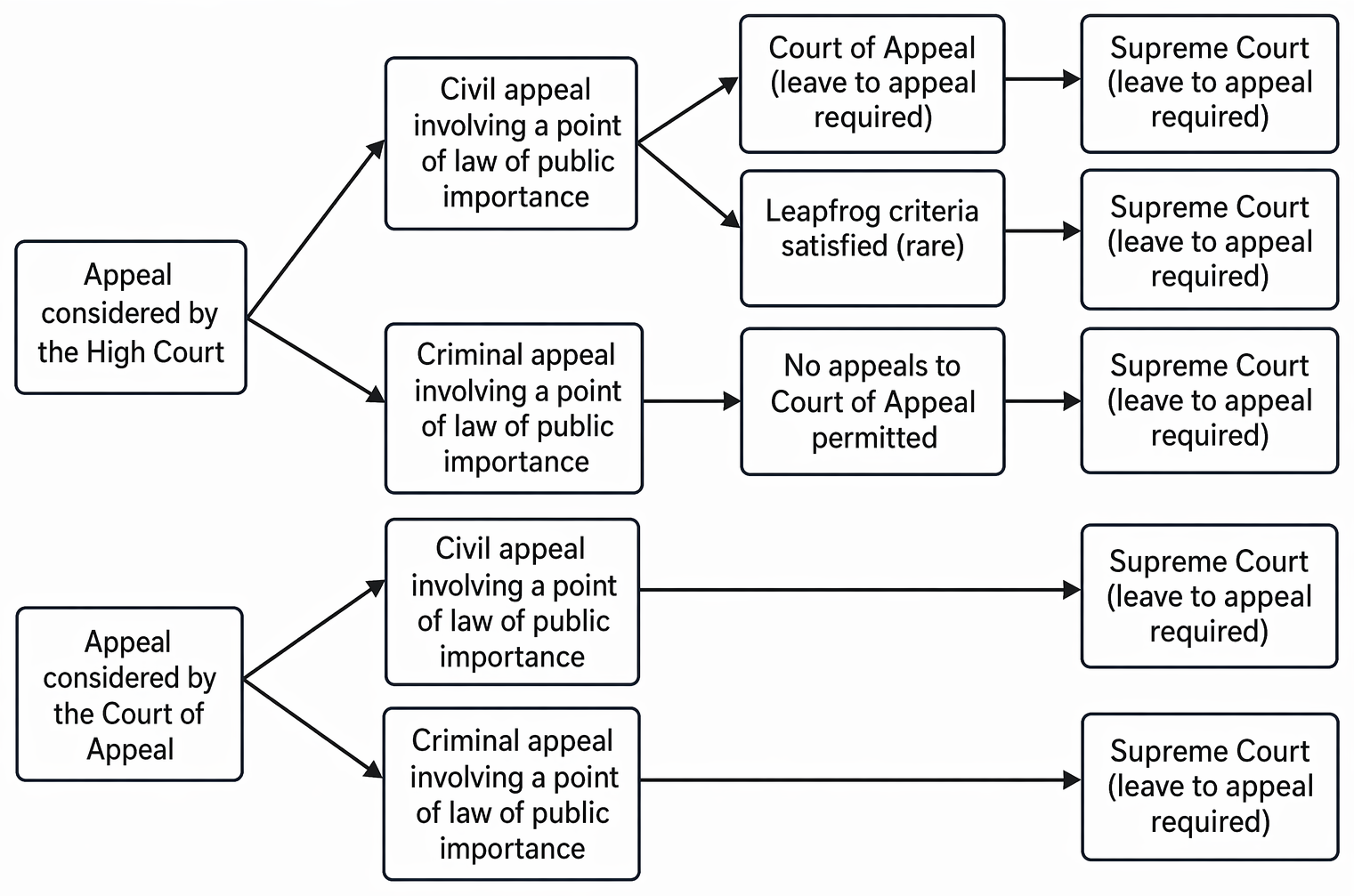
Court of Appeal structure, jurisdiction, appeal routes, and the operation of precedent are summarised, including the Young v Bristol Aeroplane exceptions.>Key Term: Supreme Court> The Supreme Court is the highest appellate court in the UK, hearing appeals from the Court of Appeal and exercising constitutional review where required by law.
Where the Court of Appeal’s decision is shown to be in conflict with an existing Supreme Court authority, or the Supreme Court subsequently departs from its prior decisions, the general rule remains that the Supreme Court's decision prevails.
Precedent in Practice
Court of Appeal decisions carry significant authority for the development of English law and are frequently cited not just in the High Court, Crown Court, and County Court, but also in tribunals, specialist jurisdictions, and in public law contexts such as judicial review.
Practitioners and lower courts rely on Court of Appeal authority to interpret procedural rules, clarify statutory terminology, resolve ambiguities, and apply key legal concepts consistently.
Where two lines of authority from the Court of Appeal appear to diverge, Supreme Court intervention may be needed to resolve the impasse, but lower courts must nevertheless apply binding appeal court law unless the Young exceptions allow otherwise.
The Criminal Division additionally ensures that errors with potentially grave consequences for personal liberty, such as failures by trial counsel or newly discovered evidence, can be addressed flexibly and with due regard to the interests of justice.
Key Term: vertical stare decisis
Vertical stare decisis refers to the principle that lower courts must follow decisions of superior courts in the hierarchy. Key Term: horizontal stare decisis
Horizontal stare decisis is the doctrine that a court is generally bound to follow its own previous decisions unless an exception applies.
Worked Example 1.4
Worked Example 1.4 Details
A County Court judge is hearing a civil case. The parties each cite conflicting Court of Appeal decisions in support of their respective positions. How should the County Court judge proceed?
Answer:
The County Court judge must follow the decision of the Court of Appeal that is still binding, applying the most recent and directly applicable authority, unless the Court of Appeal decisions are truly irreconcilable—in which case, the County Court judge should follow the line that best aligns with decisions of the Supreme Court or, failing that, give reasons for their choice.
Recent Developments
The Court of Appeal has increasingly employed digital filing and remote hearings, particularly in response to challenges introduced by the COVID-19 pandemic. Court procedure is now more streamlined, with online applications for permission to appeal, digital document management, and the option for certain appeals to be decided on the documents without an oral hearing if appropriate.
Significant reforms in recent years include:
- Greater emphasis on the need to seek permission to appeal and on providing clear, justified grounds for appeal—helping to reduce unmeritorious cases and ensuring efficient use of judicial resources.
- More rigorous preparation requirements, with focused skeleton arguments and strict timetabling, especially for appeals of public or constitutional importance.
- The continued evolution of judicial guidance to ensure clarity and coherence in the handling of precedent, including updated Practice Directions and ongoing dialogue with the Supreme Court on the boundaries of the Young exceptions.
Key Point Checklist
This article has covered the following key knowledge points:
- The Court of Appeal is a senior appellate court with Civil and Criminal Divisions.
- It hears appeals from the High Court, Crown Court, County Court, and certain tribunals.
- Its decisions are binding on lower courts and, generally, on itself, subject to the Young exceptions for departing from previous decisions.
- The Court of Appeal’s Civil Division follows Young v Bristol Aeroplane Co Ltd strictly; the Criminal Division is more flexible, prioritising justice and liberty.
- Appeals to and from the Court of Appeal require permission, with further appeal to the Supreme Court only in cases of important points of law.
- Precedent from the Court of Appeal is central for practitioners, shaping law and ensuring consistent application throughout the judicial system.
- The Court of Appeal is using digital processes and procedural reform for greater efficiency and reduced backlog.
Key Terms and Concepts
- Court of Appeal
- appellate jurisdiction
- precedent
- per incuriam
- Young exceptions
- stare decisis
- vertical stare decisis
- horizontal stare decisis
- Supreme Court