Learning Outcomes
This article examines the High Court’s structure and function in England and Wales, explaining the roles of the King’s Bench, Chancery, and Family Divisions, their specialist lists, and how cases are allocated between them and the County Court. It covers the High Court’s original, appellate, and supervisory jurisdiction, including when civil, family, commercial, and public law matters should be brought at first instance, on appeal, or by judicial review. It outlines the mechanisms by which the High Court reviews decisions of lower courts, tribunals, and public bodies, the scope and limits of remedies such as quashing, prohibiting, and mandatory orders, and the procedural features of judicial review. It analyzes the High Court’s status as a superior court of record, the binding and persuasive effect of its decisions within the doctrine of precedent, and its relationship with the Court of Appeal and Supreme Court. It also details the High Court’s constitutional significance in safeguarding the rule of law and access to justice, highlighting points commonly tested in SQE1 FLK1 questions.
SQE1 Syllabus
For SQE1, you are required to understand the High Court’s structure, divisions, jurisdiction, and role within the court hierarchy, including its contribution to precedent and judicial review, with a focus on the following syllabus points:
- the structure and divisions of the High Court (King’s Bench Division, Chancery Division, Family Division)
- the original, appellate, and supervisory jurisdiction of the High Court, including distinctions between trial and appeal functions
- types of cases allocated to each division and their specialist sub-courts
- the High Court’s authority as a court of record and the binding effect of its judgments
- the operation and limits of precedent: when High Court decisions bind, and when they are persuasive
- the High Court’s unique role in judicial review and in reviewing the decisions of public bodies and tribunals
- the interface between the High Court and lower courts (such as the County Court, Magistrates’ Court, and tribunals) and its relationship with the Court of Appeal and Supreme Court
- the principles of the High Court’s involvement in constitutional and administrative law, including fundamental obligations like the rule of law and access to justice
Test Your Knowledge
Attempt these questions before reading this article. If you find some difficult or cannot remember the answers, look more closely at that area during your revision.
- Which three main divisions make up the High Court, and what is the primary focus of each?
- What is the difference between the original and appellate jurisdiction of the High Court?
- In what types of cases does the High Court exercise supervisory jurisdiction?
- How does the High Court contribute to the development of legal precedent in England and Wales?
Introduction
The High Court of England and Wales sits at the apex of the civil court structure beneath the Court of Appeal and Supreme Court. As a superior court of record, it maintains jurisdiction across England and Wales, hearing both original and appeal cases, and taking a leading role in supervising the legality of actions by lower courts and public authorities. Through its specialist divisions, the High Court decides highly complex, high-value, and constitutional issues, with judgment that binds a broad range of courts and influences legal doctrine through precedent. A robust awareness of the High Court’s functions, jurisdiction, and authority is necessary for legal practice and for meeting the requirements of SQE1.
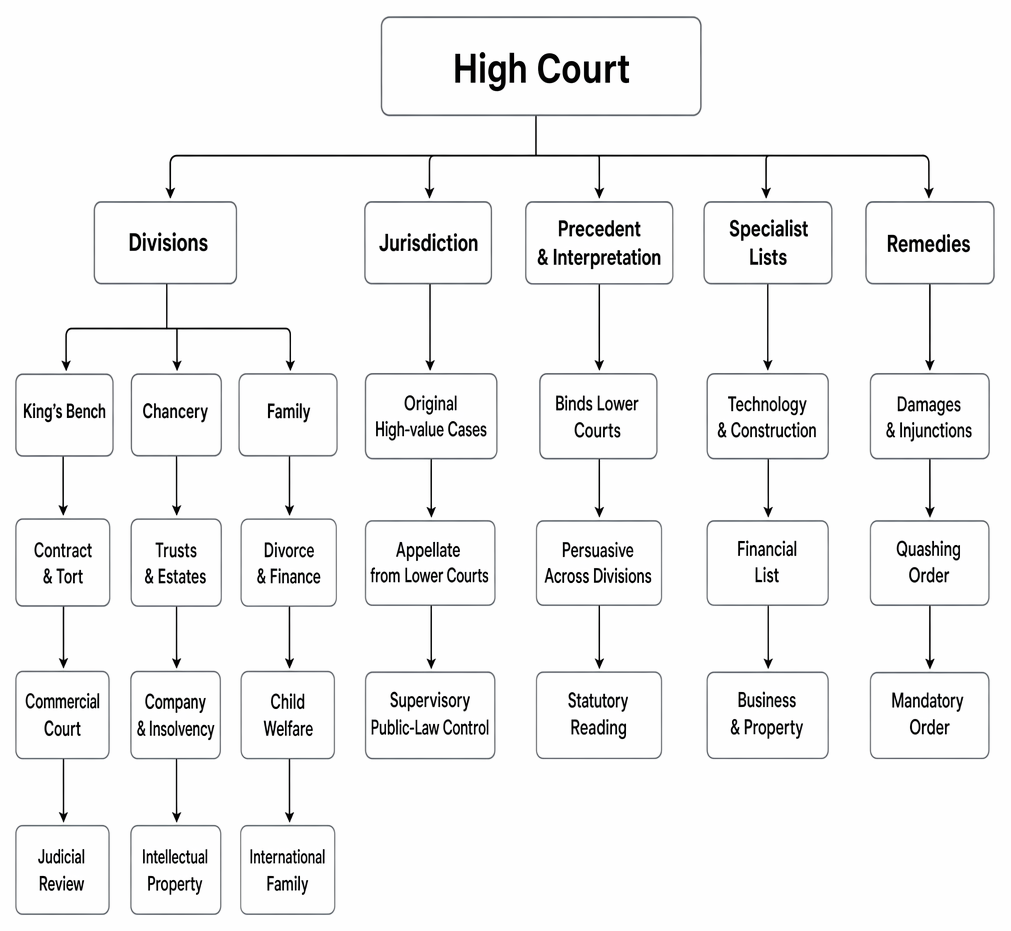
High Court jurisdiction, divisional allocation, specialist lists, precedent and interpretation, and principal civil and public-law remedies are summarised.
The Structure of the High Court
The High Court is one of the Senior Courts of England and Wales, established under the Senior Courts Act 1981. It is headquartered at the Royal Courts of Justice in London but operates district registries in key locations nationwide. Structurally, the High Court is divided into three main divisions, each with its own focus, specialist jurisdictions, and leadership:
- King’s Bench Division
- Chancery Division
- Family Division
Each division is headed by a senior judge—respectively, the President of the King’s Bench Division, the Chancellor of the High Court, and the President of the Family Division. Within each division are further specialist courts or lists that address particular legal issues and case types appropriate to the division’s central area of specialisation.
Key Term: High Court
The High Court is a superior court of record in England and Wales, established by statute, with authority to hear complex civil cases, appeals, and judicial review applications across a wide subject-matter jurisdiction.
The Divisions of the High Court
King’s Bench Division
The King’s Bench Division (KBD), presided over by the President of the KBD, is the largest of the three divisions and deals with a broad spectrum of common law cases. Its caseload includes mainly contract and tort common law claims, as well as personal injury, defamation, professional negligence, commercial, and admiralty matters. The KBD also supervises public law decisions through its Administrative Court, which is the main forum for judicial review. The Administrative Court handles judicial review applications and extradition cases, and when hearing such matters it typically sits with two or more judges as a Divisional Court.
Key Term: king’s bench division
The division of the High Court that handles major common law claims, including contract, tort, commercial disputes, complex personal injury, judicial review, and certain appeals from lower courts.
Specialist courts within the King’s Bench Division include:
- Commercial Court: Deals with complex national and international business disputes, banking and finance cases, insurance, and shipping disputes.
- Admiralty Court: Handles shipping, maritime, and sea-related legal matters, including salvage, collision, and marine insurance claims.
- Technology and Construction Court (TCC): Focuses on disputes that involve technical subject matter, such as engineering or construction.
- Administrative Court: Reviews the lawfulness of decisions by public authorities, acting as the principal forum for judicial review and other public law claims.
Chancery Division
Led by the Chancellor of the High Court, the Chancery Division is the principal forum for civil matters involving equity. It handles business and property cases, including disputes over trusts, estates, the administration of property and assets, company law, insolvency, some tax litigation, and intellectual property. Specialist courts within the division include the Insolvency and Companies Court, the Patents Court, and the Intellectual Property Court, each dealing with complex matters within their respective fields.
Key Term: chancery division
The High Court division with principal jurisdiction over cases involving equity, trusts, company law, partnership, bankruptcy, insolvency, real property, and all matters where equitable (as opposed to purely common law) remedies are sought.
Specialised courts within the Chancery Division include:
- Companies Court: Deals with matters involving company law, including company winding-up and disqualification of directors.
- Bankruptcy Court: Considers cases of personal and partnership insolvency.
- Patents Court: Manages high-value or contested intellectual property and patents litigation.
- Insolvency and Companies List: Supervises large-scale insolvency and restructuring matters.
The creation of the Business and Property Courts, which brings together the Chancery and specialist King’s Bench Divisions (such as the Commercial Court and Technology and Construction Court) into a single "umbrella," enhances the court’s efficiency and specialist knowledge in business-related cases.
Family Division
The Family Division, led by the President of the Family Division, addresses complex family law cases, often involving international elements. Its caseload includes divorce, financial remedies following relationship breakdown, disputes related to children (including international child abduction), forced marriage, and cases requiring the court’s residual jurisdiction. The Family Division has exclusive jurisdiction in wardship proceedings, which give custody of a minor to the court itself, and it hears appeals from the Family Court on matters of law and procedure.
Key Term: family division
The High Court division dealing with the most complex and high-value family cases, including private and public family law, international child abduction, forced marriage, and important cases under the court’s residual jurisdiction.
The Family Division also deals with specific applications involving serious welfare issues, medical treatment, and those cases where special statutory provision is required (e.g., under the Children Act 1989 or Mental Capacity Act 2005).
Jurisdiction of the High Court
The High Court is a court of unlimited original jurisdiction in civil matters (subject to certain statutory restrictions), and it has the authority to hear cases at first instance, on appeal, or in its supervisory capacity. Its powers are conferred by the Senior Courts Act 1981 and other legislation.
- Original jurisdiction: The High Court hears claims at first instance, including those commenced in its own name or transferred from lower courts due to complexity, value, or importance.
- Appellate jurisdiction: The High Court hears appeals from lower courts (especially the County Court and Magistrates’ Courts in civil matters), tribunals, and other bodies where statute so provides.
- Supervisory jurisdiction: Through the Administrative Court and Divisional Courts, the High Court has supervisory authority over the legality of actions by inferior courts, public bodies, and tribunals, primarily exercised through judicial review.
Key Term: original jurisdiction
The legal power of a court to hear and decide a case for the first time rather than on appeal. Key Term: appellate jurisdiction
The authority to review, amend, or overturn the judgments of lower courts or bodies upon an appeal. Key Term: supervisory jurisdiction
The power of the High Court to oversee, and where appropriate quash, mandate, or prohibit, the actions of inferior courts, tribunals, and public authorities to ensure legality and fairness.
Worked Example 1.1
A business brings a claim for breach of contract valued at £250,000, involving complex allegations of misrepresentation and cross-border elements. Which division and specialist court should hear the case?
Answer:
The King’s Bench Division, likely within the Commercial Court, would be appropriate due to the complexity and value, particularly if the issues involve business or international law.
Worked Example 1.2
An individual is subject to bankruptcy proceedings involving considerable assets and allegations of fraud. Which court within the High Court will hear this matter?
Answer:
The Chancery Division, specifically the Bankruptcy Court, will hear personal and partnership insolvency proceedings or those involving allegations of fraud. Original jurisdiction is not limited by value alone. The High Court’s threshold is generally higher than that of the County Court, and cases of high public importance, legal novelty, procedural complexity, or very high value are typically reserved for it. By contrast, most lower-value and low-complexity cases are started in the County Court unless a statute provides otherwise. There is frequent "concurrent jurisdiction"—some cases, especially the most serious and complex, can be commenced in either the High Court or County Court, but such decisions must consider cost, likely complexity, need for specialist knowledge, and judicial guidance.
- Appellate jurisdiction: The High Court hears appeals on points of law and/or fact from:
- decisions of district and circuit judges in the County Court
- certain family law and care proceedings from the Family Court or Magistrates’ Courts
- decisions of Magistrates’ Courts in civil or quasi-criminal matters (e.g., licensing)
- certain administrative and specialist tribunals
These appeals are typically decided by a single High Court judge or, for legal questions of importance, by a divisional court (consisting usually of two or more judges).
- Supervisory jurisdiction: The High Court, mainly through the Administrative Court, is the engine of judicial review in England and Wales. It may quash unlawful decisions, issue mandatory or prohibiting orders, declare rights, or grant other appropriate remedies against public bodies, inferior courts, or tribunals.
Worked Example 1.3
A public body refuses an individual's application for planning permission. The individual believes the decision was procedurally unfair and unlawful. What is the correct route for challenging this decision?
Answer:
An application for judicial review may be made to the Administrative Court of the King’s Bench Division to challenge the lawfulness of the decision.
The High Court and Precedent
As a superior court of record, the High Court’s judgments are an important source of the common law. Precedent ensures consistency and fairness across the legal system, with the judgments of the High Court binding on lower courts and, in some contexts, persuasive for courts of equivalent rank.
- High Court decisions are binding on County Courts, Family Courts, and Magistrates’ Courts.
- When sitting as an appellate court or in a Divisional Court, the High Court is generally bound by its own previous decisions, with exceptions similar to those laid down for the Court of Appeal (notably the Young v Bristol Aeroplane rules).
- Decisions of a single High Court judge at first instance, though highly persuasive, are not legally binding on other High Court judges but are expected to be followed unless there is good reason otherwise.
Key Term: precedent
A judicial decision or authoritative statement of legal principle that must be followed by lower courts in future similar cases. Key Term: binding precedent
A past decision from a higher or equivalent court that must be followed by a court when deciding later cases on materially similar facts. Key Term: persuasive precedent
A past decision that is not strictly binding but may be considered and adopted as guidance by other courts.
As the Supreme Court and Court of Appeal deal overwhelmingly with appeals and constitutional questions, the High Court determines most leading first-instance civil law issues and thus contributes considerably to doctrinal legal development. Importantly, while the High Court is generally expected to follow its previous appellate decisions, it is not always bound by them at first instance. This allows flexibility for legal evolution but also makes consistency significant, especially in divisional or appellate configurations.
Worked Example 1.4
A High Court judge in the Chancery Division hears a contentious intellectual property case raising a new legal issue. The judge's ruling sets out a principle not previously articulated by any higher court. What is the precedential effect?
Answer:
The judgment will be binding on lower courts (County Court, Family Court, Magistrates’ Courts) but will be persuasive, rather than strictly binding, for other High Court judges and the Court of Appeal, unless adopted by them in future. The High Court is not bound to follow the European Court of Human Rights' case law, but must "take it into account" when convention rights are in issue. A High Court judge may be required to resolve conflicts between its own previous authority and guidance or legislation from higher courts.
The High Court’s Role in Judicial Review
The High Court's Administrative Court, an aspect of the King’s Bench Division, is the principal forum for judicial review in England and Wales. Judicial review is a mechanism by which individuals, groups, and sometimes public bodies themselves can challenge the lawfulness of decisions, actions, or omissions of public authorities.
Key Term: judicial review
The court procedure by which the High Court exercises its supervisory jurisdiction to ensure public bodies act lawfully, reasonably, and fairly, generally by application to the Administrative Court.
Judicial review is strictly concerned with legal process, not with the merits of the original decision. The grounds for challenge are well established: illegality, procedural unfairness, and irrationality (also known as Wednesbury unreasonableness), and where convention rights are engaged, the test of proportionality.
The Administrative Court has exclusive jurisdiction for most judicial review proceedings. Judicial review will generally not substitute the court’s opinion for that of the original body but will consider whether the public body acted lawfully, within its powers, and with fair procedure.
The Administrative Court has powers to grant remedies such as:
- quashing orders (formerly known as certiorari) to set aside an invalid decision
- prohibiting orders (formerly prohibition) to stop unlawful action or prospective abuse
- mandatory orders (formerly mandamus) to require a body to act lawfully or make a certain decision
- declarations on rights and legal status
- interim relief (such as injunctions) to preserve the parties’ positions pending a full decision
Key points relevant to judicial review include:
- Only "public bodies" or those performing public functions may be subject to judicial review; private acts are generally excluded unless they have a statutory basis or exercise statutory powers.
- Standing to bring a claim is limited to those with a "sufficient interest" in the matter.
- Pre-action protocols and tight time limits, usually three months from the challenged decision, apply.
- Judicial review does not generally address the substance of decisions (merits), but the lawfulness of the process.
The High Court’s Appellate Role
The High Court is empowered to hear appeals from a range of inferior courts and tribunals by statute, including:
- Appeals on points of law from the County Court (e.g., in complex or high-value cases heard at first instance by a Circuit Judge or District Judge)
- Appeals from Magistrates’ Courts on certain civil matters, including applications for judicial review or statutory appeals "by way of case stated"
- Appeals from certain tribunals falling within the purview of civil or public law (e.g., the Upper Tribunal, or judicial review of tribunal decisions unavailable on appeal)
In appellate cases, the High Court may reconsider findings of fact and law. Appeals are almost always limited to review (not full rehearings), focusing on whether the lower body applied law correctly and acted within procedural and substantive constraints set by statute or rules of law.
Divisional Courts of the High Court (constituted of two or more High Court judges) hear particular important cases on appeal, such as from Magistrates’ Courts "by way of case stated," habeas corpus applications, and some high-profile public law claims.
The High Court’s Supervisory Role
As a supervisory court, the High Court has primary responsibility to ensure the rule of law is observed. Supervisory jurisdiction is broader than appellate jurisdiction and is rooted in the court’s historic authority over all subordinate courts, tribunals, and persons or bodies that exercise public functions, whether derived from statute or common law.
Examples of orders available under the High Court’s supervisory jurisdiction:
- Quashing order: Sets aside the decision of a lower court, tribunal, or public body as unlawful.
- Mandatory order: Requires a body to act or perform a legal duty.
- Prohibiting order: Forbids a body from acting unlawfully or beyond its powers.
The High Court may issue declarations and injunctions and award damages in limited cases involving breach of convention rights.
The court supervises Magistrates’ Courts, County Courts when acting outside their jurisdiction, local authorities, central government departments, and most statutory tribunals. Where no right of appeal exists, judicial review in the High Court preserves access to justice and redress for unlawful conduct.
The High Court in Practice
The High Court is headquartered at the Royal Courts of Justice in London, with cases also heard in district registries throughout England and Wales. The overriding objective under the Civil Procedure Rules requires the High Court to manage proceedings justly, proportionately, and efficiently, with early allocation of specialist judges and case management conferences.
Cases are allocated to the appropriate division on the basis of subject matter, complexity, and value. High Court proceedings are predominantly heard by a single judge, except in divisional, appellate, or especially serious cases, where two or more judges may preside.
The High Court has both a public and constitutional role. It is responsible for safeguarding the rule of law and the separation of powers, as articulated in section 1 of the Constitutional Reform Act 2005, which recognises the independence and central importance of the judiciary.
High Court judges are appointed based on merit by the independent Judicial Appointments Commission, and their tenure is secured to protect judicial independence. The most senior judges of the High Court are eligible for promotion to the Court of Appeal or the Supreme Court.
Exam Warning: The High Court and County Court share jurisdiction in many areas. High-value or high-complexity cases may commence in either the County Court or High Court, but cases should only be started in the High Court if appropriate under the Civil Procedure Rules and relevant Practice Directions. A failure to commence in the correct court may result in costs sanctions, strike out, or transfer.
Revision Tip: For the SQE1 assessment, be fluent in identifying the appropriate division and court for complex scenarios, appreciating the division of functions within the High Court and the relationship with the appellate system. Compare the High Court’s trial, appellate, and supervisory functions, as well as the effect of its binding precedent and role in upholding constitutional justice through judicial review.
Key Point Checklist
This article has covered the following key knowledge points:
- The High Court is a superior court of record within the senior courts, comprising three divisions: King’s Bench, Chancery, and Family.
- Each division has specialist subject-matter jurisdiction, including sub-courts such as the Commercial Court, Admiralty Court, Bankruptcy Court, and the Administrative Court.
- The High Court exercises original, appellate, and supervisory jurisdiction, including hearing cases at first instance, appeals from lower courts and tribunals, and judicial review.
- The High Court’s appellate and Divisional Courts have binding authority for lower courts and are persuasive for courts of similar level.
- In its supervisory capacity, the High Court ensures that public authorities, inferior courts, and tribunals act within their lawful powers and conform to the rule of law, issuing orders such as quashing, mandatory, or prohibiting orders where necessary.
- The High Court’s Administrative Court is the primary forum for judicial review, providing remedies for unlawful actions, decisions, or omissions of public bodies.
- The High Court’s decisions shape legal doctrine and are binding on inferior courts.
- High Court judges are independent, secure in tenure, and are selected through a merit-based process, ensuring the quality and integrity of the court’s work.
Key Terms and Concepts
- High Court
- king’s bench division
- chancery division
- family division
- original jurisdiction
- appellate jurisdiction
- supervisory jurisdiction
- precedent
- binding precedent
- persuasive precedent
- judicial review