Learning Outcomes
This article provides comprehensive coverage of the roles and responsibilities of the judiciary in England and Wales. Key outcomes include:
- Understanding the principle of judicial independence as a foundational element of the UK's unwritten constitution, including essential legal and practical safeguards
- Understanding the doctrine of the separation of powers in the UK and appreciating its particular interaction with the judiciary, legislature, and executive
- Exploring the judicial hierarchy, the structure and jurisdiction of courts, and the distribution of judicial offices and functions at every tier
- Analysing the doctrine of judicial precedent, including the concepts of binding and persuasive precedent, ratio decidendi, obiter dicta, the hierarchy of courts, and exceptions to the general doctrines
- Critically evaluating the role and application of statutory interpretation by courts, and the ability of courts to influence or shape law in a constitutional context
- Assessing the judiciary’s obligations under the Human Rights Act 1998 and related constitutional instruments, including the interpretation and application of UK and European law to protect individual rights
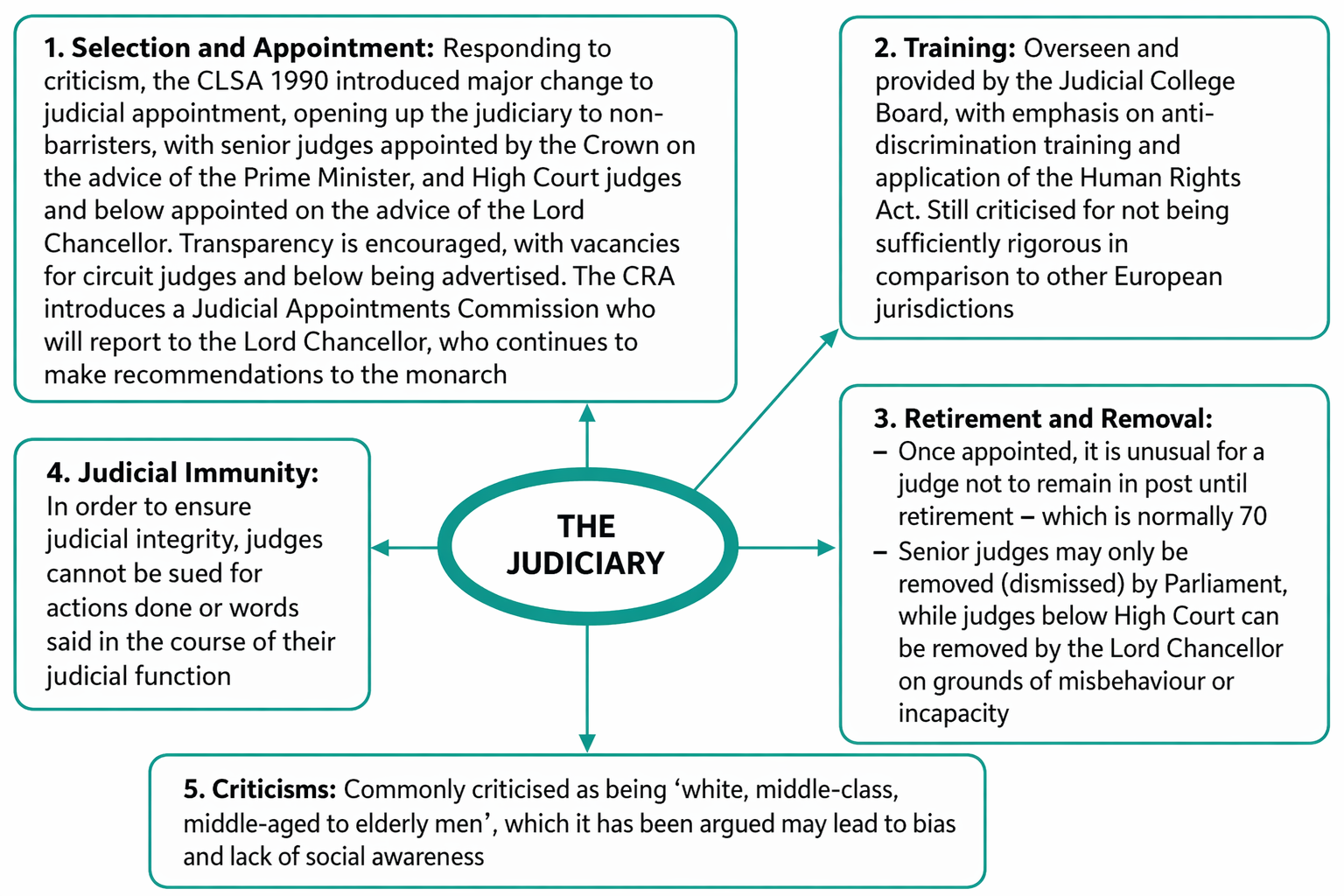
- Detailing the mechanisms and processes for the appointment, conduct, accountability, and discipline of judges, and the function of bodies such as the Judicial Appointments Commission
- Examining principles of impartiality, accountability, and judicial diversity, as well as the importance of ethical and professional standards within the judiciary
- Linking these principles to access to justice, public confidence, the preservation and development of the rule of law, and constitutional protections against abuses of public power
SQE1 Syllabus
For SQE1, you are required to understand the judiciary’s roles and responsibilities and the structure and operation of the courts in England and Wales, with a focus on the following syllabus points:
- the principle and safeguards of judicial independence in England and Wales, including the separation of powers
- the organisation, hierarchy, and jurisdiction of courts and judges, and their designated functions
- the doctrine of judicial precedent, stare decisis, ratio decidendi, and obiter dicta
- how appellate and first-instance decisions are treated and the routes of appeal
- the judiciary’s statutory and constitutional obligations under the Human Rights Act 1998, and the role of UK courts in interpreting legislation to protect human rights
- impartiality, accountability requirements, and the encouragement of diversity in judicial appointments and conduct
- the process for judicial appointments and the role of the Judicial Appointments Commission
- the mechanisms of judicial accountability, including public judgments and the possibility of removal from office
- recognition of the relationship between judges and other branches of government, including the limits of judicial power
Test Your Knowledge
Attempt these questions before reading this article. If you find some difficult or cannot remember the answers, look more closely at that area during your revision.
- What is meant by judicial independence, and why is it important for the legal system?
- Which part of a judgment is binding on lower courts: the ratio decidendi or the obiter dicta?
- How does the Human Rights Act 1998 affect the way judges interpret UK statutes?
- Who appoints judges in England and Wales, and what is the role of the Judicial Appointments Commission?
Introduction
The judiciary stands as one of the core institutions within the constitutional structure of England and Wales, working alongside the legislature (Parliament) and the executive (Government) to uphold the legal order. The judiciary’s primary functions include interpreting and applying the law, safeguarding the rights and freedoms of individuals, ensuring the effective resolution of disputes, and maintaining checks and balances on the use of power by other branches of the state. As a unique institution, the judiciary operates under defined constitutional and legal principles, including the separation of powers, judicial independence, and accountability to the rule of law.
At the centre of this institutional role lies a set of duties and responsibilities—enshrined in constitutional statutes, common law, professional codes, and ethical standards—that frame how the judiciary delivers justice, maintains public trust, and adapts to changing social and political landscapes. The judiciary’s independence and effective operation are intimately linked to the public confidence in the justice system and are fundamental to a functioning democracy respecting the rule of law.
Key Term: judiciary
The body of judges and judicial officers collectively responsible for interpreting and applying the law within the court system of England and Wales.Test Tip: In SQE-style questions on The judiciary: roles and responsibilities, identify the legal test, the triggering fact, and the consequence before choosing between similar answer options.
Exam Warning: Do not rely on a familiar phrase from The judiciary: roles and responsibilities alone; check whether the facts satisfy every condition, exception, and timing requirement.
The Principle of Judicial Independence
Meaning and Constitutional Status
Judicial independence is the principle that judges must be free from outside interference—whether from government, Parliament, litigants, or powerful private interests—when deciding cases. As a fundamental element of the UK’s constitutional structure, it is necessary for the fair and impartial administration of justice, and is a foundational pillar of the rule of law.
Judicial independence is both an individual duty of judges (personal independence) and an institutional characteristic (collective independence of the judicial system from the other branches of government).
Key Term: judicial independence
The constitutional principle that judges must be free to decide cases impartially, based solely on law and facts, without interference, influence, or intimidation from external sources.
Relationship with the Rule of Law and Separation of Powers
In the UK’s unwritten constitution, judicial independence underpins the rule of law. The rule of law ensures that all—government officials, public authorities, and citizens—are subject to and can rely on the law, and that government power is exercised according to law. Judicial independence ensures that the courts can hold public authorities to account and provide remedies to those whose rights have been violated.
The doctrine of the separation of powers also supports independence by dividing the functions of government between the executive (implementation and policy), the legislature (law-making), and the judiciary (dispute resolution and interpretation). Although the UK constitution historically allows for interplay and overlap between the branches (e.g. judges historically sitting in the House of Lords), fundamental reforms—such as the Constitutional Reform Act 2005—have confirmed the structural separation between the judiciary and other branches.
Key Term: separation of powers
The division of state authority among the executive, legislative, and judicial branches, designed to act as a safeguard against the concentration of power and to preserve the rule of law.
Legal and Practical Safeguards for Judicial Independence
Judicial independence is protected by a combination of constitutional, statutory, and professional safeguards:
- Security of tenure: Senior judges (those in the Supreme Court, Court of Appeal, and High Court) hold office during good behaviour and can only be removed by the monarch following an address by both Houses of Parliament. This makes arbitrary removal due to political disagreement or unpopular decisions highly unlikely.
- Remuneration protection: Judicial salaries are fixed by statute and may not be reduced during a judge’s tenure. This financial security insulates judges from financial pressure.
- Appointment by merit and robust appointment processes: Judicial appointments are based on merit, legal ability, and integrity, rather than political patronage. The Judicial Appointments Commission (JAC), established by the Constitutional Reform Act 2005, is an independent body tasked with recruiting and selecting candidates for judicial office. The process is transparent, based on published criteria, and aims to encourage diversity in the judiciary.
- Immunity from suit: Judges have immunity from civil proceedings in respect of judicial acts performed in good faith, provided those acts are within their jurisdiction. This prevents vexatious litigation from influencing judicial behaviour.
- Ethical Codes and Professional Standards: Judges are governed by codes of conduct and principles (e.g., the Guide to Judicial Conduct), which require impartiality, propriety, integrity, and independence, and are enforceable by disciplinary procedures.
- Restrictions on external activities: Judges are prohibited from holding political office and are expected to avoid any party-political activity. They must recuse themselves from cases where impartiality is potentially compromised.
Key Term: Judicial Appointments Commission (JAC)
An independent statutory body responsible for selecting candidates for judicial office in courts and tribunals in England and Wales, focusing on merit and encouraging diversity.
Legal Foundations: The Constitutional Reform Act 2005
One of the most significant statutory interventions in recent decades to secure judicial independence is the Constitutional Reform Act 2005. Among its reforms, the Act:
Judicial independence is summarised by reference to statutory guarantees, common law doctrines, parliamentary self-restraint, constitutional convention, and Miller I and II.
- Created the Supreme Court of the United Kingdom, fully separating the highest court from the legislature (the House of Lords).
- Removed the Lord Chancellor’s role as both a minister, a member of the legislature, and the Head of the Judiciary; instead, the Lord Chief Justice became Head of the Judiciary for England and Wales.
- Established the independent Judicial Appointments Commission.
- Imposed a statutory duty (s1) on ministers of the Crown (including the Lord Chancellor) to uphold judicial independence and not seek to influence particular judicial decisions through any special access to judges.
Importance and Rationale for Judicial Independence
Judicial independence is necessary for:
- Ensuring that court decisions are based on law and evidence rather than personal or political pressures
- Guaranteeing a fair trial and access to justice for individuals, including protection from arbitrary state actions
- Maintaining public confidence in the courts and the legal system
- Enabling meaningful judicial review of executive actions and administration, and enforcing legal and constitutional limits on government
- Protecting vulnerable minorities and the rights of individuals, often against the interests of the majority or those in power
A judiciary that is not independent would be vulnerable to corruption, political manipulation, and loss of public trust. Judicial independence is thus closely interwoven with the maintenance of democracy in the UK’s constitutional system.
Worked Example 1.1
A new government takes office and seeks to remove several High Court judges, alleging they are 'politically unsympathetic.' The judges have no disciplinary findings against them.
Answer:
This would violate the principle of judicial independence and the statutory safeguards of security of tenure. Judges can only be removed for proven incapacity or serious misconduct, and only through a formal process requiring an address from both Houses of Parliament and the monarch’s approval.
Judicial Accountability and Transparency
Judicial independence does not mean judges are unaccountable. Judicial accountability is maintained through:
- The requirement to provide written, reasoned judgments for public scrutiny, often subject to further appeal or review
- The right of parties to appeal decisions to higher courts, which can correct errors in law or procedure
- Public access to most hearings and judgments (other than in exceptional cases requiring confidentiality or protection of sensitive information)
- Investigatory and disciplinary mechanisms for serious judicial misconduct or incapacity
- The possibility (although rare) of removal from office for incapacity or misconduct, in accordance with constitutional safeguards
Accountability is further supported by transparency in judicial appointments and disciplinary procedures, and by mechanisms for complaints through bodies such as the Judicial Conduct Investigations Office (JCIO).
Appointment Processes and Promoting Diversity
Appointments to judicial office follow principles of merit, integrity, and transparency. The Judicial Appointments Commission receives applications, shortlists and interviews candidates, and makes recommendations for appointment to the judiciary at all levels. The process includes:
- Objective assessment of legal ability, experience, and suitability
- Encouragement and support for applications from underrepresented groups, to improve judicial diversity and ensure the bench better reflects the society it serves
- Emphasis on ethical standards, impartiality, and adherence to the principles of fairness and equal treatment
The Lord Chief Justice is responsible for the deployment, training, and welfare of judges. Training is provided (primarily by the Judicial College) at induction and throughout service, encompassing law, procedure, judicial ethics, and emerging social issues.
A diverse judiciary is increasingly viewed as necessary to maintaining public confidence, ensuring different viewpoints are brought to decision-making, and supporting the development of law that is responsive to the needs of society.
Mechanisms of Judicial Discipline and Complaints
Judicial complaint procedures are available for concerns regarding incapacity, misconduct, bias, or significant procedural breaches. Complaints are assessed by the JCIO, which has powers to investigate, recommend disciplinary sanctions, and, in severe cases, refer for possible removal from office. Sanctions range from advice or warnings to removal, but are designed to maintain public confidence and the proper functioning of the judiciary.
Key Term: judicial hierarchy
The ranked system of courts and judges, defined according to their authority, jurisdiction, and the types of cases they hear.
The Judicial Hierarchy and Court Structure
The Court System at a Glance
England and Wales have a multi-tiered court system operating in both civil and criminal justice. The principal hierarchy is as follows:
- Supreme Court: The highest court in the United Kingdom, hearing cases of the greatest constitutional, legal, or public significance on appeal from the Court of Appeal and (in civil matters) the High Court. Its decisions are binding on all other courts.
- Court of Appeal: Split into Civil and Criminal Divisions, hearing appeals from lower courts. Its judgments are binding on lower courts and generally on itself, subject to limited exceptions.
- High Court: Divided into three divisions (King’s Bench, Chancery, and Family), with original trial and appellate jurisdiction. The King’s Bench Division includes the Administrative Court, which handles judicial review of public authorities. High Court decisions bind lower courts.
- Crown Court: Handles indictable criminal cases, some either-way criminal cases, and appeals from magistrates’ courts. It has both original and appellate jurisdiction.
- County Court: Deals predominantly with civil disputes, including contract, tort, and family matters of lower value or complexity.
- Magistrates' Courts: Deal with criminal summary offences, some either-way offences, family law, youth matters, and certain civil regulatory cases. Generally courts of first instance.
- Tribunals: Specialist judicial bodies dealing with claims and disputes in such areas as employment, asylum, immigration, tax, and social security. There is a two-tier tribunal structure consisting of the First-tier Tribunal and the Upper Tribunal.
Key Term: jurisdiction
The legal authority and power a court or judge has to hear a case and issue a decision.
The structure is designed to support clear chains of appellate authority, encourage certainty through judicial precedent, and ensure that cases are determined by judges with appropriate knowledge and within their designated authority.
At working level, several judicial office-holders are especially important:
- Lay magistrates: unpaid justices of the peace who usually sit in panels of three in the magistrates’ courts and decide large volumes of criminal and family work with legal advice from court legal advisers.
- Legal advisers in the magistrates’ courts: legally qualified officers who advise magistrates on law, procedure, and powers while remaining independent in that advisory role.
- District Judges: full-time professional judges who handle substantial volumes of county court work and, in the magistrates’ courts context, may sit alone on more complex or demanding cases.
- Circuit Judges and Recorders: judges who often conduct trials and heavier case-management work in the Crown Court and County Court.
These roles matter in SQE1 because questions often test not only abstract hierarchy, but also which level of judge is likely to hear or manage a particular matter.
Roles and Responsibilities within the Judicial Hierarchy
Each court is staffed by judges with specific appointments, roles, and titles:
- Supreme Court: Justices of the Supreme Court
- Court of Appeal: Lords Justices of Appeal (Lord/Lady Justice)
- High Court: High Court Judges, Deputy High Court Judges
- Crown Court, County Court: Circuit Judges, Recorders, District Judges
- Magistrates' Courts: District Judges (Magistrates’ Courts), Lay Magistrates (Justices of the Peace)
- Tribunals: Tribunal Judges, Chamber Presidents and specialist members
The allocation of cases to court and the judge(s) responsible is governed by procedural rules, statutory frameworks, and considerations of subject-matter complexity, value, and public importance.
Classification and Functions of Courts
Courts are commonly classified as:
- Criminal or civil courts: According to the type of law they administer
- Trial (courts of first instance) or appellate courts: According to their function
- Superior or inferior courts: According to the breadth of their jurisdiction and reviewability by higher courts
Key distinguishing features of superior courts include unlimited jurisdiction, power to hear appeals, and (for the High Court and above) forming binding precedents on courts below.
Worked Example 1.2
A claimant brings a £300,000 contract claim. Should the case be started in the High Court or the County Court?
Answer:
Claims exceeding £100,000 in value or of exceptional complexity may be brought in either the High Court or the County Court, but it is customary (and often more appropriate) for cases of substantial value or complexity to be issued in the High Court, where there is greater judicial experience and jurisdictional competence for significant matters.
Routes of Appeal and the Operation of Appellate Courts
Clear appellate routes ensure error correction and prompt legal development. In criminal matters:
- Appeals from the Magistrates’ Court may be made to the Crown Court (full rehearing on facts and law), or to the High Court (Administrative Court) by way of case stated or judicial review.
- Appeals from the Crown Court (on indictment) go to the Court of Appeal (Criminal Division), usually on questions of law or where the conviction is unsafe.
- Appeals from the Court of Appeal (Criminal Division) can be made to the Supreme Court for points of law of general public importance, if certified.
In civil matters:
- Appeals from the County Court are heard either by a more senior judge within the County Court or by the High Court, depending on the level of judge who made the decision and the nature of the case.
- Appeals from the High Court are usually to the Court of Appeal (Civil Division), with further appeal to the Supreme Court in cases raising important points of law.
- In specialized matters, appeals may be made from tribunals to the Upper Tribunal and, with permission, to the Court of Appeal.
Both the Court of Appeal and Supreme Court are primarily appellate courts and do not generally operate as courts of first instance, except in limited circumstances.
Special Considerations: Tribunals, ADR, and Other Forums
Tribunals—such as the Employment Tribunal or Social Security Tribunal—are specialist forums outside the main court hierarchy. They provide accessible, specific adjudication in fields requiring specialist knowledge. Some tribunal decisions may be appealed to the upper-tier tribunals, and from there to the higher courts on points of law. Alternative dispute resolution (ADR), including mediation and arbitration, plays an increasingly important role in the resolution of civil disputes and is supported by the Civil Procedure Rules.
The Doctrine of Judicial Precedent
Meaning and Function
The doctrine of judicial precedent is a feature of the English common law legal system. It upholds the principle that like cases should be decided alike, ensuring consistency, predictability, and legal certainty. When a higher court decides a point of law, courts lower in the hierarchy are, in general, obliged to follow that legal principle in subsequent cases with materially similar facts.
Key Term: doctrine of judicial precedent
The principle that courts are bound to follow legal principles established in previous binding decisions of higher courts in the same hierarchy, when the material facts are sufficiently similar; also known as stare decisis. Key Term: stare decisis
Latin for "to stand by things decided." The doctrine requiring courts to apply binding principles established by previous decisions where relevant.
Legal precedent not only facilitates stability, but also enables courts to encourage the orderly development and flexibility of the law through mechanisms such as overruling, distinguishing, and reversal.
The Structure of Precedent
The operation of precedent depends on a combination of:
- The hierarchy of courts—binding precedents are set by higher courts and must be applied by lower courts
- The identification of the ratio decidendi—the legal principle or rule necessary for the decision
- The recognition of obiter dicta—statements or commentary in a judgment not necessary for the decision, which may be of persuasive but not binding value
- The use of persuasive precedent—decisions from other jurisdictions, courts at the same level, or obiter statements, which can guide but not bind
Key Term: ratio decidendi
The core legal principle or rule in a judgment that is essential to the decision and constitutes the binding precedent for future cases with similar facts. Key Term: obiter dicta
Statements within a judgment that, while related to the issues at hand, are not essential to the court’s decision. They are persuasive, not binding, in future cases. Key Term: binding precedent
A precedent that a court is obliged to follow due to its source in a higher (or equal) court and its identification as the essential reasoning for a decision. Key Term: persuasive precedent
A precedent a court may consider and, if deemed appropriate, apply or refer to, though it is not compelled to follow.
Precedent and the Hierarchy of Courts
The general rules are:
- The Supreme Court binds all lower domestic courts and is normally bound by its own precedents, but may depart where "it appears right to do so," guided by the Practice Statement 1966 and subsequent case law. Use of this exceptional power is rare to ensure legal certainty.
- The Court of Appeal is bound by decisions of the Supreme Court and usually by its own decisions, except where exceptions from Young v Bristol Aeroplane Co Ltd apply, such as conflicting previous decisions, subsequent Supreme Court decisions, or previous per incuriam decisions.
- The High Court is generally bound by decisions of higher courts and, at first instance, is not bound by its own decisions (but often follows them for consistency).
- Crown Court and lower courts are bound by higher courts but not by themselves.
- Decisions of the Judicial Committee of the Privy Council and most foreign courts are persuasive, not binding.
- Certain international courts, such as the European Court of Human Rights (ECHR), provide persuasive authorities that UK courts must "take into account" under s2 Human Rights Act 1998 but are not bound to follow.
Exceptions and Flexibility
There are mechanisms for adapting or departing from strict precedent to avoid injustice or to develop the law:
- Distinguishing: Lower courts may refuse to follow precedent if the facts of the current case are materially different.
- Overruling: A higher court can overrule a previous decision (its own or a lower court’s) if it considers the earlier decision to be incorrect in law.
- Reversing: An appellate court can reverse the decision of a lower court in the same case, setting a new precedent for that point.
Worked Example 1.3
The High Court is faced with a case where the facts are not the same as those in a prior Court of Appeal decision. The judge identifies key differences.
Answer:
If the differences are material—that is, they affect the legal reasoning—the High Court judge can distinguish the present case from the previous one, and is not required to follow the Court of Appeal’s decision.
Precedent and Statutory Interpretation
The role of the courts includes not just the creation of precedent, but also the interpretation of legislation. In common law systems, courts use established rules of statutory interpretation (the literal rule, golden rule, mischief rule, and purposive approach), as well as linguistic canons and internal/external aids (such as Hansard by virtue of Pepper v Hart [1993] AC 593) to clarify Parliamentary intention. These judicial interpretations may acquire precedential authority for future cases, particularly regarding ambiguous or complex statutory provisions.
Precedent and the Impact of EU Law and the Human Rights Act 1998
The relationship between precedent and other sources of law has changed due to constitutional developments. For example:
- The supremacy of European Union law (while the UK was an EU member, and under the withdrawal agreement for certain retained EU law) required national courts to disapply domestic law (including statutes and precedent) that conflicted with directly effective EU law.
- The Human Rights Act 1998 requires domestic courts to interpret all legislation, as far as possible, to be compatible with the Convention rights in Schedule 1. In this context, courts must take into account Strasbourg jurisprudence, but are not bound by it.
Domestic precedent that cannot be reconciled with Convention rights, or with "retained EU law," may be reconsidered by higher courts, who may overrule or depart when necessary.
Worked Example 1.4
A County Court must decide a case covered by a previous High Court decision, but a new Supreme Court ruling has altered the legal position.
Answer:
The County Court must follow the principle established by the Supreme Court, as it is the highest court in the hierarchy and its decisions set binding precedent for all lower courts.
Flexibility, Development, and Criticism of Precedent
The doctrine, while central to legal certainty, has faced criticism for potential rigidity, complexity, and the propagation of errors. However, its flexibility—through exception doctrines, overruling, and distinguishing—enables the law to change as society changes, new legislation is enacted, or higher courts reconsider principles.
The Human Rights Act 1998 and Judicial Duties
Overview and Purpose
The Human Rights Act 1998 (HRA) incorporates the majority of rights in the European Convention on Human Rights (ECHR) into domestic law, making them directly enforceable in UK courts and profoundly influencing the role of the judiciary in protecting rights and reviewing governmental action.
Key Term: Human Rights Act 1998 (HRA)
The statute that requires UK courts to interpret legislation, as far as possible, in a way that is compatible with the ECHR rights, and allows UK courts to take human rights claims directly.
Key Judicial Obligations under the HRA
Judges must:
- Interpret domestic legislation compatibly with the ECHR (s3): All primary and subordinate legislation must be 'read and given effect in a way which is compatible with the Convention rights so far as it is possible to do so.'
- Take into account Strasbourg case law (s2): Courts must take into account relevant decisions of the European Court of Human Rights, but are not bound by them and may decline to follow them where there are proper reasons, such as a different national context or a more recent domestic authority.
- Issue Declarations of Incompatibility (s4): Where it is not possible to interpret legislation compatibly with the ECHR, higher courts (High Court and above) may make a declaration of incompatibility. This signals to Parliament a need for legislative amendment but does not invalidate the statute—maintaining respect for parliamentary sovereignty.
- Provide remedies (s8): Section 8 provides that where a UK court finds that a public authority has acted unlawfully in violating ECHR rights, it may grant such relief or remedy as it considers just and appropriate, including damages.
UK courts are additionally required to act compatibly with Convention rights in their role as public authorities under s6 of the HRA, except where prevented by primary legislation.
Interpretative Technique
Section 3 of the HRA requires judges to read and give effect to legislation compatibly with the Convention rights "so far as it is possible to do so." This goes beyond ordinary rules of interpretation and can result in judicially modifying the effect of legislation, provided this does not fundamentally undermine the statute’s purpose. In R v A (No 2) [2002] 1 AC 45, the House of Lords interpreted statutory provisions very broadly to prevent infringement of Article 6 ECHR (the right to a fair trial).
Incompatibility may nevertheless arise, but the courts may only declare incompatibility and cannot strike down or ignore legislation; Parliament retains authority for legislative change.
Relationship with Strasbourg Jurisprudence
The obligation under section 2 requires UK courts to "take into account" judgments of the ECHR. Domestic courts will generally follow clear Strasbourg case law unless there are good reasons not to, but ultimately UK courts may diverge where the domestic context justifies it or where the principles of democratic self-government, the margin of appreciation, or certainty in domestic law so require.
Key Term: margin of appreciation
The leeway afforded to states in applying and limiting Convention rights, recognising differences in national context, culture, or values.
Judicial Review and Rights Protection
Courts now play a significant role in reviewing the decisions of public authorities, ensuring that the exercise of powers complies with the HRA, and that lawful remedies exist where breaches occur. This has increased both direct legal protection for individuals and the broader accountability of government.
Judges, however, must be aware of the limitations of their powers under the Act, upholding respect for the constitutional balance and democratic legitimacy of Parliament, and recognising that their function is to interpret, but not re-write or strike down, primary legislation.
Worked Example 1.5
A claimant brings a challenge in the High Court alleging that a statutory provision infringes their Convention rights.
Answer:
The court will attempt to interpret the provision compatibly with the ECHR. If this is not possible, the court may make a declaration of incompatibility but is not empowered to strike down or set aside the legislation; it is for Parliament to reconsider or amend the law.
Judicial Accountability and Diversity
Mechanisms for Judicial Accountability
The accountability of the judiciary is maintained through several mechanisms:
- Detailed, reasoned judgments: Courts set out their legal reasoning and conclusions, permitting appeals and public scrutiny.
- Appeal and review: Most decisions can be challenged to higher courts, which can correct legal errors and provide authoritative clarification.
- Transparency in appointments and conduct: The Judicial Appointments Commission and related bodies ensure appointments are based on merit, open process, and published criteria.
- Complaint and discipline: Regulated by bodies such as the JCIO, serious misconduct, incapacity or breach of ethical standards can result in sanctions, including possible removal from office.
- Removal for incapacity or misconduct: For senior judges (High Court and above), removal requires address to the monarch by both Houses of Parliament. For less senior judges, dismissal follows disciplinary processes established by the Lord Chief Justice and the Lord Chancellor.
Legal and ethical requirements for openness are also supported by increasing demands for public engagement and ongoing training.
Judicial Diversity and Legitimacy
Efforts have intensified to diversify the judiciary on the basis of gender, race, socio-economic background, and other relevant factors so as to reflect the society served and increase legitimacy. While progress is gradual, representation is seen as necessary for public confidence and to bring broader viewpoints to the development of the law.
Impartiality, Integrity, and Codes of Conduct
Judges are required to demonstrate complete impartiality and integrity, both in and out of court. Ethical codes, such as the Guide to Judicial Conduct and further guidance by the Judicial College, detail expectations for behaviour, conflicts of interest, bias (whether actual or apparent), and recusal.
Where a judge’s impartiality may reasonably be questioned (for example, due to a personal relationship or financial interest), the judge must recuse themselves to maintain public confidence in decisions and in the administration of justice.
The Judiciary and Public Access to Justice
The structure, conduct, and openness of the judiciary are important to ensuring access to justice by all, increasing the availability of legal remedies irrespective of background or resources. Efficient court administration, clear procedures, and efforts to minimise delay are part of the judiciary’s obligations to the public.
Judicial officers also support alternative dispute resolution (ADR) and encourage the use of tribunals and simplified processes to address the needs of specific groups (for instance, employment disputes, immigration, or benefit claims).
The Judiciary and the Rule of Law
The judiciary’s collective role is to preserve and develop the rule of law, including:
- Ensuring equality before the law for all, including government and private citizens
- Protecting rights and liberties from abuse or arbitrary exercise of power
- Supporting legal certainty by developing and applying the law in principled ways
- Maintaining the checks and balances amongst the branches of government
Key Term: rule of law
The principle that all are subject to law, including government, and that rights and obligations are to be exercised and determined by established legal processes.
Key Point Checklist
This article has covered the following key knowledge points:
- The judiciary, as an independent branch, interprets and applies the law, ensuring disputes are resolved impartially and justly.
- Judicial independence is protected by constitutional structures—principally the separation of powers, security of tenure, appointment on merit, and financial protections.
- The judicial hierarchy sets the authority of courts and judges, enabling proper allocation of cases, the operation of appellate review, and the application of precedent.
- The doctrine of judicial precedent supports consistency and predictability; lower courts are bound by the ratio decidendi of superior courts, while obiter dicta may be persuasive where relevant.
- Precedent allows for legal flexibility through distinguishing, overruling, and reversal; strict adherence may be departed from by higher courts or if material facts can be distinguished.
- The Human Rights Act 1998 imposes a statutory duty on judges to interpret UK law compatibly with ECHR rights where possible, and to issue declarations of incompatibility where not.
- Domestic courts must take account of, but are not bound by, Strasbourg case law and use the margin of appreciation where appropriate.
- Judicial accountability is preserved through published judgments, routes of appeal, transparent appointments, and disciplinary and removal mechanisms.
- The Judicial Appointments Commission ensures that judicial appointments are merit-based, with a growing focus on encouraging diversity.
- Judicial impartiality, codes of conduct, and recusal for conflicts of interest maintain confidence in the administration of justice.
- Access to justice, public confidence, and efficiency in court administration are core duties of the judiciary.
- The role of the judiciary in upholding the rule of law includes ensuring that executive action is subject to legal limits, providing remedies for unlawful conduct, and securing equal treatment before the law.
Key Terms and Concepts
- judiciary
- judicial independence
- separation of powers
- rule of law
- Judicial Appointments Commission (JAC)
- judicial hierarchy
- jurisdiction
- doctrine of judicial precedent
- stare decisis
- ratio decidendi
- obiter dicta
- binding precedent
- persuasive precedent
- Human Rights Act 1998 (HRA)
- margin of appreciation