Learning Outcomes
This article examines the Supreme Court of the United Kingdom—its status, jurisdiction, and constitutional role, including:
- Legal and constitutional status of the Supreme Court and its place within the broader English and UK court hierarchies
- Appellate and constitutional functions for both civil and criminal matters, and the distinctive routes of appeal across different UK jurisdictions
- The doctrine of precedent as it applies to the Supreme Court, including its binding effect on lower courts and its ability to depart from previous decisions where justified
- The Supreme Court’s role in devolution and constitutional issues, including review of legislative competence and resolution of ‘devolution issues’
- The process for appointment of Supreme Court Justices, criteria for eligibility, and how judicial independence is maintained
- The balance of legal power between Parliament, the executive, and the judiciary, respecting parliamentary sovereignty while upholding the constitutional rule of law
- Application of these principles to scenarios involving appeals, constitutional review, and the interaction of UK law with international and human rights obligations, including the Human Rights Act 1998 and retained EU law
SQE1 Syllabus
For SQE1, you are required to understand the legal status, jurisdiction, and constitutional role of the UK Supreme Court, with a focus on the following syllabus points:
- the legal basis and constitutional status of the Supreme Court, including the impact of the Constitutional Reform Act 2005
- the Supreme Court’s appellate jurisdiction in both civil and criminal cases from England and Wales, Scotland, and Northern Ireland
- the distinctive role of the Supreme Court in matters involving the devolved parliaments and governments of Scotland, Wales, and Northern Ireland (devolution issues)
- the composition of the Supreme Court, the process and criteria for appointment of Justices, and the principle of judicial independence
- the operation of the doctrine of precedent at the Supreme Court and its binding effect on lower courts
- the interplay between the Supreme Court, Parliament, and the executive, particularly the principle of parliamentary sovereignty and the limits of judicial review
- the Supreme Court’s interpretation of constitutional statutes, human rights, and retained EU law
Test Your Knowledge
Attempt these questions before reading this article. If you find some difficult or cannot remember the answers, look more closely at that area during your revision.
- What is the constitutional status of the Supreme Court, and how was it established?
- From which courts does the Supreme Court hear appeals in civil and criminal matters?
- What is the significance of the Supreme Court’s decisions for lower courts?
- How does the Supreme Court handle devolution issues?
- What is the process for appointing Justices to the Supreme Court?
Introduction
The Supreme Court of the United Kingdom is the highest appellate court for most legal matters arising under UK law, and it is central in defining the structure and boundaries of constitutional and public law. Created by the Constitutional Reform Act 2005 and operational since 1 October 2009, the Supreme Court physically and constitutionally separated the highest court of appeal from Parliament by replacing the House of Lords’ judicial committee. It occupies a key role as the ultimate arbiter of cases raising issues of law of general public importance, shaping the evolution and consistency of UK legal principles.
Key Term: Supreme Court of the United Kingdom
The final court of appeal for all civil cases in the United Kingdom, and for criminal cases from England, Wales, and Northern Ireland. It sets authoritative legal precedent for all other UK courts.
The Constitutional Status and Creation of the Supreme Court
The Supreme Court’s establishment via the Constitutional Reform Act 2005 marked a significant constitutional development, recognising and entrenching the separation of powers in the UK. Prior to 2009, the Appellate Committee of the House of Lords acted as the final court of appeal, but this arrangement raised constitutional concerns over the overlap between the legislature and judiciary. The 2005 Act created a court whose independence is guaranteed, physically separating its members from the legislature and clarifying the relationship among the judicial, executive, and legislative branches of government.
Under s 23(1) of the Constitutional Reform Act 2005, the Supreme Court consists of a President, a Deputy President, and up to ten other Justices, though the Court may sit with any appropriate number as required by statute, typically sitting in panels of five or more for significant cases. The Court’s independence is further protected by the security of tenure of its Justices and its financial and administrative autonomy.
The Supreme Court’s main function is appellate, and it is able to adjudicate only on points of law and not on matters of fact. Its independence from Parliament and the executive ensures it is well-positioned to maintain the rule of law and to provide an effective check and balance on the other branches of state.
Key Term: constitutional independence
The structural and institutional separation of the judiciary from other branches of government, ensuring impartial decision-making.
Jurisdiction and Appellate Role
The Supreme Court's jurisdiction is defined both by statute and by the relevant rules of procedure. It is the final court of appeal for civil cases in the United Kingdom and for criminal cases from England, Wales, and Northern Ireland. It also acts as the final court for certain types of appeals and references concerning devolution and constitutional issues under the Scotland Act 1998, the Government of Wales Act 2006, and the Northern Ireland Act 1998.
Civil Appeals
Civil appeals to the Supreme Court may come from:
- the Court of Appeal (Civil Division) in England and Wales
- the Court of Session (Inner House) in Scotland
- the Court of Appeal in Northern Ireland
For most civil matters, permission (leave) to appeal must be sought, and the test is whether the case raises a point of law of general public importance. Appeals may also arise via a “leapfrog” procedure, where the Supreme Court hears an appeal directly from the High Court of England and Wales or Northern Ireland, bypassing the Court of Appeal, when the case involves a point of general public importance or where the statutory criteria are met.
It should be emphasised that the Supreme Court’s jurisdiction is primarily appellate, and fact-finding remains the preserve of lower courts. The Supreme Court does not generally consider new evidence or matters not aired below unless it can be shown that the interests of justice clearly require it.
Criminal Appeals
Criminal appellate jurisdiction is more restricted:
- In England and Wales, appeals may come from the Court of Appeal (Criminal Division).
- In Northern Ireland, the Supreme Court hears appeals from the Court of Appeal.
- In Scotland, the High Court of Justiciary is the final court of appeal for almost all criminal cases. The exception is where a "devolution issue" or a compatibility issue under the Human Rights Act 1998 or the European Convention on Human Rights is raised.
Appeals to the Supreme Court in criminal matters generally require a certificate from the lower appellate court that the case involves a point of law of general public importance, and permission is needed to appeal.
In all cases, the Supreme Court sets the authoritative interpretation for the law in question.
Key Term: appellate jurisdiction
The power of a court to hear appeals from lower courts and to review, affirm, vary, or overturn their decisions.
Constitutional and Devolution Matters
As a court at the apex of the UK’s legal system, the Supreme Court exercises important constitutional functions, upholding the principle that all public bodies act within their legal powers and according to law. This role is particularly significant where the questions concern the UK's unwritten constitution, the allocation of powers between devolved governments and Parliament, and the compatibility of legislation with human rights obligations.
Constitutional Interpretation
The Supreme Court acts as the court of final appeal on matters of constitutional significance—such as the meaning and effect of constitutional statutes (e.g., the Human Rights Act 1998, the Scotland Act 1998) and the common law principles forming the UK’s constitutional order (e.g., the rule of law, parliamentary sovereignty). It articulates and develops the basic constitutional relationships among the different branches of government and can, in exceptional cases, provide judicial commentary on the boundaries of legal authority (e.g., the extent and use of royal prerogative powers).
In several landmark cases, such as R (Miller) v Secretary of State for Exiting the European Union [2017] UKSC 5 and R (Miller) v Prime Minister [2019] UKSC 41, the Supreme Court clarified that, for constitutional changes such as withdrawal from the EU, only an Act of Parliament could authorise the government to take such action. These decisions emphasise the principle that executive action cannot alter domestic law or fundamental constitutional arrangements without statutory authority.
Devolution Issues
The Supreme Court is also the final court for references involving “devolution issues,” i.e., legal questions about the extent of powers exercised by devolved governments or provisions of devolved legislation. When a UK or devolved government legal officer certifies that a bill or statutory provision may exceed devolved legislative competence or breach the ECHR, the Supreme Court can rule on that question.
This supervisory jurisdiction ensures, for example, that actions or statutes of the Scottish Parliament, Senedd Cymru (Welsh Parliament), or the Northern Ireland Assembly do not exceed the constitutional limits set by the UK Parliament—respecting both the devolution settlement and the principle of parliamentary sovereignty.
Key Term: devolution issue
Any question as to whether a devolved legislature or executive in Scotland, Wales, or Northern Ireland has acted within its statutory powers.
Composition and Appointment of Justices
The Supreme Court is composed of up to twelve Justices, including a President and a Deputy President. This composition ensures balance and representation from the three UK legal jurisdictions: England and Wales, Scotland, and Northern Ireland. There is an expectation, though not a strict legal requirement, that the court's membership will include Justices with experience in each of these jurisdictions.
Eligibility
To be eligible for appointment as a Justice of the Supreme Court, the candidate must have held either:
- high judicial office for at least two years (i.e., as a judge in the Court of Appeal, High Court, or equivalent in Scotland/Northern Ireland), or
- been a qualified legal practitioner (barrister, solicitor, or advocate) for at least 15 years.
The purpose is to ensure that Justices are appointed from individuals of exceptional ability and integrity.
Appointment Process
The appointment of Supreme Court Justices is governed by Part 3 of the Constitutional Reform Act 2005 and is designed to insulate the process from political interference and protect judicial independence.
The process (for filling vacancies other than President/Deputy President) typically involves:
- Announcement of a vacancy.
- Formation of an ad hoc selection commission—comprising the President of the Supreme Court, and members from the three judicial appointments bodies (from England and Wales, Scotland, and Northern Ireland).
- Consultation by the commission with senior judges (including those outside the Supreme Court), the Lord Chancellor, and the First Ministers of Scotland, Wales, and Northern Ireland.
- Consideration of all eligible candidates, with particular regard to knowledge and experience of the main legal systems in the UK and the need to maintain judicial independence and the highest standards.
- Nomination of a candidate by the commission to the Lord Chancellor.
- The Lord Chancellor may accept, reject, or require reconsideration of the nomination.
- Once accepted, the appointment is formally made by the Monarch.
The President and Deputy President of the Supreme Court are appointed following a similar process, though the membership of the selection commission differs slightly to avoid any conflict of interest.
Key Term: selection commission
An ad hoc panel composed for the purpose of selecting and recommending a candidate for appointment as a Justice of the Supreme Court.
Diversity and merit are guiding principles throughout the process. Where two or more candidates are equally qualified, the commission may give preference to a candidate who would improve the diversity of the Supreme Court, reflecting the different parts of the UK and protected characteristics under equality law.
The Doctrine of Precedent and the Supreme Court
A core function of the Supreme Court is to provide authoritative clarification of the law, and its decisions form binding precedents for all lower courts in the UK.
Key Term: binding precedent
A principle or rule established by a superior court’s decision that must be followed by lower courts in future cases with materially similar facts.
The operation of binding precedent at the Supreme Court level supports legal certainty, predictability, and the stability of the legal system. However, the Supreme Court is not absolutely bound by its own previous decisions. Under the Practice Statement [1966] 1 WLR 1234, formerly issued by the House of Lords, and subsequently adopted by the Supreme Court, the court “will depart from a previous decision when it appears right to do so”. This means the Supreme Court can correct the development of legal doctrine when adherence to precedent would perpetuate injustice or hinder necessary legal or societal progress.
Departures from precedent by the Supreme Court remain rare and are treated with caution in order to support legal continuity, particularly where the decision at stake has widespread practical implications (for instance, on property, contractual, or criminal law).
Lower appellate courts, such as the Court of Appeal (Civil and Criminal Divisions), are also generally bound by their own previous decisions but may depart from them in limited situations such as where there are conflicting decisions, a Supreme Court precedent requires departure, or a previous decision was made per incuriam.
Relationship with Courts of the European Union and Human Rights Courts
Decisions of the European Court of Human Rights are persuasive, but not binding, on the Supreme Court. UK courts must “take account” of ECtHR decisions when applying Convention rights under the Human Rights Act 1998 but remain free to formulate domestic doctrine.
The Supreme Court of the United Kingdom is summarised through constitutional status, appellate and devolution jurisdiction, composition, precedent, and legal development.
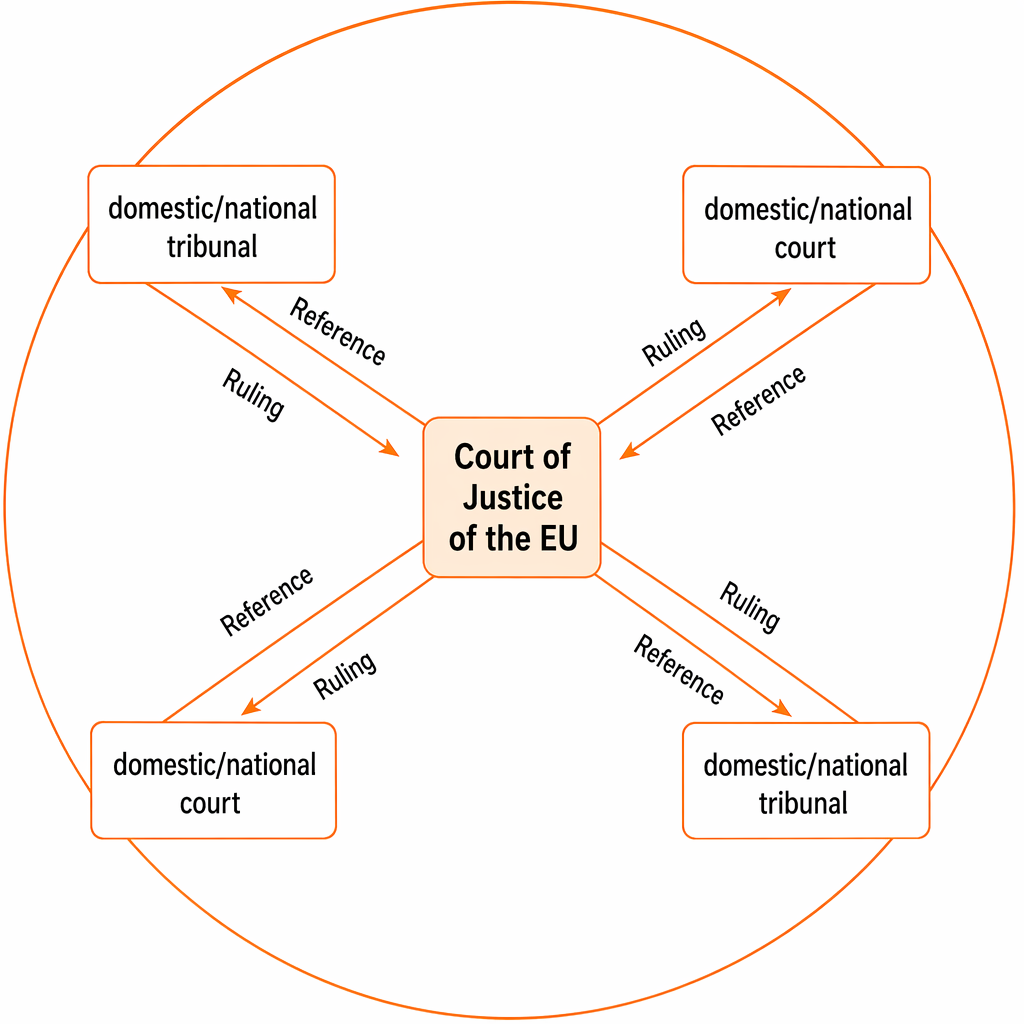
Following the UK's exit from the European Union, the Supreme Court is not bound by decisions of the Court of Justice of the European Union made after 31 December 2020. However, as regards retained EU law, the Supreme Court may depart from its own previous decisions or those of the CJEU, if it considers it appropriate to do so (s 6(4) and Sch 1, para 4 of the EU (Withdrawal) Act 2018).
Definitions of Key Precedent Terms
- Follow: To apply a binding precedent from a previous case with materially similar facts.
- Distinguish: To hold that the facts of the current case differ in a material respect from those of a precedent, so the binding rule does not apply.
- Overrule: To decide that a previous authority is incorrect in law and should no longer be followed; only superior courts can overrule precedent from lower courts.
- Reverse: To overturn a decision of a lower court in the same case on appeal.
Key Term: stare decisis
The doctrine requiring courts to follow legal principles established in earlier decisions to support consistency and foreseeability in the law.
Worked Example 1.1
A party loses a contract dispute in the Court of Appeal (Civil Division) and wishes to appeal to the Supreme Court. The case involves a novel point of law affecting many future contracts.
Question: Can the Supreme Court hear the appeal, and what is the significance of its decision?
Answer:
The Supreme Court may grant permission to appeal if the case raises a point of law of general public importance. If it hears the appeal and decides the issue, its ruling will set a binding precedent for all lower courts in the UK, shaping the future interpretation of contract law.
The Supreme Court’s Role in Legal Development
The Supreme Court’s decisions contribute to the development of both statutory and common law. The Court interprets primary and secondary legislation, develops common law principles, and ensures that public bodies and the executive remain within their legal powers through judicial review. The Supreme Court’s authority supports the balance between Parliament, government, and courts in the UK’s unwritten constitution.
Through its constitutional oversight, the Court protects the rule of law, ensuring that government acts lawfully and that the administration of justice is preserved for all. It does this without the authority to strike down primary legislation—a key distinction between UK law and the power of some constitutional courts internationally.
Where the compatibility of legislation with the European Convention on Human Rights is in issue, the Supreme Court may make a “declaration of incompatibility” under s 4 Human Rights Act 1998, but such a declaration does not nullify the offending provision. It is then for Parliament to decide whether to amend or repeal the legislation.
The Supreme Court also can rule on major constitutional issues such as the limits of the royal prerogative and the relationship between devolved and central government (see R (Miller) v The Prime Minister [2019] UKSC 41).
Key Term: judicial review
The process by which courts supervise the legality of the actions of public bodies, ensuring they act within their legal powers.
Worked Example 1.2
The government seeks to implement a major constitutional change using prerogative powers alone. A legal challenge is brought, arguing that an Act of Parliament is required.
Question: How would the Supreme Court approach this issue?
Answer:
The Supreme Court would consider whether the government’s action alters domestic law or affects rights. If so, the Court may rule that only Parliament can authorise such changes (as in R (Miller) v Secretary of State for Exiting the EU [2017] UKSC 5). The Court would reaffirm parliamentary sovereignty by requiring legislative approval for key constitutional changes.
The Supreme Court and Precedent: Key Principles
Within the context of Supreme Court jurisprudence, the following principles structure its relationship to precedent and the development of UK law:
- Decisions of the Supreme Court are binding on all lower courts throughout the UK.
- The Supreme Court is generally bound by its own previous decisions and by House of Lords decisions prior to 2009, but may depart from them “when it appears right to do so,” especially where adherence would cause injustice or impede legal development.
- The Supreme Court’s approach to departing from precedent is cautious, given the importance of legal certainty.
- The Supreme Court is the ultimate arbiter on the interpretation of retained EU law post-Brexit, and may depart from prior CJEU case law in accordance with the relevant statutory framework.
- Supreme Court judgments on devolution issues and constitutional questions are authoritative and may affect the continuing development of the UK’s constitutional order.
Worked Example 1.3
A statute is passed that appears to infringe a protected right under the European Convention on Human Rights. The claimant has exhausted all lower appeal options and brings the case to the Supreme Court.
Question: What remedies could the Supreme Court provide, and does it have the power to invalidate the statute?
Answer:
The Supreme Court may issue a declaration of incompatibility under s 4 Human Rights Act 1998 if the statute cannot be interpreted compatibly with Convention rights. However, it cannot invalidate or strike down an Act of Parliament—Parliament remains sovereign. The declaration places political pressure on Parliament to amend the law.
The Supreme Court’s Decision-Making Process and Judicial Panels
Panels in the Supreme Court usually consist of five Justices, but for particularly important or complex appeals (such as those involving possible departure from precedent, constitutional issues, or conflicting legal authorities), the panel may sit with seven, nine, or—very rarely—eleven Justices. The panel is always composed to ensure diversity of specialism and representation of the UK's different legal systems, as necessary for the case.
For a decision to have precedential effect, the ratio decidendi—that is, the reasoning essential to the decision—must be identified. Judges may also make obiter dicta (statements made in passing), which are not binding but may be highly persuasive to lower courts.
Key Term: ratio decidendi
The legal reason or principle on which a judicial decision is founded, and which forms the basis of binding precedent. Key Term: obiter dicta
Judicial comments in a judgment that are not necessary to determine the case and are thus not binding precedent.
Supreme Court in Practice: Civil, Criminal, Constitutional, and European Law
The Supreme Court controls the gateway for appeals through strict permission criteria. Appeals must usually involve points of law of general public importance, and not every dissatisfied litigant may appeal. In civil cases, appeals from the Court of Appeal, the Court of Session (Scotland), or the Court of Appeal in Northern Ireland require that permission be granted either by the court appealed from or by the Supreme Court itself. “Leapfrog” appeals from the High Court or the High Court in Northern Ireland require a certificate from the trial judge that the case ought to be considered by the Supreme Court, and the same strict public importance threshold applies.
In criminal cases, appeals from England, Wales, or Northern Ireland generally require both a certificate that the case involves a point of law of general public importance and permission to appeal. As noted earlier, there is no general right of appeal from the High Court of Justiciary in Scottish criminal cases to the Supreme Court; only devolution or ECHR compatibility issues allow for appeal in such cases.
The Supreme Court's involvement with retained EU law is governed by the EU (Withdrawal) Act 2018. It may depart from retained CJEU case law when it appears appropriate to do so, weighing the need for legal certainty with the desirability of aligning UK law with UK priorities. On matters of Convention rights, the Supreme Court will apply the Human Rights Act 1998, but cannot set aside an Act of Parliament on grounds of incompatibility, as discussed.
Judicial Independence, Parliament, and Accountability
The Supreme Court’s independence is protected by security of tenure, protection against reduction of salary during office, and non-renewable appointments. The role of Parliament is to remain sovereign, but political and practical considerations create continuous dialogue between the judiciary and the legislature. Justices are required to uphold the constitutional principle of the rule of law, and, under s 17 of the Constitutional Reform Act 2005, the Lord Chancellor is obliged to respect and defend judicial independence. The Supreme Court also has an educative and symbolic role, fostering public understanding and supporting public confidence in the justice system.
It is a constitutional principle that while the Supreme Court may interpret and scrutinise Acts of Parliament, it is unable to ‘strike down’ primary legislation. The Parliamentary sovereignty doctrine means that even a declaration of incompatibility does not affect the validity of statute, but experience demonstrates that such declarations exert substantial political pressure for reform.
Key Term: parliamentary sovereignty
The principle that Parliament has ultimate authority to make or unmake any law. The courts, including the Supreme Court, may not override Acts of Parliament.
Worked Example 1.4
A piece of devolved legislation passed by the Scottish Parliament is challenged on the grounds that it exceeds the legislative competence set out in the Scotland Act 1998.
Question: Who has jurisdiction to decide this issue, and on what legal basis?
Answer:
The Supreme Court has final authority to decide whether devolved legislation exceeds the legal competence conferred by statute. Competence is determined by reference to the Scotland Act (or other devolution statutes) and relevant legal provisions. The Supreme Court will adjudicate on the reference and its judgment is binding, ensuring that devolved governments remain within their legal powers.
The Role and Structure of the Supreme Court in the Court System
Understanding where the Supreme Court fits in the UK court system is essential. As the final court of appeal, it sits at the top of the hierarchy for both civil and most criminal cases. The Court of Appeal (Civil and Criminal Divisions for England and Wales and Northern Ireland), together with the Inner House of the Court of Session in Scotland, are immediately below it. The Supreme Court’s appellate function is complemented in the broader UK context by the Judicial Committee of the Privy Council, which hears appeals from certain Commonwealth jurisdictions, UK overseas territories, and Crown dependencies, as well as certain specialist domestic appeals.
Appeals generally reach the Supreme Court only after consideration by these senior appellate courts, and the Supreme Court will not consider new factual matters other than in exceptional circumstances.
Supervisory Role in Public Law, Human Rights, and Judicial Review
Beyond its primary appellate jurisdiction, the Supreme Court fulfils an important constitutional function in supervisory judicial review. It ensures the conduct of public authorities and the government itself are within the limits of their legal powers and that due process and Convention rights are respected. It also interprets and applies statute in the light of common law constitutional principles—such as the rule of law, the right to a fair hearing, equality before the law, and due process. In applying these principles, the Court balances the demands of parliamentary sovereignty and governmental accountability under the rule of law.
The Court's review function may involve direct challenges to administrative action, secondary legislation, and the acts of public bodies, and, in the context of devolution, examining the boundaries of legislative and executive authority granted to devolved governments. It also decides references and appeals concerning ‘devolution issues’ as defined by the devolution statutes, often relating to the legality of actions or laws made by devolved governments in Scotland, Wales, or Northern Ireland.
The Supreme Court and International Law
While the Supreme Court recognises the importance of the UK’s treaty obligations—including under the European Convention on Human Rights and (prior to Brexit) under EU law—it does so within the framework of domestic law. International treaties do not have direct effect in domestic law unless incorporated by statute, and it is the role of the Supreme Court to ensure that effect is given to such statutes in a manner consistent with legal principles outlined above. Where there is ambiguity in domestic law, courts may presume that Parliament intends compliance with international legal obligations, unless Parliament has expressed a contrary intention.
Exam Warning: The Supreme Court cannot strike down Acts of Parliament. Its power is limited to interpreting legislation and issuing declarations of incompatibility under the Human Rights Act 1998 where statute cannot be interpreted to comply with Convention rights. Do not confuse this with the power of constitutional courts (e.g., the US Supreme Court) to nullify statutes.
Revision Tip: Focus on routes of appeal to the Supreme Court, its relationship to the devolved administrations, its responsibility in shaping legal precedent, and its constitutional limits. Know the statutory requirements for Supreme Court appointment, the importance of judicial independence, and the difference between binding and persuasive precedent.
Key Point Checklist
This article has covered the following key knowledge points:
- The Supreme Court is the highest court of appeal in the UK; its authority is conferred by the Constitutional Reform Act 2005.
- The Supreme Court’s jurisdiction covers civil appeals from England and Wales, Scotland, and Northern Ireland, and criminal appeals from England, Wales, and Northern Ireland, but not generally from Scotland (except for devolution and ECHR compatibility issues).
- Its decisions are binding precedent on all lower courts, setting authoritative legal principles for the UK.
- The Supreme Court’s role includes constitutional review, interpreting key statutes, reviewing government action for legality, and protecting the balance of legal and political power.
- Justices are selected through an independent, merit-based process involving consultation with senior judicial and political figures of all UK jurisdictions, preserving judicial independence and confidence.
- The Supreme Court interprets and applies the Human Rights Act 1998; it cannot strike down primary legislation but can issue declarations of incompatibility.
- The Supreme Court adjudicates devolution issues, ensuring devolved governments act within their legal powers and that UK-wide constitutional structure is preserved.
- In the post-Brexit context, the Supreme Court plays a key role in the interpretation and development of retained EU law in the UK legal system.
Key Terms and Concepts
- Supreme Court of the United Kingdom
- appellate jurisdiction
- devolution issue
- selection commission
- binding precedent
- stare decisis
- ratio decidendi
- obiter dicta
- judicial review
- parliamentary sovereignty
- constitutional independence