Learning Outcomes
This article examines the monarch’s constitutional and legal role in the UK, including:
- Formal and practical functions of the monarch as head of state in a modern constitutional monarchy
- Interaction between the Crown, Parliament, the executive, and the judiciary, and how these relationships shape public law
- Distinction between the monarch’s legal powers, non-legal constitutional conventions, and the concept of the Crown as a legal person
- Nature, scope, and limits of key royal prerogative powers, including foreign affairs, defence, and the prerogative of mercy
- Ways in which statute, parliamentary sovereignty, and ministerial responsibility constrain and supervise the exercise of royal authority
- Principles for identifying when prerogative powers and conventions are justiciable, and how courts approach review of such powers
- Criteria for distinguishing enforceable legal rules from political conventions, and the consequences of breaching each in exam problem questions
- Application of these principles to SQE1-style problem scenarios involving Royal Assent, prorogation, treaty-making, and appointment of the Prime Minister
- Contemporary significance of the monarchy in the UK’s uncodified constitution, with reference to recent leading case law and reforms
- Common SQE1 pitfalls on this topic, such as confusing the monarch’s personal role with the Crown as an abstract legal entity
SQE1 Syllabus
For SQE1, you are required to understand the constitutional and legal role of the monarch and the Crown in UK public law, with a focus on the following syllabus points:
- the constitutional functions of the monarch as head of state, including succession, representation, and state acts
- the distinction between the monarch’s legal powers and non-legal constitutional conventions, including Crown-in-Parliament and the monarch’s personal prerogatives
- the content and boundaries of the royal prerogative, including which powers are exercised by ministers and which remain personal to the monarch
- the principle of ministerial advice, Cabinet government, and legal responsibility for exercise of royal powers
- the relationship and separation of powers between the Crown, Parliament, and the courts
- parliamentary sovereignty in relation to royal powers and Royal Assent
- judicial review of prerogative powers: which prerogative acts are justiciable, on what grounds, and their remedies
- the modern status, limitations, and public accountability of the monarchy in UK government
Test Your Knowledge
Attempt these questions before reading this article. If you find some difficult or cannot remember the answers, look more closely at that area during your revision.
- What is the difference between a legal power of the monarch and a constitutional convention?
- Name two key royal prerogative powers still exercised by government ministers today.
- Can the courts review the exercise of royal prerogative powers? If so, in what circumstances?
- True or false? The monarch may refuse Royal Assent to a Bill passed by both Houses of Parliament.
- What is the significance of the Case of Proclamations (1611) for the limits of the monarch’s authority?
Introduction
The monarch sits at the apex of the UK's uncodified constitution as its formal head of state. This role is the product of centuries of constitutional evolution, blending ancient prerogative power with statutory rules and a network of non-legal conventions. The monarchy’s powers are exercised less by the monarch personally and more on behalf of the state (the “Crown”), especially by government ministers acting in the monarch’s name, with a sharp distinction between what is permitted by law and what is required by settled constitutional convention. Modern UK governance now relies as much on the tight constraints imposed by political accountability, public expectation, parliamentary sovereignty, and legal review, as it does on the exercise of historical royal powers.
Test Tip: In SQE-style questions on Role of the monarch, identify the legal test, the triggering fact, and the consequence before choosing between similar answer options.
Exam Warning: Do not rely on a familiar phrase from Role of the monarch alone; check whether the facts satisfy every condition, exception, and timing requirement.
The Monarch’s Constitutional Role
The monarch’s role is a convergence of symbolic and practical constitutional functions. The sovereign is the personification of the state, the source of executive legal authority, and the sign and continuity of national identity. Constitutionally significant duties include:
- appointing the Prime Minister (and, through ministerial advice, other ministers)
- summoning, proroguing, and dissolving Parliament
- granting Royal Assent to Bills for enactment as statutes
- opening and closing sessions of Parliament (State Opening)
- bestowing honours and peerages
- performing international representation and state visits
- summoning and briefing the Privy Council
- exercising the prerogative of mercy (pardons)
- acting as Commander-in-Chief of the Armed Forces (by convention, on ministerial advice)
- conferring titles and precedence
In practice, almost all these functions are subject to well-established legal and constitutional limits. By convention, the monarch only acts on the advice of ministers responsible to Parliament, and does not act autonomously. The scope for personal discretionary power is extremely narrow and almost never exercised. Even those prerogative powers often described as “personal prerogatives” (such as the appointment of the Prime Minister in certain coalition circumstances) are constrained by the requirement to appoint the individual most likely to command the confidence of the House of Commons.
Key Term: constitutional convention
A non-legal rule shaping constitutional practice, regarded as binding by those it governs, but not enforceable or reviewable by courts, and enforced politically rather than legally.
Parliament, not the monarch, holds ultimate legislative supremacy. The monarch’s involvement is required in formal steps (such as Royal Assent), but only according to convention. Any attempt by the monarch to act contrary to ministerial advice would provoke a constitutional crisis and would lack legal enforceability.
The Relationship with Parliament and Ministers
Parliament is constitutionally composed of the monarch, the House of Commons, and the House of Lords, but the monarch does not initiate or control the legislative agenda. Under constitutional convention, the monarch’s residual capacity to refuse Royal Assent is not exercised—Royal Assent is given to Bills passed by both Houses. The last refusal was by Queen Anne in 1708, and refusal is now regarded as unconstitutional. Similarly, the monarch’s role in “proroguing” or dissolving Parliament is also exercised on the advice of ministers, not at royal pleasure.
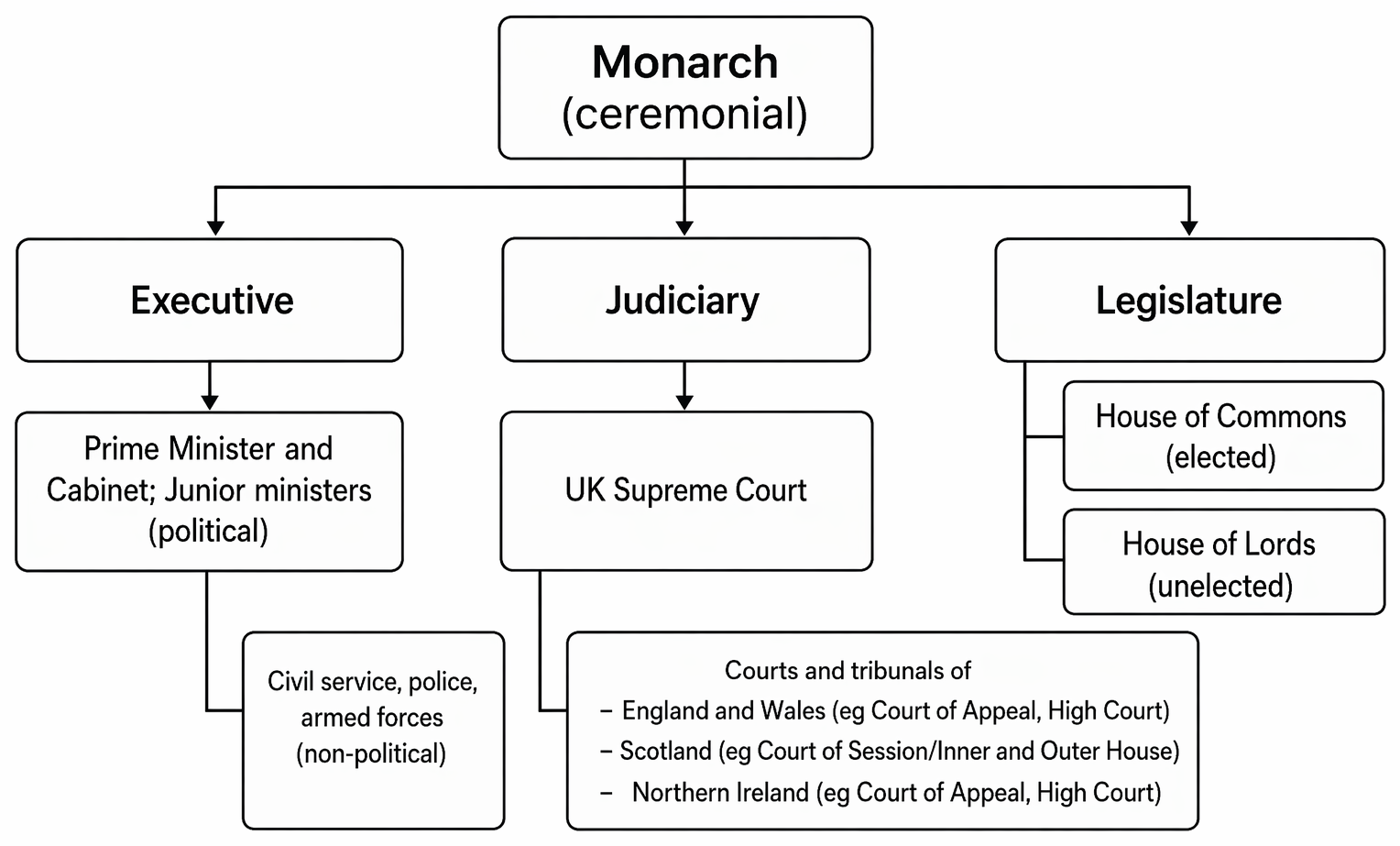
The monarch’s role as head of state is presented through prerogative powers, conventions, legal limits, and judicial review of prerogative acts.
Ministers are the practical agents of royal power. The key constitutional device ensuring the monarch’s neutrality is that ministers bear legal and political responsibility for their advice and actions under both statutory and prerogative powers exercised in the Crown’s name. Ministerial accountability ensures that, though the legal act is taken formally by the monarch (or on behalf of the Crown), the practical responsibility and answerability rest with ministers.
Key Term: ministerial advice
The established principle that the monarch acts only on, and in accordance with, the advice of ministers, who are responsible to Parliament for the advice they tender and the actions taken in the monarch’s name.
The Monarchy and Modern Practice
The constitutional monarchy is now shaped more by convention and modern expectations of political neutrality and transparency than by untrammelled royal authority. The monarch does not intervene in political disputes, does not make partisan statements, and does not obstruct or oppose government policy. The monarch’s constitutional “rights” are summarized (following Bagehot) as the right to be consulted, to encourage, and to warn ministers; these are exercised in private, particularly in regular audiences with the Prime Minister.
Key Term: Royal Assent
The formal approval by the monarch of a Bill passed by Parliament, required for the Bill to become law. By settled convention, Royal Assent is always granted when advised by ministers.
Legal Powers and Constitutional Conventions
UK constitutional law maintains a clear line between legal rules (enforceable by courts) and constitutional conventions (politically binding but not justiciable). Many legal powers technically vest in the monarch—such as the right to refuse Royal Assent, to dissolve Parliament, or appoint the Prime Minister—but the manner in which these are exercised (if at all) is dictated by robust conventions.
- Legal powers: Statutorily or prerogatively derived powers legally vesting in the monarch or their ministers. Their exercise can, where justiciable, be subject to review and constraint by the courts.
- Constitutional conventions: Customary or established practices determining how legal power is exercised, giving rise to binding expectations, but enforced only through political (not legal) means.
Legal Power Example
Legally, the monarch has the power to grant or withhold Royal Assent to legislation. However, by convention, the monarch always grants assent when presented with a Bill that has passed through both Houses of Parliament, and to refuse would precipitate a constitutional crisis.
Similarly, in forming a new government, the monarch conventionally appoints as Prime Minister that Member of Parliament best positioned to command a majority in the House of Commons—a legal power constrained by an inviolable political practice.
Key Term: royal prerogative
The residual powers of the Crown under common law, not requiring Parliamentary sanction, historically personal to the monarch but now mainly exercised by ministers on the monarch’s behalf and subject to constitutional and legal controls.
The Royal Prerogative
The royal prerogative represents the core remainder of executive powers once enjoyed by the monarch but now overwhelmingly exercised by the government. Its legitimacy and scope may be traced to two essential lines: those ancient powers, privileges, and immunities necessary for state governance, and those that have survived legislative encroachment or statutory replacement.
Main prerogative powers exercised by ministers in the monarch’s name include:
- Conduct of foreign affairs (treaties, diplomatic recognition, war, peace)
- Deployment and command of the armed forces
- Grant and withdrawal of passports
- Granting of honours and peerages
- Appointment (and removal) of ministers and senior officials
- Proroguing and dissolving Parliament (under current law, by advice)
- Grant of mercy (pardons and commutations)
Prerogative powers are distinct from statutory powers—if a statute covers an area previously governed by the prerogative, the statutory framework prevails.
Key Term: Case of Proclamations (1611)
A foundational case stating that the monarch has “no prerogative but that which the law of the land allows,” holding that no new prerogative powers can be created or the law changed without Parliament.
Limits and Revocation of Prerogative Powers
The scope of the prerogative is not unlimited and is firmly subject to:
- Parliamentary sovereignty: Parliament can abolish, curtail, or regulate prerogative powers by statute. A pre-existing prerogative is displaced by an Act covering the same subject (see Attorney General v De Keyser's Royal Hotel Ltd [1920] AC 508).
- Non-creation principle: New prerogatives cannot be developed; prerogative is a “closed list.” (BBC v Johns [1965]: no new prerogative powers can be created.)
- Subjection to common law: Prerogative is a category of common law and is interpreted—and where necessary, confined—by the courts.
Ministerial Accountability and Legal Effect
The monarch is not personally liable for the consequences of exercising the prerogative; rather, the responsibility falls on the relevant minister. Ministers may be held accountable by Parliament or, in certain cases, the courts.
Examples of Ministerial Prerogative Use
- Foreign affairs (e.g., the power to sign and withdraw from international treaties): Ministers may negotiate, sign, and ratify treaties without a need for legislation, except where domestic law is altered.
- Defence and armed forces: Ministers deploy the armed forces under the prerogative, but parliamentary approval is politically expected in practice for significant military action.
Key Term: judicial review
A process by which courts scrutinize whether public authorities (including ministers using prerogative powers) have acted lawfully, rationally, and in accordance with proper procedures.
Worked Example 1.1
Scenario: The monarch personally disagrees with a Bill but is advised by ministers to grant Royal Assent. May the monarch refuse?
Answer:
Legally, the monarch has the power to refuse Royal Assent, but constitutional convention requires that the monarch always grants assent on ministerial advice. Any refusal would breach convention and provoke a constitutional crisis, but would not be reviewable by the courts.
Worked Example 1.2
Scenario: The Prime Minister, leading a minority government after a general election, advises the monarch to prorogue Parliament to avoid a confidence vote. Can the monarch refuse?
Answer:
By convention, the monarch must act on the Prime Minister’s advice and grant prorogation, regardless of the political context, unless the government clearly cannot command the confidence of the Commons (the “Lascelles Principles” are of historic relevance but now largely academic). In R (Miller) v The Prime Minister [2019], the courts held that advice to prorogue Parliament may be justiciable if it frustrates Parliament’s ability to perform its constitutional functions.
Limits on the Monarch’s Authority
The law imposes strict limits on the legal authority of the monarch and the Crown:
- Statutory override: Parliament may legislate to curtail or abolish prerogative powers. Where an Act covers the ground previously occupied by a prerogative, the statute prevails, and the Crown may not act outside the statutory scheme.
- No unilateral lawmaking: The monarch cannot issue proclamations, create new prerogatives, or alter the law without statutory authority.
- Judicial scrutiny: The courts decide both the existence and scope of prerogative powers and, in appropriate cases, review the lawfulness of their exercise.
- Accountability through Parliament: Ministers exercising prerogative powers must justify their actions to Parliament and, if appropriate, may be held politically or legally accountable for excess, error, or malfeasance.
Worked Example 1.3
Scenario: The government invokes prerogative power to make a treaty that alters the UK’s domestic law or citizen’s rights.
Answer:
The government cannot use the prerogative alone to make or withdraw from treaties that change domestic legal rights. Parliament must legislate for any modification of domestic law (see R (Miller) v Secretary of State for Exiting the European Union [2017] UKSC 5).
Case Law: Review and Control of Prerogative Power
The judicial role in policing the boundaries of royal powers is well-established. Courts may review:
- Whether a prerogative power exists (Case of Proclamations)
- The scope of any such prerogative
- The exercise of prerogative power for lawfulness, rationality, and procedural integrity where justiciable
However, courts will not review the merits of high policy (e.g., treaty-making, deployment of armed forces) unless domestic law or individual rights are affected. Even in non-justiciable areas, Parliament retains political oversight.
In CCSU v Minister for Civil Service (the "GCHQ case"), the House of Lords confirmed that decisions using the prerogative may be reviewed on typical public law grounds (illegality, irrationality, procedural impropriety), but certain core state functions (defence, foreign affairs, and granting honours) remain excluded from judicial scrutiny.
Key Term: separation of powers
The constitutional principle that governmental powers are distributed and balanced between the legislative, executive, and judicial branches, preventing excessive concentration of power.
Constitutional Conventions and Political Neutrality
The legitimacy and sustainability of the monarchy in the constitutional structure rest on its strict political neutrality. The conventions protecting this include:
- The monarch acts only on the advice of ministers, not at will or on personal initiative
- Royal Assent is always granted; refusal would breach constitutional expectations
- The monarch appoints (or dismisses) a Prime Minister only when no clear candidate exists or a government loses the confidence of the Commons
- The monarch, and members of the Royal Family, do not intervene in party politics, nor do they express public opinions on government policy
Where breach of convention occurs, the consequences are political—loss of confidence and likely removal of ministers or the triggering of constitutional reform—not legal sanction.
Worked Example 1.4
Scenario: The monarch is privately persuaded by a departing Prime Minister to appoint his or her chosen successor, despite another candidate having majority Commons support.
Answer:
The monarch should appoint as Prime Minister the individual best able to command the confidence of the House of Commons. Any attempt to appoint another would breach constitutional convention and risk a crisis but would attract only political, not legal, sanction.
Judicial Review of Prerogative Powers
Contemporary constitutional practice has widened the scope for judicial review of prerogative powers where their exercise affects legal rights, frustrates the constitutional role of Parliament, or is otherwise unlawful.
- The existence and scope of prerogative powers are questions of law, for courts to determine.
- The manner of exercise is justiciable in areas where exercise affects individual rights, statutory obligations, or constitutional principles.
- Political questions (e.g., declaration of war, high-level foreign affairs) remain outside justiciable review, save where legal boundaries are overstepped.
Key cases include Miller (2017, Brexit), Miller/Cherry (2019, prorogation), BBC v Johns (1965), and Attorney General v De Keyser's Royal Hotel (1920)—all affirming that the prerogative cannot be enhanced or used to evade statutory control.
Worked Example 1.5
Scenario: The government uses the prerogative to refuse a passport for purely political reasons.
Answer:
This is a prerogative power, but following R v Secretary of State for the Home Department ex parte Everett [1989], the courts may review such decisions to ensure they are exercised lawfully, rationally, and fairly, where the subject’s rights or legitimate expectations are affected.
Worked Example 1.6
Scenario: Parliament passes an Act requiring that a prerogative power be exercised only in a particular way, but a minister ignores the statute and purports to use the prerogative differently.
Answer:
Statute always prevails over prerogative. The minister’s action would be ultra vires: the prerogative cannot be used to override or circumvent an Act of Parliament. Key Term: supremacy of Parliament
The constitutional doctrine that Parliament is the highest authority in the UK and can make or unmake any law; no other body, including the Crown, can override or set aside a statute.
The Monarch and Modern Governance
The contemporary British monarchy persists as a stabilizing constitutional figure, symbolizing the rule of law and historical continuity. Modern statutes (such as the Succession to the Crown Act 2013, the Sovereign Grant Act 2011) clarify succession rules and the financial arrangements for the monarchy, reflecting the principle that Parliament controls the monarchy’s constitutional and legal powers.
The monarch’s role is almost entirely ceremonial, with real executive authority exercised only through the sieve of ministerial advice and subject to Parliament’s statutory control.
Parliament can legislate to change the rules of succession, the functions of the monarchy, and even to abolish the monarchy itself, subject only to political constraints and considerations of legitimacy, not legal prohibition.
Key Point Checklist
This article has covered the following key knowledge points:
- The monarch is the UK’s formal head of state, constitutionally embedded but politically neutral, with a role defined by law and convention.
- Royal powers are exercised primarily by government ministers, acting on ministerial advice, under the royal prerogative and subject to strict legal and political controls.
- Constitutional conventions require the monarch to act in accordance with ministerial advice and maintain strict neutrality.
- Statute law, including statute-based controls over Crown finances and succession, overrides any contrary prerogative power or convention.
- Prerogative powers are a closed class, interpreted and limited by the courts, and reviewable where they affect legal rights or frustrate constitutional principles.
- The exercise, existence, and limits of prerogative powers are subject to judicial review where appropriate, but political accountability to Parliament remains central.
- Courts will not enforce constitutional conventions but may acknowledge their existence and relevance in interpreting law and practice.
- The modern monarchy is tightly circumscribed by law, statute, democratic principle, and convention, securing the continuity and legitimacy of government.
Key Terms and Concepts
- constitutional convention
- Royal Assent
- ministerial advice
- royal prerogative
- judicial review
- Case of Proclamations (1611)
- supremacy of Parliament
- separation of powers