Learning Outcomes
This article examines the nature and scope of royal prerogative powers within the UK's constitutional framework. It outlines the distinction between the monarch and the Crown, explains the key categories of prerogative powers, and analyses their relationship with statute law and constitutional conventions. It also explains how prerogative powers operate today, including ministerial and personal prerogatives, Orders in Council, and how treaty ratification is controlled by statute. It clarifies the principle that statute prevails where it overlaps with prerogative (and the idea of prerogative being “in abeyance”), and explores the extent and limits of judicial review of prerogative decisions, including the courts’ willingness to determine the existence and legal boundaries of prerogatives. The article details mechanisms through which prerogative powers are controlled in practice, such as parliamentary accountability, financial control, conventions governing the monarch’s role, and the Human Rights Act 1998. It additionally reviews leading case law—such as De Keyser’s Royal Hotel, Fire Brigades Union, the Miller decisions, GCHQ, Everett, Bentley, and Dumbarton DC—so that doctrine, examinable principles, and their application to SQE1-style questions on executive authority are clearly reinforced.
SQE1 Syllabus
For SQE1, you are required to understand the concept of the royal prerogative as a source of constitutional law and its practical operation within the UK government structure, with a focus on the following syllabus points:
- The definition and historical origins of royal prerogative powers, including the Case of Proclamations and Dicey’s definition.
- The distinction between the monarch and the Crown, and who exercises prerogative powers in practice (ministerial vs personal prerogatives; Bagehot’s “advise, encourage, warn”).
- Key examples of remaining prerogative powers (e.g., foreign affairs, defence, recognition of states, passports, prerogative of mercy, honours, royal charter).
- The relationship between prerogative powers and statute law, including the principle that statute prevails over prerogative (Attorney General v De Keyser’s Royal Hotel) and the control of prerogative where statute covers the field (ex p Fire Brigades Union; Northumbria Police Authority).
- Treaty-making and ratification under the Constitutional Reform and Governance Act 2010 (CRAG) and the limits on using prerogative to change domestic law (R (Miller) 2017).
- The role of constitutional conventions (e.g., the monarch acting on ministerial advice; war powers convention; appointment of Prime Minister).
- The extent to which the exercise of prerogative powers is subject to judicial review, including justiciable vs non-justiciable powers (CCSU v Minister for the Civil Service), boundary-setting on the existence and scope of prerogatives (R (Miller) v The Prime Minister 2019), and reviewability of passports and mercy decisions (Everett; Bentley).
- The legal position of the Crown, including immunities and liabilities under the Crown Proceedings Act 1947; injunctions against ministers (M v Home Office); statutes binding the Crown only by express words or necessary implication (Lord Advocate v Dumbarton DC).
- Dissolution of Parliament and the effect of the Dissolution and Calling of Parliament Act 2022 reviving the prerogative.
Test Your Knowledge
Attempt these questions before reading this article. If you find some difficult or cannot remember the answers, look more closely at that area during your revision.
- True or false? Royal prerogative powers are granted to the government by Acts of Parliament.
- Which of the following statements best describes the legal relationship between statute law and royal prerogative powers?
- a) Prerogative powers always take precedence over statute law.
- b) Statute law and prerogative powers have equal standing.
- c) Statute law takes precedence over prerogative powers where they conflict.
- d) Prerogative powers can be used to amend statute law.
- True or false? The monarch personally exercises most royal prerogative powers according to their own discretion.
- Which landmark case established that the courts can, in principle, judicially review the exercise of prerogative powers?
Introduction
The UK constitution, being uncodified, draws its rules from various sources. Alongside Acts of Parliament and case law, the royal prerogative represents a significant, albeit residual, source of executive power. These powers originate from the historical authority of the monarch but are now, by convention and law, primarily exercised by government ministers acting in the monarch's name. Parliamentary sovereignty means Parliament can abolish or regulate prerogatives by statute; the courts identify which prerogatives still exist and define their scope. The modern constitution complements these rules with conventions—such as the monarch acting on ministerial advice—which ensure democratic accountability in practice.
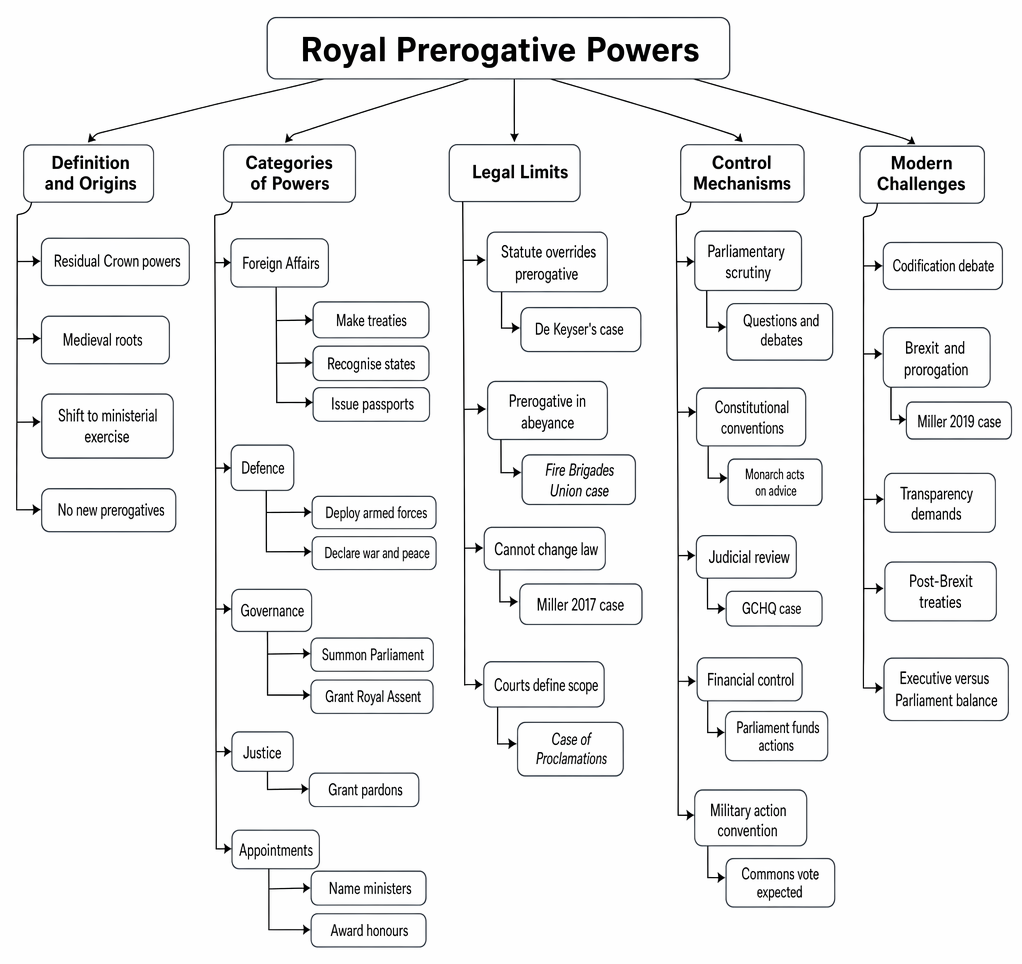
Royal prerogative powers are presented by reference to their definition, principal categories, legal limits, mechanisms of control, and contemporary constitutional issues.
The prerogative is flexible in its application but not in its creation. The list of prerogatives is “closed”: no new prerogative power can be created today. Statute may overlap with or replace prerogative powers; where it does, statute prevails. Internationally oriented prerogatives (like treaty-making and war) often raise high policy issues, giving rise to limits on judicial review, whereas prerogatives affecting individual rights (like passports or mercy) are more commonly reviewable.
Test Tip: In SQE-style questions on Royal prerogative powers, identify the legal test, the triggering fact, and the consequence before choosing between similar answer options.
Exam Warning: Do not rely on a familiar phrase from Royal prerogative powers alone; check whether the facts satisfy every condition, exception, and timing requirement.
The Monarch and The Crown
It is important to distinguish between the monarch as an individual (the King or Queen personally) and 'the Crown' as a constitutional concept representing the executive branch of government. While prerogative powers legally vest in the monarch, their exercise is almost entirely governed by constitutional conventions and, increasingly, statute law.
Key Term: The Crown
A term used in UK constitutional law to refer to the executive branch of government, acting formally in the name of the reigning monarch. It encompasses government ministers, departments, civil servants, and the armed forces.
The monarch's personal role is largely ceremonial. Key 'personal prerogatives', such as appointing the Prime Minister or granting Royal Assent to legislation, are exercised according to firmly established constitutional conventions. For example, the monarch appoints as Prime Minister the individual who commands the confidence of the House of Commons and grants Royal Assent to all Bills passed by Parliament. The “cardinal convention” requires the monarch to act on ministers’ advice; in return, the monarch is “entitled to be consulted, to encourage, and to warn” (Bagehot). Weekly audiences with the Prime Minister and receipt of government papers reflect these consultative functions. The Privy Council formalises certain executive acts (e.g., Orders in Council), but policy decisions are made by ministers who are accountable to Parliament.
The government, headed by the Prime Minister and Cabinet, exercises most prerogative powers. These are often termed 'ministerial prerogatives'. Examples include foreign affairs, defence of the realm, recognition of states, and the grant and revocation of passports. The Prime Minister exercises significant prerogative-linked patronage (e.g., advising on appointments and honours), albeit constrained by conventions, statutory frameworks, and practice (e.g., independent appointments processes for judges; the House of Lords Appointments Commission’s role in non-party peerages).
Crown Immunity and Liability
Historically, the Crown enjoyed significant immunity from legal proceedings ("The King can do no wrong"). The Crown Proceedings Act 1947 significantly altered this position.
Key Term: Crown Immunity
The historic legal doctrine that prevented legal action being taken against the Crown (meaning both the monarch personally and the government). Largely abolished by the Crown Proceedings Act 1947, though some specific immunities remain.
The 1947 Act allows the Crown (i.e., government departments) to be sued in tort and contract, largely placing the government in the same position as a private citizen regarding civil liability. However, the Act preserves certain immunities and special rules:
- The monarch personally remains immune from prosecution and civil suit; the Act did not alter the monarch’s personal immunity from the criminal law.
- Proceedings cannot be brought in tort against the monarch personally.
- Injunctions and orders of specific performance cannot be issued “against the Crown” (s.21), but courts can grant orders against ministers and officials acting in their official capacity. In M v Home Office [1994] 1 AC 377, the House of Lords confirmed that court orders can be made against ministers, and contempt sanctions apply if disobeyed. Similarly, interim injunctive relief was granted against a minister in Factortame (No 2).
- Members of the armed forces were historically barred from suing for injuries sustained during service; the Armed Forces (Crown Proceedings) Act 1987 suspended that immunity but allows revival in war or national emergency.
- Statutes do not bind the Crown unless they expressly state so or do so by necessary implication. In Lord Advocate v Dumbarton DC [1990] 1 All ER 1, planning legislation was held not to bind the Crown. Many modern Acts expressly apply to the Crown (e.g., the Human Rights Act 1998).
- The ancient “act of state” doctrine (non-actionability of certain sovereign acts against foreign nationals outside the UK) persists, though it does not permit government to escape all legal controls and is increasingly scrutinised.
The Royal Prerogative
The royal prerogative consists of the residue of discretionary powers legally left in the hands of the Crown, originating from common law rather than statute. These powers represent the remnants of the authority once wielded personally by the monarch.
Key Term: Royal Prerogative
The body of customary authority, privilege, and immunity recognised in common law as belonging to the Crown alone. These residual powers are now mostly exercised by government ministers.
No new prerogative powers can be created (BBC v Johns [1965]); existing powers can only be identified by the courts or abolished/regulated by statute. The Case of Proclamations (1611) established that the monarch has no prerogative except that which the law allows and cannot change the law by proclamation. The principle of legality requires that any interference with fundamental rights must have clear statutory authority; prerogative powers cannot supply that authority where Parliament has not done so.
Prerogatives remain important because they allow government to act without needing bespoke statutory authorisation in areas traditionally reserved to the executive (e.g., foreign relations). But they are subject to constitutional limits: they cannot change domestic law, cannot frustrate statutes, and their existence and extent are questions of law determined by courts.
Key Prerogative Powers
Prerogative powers cover several key areas of government activity:
-
Foreign Affairs:
- Making international treaties (ratification controlled by statute—CRAG 2010).
- Conducting diplomacy, recognising foreign states and governments, appointing and receiving ambassadors/High Commissioners.
- Acquiring or ceding territory.
- Issuing and revoking passports (administrative and reviewable).
-
Defence and National Security:
- Deploying armed forces overseas (increasingly subject to convention requiring parliamentary debate/vote).
- Declaring war and making peace.
- Maintaining the Queen’s (King’s) Peace within the UK; ensuring public order (e.g., prerogative to support policing where necessary).
-
Domestic Affairs:
- Appointing the Prime Minister (who must command Commons confidence) and other ministers.
- Summoning, proroguing, and dissolving Parliament. Dissolution is again a prerogative power following the Dissolution and Calling of Parliament Act 2022.
- Granting Royal Assent to legislation.
- Granting pardons (the prerogative of mercy).
- Granting honours and dignities.
- Creating public bodies via royal charter (e.g., BBC).
Orders in Council are a prerogative form of legislation used to implement certain executive decisions; their legality is reviewable on ordinary public law grounds. Under the Human Rights Act 1998, Orders in Council made under the prerogative are treated as primary legislation for HRA purposes (s.21), so the court’s remedy is a declaration of incompatibility if human rights are breached, rather than quashing; however, non-HRA public law grounds (illegality, irrationality, procedural unfairness) remain available.
Relationship Between Prerogative and Statute
A core principle of parliamentary sovereignty is that statute law enacted by Parliament is the highest form of law in the UK. This has significant implications for the royal prerogative.
- Statute Prevails: Where statute and prerogative powers cover the same area and conflict, statute law prevails. The prerogative power cannot be used to override the statute (Attorney General v De Keyser’s Royal Hotel [1920] AC 508). The courts will construe the statute to determine whether Parliament intended to occupy the field. Where Parliament has provided a statutory scheme with safeguards or rights (e.g., compensation), the executive must act under the statute and not avoid those safeguards by invoking the prerogative.
- Prerogative in Abeyance and Revival: If Parliament legislates on a matter previously governed by the prerogative, the prerogative is placed in 'abeyance' for as long as the statute remains in force. It is not necessarily abolished and may revive if the statute is repealed, depending on the wording and intention of Parliament. The Dissolution and Calling of Parliament Act 2022 revived the prerogative of dissolution previously displaced by the Fixed-term Parliaments Act 2011. In ex parte Fire Brigades Union [1995] 2 AC 513, the House of Lords held it was unlawful to use the prerogative to supplant a statutory scheme that Parliament had enacted (even if not yet commenced).
- Co-existence in Some Areas: Statute and prerogative can co-exist where they are not inconsistent. In ex parte Northumbria Police Authority [1989] QB 26, the Court of Appeal held that the home secretary’s prerogative to maintain the peace allowed supply of equipment to police forces alongside statutory powers, as there was no inconsistency with the Police Act.
- Prerogative Cannot Alter Law: Prerogative powers cannot be used to change domestic law or remove rights granted by statute. In R (Miller) v Secretary of State for Exiting the European Union [2017] UKSC 5, the Supreme Court held that the government could not trigger Article 50 under prerogative powers because doing so would alter domestic law by removing EU law as a source of UK law and affecting rights created under the European Communities Act 1972. An Act of Parliament was required.
Treaty Ratification under CRAG 2010
CRAG 2010 places the process of treaty ratification under parliamentary control while preserving treaty-making as a prerogative. The government must lay a treaty before Parliament for a minimum of 21 sitting days. If either House resolves that the treaty should not be ratified, the government must explain its position and, subject to repeat consideration in the Commons, ratification can be blocked. In exceptional cases, the duty to lay may be bypassed, though the Act does not define “exceptional”. Importantly, ratification does not incorporate treaty obligations into domestic law; legislation is required to give internal legal effect where necessary.
Control of Prerogative Powers
While historically less accountable, the exercise of prerogative powers is now subject to significant controls through Parliament, conventions, and the courts.
Parliamentary Control and Accountability
- Legislation: Parliament can abolish or regulate any prerogative power by statute (e.g., the Fixed-term Parliaments Act 2011, subsequently repealed; CRAG 2010). Parliament also places many former prerogatives on a statutory footing (e.g., Security Service Act; civil service management in the Constitutional Reform and Governance Act 2010).
- Financial Control: The government requires parliamentary authorisation to raise taxes and spend public money. This “power of the purse” indirectly controls prerogatives: war or major deployments require funding; implementing treaties often requires legislation and supply.
- Scrutiny: Ministers are accountable to Parliament for the exercise of prerogative powers through questions, statements, debates, and select committee inquiries. The Prime Minister is questioned regularly, including by the Liaison Committee. Some prerogative matters (e.g., national security, honours lists, advice to the monarch) are traditionally shielded from full disclosure, but scrutiny of policy remains robust.
- Convention on Military Action: A convention has developed that the government seeks the support of the House of Commons before committing the armed forces to significant combat operations, except in emergencies or where secrecy is essential. The Syria votes (2013 and 2015), as well as debates on Iraq and Libya, illustrate this developing convention. Although not legally binding, departures attract political accountability and intense scrutiny.
Constitutional Conventions
Conventions play an important role, particularly regarding personal prerogatives. The convention that the monarch acts on ministerial advice ensures that powers legally vested in the monarch are exercised by the democratically accountable government.
Key Term: Constitutional Convention
An unwritten rule of constitutional behaviour considered politically or morally binding on those operating the constitution, but not enforceable by the courts.
Conventions like the monarch always granting Royal Assent or appointing the leader who commands the Commons' confidence as Prime Minister are fundamental to the UK's constitutional monarchy. The “war powers” convention and the practice of laying treaties before Parliament (formerly the Ponsonby Rule, now in CRAG) show how conventions and statutes interact to shape prerogative control. Conventions can develop or fall into disuse; they are not law, but breach carries political consequences.
Judicial Review
Historically, the exercise of prerogative powers was considered immune from judicial review. However, the landmark case of Council of Civil Service Unions v Minister for the Civil Service [1985] AC 374 (the GCHQ case) established that the exercise of prerogative powers is, in principle, reviewable by the courts, just like statutory powers.
Key Term: Judicial Review
The process by which courts examine the lawfulness of decisions or actions taken by public bodies, including those acting under prerogative powers. The key question is not the source of the power (prerogative vs statute) but its nature.
In GCHQ, the House of Lords confirmed that prerogative decisions can be scrutinised for lawfulness when they affect rights and are of a kind suitable for judicial determination. The usual public law grounds apply: illegality (acting outside powers), irrationality, and procedural impropriety (including legitimate expectations and fair process). Where national security is genuinely at stake, courts accord deference.
The courts also decide whether a prerogative exists and define its scope. In R (Miller) v The Prime Minister [2019] UKSC 41, the Supreme Court held that prorogation’s legal limits are constrained by constitutional principles (parliamentary sovereignty and accountability). The advice to prorogue for five weeks without reasonable justification was unlawful; prorogation was void. This is distinct from reviewing how a power is exercised in a high-policy context; Miller 2019 addressed the existence and extent of the power’s legal limits.
Justiciability
Despite the GCHQ ruling, courts will still decline to review the exercise of certain prerogative powers deemed 'non-justiciable' – meaning they raise issues of 'high policy' unsuitable for judicial resolution.
Key Term: Non-justiciable
A legal matter considered inappropriate for determination by a court, often because it involves high-level political or policy judgments rather than questions of law.
Examples of typically non-justiciable areas include:
- Making treaties (though courts can review whether prerogative can be used to change domestic law; Miller 2017).
- Defence of the realm and high-level deployment decisions.
- Grants of honours.
- Dissolution of Parliament (now revived as a prerogative).
- Certain aspects of foreign relations and recognition.
However, the boundaries are not fixed. Courts can determine the existence and scope of a prerogative power (Miller 2019 – prorogation). They are less likely to review the manner of exercise within non-justiciable areas. Where prerogative powers affect individual rights and do not involve high policy (e.g., issuing a passport, certain mercy decisions), they are more likely to be considered justiciable and subject to review on grounds like illegality, irrationality, or procedural impropriety.
Examples:
- Passports: In R v Secretary of State for Foreign and Commonwealth Affairs, ex p Everett [1989] 1 QB 811, the court held passport decisions were administrative and justiciable, though the claim failed on the facts.
- Mercy: In ex p Bentley [1993] 4 All ER 442, the court reviewed whether the Home Secretary had misunderstood the breadth of the mercy power; the decision was amenable to review to the extent it turned on legal misunderstanding.
- Overseas territory policy: In Bancoult litigation, the courts scrutinised Orders in Council on public law grounds but ultimately upheld them (R (Bancoult) No 2 [2016] UKSC 35).
The Human Rights Act 1998 enhances scrutiny. Public authorities (including ministers exercising prerogatives) must act compatibly with Convention rights (s.6), though prerogative Orders in Council are treated as primary legislation for HRA remedies. The courts have used declarations of incompatibility where appropriate, and ordinary judicial review remains available for non-HRA grounds.
Worked Example 1.1
The UK Government enters into an international environmental treaty using the royal prerogative. The treaty requires significant changes to UK domestic law regarding emissions standards for factories. Does the government need to take any further action for the treaty obligations to be enforceable against factory owners in the UK?
Answer:
Yes. Entering into the treaty is a valid exercise of the prerogative power. However, international treaties do not automatically change UK domestic law (R (Miller) v Secretary of State for Exiting the European Union). For the new emissions standards required by the treaty to be legally binding on factory owners within the UK, Parliament must pass an Act of Parliament incorporating those obligations into domestic law. The government cannot use the prerogative to alter domestic law.
Worked Example 1.2
Following a general election resulting in a hung Parliament (no single party has an overall majority), the leaders of the two largest parties are negotiating to form a coalition government. The incumbent Prime Minister, whose party lost seats but remains the largest single party, advises the King to appoint him to continue as Prime Minister.
Must the King follow this advice?
Answer:
Not necessarily. While the convention is that the monarch acts on the Prime Minister's advice, another fundamental convention requires the Prime Minister to command the confidence of the House of Commons. In a hung Parliament, it is initially unclear who can command that confidence. The monarch would typically allow the political parties time to negotiate. If it becomes clear that the incumbent Prime Minister cannot command confidence, but another individual (e.g., the leader of the second largest party, supported by others) can, the monarch would be expected by convention to appoint that person, potentially acting against the incumbent's advice. The monarch's role is to appoint someone who can command the Commons' confidence.
Worked Example 1.3
The Home Office refuses to issue a passport to a British citizen living abroad on the basis that there is an outstanding arrest warrant in the UK. The individual seeks judicial review of the refusal. Is the decision justiciable?
Answer:
Yes. Passport decisions are an exercise of the prerogative but are administrative and affect individual rights; they are generally justiciable. In ex p Everett, the Court of Appeal recognised that decisions about issuing passports can be reviewed on public law grounds, provided the challenge does not require the court to adjudicate on high-policy foreign affairs issues. The specific outcome depends on whether the refusal was lawful, reasonable, and procedurally fair.
Worked Example 1.4
Parliament has enacted a statute creating a new criminal injuries compensation scheme but has not yet brought it into force. The minister proposes to replace the old, generous prerogative scheme with a tariff-based prerogative scheme providing lower compensation. Is this lawful?
Answer:
No. In ex p Fire Brigades Union, the House of Lords held that the minister could not use the prerogative to frustrate the will of Parliament. Where Parliament has enacted a statutory scheme, even if not commenced, the executive must not replace it with an inconsistent prerogative scheme. Doing so unlawfully undermines Parliament’s intention.
Worked Example 1.5
The Ministry of Defence closes a public road to erect a perimeter fence on a defence installation. The local authority argues the department needed planning consent under statute. Is the Ministry of Defence bound by the planning legislation?
Answer:
Not unless the statute expressly binds the Crown or does so by necessary implication. In Lord Advocate v Dumbarton DC, the House of Lords held that planning legislation did not bind the Crown absent express words or necessary implication. Many statutes now expressly state they bind the Crown; where they do not, the principle is that the Crown is not bound.
Worked Example 1.6
The Prime Minister advises the monarch to prorogue Parliament for five weeks while major constitutional policy is being pursued and Parliament is seeking to scrutinise that policy. Is the advice within the lawful scope of the prerogative?
Answer:
No, absent reasonable justification. In Miller (2019), the Supreme Court held that the prerogative to prorogue is subject to constitutional principles. Advice to prorogue that frustrates or prevents Parliament from carrying out its constitutional functions, without reasonable justification, is unlawful; the prorogation is void.
Key Point Checklist
This article has covered the following key knowledge points:
- The 'Crown' represents the executive government, distinct from the monarch personally; ministers act in the monarch’s name and are accountable to Parliament.
- Royal prerogative powers are residual common law powers of the Crown, mostly exercised by ministers; no new prerogatives can be created (BBC v Johns).
- Key prerogative powers relate to foreign affairs, defence, justice, and the functioning of government; Orders in Council are a prerogative legislative form, reviewable on public law grounds.
- Statute law prevails over conflicting prerogative powers (De Keyser's Royal Hotel); prerogatives cannot be used to frustrate a statutory scheme (Fire Brigades Union).
- Prerogatives may coexist with statute where they are not inconsistent (Northumbria Police Authority); prerogatives can revive when a displacing statute is repealed (e.g., dissolution after the 2022 Act).
- Using prerogative powers to change domestic law or remove statutory rights is unlawful (Miller 2017).
- Treaty ratification is a prerogative controlled by CRAG 2010; treaties require legislation to have domestic effect.
- Constitutional conventions regulate the exercise of many prerogative powers, especially personal prerogatives (appointment of PM; Royal Assent; war powers convention).
- The exercise of prerogative powers is subject to judicial review, unless the subject matter is non-justiciable (e.g., high policy areas like treaty-making or defence) (GCHQ case), but courts can determine existence and scope and define legal limits (Miller 2019).
- Crown immunity is largely abolished by the Crown Proceedings Act 1947; ministers can be injuncted and held in contempt (M v Home Office); the monarch retains personal immunity; statutes bind the Crown only by express words or necessary implication (Dumbarton DC).
Key Terms and Concepts
- The Crown
- Crown Immunity
- Royal Prerogative
- Constitutional Convention
- Judicial Review
- Non-justiciable