Learning Outcomes
This article covers appeals from the Crown Court to the Court of Appeal, including:
- the statutory and procedural framework governing defendant and prosecution appeals, with emphasis on the Criminal Appeal Act 1968 and the Criminal Procedure Rules 2020
- the distinct grounds for appealing conviction and sentence, the “unsafe conviction” test, and how exam questions typically frame these issues
- the full procedural pathway for an appeal, from drafting grounds and notices, obtaining transcripts and skeleton arguments, to the single judge and renewed application procedures
- the Court of Appeal’s jurisdiction, remedial powers, and limits, and how these shape potential outcomes such as quashing, substituting verdicts, ordering retrials, or dismissing appeals
- the criteria for admitting fresh evidence, including credibility, relevance, due diligence, and the “interests of justice” assessment, illustrated with common problem‑question patterns
- how time limits, leave requirements, and the risk of loss-of-time orders affect strategic advice to convicted defendants considering an appeal
- structured approaches for analysing SQE1-style scenarios, spotting common traps (e.g. confusing conviction and sentence appeals), and presenting concise, examiner-friendly answers
SQE1 Syllabus
For SQE1, you are required to understand the appeals procedure from the Crown Court to the Court of Appeal, with a focus on the following syllabus points:
- statutory framework for appeals from the Crown Court to the Court of Appeal (Criminal Division)
- legal grounds for appealing against conviction (including the meaning of “unsafe”) and against sentence (including ‘manifestly excessive’, ‘wrong in principle’, and ‘unlawful’)
- procedural steps, including time limits, leave to appeal, notice of appeal, and the single judge procedure
- preparation and use of skeleton arguments and the process for written and oral submissions at an appeal
- Court of Appeal’s powers: quashing, upholding, substituting verdicts, ordering retrials, and impact on sentence
- rules and principles for admitting fresh evidence under s.23 Criminal Appeal Act 1968 and related authorities
- limits on the Court of Appeal’s jurisdiction and its approach to procedural irregularities, including when an error makes a conviction “unsafe”
- role and jurisdiction of the Court of Appeal in prosecution appeals, including Attorney General’s References and appeals against terminating rulings
- guidance for advising clients post-conviction regarding prospects and risks of appeal
Test Your Knowledge
Attempt these questions before reading this article. If you find some difficult or cannot remember the answers, look more closely at that area during your revision.
- What is the primary statutory test the Court of Appeal applies when deciding whether to allow an appeal against conviction?
- What is the usual time limit for filing a notice of appeal from the Crown Court to the Court of Appeal?
- Can the Court of Appeal increase a sentence on an appeal by the defendant against sentence?
- What are the main powers available to the Court of Appeal if it allows an appeal against conviction?
Introduction
Appeals from the Crown Court to the Court of Appeal are a central feature of criminal litigation in England and Wales. This appellate route provides critical oversight by an independent tribunal, allowing review and correction of errors that may have occurred at trial. The process is governed by complex statutory and procedural rules, with significant consequences for conviction, justice, and the rights of both defendants and victims.
Key Term: Court of Appeal (Criminal Division)
The appellate court that hears appeals from the Crown Court in criminal cases. Its judges include the Lord Chief Justice, other Lords Justices of Appeal, and High Court judges. The Court has the power to quash or uphold convictions, substitute verdicts, vary sentences, or order retrials.
The Statutory Framework
Appeals from the Crown Court in criminal cases are primarily governed by the Criminal Appeal Act 1968 (as amended). The Act sets out:
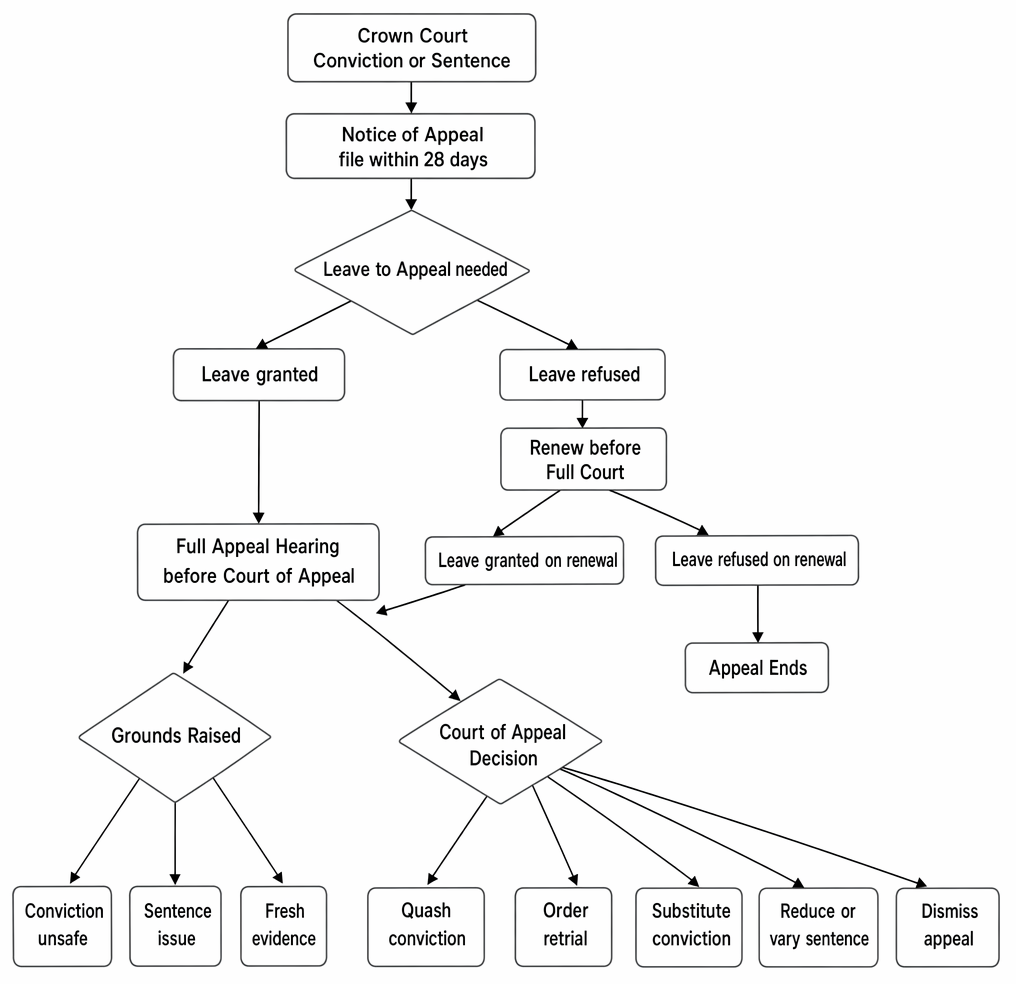
Crown Court appeals to the Court of Appeal are outlined from notice and leave applications to hearing, grounds advanced, and disposal.
- Categories of persons who may appeal (e.g. convicted offenders, prosecution in certain circumstances)
- Types of appeal available (conviction, sentence, certain orders)
- Grounds and procedures for appeal, including requirements for leave (permission) to appeal
- Powers and limitations of the Court of Appeal in determining appeals
Additional procedural rules are found in the Criminal Procedure Rules 2020, which govern the format and filing of appeal notices, contents of skeleton arguments, and deadlines.
Grounds for Appeal
Appeals Against Conviction
A defendant convicted on indictment in the Crown Court may appeal to the Court of Appeal (Criminal Division) against conviction (or finding of guilt) on the central statutory ground that the conviction is “unsafe”.
Key Term: unsafe conviction
A conviction is “unsafe” if, having considered all relevant evidence and submissions (including errors of law, irregularities, or fresh evidence), the Court of Appeal cannot be sure that the conviction was correct and just in the circumstances.
The “unsafe” test is interpreted broadly. A conviction may be found unsafe for a variety of reasons, including:
- Misdirection of the jury by the trial judge (e.g. on law or evidence)
- Material error of law or fact at trial
- Significant procedural or evidential irregularities (such as unfairness in the conduct of the trial, improper admission or exclusion of evidence, wrongful refusal of a submission of ‘no case’ to answer, wrongful joinder of charges)
- Wrongful withdrawal of issues from the jury or misdirection on law or facts in the course of summing up
- Conduct of the trial judge that resulted in unfairness to the defendant
- Inconsistent jury verdicts, where the verdicts on different counts cannot logically stand together
- The emergence of fresh evidence not available at trial, which undermines the safety of the conviction
- Defects in the indictment that affect the fairness or validity of the proceedings
- Conduct of lawyers, whether prosecution or defence, that was so deficient as to render the trial unfair
- Discovery of juror misconduct or bias not known at trial
- In some rare cases, public interest or policy grounds—though these are exceptional
It is not sufficient that there was a technical defect or procedural error at trial; the conviction will only be quashed if the error renders the conviction unsafe. The Court of Appeal will not interfere with findings of fact made by the jury unless the process was fundamentally flawed.
Appeals Against Sentence
A defendant may appeal against the sentence imposed by the Crown Court if it is:
- Wrong in law, where the sentence imposed was not permitted by statute or was otherwise unlawful
- Wrong in principle, such as misapplication of sentencing guidelines or consideration of irrelevant or impermissible factors
- Manifestly excessive, i.e. so severe as to fall outside the range of sentences that a judge, properly directing themselves, could reasonably impose for the offence and circumstances
- Legitimate expectation, where the defendant was led to expect a particular sentencing outcome that was not honoured
- Failure to take account of relevant matters, such as mitigation or personal circumstances material to sentencing
- Taking account of improper considerations not relevant to the sentencing exercise
- Unjustified disparity between co-defendants or a failure to distinguish between offenders whose roles or circumstances differed materially
Key Term: manifestly excessive sentence
A sentence is manifestly excessive if it is plainly disproportionate to the seriousness of the offence and circumstances, taking into account the relevant sentencing guidelines and comparators.
Procedural Requirements
Time Limits
To commence an appeal from the Crown Court, the appellant (usually the convicted person) must submit a notice of appeal to the Registrar of Criminal Appeals. The standard time limits are:
- 28 days from the date of conviction (for appeals against conviction)
- 28 days from the date of sentence (for appeals against sentence)
The notice must set out the grounds of appeal with sufficient detail and be supported by legal argument (“skeleton argument”) and any supporting documents required.
Key Term: notice of appeal
The formal document, submitted in the prescribed manner and within fixed time limits, used to initiate an appeal. The notice outlines in detail each ground relied upon and is accompanied by supporting materials.
Late appeals may be accepted only in exceptional circumstances, and the appellant must provide full and adequate reasons for delay.
Leave to Appeal and Single Judge Procedure
Almost all appeals to the Court of Appeal require leave (permission) to appeal. Leave to appeal can be granted in two ways:
- By the trial judge at the conclusion of proceedings, who may grant a certificate that the case is fit for appeal (rarely used in practice)
- More commonly, by a single judge of the Court of Appeal on paper, following consideration of the application and grounds
Key Term: leave to appeal
Authority granted by a judge or the single judge of the Court of Appeal for an appeal to proceed to full hearing.
If leave is refused by the single judge, the appellant has a right to renew the application for leave to the full Court of Appeal (usually a panel of three judges) at an oral hearing. This provides a safeguard to ensure that potentially meritorious grounds are not dismissed without oral argument.
The Appeal Hearing
Where leave to appeal is granted, the appeal proceeds to a full hearing, usually before a panel of three judges. The parties submit written skeleton arguments and may make oral submissions in open court. The Court reviews all material (including the trial transcript, legal argument, and any fresh evidence admitted) and considers whether the conviction is unsafe or whether the sentence appealed is manifestly excessive, unlawful, or wrong in principle.
As a rule, the Court of Appeal examines only matters raised in the grounds of appeal, but it may consider any issue apparent on the papers that may affect the safety of the conviction or sentence.
Key Term: skeleton argument
A written summary of counsel’s key legal arguments and authorities, served and filed in advance of the appeal hearing.
Fresh Evidence
The Court of Appeal may admit fresh (new) evidence on appeal, but only if strict conditions are met. The statutory criteria, under s.23 Criminal Appeal Act 1968, are:
- The evidence appears capable of belief (i.e. credible)
- The evidence is relevant to an issue at trial
- The evidence would afford a ground for allowing the appeal (i.e. might have affected the result)
- There must be a reasonable explanation for the failure to adduce the evidence at trial; the party seeking to introduce the evidence must show that it could not reasonably have been obtained before
Key Term: fresh evidence
New evidence not available at trial and not reasonably obtainable with due diligence, admissible on appeal only if its admission is necessary in the interests of justice and if the strict statutory criteria are met.
The interests of justice will guide the Court’s decision; the overriding focus is whether admission of the evidence might render the conviction unsafe.
Powers of the Court of Appeal
Once an appeal is heard, the Court of Appeal exercises broad but defined powers under the Criminal Appeal Act 1968:
-
Against Conviction: If the conviction is found to be unsafe, the Court may quash the conviction, direct an acquittal, substitute a conviction for a different offence (usually a lesser included or alternative offence), or order a retrial if appropriate.
- Ordering a retrial: The Court has discretion to order a retrial in the interests of justice
-
Against Sentence: If the appeal is against sentence, the Court may quash the original sentence and substitute another sentence (not more severe than the original). The Court cannot increase the sentence on an appeal by the defendant, but may lower it or otherwise correct it.
Key Term: retrial
A new trial, usually in the Crown Court, ordered where the conviction is quashed but the interests of justice require that the charges be determined afresh by a new jury.
- The Court may dismiss the appeal (uphold the conviction or sentence) if not satisfied that the “unsafe” test is met for conviction or that the sentence is manifestly excessive, unlawful, or wrong in principle.
The Court also has the power, in exceptional cases, to order that time spent in custody pending the appeal does not count towards sentence (a “loss of time order”) if the appeal was without merit.
Further Powers
The Court may:
- Substitute a verdict of guilty of a lesser or alternative offence if it is satisfied (on the facts found) that the jury could properly have convicted of that alternative
- Make any consequential orders (e.g. ancillary orders, forfeiture, restraining orders), as appropriate
- Quash or vary orders made by the Crown Court (e.g. regarding costs or restitution)
The Court cannot, on an appeal against sentence by the defendant, impose a sentence greater than that imposed by the Crown Court, nor can it intervene if the appellant has already served the sentence in full (unless there are ongoing consequences such as a restraining order).
Limitations and Principles
- The Court of Appeal is generally hesitant to interfere with the Crown Court’s findings of primary fact or jury decisions, intervening only where there is a miscarriage of justice or the verdict can no longer be regarded as safe.
- Fresh evidence will be admitted only in rare and carefully limited cases, respecting the importance of finality in criminal litigation and the public interest in the certainty of verdicts.
- Minor procedural errors or technical noncompliance at trial will not normally result in a conviction being quashed unless the error resulted in a substantial injustice.
- The practical effect of the “safety” test is to preserve public confidence in jury verdicts while providing a mechanism to remedy injustice caused by significant errors.
- The prosecution has limited appeal rights. The Attorney General may refer unduly lenient sentences to the Court of Appeal for offences triable only on indictment and some either-way offences specified by the Home Secretary. The Attorney General may also refer points of law to the Court of Appeal following an acquittal on indictment, without affecting the acquittal itself. The Criminal Cases Review Commission may refer a conviction or sentence to the Court of Appeal at any time where it considers there is a real possibility that the conviction or sentence would not be upheld. The prosecution may appeal against terminatory rulings made before the judge begins the summing up, provided an acquittal agreement is given and the ruling is not otherwise appealable by another route.
Worked Example 1.1
Question: A defendant is convicted in the Crown Court. After trial, new DNA evidence emerges that casts doubt on the defendant’s guilt. What can the defendant do?
Answer:
The defendant may apply for leave to appeal out of time, relying on the fresh evidence. The Court will consider whether the new evidence is credible, relevant, and whether it could reasonably have been obtained at trial. If these conditions are met and the conviction now appears unsafe, the Court may admit the evidence, quash the conviction, and could order a retrial in the interests of justice.
Worked Example 1.2
A defendant appeals against sentence, arguing that the sentence is manifestly excessive. The Court of Appeal agrees. What can the court do?
Answer:
The Court of Appeal can quash the original sentence and substitute a reduced sentence that it considers appropriate. It cannot impose a sentence more severe than that passed by the Crown Court on appeal by a defendant.
Worked Example 1.3
Question: A defendant’s appeal against conviction is allowed because the trial judge gave a material misdirection to the jury, but the Court of Appeal considers there was overwhelming evidence of guilt. Can the conviction still be quashed?
Answer:
Yes. A significant misdirection, even where evidence of guilt appears strong, may render the conviction unsafe. The Court of Appeal cannot substitute its own view for that of the jury on the impact of the error; if the safety of the conviction is undermined, the conviction should be quashed.Exam Warning: The Court of Appeal will not allow an appeal against conviction merely because a technical or minor procedural error occurred at trial. The error must be material and result in substantial injustice, rendering the conviction unsafe.
Revision Tip: When addressing appeal procedure in a problem or scenario, always identify:
- Whether the appeal is against conviction or sentence;
- The applicable time limit;
- Whether leave is required and how it is obtained;
- The relevant ground for appeal (unsafe conviction, manifestly excessive sentence, error of law, etc);
- The possible powers and outcomes available to the Court.
Summary
| Appeal Type | Grounds | Time Limit | Leave Required | Possible Outcomes |
|---|---|---|---|---|
| Conviction (by defendant) | Unsafe conviction | 28 days | Yes | Quash, retrial, substitute, dismiss |
| Sentence (by defendant) | Manifestly excessive, wrong in principle, unlawful | 28 days | Yes | Vary, reduce, dismiss |
Key Point Checklist
This article has covered the following key knowledge points:
- Appeals from the Crown Court to the Court of Appeal are governed by the Criminal Appeal Act 1968 and the Criminal Procedure Rules.
- Most appeals require leave to appeal, generally granted by a single judge; if refused, may be renewed to the full court.
- A notice of appeal (with grounds) must usually be filed within 28 days of conviction (or sentence) and must set out the grounds for appeal.
- The main ground for appeal against conviction is that the conviction is “unsafe,” reflecting significant legal, evidential, or procedural defects or the emergence of compelling new evidence.
- Appeals against sentence lie where the sentence is manifestly excessive, unlawful, or wrong in principle.
- The Court of Appeal may quash convictions, order retrials, substitute verdicts for lesser or alternative offences, uphold convictions, or vary sentences—but not increase a defendant’s sentence if the appeal is by the defendant.
- Fresh evidence may be admitted on appeal only where strict statutory conditions are satisfied.
- The Court is reluctant to interfere with jury findings of fact, and finality of litigation is a key principle.
- Prosecution appeals to the Court of Appeal are possible but are limited by statute and subject to different procedures.
- Only significant errors resulting in substantial injustice will lead to a conviction being quashed.
Key Terms and Concepts
- Court of Appeal (Criminal Division)
- unsafe conviction
- manifestly excessive sentence
- notice of appeal
- leave to appeal
- skeleton argument
- fresh evidence
- retrial