Learning Outcomes
This article provides a structured explanation of the routes and procedures for appealing a criminal conviction or sentence in England and Wales. It explains the distinct appeal pathways from the magistrates’ court and the Crown Court, including direct appeals, case stated appeals, and references for unduly lenient sentences, and identifies which appellate court has jurisdiction at each stage. It outlines the procedural steps, forms, and strict time limits for bringing appeals, together with the requirement for leave in most Crown Court and further appeals. It explores the key grounds of challenge, including unsafe conviction, manifestly excessive sentence, and wrong in law or principle, and shows how new or fresh evidence can support an appeal. It analyzes the prosecution’s limited rights of appeal, the potential outcomes and remedial powers of the appellate courts, and the prospects of further appeal to the Supreme Court. It also highlights key exam-focused issues such as costs, loss of time orders, sentence increase risk, bail pending appeal, and the interaction with fair trial rights and professional ethics, supporting confident SQE1 FLK2 performance.
SQE1 Syllabus
For SQE1, you are required to understand the appeals procedure for criminal convictions and sentences in England and Wales, with a focus on the following syllabus points:
- the available routes of appeal from the magistrates’ court and the Crown Court, including direct appeal and case stated procedures
- the difference between appeals on fact (full rehearing) and appeals on law (points of law or jurisdiction)
- procedural steps required for filing an appeal—including form, content, and service of the notice of appeal
- strict time limits and requirements for each type of appeal, and the process for out-of-time appeals
- possible outcomes and the powers of appellate courts, including the ability to order retrials, vary, quash, substitute, remit, or confirm decisions and sentences
- grounds for appeal, including definitions of “unsafe conviction” and “manifestly excessive sentence”
- the concept and application of an “unduly lenient sentence” and the process for references by the Attorney General
- the prosecution's limited rights of appeal (cases stated, terminative rulings, unduly lenient references, and double jeopardy retrials)
- procedure for further appeals to the Supreme Court on points of law of general public importance
- interactions with principles such as the burden and standard of proof, natural justice, and fair trial rights under Article 6 ECHR
Test Your Knowledge
Attempt these questions before reading this article. If you find some difficult or cannot remember the answers, look more closely at that area during your revision.
- What are the two main routes of appeal available to a defendant convicted in the magistrates’ court?
- What is the time limit for filing an appeal against conviction or sentence from the Crown Court to the Court of Appeal?
- What does the term “unsafe conviction” mean in the context of a Crown Court appeal?
- Can the prosecution appeal against an acquittal in the Crown Court? If so, in what circumstances?
Introduction
The system of appeals in criminal law is essential to correcting miscarriages of justice, maintaining confidence in the legal system, and ensuring the accurate application of both substantive and procedural law. Appeals not only provide remedies for errors but also clarify legal interpretation. Understanding the routes, requirements, and constraints in appeals is critical for legal professionals, ensuring both that defendants’ rights are protected and that the public interest is served. The procedure adopted depends on the original trial venue (magistrates’ or Crown Court), the type of challenge, the grounds asserted, and the party appealing.
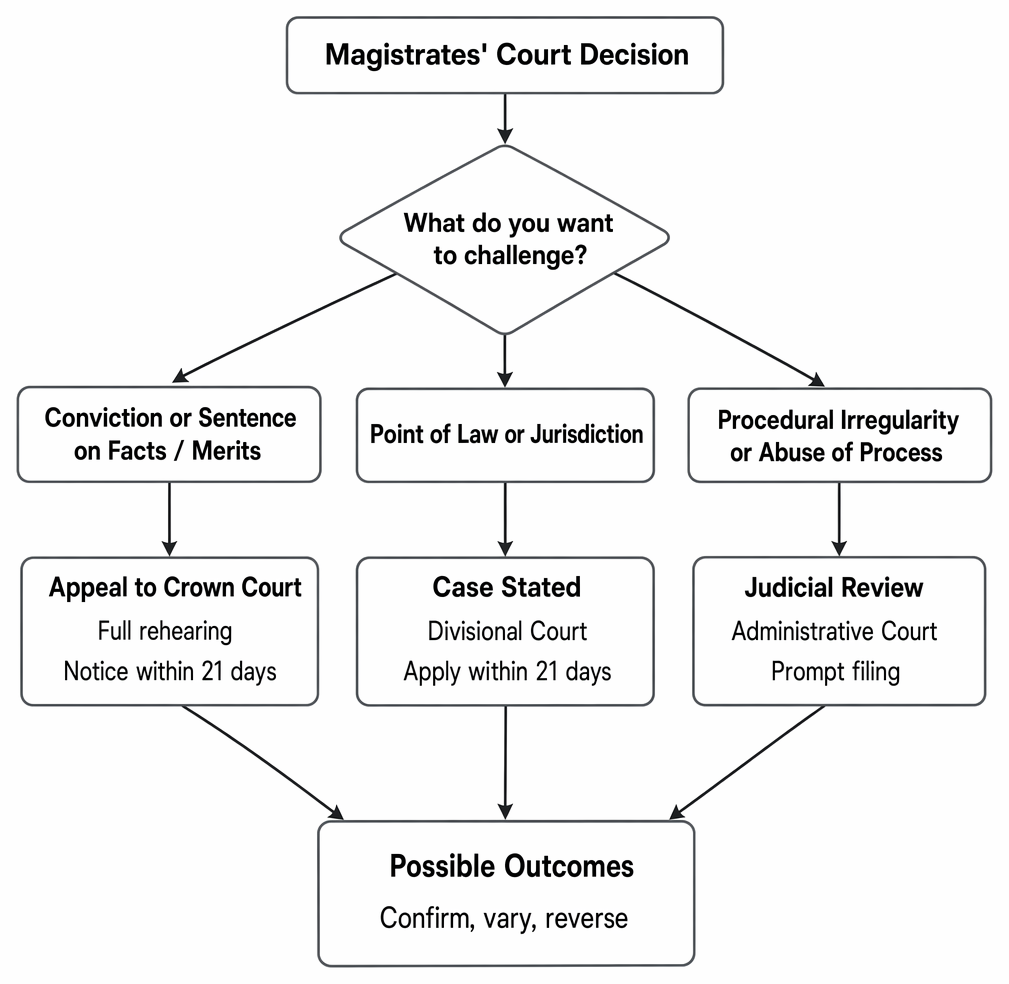
Appeal routes from a magistrates’ court decision and the corresponding courts, time limits, and possible outcomes.
Key Term: appeal
A formal process by which a party seeks to challenge a conviction, sentence, or decision made in a lower court, asking a higher court to review and, if appropriate, overturn, vary, or remit the original decision.Test Tip: In SQE-style questions on Procedure for appealing conviction and/or sentence, identify the legal test, the triggering fact, and the consequence before choosing between similar answer options.
Routes of Appeal from the Magistrates’ Court
A defendant convicted or sentenced in the magistrates’ court has two principal routes of appeal, each with distinct features, procedural steps, and time limits relevant for effective practice.
Appeal to the Crown Court
A defendant has an automatic right to appeal to the Crown Court against conviction (if pleaded not guilty), against sentence (even if pleaded guilty), or both. This right is not subject to prior permission ("leave"), so the Crown Court must hear the appeal if properly brought. The scope and nature of the appeal procedure in these circumstances should be clear to anyone representing defendants.
- The notice of appeal must be lodged in writing with the magistrates’ court (and served on the prosecution) within 21 days of the date of sentence (not conviction). The calculation of this time limit excludes the day of sentencing, but includes weekends and public holidays. For out-of-time appeals, the defendant must include reasons for delay, and the Crown Court has discretion to extend the time if it considers it in the interests of justice.
- The appeal is heard before a Crown Court judge, usually sitting with two (but up to four) magistrates who took no part in the original decision.
- For appeals against conviction, the case is entirely reheard ("de novo"), allowing new evidence to be adduced, new legal arguments to be presented, and witnesses (including new or previously unavailable witnesses) to be called or cross-examined as appropriate.
- When challenging sentence only, the appeal is limited to the appropriateness or lawfulness of the original sentence, considering all relevant aggravating and mitigating factors. The Crown Court is empowered to increase, decrease, or leave the sentence unchanged, subject to the statutory maximum power that the magistrates’ court itself had. A defendant should therefore be advised of the possible risk of a harsher sentence following an unsuccessful appeal.
Key Term: manifestly excessive sentence
A sentence that significantly exceeds the normal range of appropriate penalties for the offence and circumstances, such that it is clearly unjust or disproportionate.
- The Crown Court’s decision on appeal is binding and final unless a further appeal on a point of law is made by way of case stated to the High Court or (rarely) by judicial review.
Defendants should be aware that an unsuccessful appeal from the magistrates’ court may result in a costs order against them and, as noted, the risk of a higher sentence if the appeal is considered without merit or the original sentence is found to have been lenient.
Appeal by Way of Case Stated to the High Court
Either party, including the prosecution, may challenge a magistrates’ court or Crown Court decision on a point of law, or where the magistrates have acted in excess of their jurisdiction.
Key Term: case stated appeal
A form of appeal where a lower court sets out the facts found, its decision, and the legal questions for consideration by the High Court (Divisional Court), restricted to points of law arising from the decision.
- The application to state a case must be made in writing to the convicting or sentencing magistrates’ court within 21 days of the date of decision. The application should precisely state the point of law or alleged jurisdictional error to be considered.
- The magistrates’ court, if agreeing that a legal issue arises, prepares a "case stated" document for the High Court, detailing findings of fact, legal reasoning, and the question(s) to be answered.
- The High Court (usually two or three judges in the Divisional Court) reviews the stated case and makes a decision on the legal issue(s) presented. The hearing is limited to legal argument based on the recorded facts; no new evidence is heard.
- The High Court can confirm, reverse, or amend the decision, or remit the case to the magistrates’ court for re-determination in line with its reasoning.
If the magistrates’ court refuses to state a case, an application for judicial review may be appropriate. Case stated appeals are especially suitable for matters involving statutory interpretation, the admissibility of evidence, or alleged procedural irregularities.
Worked Example 1.1
A defendant is convicted in the magistrates’ court of failing to provide a specimen of breath, but argues that the breathalyser machine was not working properly and that the law was wrongly applied. What should the defendant do?
Answer:
The defendant should appeal by way of case stated to the High Court, as the dispute concerns a question of law regarding the operation of the machinery and legal requirements.
Appeals from the Crown Court
Appeals from trials or sentences imposed in the Crown Court are heard by the Court of Appeal (Criminal Division), a panel that does not rehear the case entirely, but reviews for errors of law, procedure, or newly available evidence.
Appeals Against Conviction
A defendant may appeal against conviction to the Court of Appeal if it is believed that a legal or procedural error has rendered the trial unsound, or where significant new evidence has become available that was not, and could not have been, adduced at trial.
- A notice and grounds of appeal must be filed (served on the Registrar of Criminal Appeals) within 28 days of the date of conviction (even if sentencing is delayed). If the deadline is missed, an extension may be granted, but only with a compelling, justified reason.
- The appellant must obtain leave ("permission") to appeal, which may be granted by the trial judge at the conclusion of proceedings (rare) or, more typically, by a single judge of the Court of Appeal reviewing the grounds out-of-court. If refused by the single judge, the application can be renewed orally before the full court.
Key Term: unsafe conviction
A conviction which, in view of a legal or procedural error, evidential irregularity, or the emergence of credible new evidence, is considered unreliable or unjust by the Court of Appeal.
- The principal ground for an appeal against conviction is that the conviction is "unsafe" under section 2 of the Criminal Appeal Act 1968. This may arise from significant misdirections to the jury, incorrect admission or exclusion of evidence, failure to address key issues or defences, procedural breaches resulting in unfairness, or post-trial discovery of evidence which could have altered the verdict.
- The Court of Appeal has wide powers on appeal: it may dismiss the appeal and confirm the conviction; allow the appeal, quash the conviction, and direct an acquittal; or substitute a conviction for another offence (available on the indictment). It may also order a retrial if it is in the interests of justice.
The possibility of ordering a retrial gives the Court of Appeal flexibility to ensure that errors in the original trial are corrected, whilst balancing fairness for the defendant and the public interest.
Appeals Against Sentence
- Defendants convicted in the Crown Court may appeal their sentence if it is alleged to be wrong in law, wrong in principle, or manifestly excessive in the circumstances of the offence and the offender.
- The procedural rules for sentence appeals mirror those for conviction appeals: a notice (with draft grounds) must be filed within 28 days of sentence, and leave to appeal is required. Unless a clear statutory limit has been exceeded or the sentence is beyond the judge's power, sentence appeals depend on demonstrating that the sentence is outside the proper range, excessively severe, or imposed in error.
- The Court of Appeal may quash the sentence and substitute any sentence available at first instance, reduce it, or confirm it. Importantly, the Court of Appeal may not increase the sentence except on a prosecution reference for an unduly lenient sentence.
Worked Example 1.2 A defendant is convicted in the Crown Court of causing grievous bodily harm. After trial but before sentencing, CCTV evidence emerges showing the defendant was elsewhere at the time of the attack. Can the defendant appeal the conviction? Answer:
Yes. The defendant should promptly file an application for leave to appeal against conviction on the basis of fresh evidence—this is a classic example of a potentially unsafe conviction.
Prosecution Appeals
The prosecution's rights of appeal in criminal cases are strictly limited, reflecting the principle against double jeopardy and the importance of finality and certainty for acquitted defendants.
Appeals by Way of Case Stated
- The prosecution may appeal by way of case stated from the magistrates’ court, on a point of law. This applies if the prosecution believes that the court has wrongly interpreted the legislation, acted in excess of jurisdiction, or misapplied procedural rules.
Appeals Against Terminative Rulings (Crown Court)
- The prosecution may appeal to the Court of Appeal against certain rulings by a trial judge in the Crown Court that have the effect of terminating proceedings (e.g., upholding a submission of no case to answer, excluding key evidence). This is provided by the Criminal Justice Act 2003, which allows the prosecution to challenge rulings that would otherwise prevent any further prosecution. Constraints apply: such appeals are only permitted if the ruling is capable of being reversed without prejudice to the defendant.
Reference of Unduly Lenient Sentences
- The Attorney General may refer a sentence passed in the Crown Court to the Court of Appeal if, in their view, it is “unduly lenient”—that is, significantly below the range that the sentencing guidelines and case law indicate as appropriate for such an offence.
- The reference must be made within 28 days of the date of sentence.
- If the Court of Appeal finds the sentence to be unduly lenient, it has jurisdiction to increase the sentence (subject to the limitation that any new sentence must be one that could have been lawfully imposed at first instance).
Key Term: unduly lenient sentence
A sentence which falls outside the range of reasonable sentences that a judge could properly impose for an offence of the relevant type and seriousness, such as to call for correction in the public interest.
Appeals Against Acquittals and Double Jeopardy
- Following reforms, in very limited circumstances, a person acquitted in the Crown Court may be retried for certain “qualifying offences” (such as murder) if new and compelling evidence comes to light, and if the Director of Public Prosecutions and the Court of Appeal agree that a retrial is in the interests of justice. This mechanism is strictly controlled, preserves the rule of law, and is grounded in the Criminal Justice Act 2003.
Appeals to the Supreme Court
A further (and final) appeal to the Supreme Court may be possible from the Court of Appeal (or, for a case stated, from the High Court), but only if a point of law of general public importance arises and if both the Court of Appeal and the Supreme Court give permission ("leave to appeal"). This is rare in criminal cases and is generally reserved for issues that will affect the administration of justice well beyond the facts of the specific claim.
Time Limits and Procedure
The appeals process is governed by strict procedural rules and deadlines:
- Appeals to the Crown Court from the magistrates’ court: Notice must be filed within 21 days of sentence. Extensions may be granted for good cause.
- Appeals to the Court of Appeal: Notice (with grounds) must be filed within 28 days of conviction or sentence, as appropriate.
- Appeals by way of case stated: Application to state a case must be made within 21 days.
- For most appeals to the Court of Appeal or Supreme Court, permission ("leave") must be sought and is not guaranteed.
- Out-of-time appeals (i.e., late applications) are rarely entertained and require compelling evidence as to the reasons for delay and the merits of the grounds of appeal.
- The form and content of the appeal notice, including identification of the relevant parties, points of dispute, outcome sought, and supporting documentation, is prescribed by the Criminal Procedure Rules.
- For appeals to the High Court or Supreme Court, the points of law at issue must be clearly stated and closely argued.
Exam Warning: A defendant who appeals to the Crown Court against sentence should be advised that the sentence may be increased as well as reduced, since the appellate court has the same sentencing powers as the magistrates' court.
Outcomes and Powers of Appellate Courts
Appellate courts in criminal matters have broad powers to review, correct, or clarify decisions from lower courts, within the boundaries imposed by law.
- On conviction appeals, the appellate court may quash the conviction (and substitute an acquittal), order a retrial, or substitute a conviction for a lesser (but included) offence if appropriate.
- On sentence appeals, the court can quash, substitute, reduce, or (in limited instances) increase the sentence.
- In case stated appeals or challenges on a point of law, the higher court may remit the matter to the lower court to be determined in accordance with its legal ruling, or confirm, alter, or reverse the initial decision.
- In appropriate cases, the Court of Appeal may make an order to prevent the time a convicted person has spent in custody awaiting the outcome of an unsuccessful or unmeritorious appeal from counting towards the sentence ("loss of time" orders).
- The right to a further appeal may be exhausted when the Court of Appeal or Supreme Court has delivered a final outcome (except for referral to the European Court of Human Rights in rare allegations of breach of fair trial rights).
Worked Example 1.2
A defendant was convicted in the magistrates’ court of dangerous driving and is given a 6-month sentence. The defendant accepts they committed the offence but believe the sentence is disproportionate, especially since there are no aggravating factors, and seeks to appeal.
Answer:
The defendant should appeal to the Crown Court against sentence within 21 days, arguing that the sentence is manifestly excessive for the level of seriousness and their personal circumstances.
Client Care and Professional Ethics in Appeals
Solicitors preparing appeals must balance their duty to act in the client’s best interests with the duty not to mislead the court or pursue groundless or vexatious litigation.
- Careful analysis of the original proceedings is required, including reviewing trial transcripts, directions, evidence, and sentencing remarks to identify legitimate grounds for appeal.
- Solicitors must ensure that all relevant procedures, forms, deadlines, and notice requirements are complied with.
- If a client has privately admitted guilt but wishes to appeal a conviction entered on a not guilty plea, the solicitor can test the prosecution case but may not advance a positive defence known to be false or mislead the appellate court.
- All client communications concerning appeal rights, time limits, effects of an appeal, and risks (for example, increased sentence or costs) should be contemporaneously recorded.
Principles Relating to the Grounds of Appeal
Appeals Based on Questions of Fact
These generally arise in appeals from the magistrates' court to the Crown Court, which rehears the case de novo. Material errors in finding facts, flawed assessment of witness credibility, or substantial new evidence (not available at trial despite diligence) will support such appeals.
Appeals Based on Questions of Law
Questions of law or jurisdiction—such as misinterpretation or misdirection by the trial judge, incorrect application of legal principles, or refusal to admit/exclude relevant evidence—are best dealt with by case stated appeals or by appeals to the Court of Appeal in Crown Court cases.
Appeals Based on New or Fresh Evidence
The Court of Appeal will hear new evidence (not adduced at trial) if it is credible, relevant, and if there is a reasonable explanation for failure to present it at the first opportunity. The court must be convinced that had such evidence been available, the result or safety of the conviction would probably have been different.
Sentence Appeals
A manifestly excessive sentence is one which is so severe as to be out of proportion to the circumstances of the offence or the offender's mitigation. Errors in law or principle (e.g., applying the wrong sentencing guideline, failing to give credit for a guilty plea, ignoring relevant personal circumstances) may also justify a reduction.
Worked Example 1.4
A defendant is convicted after trial in the Crown Court and is given a 12-year sentence for an offence for which the guideline range is 5–10 years. It emerges that the trial judge misapplied an aggravating factor that did not exist.
Answer:
The defendant should seek leave to appeal to the Court of Appeal against sentence on the ground that the sentence was manifestly excessive and wrong in principle.
Bail and the Effect of Appeals
An appeal does not automatically suspend the execution of sentence (except for certain types of applications). The appellant may apply for bail pending the appeal, but the grant is discretionary and rare for those serving custodial sentences unless there are compelling and urgent grounds. If an appeal is unsuccessful, time spent in custody pending the outcome will usually count toward sentence, unless a loss of time order is made.
Fundamental Rights in the Appeals Process
All appeal procedures must be consistent with fundamental rights to a fair trial and effective remedy as safeguarded by the European Convention on Human Rights (Article 6). This encompasses the right to timely notice of decisions, the opportunity for legal counsel, the right to present and challenge evidence, and the right to have reasoned judgments.
Further Appeals and the Principle of Finality
Finality is a central feature of criminal law, meaning that after all appropriate appeal avenues have been exhausted, the decision of the appellate court is final in domestic law. Only in rare circumstances can a matter proceed by way of complaint to the European Court of Human Rights. Further appeals to the Supreme Court are reserved for points of law of great general importance with leave.
Key Point Checklist
This article has covered the following key knowledge points:
- The main routes of appeal from the magistrates’ court are to the Crown Court (full rehearing) and by way of case stated to the High Court (point of law).
- Appeals from the Crown Court to the Court of Appeal require permission (leave) and must generally be based upon unsafety of conviction or sentence being manifestly excessive, wrong in law, or wrong in principle.
- The prosecution’s rights of appeal are limited but include case stated appeals, references for unduly lenient sentences, appeals against terminating rulings, and rare retrials for acquittals.
- Strict procedural requirements and time limits apply to all appeals, and failure to comply may forfeit the right of appeal.
- The appellate courts may confirm, reverse, vary, or remit decisions, substitute convictions or sentences, and, in the Crown Court, order retrials.
- The powers of appellate courts are circumscribed by law and doctrine, ensuring both justice in individual cases and consistency in the criminal process.
Key Terms and Concepts
- appeal
- case stated appeal
- unsafe conviction
- manifestly excessive sentence
- unduly lenient sentence