Learning Outcomes
This article explains the statutory purpose of the Inheritance (Provision for Family and Dependants) Act 1975 and its relationship with testamentary freedom, focusing on how the Act operates as a safety net where wills or intestacy rules fail to make reasonable financial provision. It identifies the categories of eligible applicants and the different standards of provision that apply, distinguishing clearly between the spousal standard and the maintenance standard for other claimants. It examines the statutory test for “reasonable financial provision”, the objective nature of the court’s inquiry, and the main factors the court must weigh when assessing competing claims and needs. It reviews the range of orders the court can make to reallocate resources, including periodical payments, lump sums, transfers of property, and variations of settlements or trusts. It explains the jurisdictional requirement of domicile in England and Wales, clarifies what constitutes the net estate available for provision, and outlines how the burden of an order may be directed among beneficiaries and assets. It also covers the six‑month time limit from grant, the circumstances in which late applications may be allowed, and the practical implications for personal representatives.
SQE1 Syllabus
For SQE1, you are required to understand the statutory framework for claims under the Inheritance (Provision for Family and Dependants) Act 1975, with a focus on the following syllabus points:
- the statutory purpose of the Act and its relationship to testamentary freedom
- the categories of eligible applicants and the meaning of “reasonable financial provision”
- the main factors the court must consider when deciding claims
- the types of orders the court can make to vary the distribution of an estate
- the six‑month time limit from grant and when extensions may be permitted
- the domicile requirement and what constitutes the “net estate” available for provision
- how the burden of an order may be directed among beneficiaries and assets
Test Your Knowledge
Attempt these questions before reading this article. If you find some difficult or cannot remember the answers, look more closely at that area during your revision.
- Who may apply for financial provision under the Inheritance (Provision for Family and Dependants) Act 1975?
- What is the difference between the standard of provision for a spouse and for other applicants?
- Name three factors the court must consider when deciding whether to make an order under the Act.
- What types of orders can the court make if a claim is successful?
Introduction
The Inheritance (Provision for Family and Dependants) Act 1975 (“the Act”) allows certain people to apply to the court for financial provision from a deceased person’s estate if the will or intestacy rules do not make reasonable provision for them. The Act is designed to prevent hardship where close family or dependants are left without adequate support, while still respecting the principle of testamentary freedom.
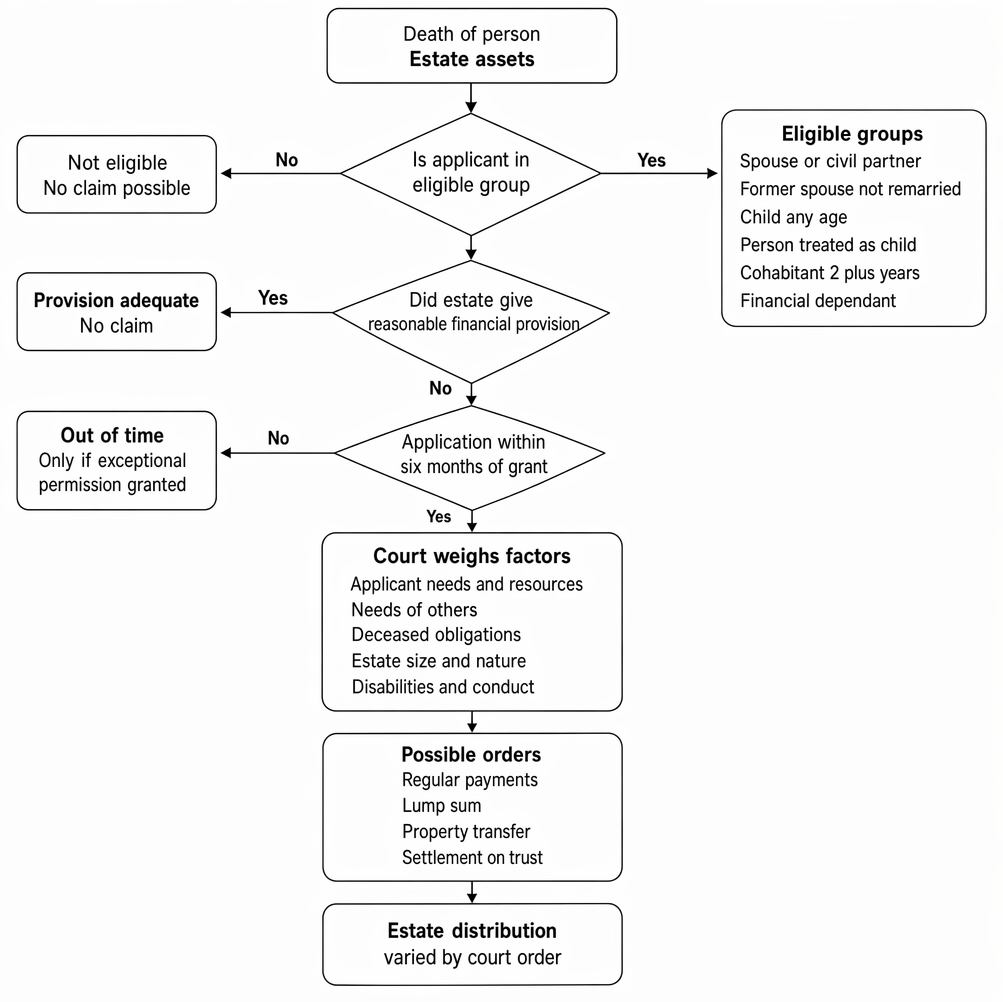
Inheritance (Provision for Family and Dependants) Act 1975 claims involve eligibility, reasonable financial provision, the six-month limit, s 3 factors, and orders.
Key Term: testamentary freedom
The legal principle that a person is generally free to leave their property to whomever they choose in their will.
The Act applies where the deceased died domiciled in England and Wales and enables the court to intervene in both testate and intestate estates if the statutory test is met.
Key Term: domicile
The legal connection between a person and a country. For the Act, the deceased must have died domiciled in England and Wales for the court to have jurisdiction.
Purpose and Scope of the Act
The Act provides a statutory safety net for family members and dependants who have not received reasonable financial provision from an estate. It enables the court to override the terms of a will or the effect of intestacy where this is justified, balancing the deceased’s wishes with the needs of those left behind. The court’s role is not to reallocate estates to reflect what it thinks is “fair” generally; instead, it applies an objective test of whether reasonable financial provision has been made for the applicant, having regard to the statutory guidelines.
Key Term: reasonable financial provision
The amount the court considers reasonable for the applicant’s maintenance (or, for a spouse/civil partner, what is reasonable in all the circumstances, not limited to maintenance).
The Act’s scope is limited to the deceased’s net estate available for provision, and the court must consider the wider circumstances, including competing claims, estate size, and any obligations owed by the deceased.
Key Term: net estate
The estate available for financial provision after deduction of funeral, testamentary and administration expenses, debts and liabilities.
The Act applies to estates of persons who died domiciled in England and Wales. It covers both testate (where there is a will) and intestate (no will) estates. Certain property may pass outside the estate (for example, by survivorship, nomination, trust or donatio mortis causa) and will not usually be directly available for redistribution, but the court can take such arrangements into account when deciding what provision to make and how to allocate the burden of any order.
Who Can Apply?
The Act sets out specific categories of people who may apply for financial provision:
- the spouse or civil partner of the deceased
- a former spouse or civil partner who has not remarried or entered a new civil partnership (unless barred by court order)
- a child of the deceased (including adult children)
- any person treated by the deceased as a child of the family (such as stepchildren or someone in a single‑parent family where the deceased stood in a parental role)
- any person who was being maintained by the deceased immediately before death
- any person who lived with the deceased as spouse or civil partner for at least two years before death (cohabitants living as if married or as civil partners)
Key Term: applicant
A person who falls within one of the statutory categories and makes a claim for provision under the Act.
Eligibility notes:
- Former spouses/civil partners may be barred by “clean break” or related orders on divorce/dissolution (under ss.15, 15A, 15B, 15ZA), but may still qualify under another category if, for example, they later cohabited with the deceased for two years.
- A cohabitant must have lived with the deceased “as husband or wife” or “as civil partner” in the same household for at least two years immediately prior to death. Public recognition of the relationship and shared domestic life support eligibility, though the existence of a sexual relationship is not determinative.
- “Maintained” means the deceased made a substantial contribution to the applicant’s reasonable needs, not pursuant to a commercial arrangement for full consideration (e.g., paying market rent).
Grounds for a Claim
A claim may be made if the will or intestacy rules do not make reasonable financial provision for the applicant. The standard of provision depends on the applicant’s relationship to the deceased:
- For spouses/civil partners: what is reasonable in all the circumstances (not limited to maintenance).
Key Term: spousal standard
The higher standard for surviving spouses/civil partners: such financial provision as is reasonable in all the circumstances, whether or not needed for maintenance. The court may consider what the applicant might have received on a notional divorce.
- For all other applicants: what is reasonable for their maintenance.
Key Term: maintenance standard
Provision limited to meeting day‑to‑day living expenses appropriate to the applicant’s circumstances, rather than conferring capital beyond what is required for maintenance. Key Term: maintenance
Provision to meet the applicant’s day-to-day living expenses, not a share of the estate as of right.
The test is objective: the question is whether the disposition of the estate fails to make reasonable provision for the applicant, assessed at the date of hearing. In claims by adult children, the Supreme Court in Ilott v The Blue Cross [2017] indicated that maintenance does not extend to everything desirable; the court approaches such claims with caution and will consider whether there is a moral claim or special circumstance beyond mere blood relationship, alongside needs and resources.
Court’s Approach and Relevant Factors
The court has wide discretion. It must consider all the circumstances, including:
- the financial resources and needs of the applicant (now and in the foreseeable future)
- the financial resources and needs of any other applicant or beneficiary
- the obligations and responsibilities the deceased had towards the applicant and others
- the size and nature of the estate
- any physical or mental disability of the applicant or any beneficiary
- any other relevant matter, including the conduct of any person
Key Term: obligations and responsibilities
Duties or moral expectations the deceased had towards the applicant or others, such as supporting a dependent child or spouse.
The Act also contains special guidelines for particular categories:
- Spouse/civil partner: the applicant’s age, duration of the relationship, contributions to the family (including home-making or caring), and the likely financial settlement on divorce/dissolution in similar circumstances.
- Cohabitant: the applicant’s age, length of cohabitation, and contributions to the welfare of the family (including looking after the home or caring for the family), and the standard of living enjoyed.
- Child of the deceased: the manner in which the applicant is being or might expect to be educated or trained (particularly relevant to minors).
- Person treated as a child of the family: whether, and to what extent, the deceased assumed responsibility for maintenance and did so knowing the applicant was not their child, and the basis, length and extent of any maintenance.
- Person maintained by the deceased: the length, basis, and extent of maintenance and the degree of responsibility assumed.
Conduct may be relevant, but it is one factor among many. The deceased’s recorded reasons for exclusion can be weighed alongside other factors; they are not decisive.
Worked Example 1.1
Scenario: A widower dies leaving his entire estate to charity, with no provision for his adult daughter, who is in low-paid employment and has health problems. Can she claim under the Act?
Answer:
Yes. As a child of the deceased, she is eligible to apply. The court will consider her financial needs, health, and the size of the estate. If the court finds that reasonable provision was not made for her maintenance, it may order a payment from the estate.
Worked Example 1.2
Scenario: A man dies intestate, survived by his long-term partner (not married or in a civil partnership), who lived with him for three years and was financially dependent on him. She receives nothing under the intestacy rules. What can she do?
Answer:
She may apply as a cohabitant and as a dependant. The court will consider her financial needs and the extent of her dependence. If satisfied that reasonable provision was not made, the court may order payments or transfer of property to her from the estate.
Worked Example 1.3
Scenario: The deceased’s former spouse applies under the Act, but there was a clean break order on divorce. The former spouse has since remarried. Is an application possible?
Answer:
An application as a former spouse is likely barred by the clean break order, and remarriage removes eligibility in that category. Unless the former spouse qualifies under another category (e.g., cohabitant for two years), the court will not entertain the application.
Worked Example 1.4
Scenario: The deceased allowed a friend to live rent-free in a flat for two years due to ill health. The friend applies as a person maintained by the deceased. The friend had another suitable property available to them during that time. Is eligibility made out?
Answer:
A rent-free arrangement can be substantial maintenance, but the court assesses “reasonable needs” at the time of maintenance. If the friend had suitable accommodation available and thus no housing need, eligibility as a maintained person may fail.
Types of Orders the Court Can Make
If the court decides to make provision, it may order:
- regular payments (periodical payments)
- a lump sum payment
- transfer of specific property
- settlement of property on trust for the applicant
- acquisition of property to transfer or settle for the applicant (e.g., purchasing a home from estate funds)
- variation of ante/post‑nuptial settlements for the benefit of a surviving spouse/civil partner or a person treated as a child of the family
- variation of the trusts on which the deceased’s estate is held (per 2014 reforms)
The court may also vary the terms of a will or the effect of intestacy to give effect to its order. It can include consequential directions to ensure fairness among beneficiaries.
Key Term: burden of order
The court’s power to direct which parts of the estate or which beneficiaries bear the cost of an award (for example, whether the burden falls on residue, a specific gift, or is shared proportionately).
The court will decide whether a periodical payments order should be capable of future variation. Where specific assets are transferred, such orders are generally final and not varied later.
Time Limits and Procedure
An application must usually be made within six months of the grant of representation (probate or letters of administration). The court may allow late applications in exceptional cases, considering factors such as the merits of the claim, the promptness of seeking permission, whether the estate has been distributed, whether personal representatives or beneficiaries had notice within the time limit, and whether the applicant has another remedy. Extensions are rare and case-specific.
Key Term: grant of representation
The legal document authorising a person to administer the estate of the deceased (either probate or letters of administration).
Personal representatives (PRs) can protect themselves from personal liability by delaying distribution until six months from the grant has expired (and, prudently, ensuring no claim has been issued and served). If earlier distribution is necessary, PRs should retain sufficient assets to meet any likely order. The court has powers to make interim orders and to direct who should bear the burden of any provision.
Property available for orders is the net estate. Assets that pass outside the will or intestacy (for example, by survivorship, statutory nomination, trust or donatio mortis causa) are generally outside the estate’s direct reach, but the court can take their existence into account, and beneficiaries of such assets may be treated as beneficiaries when apportioning the burden of any order.
Worked Example 1.5
Scenario: PRs distribute the entire estate three months after the grant, and an eligible adult child issues a claim at month five. Are the PRs personally liable?
Answer:
PRs risk personal liability if they distribute within six months and do not retain funds to meet potential claims. If a late-issued claim succeeds, the court can order recovery from beneficiaries, but PRs may still face liability if distribution was imprudent.
The Act and Testamentary Freedom
The Act does not abolish testamentary freedom, but it limits it to the extent necessary to prevent hardship for close family and dependants. The court will not rewrite a will simply because it disagrees with the deceased’s choices. The focus is on need and fairness within the statutory framework, not on equal division or rewarding conduct. For spouses and civil partners, provision is assessed by reference to all the circumstances and may reflect what might have been awarded on divorce; for others, the maintenance standard applies and is confined to meeting appropriate living expenses.
Exam Warning: The court will not make an order simply because an applicant is unhappy with the will or intestacy. The applicant must show that reasonable financial provision has not been made for their maintenance (unless they are a spouse/civil partner, in which case the standard is higher). Adult children must demonstrate needs and other compelling factors; mere disapproval of dispositions is insufficient.
Revision Tip: For SQE1, memorise the categories of eligible applicants and the distinction between the “spousal standard” and the “maintenance standard.” Practice applying the statutory factors to short scenarios, and remember the six‑month limit from grant and the domicile requirement.
Key Point Checklist
This article has covered the following key knowledge points:
- The Act allows certain people to claim financial provision from an estate if reasonable provision has not been made.
- Eligible applicants include spouses, civil partners, former spouses/civil partners (subject to bars), children, persons treated as children, dependants, and cohabitants living as spouse/civil partner for two years.
- The standard of provision is higher for spouses/civil partners than for other applicants; others are limited to maintenance.
- The court considers a range of factors, including financial needs, obligations, and the size and nature of the estate, plus category‑specific guidelines.
- The court can order periodical payments, lump sums, transfer/settlement of property, acquisition of property, and variation of nuptial settlements or trusts holding the estate.
- Applications must usually be made within six months of the grant of representation; extensions are rare and depend on the circumstances.
- The deceased must have been domiciled in England and Wales; orders are made against the net estate, and the court can direct the burden of an order among beneficiaries and parts of the estate.
Key Terms and Concepts
- testamentary freedom
- reasonable financial provision
- applicant
- maintenance
- obligations and responsibilities
- grant of representation
- domicile
- net estate
- spousal standard
- maintenance standard
- burden of order