Learning Outcomes
This article outlines caveats and citations in contentious probate and their effects on grants of representation, including:
- The function of caveats, eligible entrants, duration and renewal, and the precise legal effect on grants of representation
- Warning and appearance procedure, time limits, service requirements, and the effect of an appearance on caveat status
- Appropriate and inappropriate uses of caveats (validity or entitlement challenges vs routine enquiries or delay tactics)
- Main types of citations (to accept or refuse a grant, to take probate, to take administration, to propound a will), circumstances of use, and consequences of non-compliance
- Practical steps for issuing and serving a citation, the usual response period, and subsequent court orders if a person fails to act
- Application of relevant Non-Contentious Probate Rules 1987 (NCPR) and Senior Courts Act 1981 provisions to fact patterns, including limited grants to preserve assets while a caveat is in force
- Practical implications for estate administration when caveats or citations are employed, including cost and delay, clearing off, and loss of priority to a grant
SQE1 Syllabus
For SQE1, you are required to understand caveats and citations in contentious probate and their effects on grants of representation, with a focus on the following syllabus points:
- the function and effect of caveats in preventing grants of representation
- entering, renewing, warning off, and appearing to caveats (time limits, service, consequences)
- the different types of citations and their use in compelling executors or administrators to act
- the relevant Non-Contentious Probate Rules 1987 governing caveats and citations, and Senior Courts Act 1981 s.112 and s.116 in passing over or compelling action
- practical outcomes of caveats and citations for estate administration, including limited grants ad colligenda bona and loss of priority
Test Your Knowledge
Attempt these questions before reading this article. If you find some difficult or cannot remember the answers, look more closely at that area during your revision.
- What is the main legal effect of entering a caveat at the Probate Registry?
- What must a caveator do if they receive a warning to their caveat and wish to maintain their objection?
- Name two types of citation and briefly state their purpose.
- What can happen if an executor fails to respond to a citation to accept or refuse a grant?
Introduction
When a dispute arises over the administration of a deceased person’s estate, certain procedural tools are available to protect the interests of those involved. Two key mechanisms in contentious probate are caveats and citations. These allow interested parties to pause the grant of representation or to compel others to take action regarding their rights or duties in the estate. Understanding how and when to use caveats and citations is essential for effective estate dispute management and is a frequent focus in SQE1 assessments.
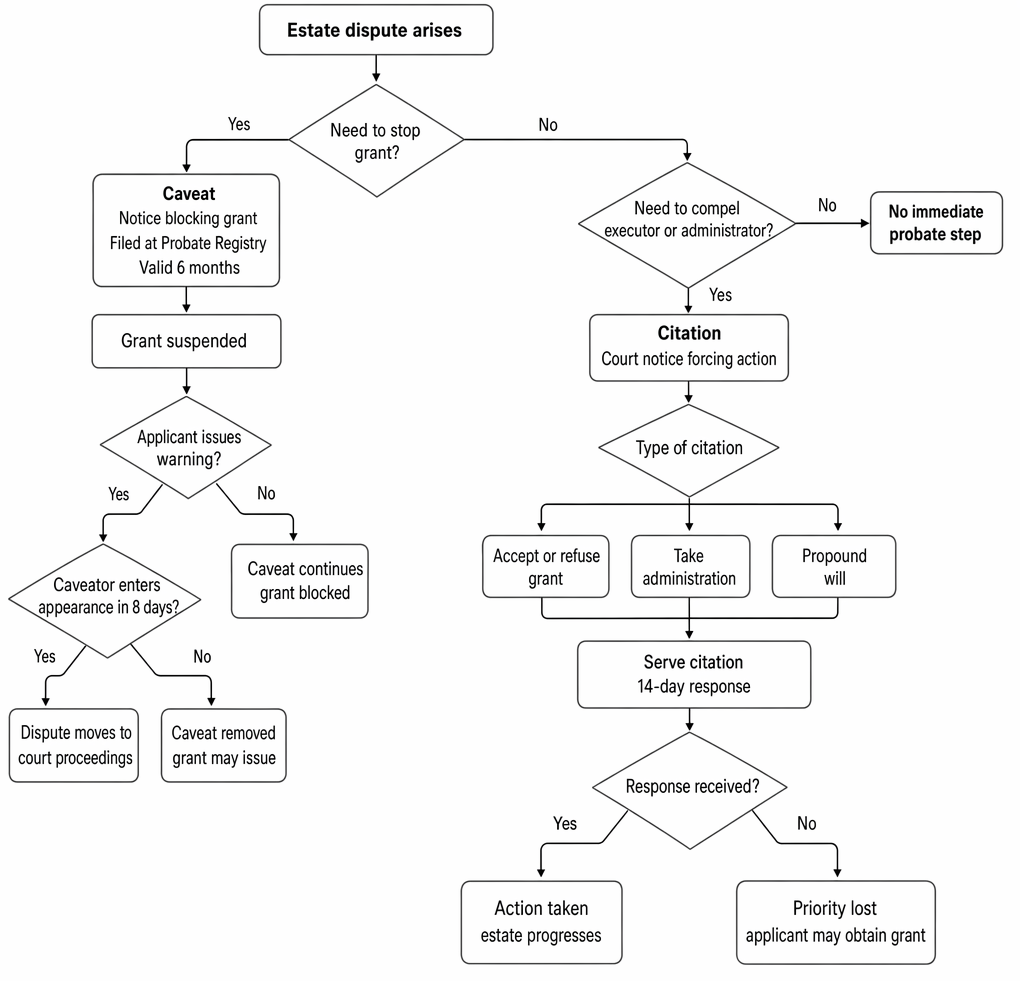
Caveats and citations in contentious probate, including caveat procedure, warning and appearance, and citation routes affecting grants of representation.
Key Term: caveat
A formal notice filed at the Probate Registry to temporarily prevent the issue of a grant of representation, allowing time to investigate or challenge the estate administration. Key Term: caveator
The person who enters a caveat to prevent a grant of representation. Key Term: warning (probate)
A formal notice served on a caveator requiring them to confirm their objection or allow the caveat to be removed. Key Term: appearance (probate)
A formal response by a caveator to a warning, confirming their objection and requiring the dispute to be resolved before a grant is issued. Key Term: citation (probate)
A formal notice issued by the court requiring a person to take action in relation to a grant of representation or estate administration. Key Term: intermeddling
Acts by an executor treating the estate as their own (e.g., disposing of assets) such that they lose the right to renounce and may be compelled to take probate. Key Term: grant ad colligenda bona
A limited grant authorising a person to collect and preserve assets pending resolution of disputes, often issued while a caveat is in place.Test Tip: In SQE-style questions on Contentious probate: caveats and citations, identify the legal test, the triggering fact, and the consequence before choosing between similar answer options.
Caveats: Stopping a Grant of Representation
A caveat is a formal notice entered at the Probate Registry to prevent a grant of probate or administration from being issued without prior notice to the caveator.
Purpose and Use
Caveats are used to:
- challenge the validity of a will (e.g., on grounds of capacity, undue influence, or improper execution)
- dispute the entitlement of a person applying for a grant (such as an executor or administrator)
- allow time to investigate concerns about the estate before a grant is made
A caveat is not appropriate for routine queries or to delay administration without good reason. Misuse may attract cost consequences.
Procedure for Entering a Caveat
A caveat is entered by submitting the prescribed form and fee to the Probate Registry. Under the NCPR, a caveat lasts for six months and can be renewed before expiry for further six-month periods by paying the fee again. It can be entered by anyone with an interest in the estate, including potential beneficiaries or creditors. No detailed reasons need be stated at the point of entry, but the caveator must have a genuine interest to protect; entering a caveat without interest is improper.
Once in place, the Probate Registry will not issue a grant of representation until the caveat is removed, withdrawn, or lapses. The caveat operates against any application for a grant made in any registry for that estate.
Effect of a Caveat
- The grant of probate or administration is suspended while the caveat is in force.
- Any grant issued in breach of a valid caveat is void.
- The caveator must be notified before any grant is made.
- If urgency requires asset protection, the court may issue a limited grant ad colligenda bona to collect and preserve assets pending resolution, notwithstanding the caveat.
Warning and Appearance
If someone wishes to proceed with a grant despite a caveat, they may issue a warning to the caveator. The warning must be served at the caveator’s address for service. The caveator must then enter an appearance within eight days to maintain their objection. If no appearance is entered, the caveat may be removed and the grant can proceed.
Entering an appearance transforms the caveat into one that remains until the dispute is resolved or the court (or registrar) orders its removal. At this point, removal generally requires consent or a court order; the matter may need to proceed to directions or a probate claim if issues (e.g., validity of a will) are joined.
Worked Example 1.1
A will is challenged on the basis of alleged undue influence. The deceased’s son, who is not named as executor, fears the executor will obtain a grant before he can gather evidence. What should he do?
Answer:
He should enter a caveat at the Probate Registry to prevent the grant being issued until he has had time to investigate and, if necessary, challenge the will.
Removal and Lapse
A caveat can be withdrawn by the caveator at any time. If not renewed, it lapses after six months. If a warning is issued and the caveator does not enter an appearance within eight days, the caveat is removed. If an appearance is entered, removal typically requires either consent of the parties or a court order. A caveat entered without a genuine dispute or interest may be set aside, often with costs.
Addressing Practical Issues
A caveat is a potent device: it halts progression of the grant, delays estate funding, and may create urgency around tax deadlines. Where a caveat is justified, applicants for grants should consider early issue of a warning. Where the caveat is obstructive and no valid grounds exist, an application to strike out or for directions can be sought. If preservation of perishable assets or urgent liabilities is required, consider an application for a limited grant ad colligenda bona while the caveat remains in force.
Worked Example 1.4
An executor applies for probate. A beneficiary enters a caveat but refuses to explain any grounds, and no warning appearance is filed after service of a warning. What happens?
Answer:
If the caveator fails to enter an appearance within eight days of proper service of the warning, the caveat is removed and the application for a grant can proceed. Costs may be sought if the caveat was used improperly to delay.
Citations: Compelling Action in Probate
A citation is a court-issued document requiring a person to take a specific step in relation to estate administration, such as accepting or renouncing a grant, or proving a will. Citations are governed by the NCPR and Senior Courts Act 1981, and are used to ensure that those with prior entitlement do not delay administration.
Types of Citation
There are several types of citation under the Non-Contentious Probate Rules 1987:
- Citation to accept or refuse a grant: Used when an executor named in a will is not acting. It compels them to accept or renounce their right to a grant. If the executor has intermeddled (e.g., collected assets or otherwise treated the estate as theirs), they may have lost the right to renounce and can be cited to take probate (Senior Courts Act 1981 s.112).
- Citation to take probate: Used where an executor has intermeddled in the estate and therefore cannot renounce; it requires them to proceed with probate promptly.
- Citation to take administration: Used when a person entitled to administer an intestate estate (e.g., the surviving spouse or child) is not applying for a grant. It requires them to apply, or risk losing their right, so someone else can proceed.
- Citation to propound a will: Used to require a person asserting the validity of a will to commence proceedings to prove it in solemn form; often appropriate where multiple testamentary documents are in issue or where suspicious circumstances exist.
These tools “clear off” persons with prior rights who are unwilling or unable to act, allowing the next entitled person to proceed with administration.
Procedure for Issuing a Citation
A citation is issued by filing the appropriate form or request at the Probate Registry with a supporting statement of truth. It must be served personally on the person cited (unless the court orders or permits alternative service). The cited person usually has 14 days to respond or take the required step (e.g., enter an appearance, accept probate, or apply for administration), though the court may direct otherwise.
If the cited person fails to act, the court may allow the applicant or another suitable person to take the grant instead, or make an order deeming the cited person to have renounced (where renunciation is still available), or pass over the cited person under Senior Courts Act 1981 s.116 where special circumstances justify appointing someone else.
Worked Example 1.2
A will names two executors, but only one is willing to act. The other is unresponsive. What can the willing executor do?
Answer:
The willing executor can issue a citation to accept or refuse a grant. If the unresponsive executor fails to respond, the court may allow the willing executor to proceed alone.
Consequences of Non-Compliance
If a cited person does not respond or act as required, they may lose their priority to a grant. The court can then appoint another person to administer the estate or deem renunciation. If an executor has intermeddled, the court can compel them to take probate and proceed without delay; they cannot renounce.
Service and Time Limits
Personal service is the default requirement to ensure the cited person has notice. Where personal service is impossible or impracticable, alternative service (e.g., by post or email) may be permitted by order. The usual response period is 14 days from service, but directions can vary. Failure to respond triggers the applicant’s right to seek orders clearing off the non-responsive party.
Worked Example 1.5
An intestate dies survived by a spouse and adult child. The spouse does not apply for a grant and is not engaging. The adult child needs to administer the estate. What is the appropriate step?
Answer:
The adult child should issue a citation to take administration requiring the spouse to apply or refuse. If the spouse fails to respond, the court may allow the adult child to proceed with a grant of letters of administration.
Propounding a Will: When and Why
Where the validity of a will is genuinely in doubt—for example, suspicions about knowledge and approval, capacity, or undue influence—someone asserting the will can be required to propound it in solemn form. This involves proving formal execution and that the testator knew and approved the contents. A citation to propound ensures the issue is brought before the court rather than stalled by inaction.
Worked Example 1.6
Two testamentary documents exist: an earlier formal will and a later, apparently homemade document with doubtful execution. A beneficiary under the later document insists it is valid but refuses to issue proceedings. What can the earlier will’s executor do?
Answer:
Apply for a citation to propound the later will. If the beneficiary fails to propound, the court may allow probate of the earlier will to proceed or make appropriate directions.
Passing Over an Executor
Separately from citations, in special circumstances the court can “pass over” an executor under Senior Courts Act 1981 s.116, appointing an administrator with will annexed. This is used where it is undesirable to appoint the named executor (e.g., incapacity, conflict causing prejudice) and complements the citation regime when the executor will not act.
Caveats and Citations in Practice
Caveats and citations are essential for managing disputes and delays in estate administration. They ensure that grants are not issued without resolving genuine concerns and that those entitled to act do so promptly. Used properly, they balance the need for timely administration with the duty to ensure the correct personal representative is appointed and any validity challenges are addressed.
Where caveats block progress but urgent action is required to safeguard assets, a grant ad colligenda bona can be sought to allow collection and preservation of assets pending resolution. Where inaction by a person with prior entitlement is obstructive, a citation will clear off that person, enabling the next entitled to proceed.
Worked Example 1.3
A beneficiary is concerned that the named executor is unsuitable due to a conflict of interest. What procedural steps are available?
Answer:
The beneficiary can enter a caveat to prevent a grant being issued and, if necessary, apply for a citation to compel the executor to accept or renounce the grant. If the executor is found unsuitable, the court may appoint an alternative administrator.
Worked Example 1.7
A caveat is in place due to a will validity challenge. The estate includes a deteriorating asset requiring immediate attention. What options exist?
Answer:
Apply for a limited grant ad colligenda bona to collect and preserve the asset pending resolution of the caveat. The limited grant does not confer full authority to distribute; it permits protective steps until the dispute is resolved.Exam Warning: Entering a caveat without a genuine interest or to delay administration without cause may be considered an abuse of process. Caveats are not for routine information requests. Confusing caveats (to stop a grant) with citations (to compel action) leads to wrong answers. Identify whether the scenario requires blocking a grant or clearing off a non-acting person with prior entitlement.
Key Point Checklist
This article has covered the following key knowledge points:
- Caveats prevent the issue of a grant of representation and allow time to investigate or challenge estate administration.
- A warning may be issued to a caveator, requiring them to enter an appearance within eight days to maintain their objection.
- An appearance makes the caveat persist until resolution or court order; removal then generally needs consent or an order.
- Citations compel executors or administrators to act (accept/refuse a grant, take probate or administration, or propound a will).
- Failure to respond to a citation can result in loss of priority to a grant, deemed renunciation (if available), or orders compelling action.
- The court can pass over an executor under s.116 Senior Courts Act 1981 in special circumstances, and issue limited grants ad colligenda bona to preserve assets pending disputes.
- The Non-Contentious Probate Rules 1987 and Senior Courts Act 1981 set out the procedures for caveats and citations in contentious probate.
Key Terms and Concepts
- caveat
- caveator
- warning (probate)
- appearance (probate)
- citation (probate)
- intermeddling
- grant ad colligenda bona