Learning Outcomes
This article outlines grants of representation in England and Wales, including:
- distinguishing between grants of probate and letters of administration, identifying when each is required, and recognising situations where no grant is needed;
- determining who may apply for each type of grant in testate, intestate, partial-intestacy and mixed-estate scenarios, and applying the four-grantee limit;
- applying the Non-Contentious Probate Rules 1987, especially rr 20 and 22, to work out orders of entitlement, priorities, clearing off and Treasury Solicitor claims;
- understanding renunciation, power reserved, caveats, citations and grants de bonis non, and evaluating how each device can delay, prevent or enable issue of a grant;
- analysing the respective legal authority and duties of executors and administrators before and after the grant, including chain of representation and liability for pre-grant acts;
- assessing the impact of minors, incapacitated applicants and vulnerable beneficiaries on entitlement, the need for two administrators and the use-and-benefit jurisdiction;
- recognising key procedural and HMRC interfaces, including IHT421, PA1P and PA1A, and sequencing the practical steps for making a compliant, exam-ready probate application.
SQE1 Syllabus
For SQE1, you are required to understand grants of representation, including probate and letters of administration, with a focus on the following syllabus points:
- the difference between a grant of probate and a grant of letters of administration
- when each type of grant is required and who may apply
- the order of priority for applicants under the Non-Contentious Probate Rules 1987
- the effect of intestacy rules on estate administration
- the legal authority and duties of executors and administrators
- renunciation, power reserved, and “clearing off” those with prior entitlement
- letters of administration with will annexed (order under NCPR r 20)
- caveats and citations in non‑contentious probate practice
- minors and incapacitated persons: special arrangements and the need for two administrators where a minor benefits
- grants de bonis non when the estate remains partly unadministered
- the practical interface with HMRC (IHT421) and probate application forms (PA1P/PA1A)
Test Your Knowledge
Attempt these questions before reading this article. If you find some difficult or cannot remember the answers, look more closely at that area during your revision.
- What is the main difference between a grant of probate and a grant of letters of administration?
- Who is entitled to apply for a grant of letters of administration if the deceased died intestate, leaving a spouse and two adult children?
- True or false? An executor named in a will can act before a grant of probate is issued.
- What happens if there is a valid will but the named executor has died before the testator?
Introduction
When a person dies, their estate must be collected, debts paid, and the remaining assets distributed to those entitled. In most cases, this process requires a grant of representation—a legal document confirming who is authorised to deal with the deceased’s estate. There are two principal types: grants of probate and grants of letters of administration. Understanding the distinction and the rules for each is essential for SQE1.
Key Term: grant of representation
A court-issued document authorising a person to administer a deceased person's estate. Includes grants of probate and letters of administration.Test Tip: In SQE-style questions on Types of grants: probate and letters of administration, identify the legal test, the triggering fact, and the consequence before choosing between similar answer options.
Types of Grants of Representation
The two main types of grants of representation are:
- Grant of probate: issued when there is a valid will and an executor is able and willing to act.
- Grant of letters of administration: issued when there is no valid will, or no executor is able and willing to act.
Grant of Probate
A grant of probate is issued to the executor(s) named in a valid will. The executor’s authority to act derives from the will, but the grant is usually required to prove their status to asset holders (such as banks or the Land Registry).
Key Term: executor
A person appointed in a will to administer the estate of the deceased.
Who may apply for probate?
Only the executor(s) named in the will may apply for a grant of probate. If more than one executor is named, any or all may apply, but a maximum of four can take a grant for the same estate. Where more than four executors are appointed, probate may be granted to up to four with power reserved to the others.
If executors are appointed for different parts of an estate (for example, separate executors for business assets and for the general estate), each appointment can be proved, subject to the four-person cap per part. Notice of the application for a grant of probate is normally given to executors to whom power is being reserved.
Key Term: chain of representation
The rule that a proving executor of a deceased’s estate can become executor of an earlier estate if the earlier proving executor dies and the chain continues, so authority passes through successive grants.
What if the executor cannot act?
If the executor has died, lacks capacity, refuses to act, or is otherwise unable or unwilling, a grant of letters of administration with will annexed may be required (see below). A divorce or dissolution occurring after execution does not revoke the whole will but ordinarily revokes any appointment or gift to the former spouse or civil partner; a named former spouse or civil partner will therefore be treated as having predeceased and cannot take the grant (Wills Act 1837, s 18A/18C).
If a sole executor is a minor, a grant of letters of administration with will annexed for the use and benefit of the minor may be made to an appropriate adult (often a parent or guardian), until the minor attains 18. If there are adult co-executors alongside a minor, probate is granted to the adult(s) with power reserved to the minor until majority.
Courts retain a discretion to “pass over” a person with a prima facie right to a grant in appropriate circumstances (for example, where they are unfit or there is a conflict that jeopardises proper administration).
Authority and duties of executors
Executors are responsible for:
- collecting in the deceased’s assets
- paying debts, taxes, and expenses
- distributing the estate according to the will
They owe fiduciary duties to beneficiaries and must act honestly, diligently, and impartially. The will itself vests the deceased’s property in the executors on death; the grant confirms that authority. In practice, institutions usually require an office copy grant to release or transfer assets. Chattels (such as furniture, jewellery, clothing, and cars) can commonly be sold on production of the death certificate without waiting for the grant, but land, bank accounts, and registered securities typically require the grant to prove title.
Acting before a grant is issued
Executors derive their authority from the will and may take some steps before probate is granted (for example, securing property, arranging the funeral, or taking urgent protective actions). However, most institutions require sight of the grant before releasing assets. Administrators have no authority until the grant is issued.
Worked Example 1.1
A will appoints two executors, Alice and Ben. Ben has died before the testator. Alice is willing to act. Who may apply for probate?
Answer:
Alice may apply for a grant of probate as the surviving executor. If Alice were unwilling or unable to act, a grant of letters of administration with will annexed would be required.
Grant of Letters of Administration
A grant of letters of administration is issued when there is no valid will (intestacy), or when no executor is able and willing to act. The person(s) entitled to apply are determined by statute and the Non-Contentious Probate Rules 1987.
Key Term: administrator
A person appointed by the court to administer the estate of a deceased person where there is no executor able and willing to act.
Types of letters of administration
- Letters of administration (intestacy): issued when there is no valid will.
- Letters of administration with will annexed: issued when there is a valid will but no executor able and willing to act.
Order of priority for administrators
The order of priority for applicants is set out in Rule 22 of the Non-Contentious Probate Rules 1987. For intestacy, the order is generally:
- surviving spouse or civil partner
- children of the deceased (and issue of any predeceased child)
- parents
- siblings of the whole blood (and issue of any predeceased whole-blood sibling)
- siblings of the half blood (and issue of any predeceased half-blood sibling)
- grandparents
- uncles and aunts of the whole blood (and issue of any predeceased)
- uncles and aunts of the half blood (and issue of any predeceased)
If none of these relatives exists, the Treasury Solicitor may claim bona vacantia on behalf of the Crown and be entitled to a grant (NCPR 1987, r 22(2)).
Key Term: intestacy
The situation where a person dies without a valid will, so their estate is distributed according to statutory rules.
Important practical points under intestacy:
- up to four administrators can take a grant for the same estate
- where a minor is entitled to a share, two administrators are usually required
- an administrator cannot have “power reserved” as such; if multiple persons are equally entitled, a grant may be made to any one or more of them without notice to others of equal rank, subject to the court’s discretion
“Clearing off” refers to obtaining renunciations or consents, or demonstrating that those with prior rights are unwilling or unsuitable, so the next entitled person may apply.
Duties of administrators
Administrators have similar duties to executors but must distribute the estate strictly according to the intestacy rules. They have no authority until the grant is issued, and property vests in them only when the court grants administration.
Worked Example 1.2
John dies intestate, survived by his wife and two adult children. Who is entitled to apply for a grant of letters of administration?
Answer:
The surviving spouse has first priority. If she does not wish to act, the children may apply. If more than one person is equally entitled, up to four may apply jointly.
Letters of Administration with Will Annexed
If there is a valid will but no executor able and willing to act (e.g., the executor has died, lacks capacity, or renounces), a grant of letters of administration with will annexed is issued. The order of priority for applicants is set out in Rule 20 of the Non-Contentious Probate Rules 1987. The residuary interest under the will is treated as the principal interest for entitlement purposes, and vested interests take precedence over contingent interests.
Under NCPR r 20, the order of entitlement is broadly:
- trustee of the residuary estate (if any)
- any other residuary beneficiary (vested interests preferred to contingent)
- personal representatives of any person entitled in the previous class (other than a life tenant of residue)
- any other beneficiary or creditor
- personal representatives of any person entitled in the previous class (other than a life tenant)
Where persons of equal rank compete, the court tends to prefer applicants with vested interests to those whose interests are still contingent. A person whose gift fails because they (or their spouse/civil partner) witnessed the will generally loses entitlement to apply as a beneficiary under the will, but they may be entitled in another capacity (e.g., creditor).
Worked Example 1.3
A will leaves residue to two nieces but does not name an executor. Who may apply for a grant of letters of administration with will annexed?
Answer:
The nieces, as residuary beneficiaries, have first priority to apply for the grant. If one niece’s interest is vested and the other’s is contingent, the court will prefer the vested interest applicant.
Worked Example 1.4
The will appoints only a minor (aged 16) as executor. The residuary beneficiary is an adult child of the testator. Who should apply?
Answer:
A grant of letters of administration with will annexed may be issued for the use and benefit of the minor to an appropriate adult (e.g., a parent/guardian), or the adult residuary beneficiary may be preferred under NCPR r 20. If adult co-executors had been appointed alongside the minor, probate would be granted to the adult(s) with power reserved to the minor until majority.
Practical Points and Special Situations
Acting before a grant is issued
Executors derive their authority from the will and may take some steps before probate is granted, but most institutions require sight of the grant before releasing assets. Administrators have no authority until the grant is issued.
Multiple applicants
A maximum of four people can take a grant for the same estate. If more than four are entitled, the grant will be made to the first four who apply. Executors can have power reserved to them if not initially taking the grant; administrators cannot.
Key Term: power reserved
Where one of several executors does not take the initial grant, their right to prove is reserved, allowing them to apply later if needed.
Renunciation and power reserved
A person entitled to a grant may renounce their right by formal deed. For executors, renunciation must be in prescribed form, signed and filed at the Probate Registry; once effective, the right cannot normally be reclaimed. Renunciation is only available if the person has not intermeddled. If there are multiple executors, one may have “power reserved” instead of renouncing, preserving flexibility to join later.
Administrators may also renounce, though intermeddling does not necessarily bar renunciation in the same way. Renunciation does not affect any separate appointment as trustee under the will; a separate disclaimer of trusteeship would be required.
Caveats and citations
Key Term: caveat
A formal entry at the Probate Registry preventing the issue of any grant without notice, typically used to pause the process where validity or entitlement is in doubt. Key Term: citation
A court document compelling a person to take or refuse probate or administration, used to move matters forward when someone entitled is failing to act.
Caveats are used to prevent a grant being sealed, for example, while investigating will validity, capacity, or entitlement issues. Citations are used to require a person entitled to take probate to proceed or to require a person with prior entitlement to accept or refuse a grant so the next entitled person can apply.
Clearing off and equal rank
“Clearing off” those with prior rights may be needed, for example by obtaining renunciation, filing evidence they are unwilling or unable to act, or serving a citation to accept or refuse a grant. Where two or more are equally entitled, the court may grant to any one or more of them, preferring vested interest applicants where applicable.
Minors and incapacitated persons
If a minor is solely entitled to administer (e.g., sole executor under a will), letters of administration with will annexed for the use and benefit of the minor may be granted to an adult. If there are adult co-executors, probate may be granted to the adults with power reserved to the minor. Where a minor is a beneficiary under intestacy, two administrators are usually required. If a person lacks capacity, an attorney under a valid power of attorney may apply on their behalf where permitted, or the court may appoint an appropriate person for their use and benefit.
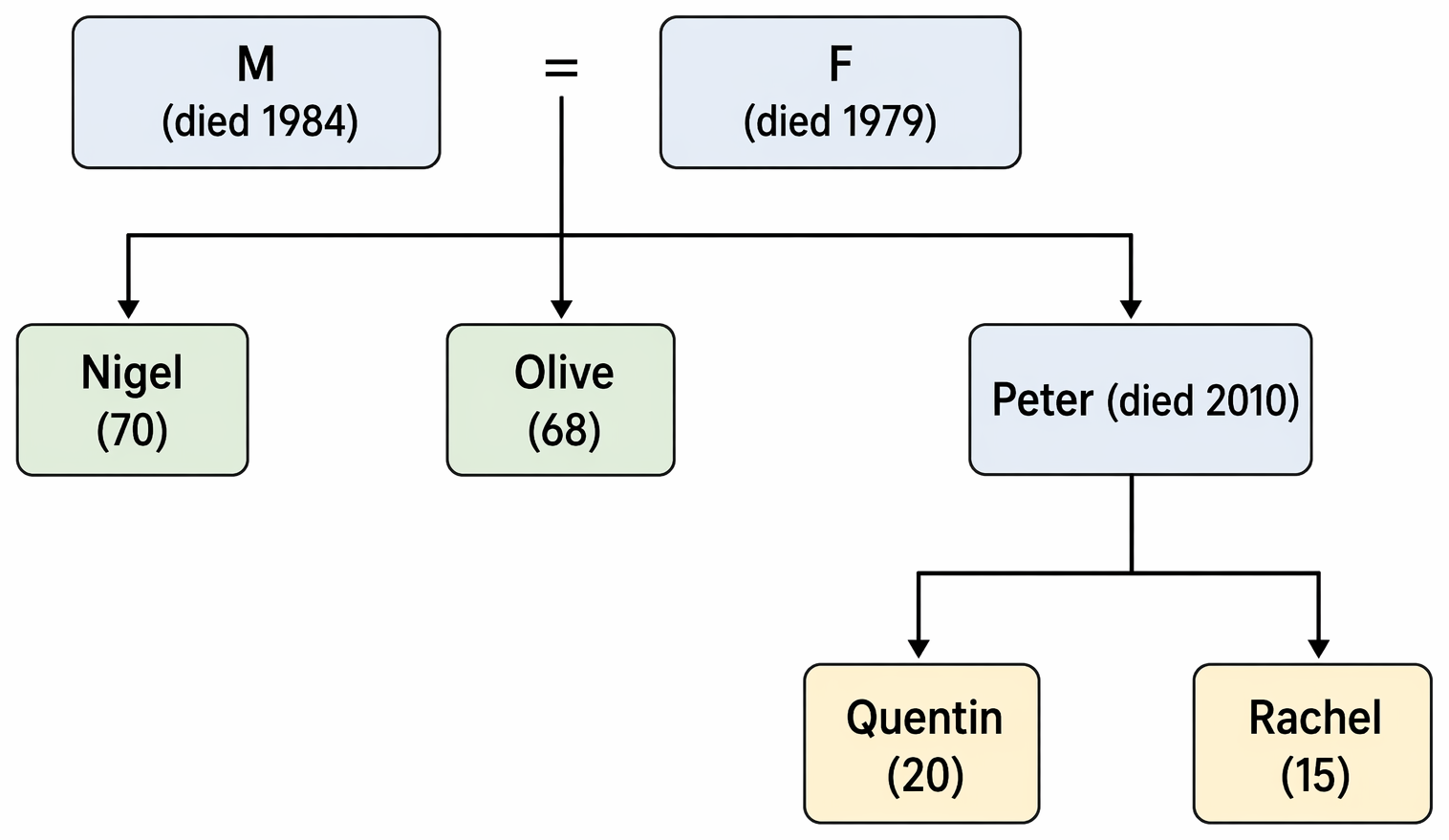
Family relationships and priority to a grant on intestacy are set out in accordance with r 22 Non-Contentious Probate Rules 1987.
HMRC and probate forms
In estates requiring inheritance tax (IHT) accounting, HMRC issues a probate summary (IHT421) which the Probate Registry needs before sealing the grant. Payment can be facilitated via the Direct Payment Scheme with participating banks/building societies. Applicants use form PA1P (where there is a will) or PA1A (intestacy), and lodge the original will (or evidence for a lost or copy will) and the legal statement. The Registry may also require affidavits or statements regarding due execution, knowledge and approval, date, or the plight and condition of the will where appropriate.
Partial intestacy
If a will does not dispose of the whole estate, the undisposed assets pass under the intestacy rules. The appropriate grant depends on who is able to act. If the will named an executor, probate may be granted to that executor even if residue passes on intestacy. If no executor is able to act, letters of administration (with or without will annexed) may be required depending on the circumstances.
Bona vacantia
If no eligible relatives can be found, the estate passes to the Crown as bona vacantia. The Treasury Solicitor may claim and be entitled to a grant where appropriate.
Grants de bonis non
Key Term: de bonis non
A grant issued where part of an estate remains unadministered (for example, the original personal representative dies or is unable to complete administration), authorising a new personal representative to complete the outstanding administration.
A grant de bonis non administratis is made where the original personal representative has ceased to act and part of the estate remains unadministered. Entitlement follows the same principles as for the original grant, adjusted for the remaining property and those now entitled.
Worked Example 1.5
Karim’s will leaves his residuary estate to his two children, Jasprit and Imran, on reaching age 25. No executor survives. Jasprit is 28; Imran is 22. Who should apply?
Answer:
Under NCPR r 20 the residuary beneficiaries are entitled and vested interests are preferred. Jasprit has a vested interest and would be preferred to apply for letters of administration with will annexed. Imran’s interest is contingent, so he would not be preferred at this stage.
Worked Example 1.6
An intestate estate was granted to a sole administrator who died before completing administration. There is an adult child of the deceased and other relatives. What grant is needed, and who may apply?
Answer:
A grant de bonis non is needed to complete the unadministered part. Entitlement follows NCPR r 22 for intestacy. The adult child has priority and may apply, subject to clearing off any persons with prior rights.
Worked Example 1.7
Two co-executors are named in the will, but both fail to proceed with probate despite reminders. What procedural step can move the matter forward?
Answer:
A citation can be issued to require them to take probate or to accept or refuse the grant. If they refuse or fail to comply, the court may permit those next entitled (e.g., residuary beneficiaries under NCPR r 20) to apply.Exam Warning: Always check the facts to determine whether a will exists, whether the executor is able and willing to act, and whether the estate is wholly or partially intestate. Apply the correct rule: NCPR r 20 for letters of administration with will annexed and NCPR r 22 for intestacy. Consider whether renunciation, power reserved, clearing off, a caveat, or a citation is relevant. Identify if a grant de bonis non is required where administration is incomplete.
Summary
| Type of Grant | When Used | Who May Apply |
|---|---|---|
| Probate | Valid will, executor able and willing to act | Executor(s) named in will |
| Letters of administration (intestacy) | No valid will | Next of kin (by statutory order) |
| Letters of administration with will annexed | Valid will, no executor able/willing to act | Residuary beneficiary or next in order |
Key Point Checklist
This article has covered the following key knowledge points:
- The two main types of grant of representation are probate and letters of administration.
- Probate is granted to executors named in a valid will; letters of administration are granted where there is no valid will or no executor able and willing to act.
- The order of priority for applicants is set by the Non-Contentious Probate Rules 1987 (r 20 for will annexed; r 22 for intestacy).
- Executors and administrators have similar duties but must distribute the estate according to the will or the intestacy rules, respectively.
- Renunciation, power reserved (for executors), clearing off, caveats, and citations are practical tools affecting entitlement and timing.
- Special grants (such as letters of administration with will annexed and grants de bonis non) are used in particular situations, including partial intestacy or where no executor is able to act.
- Where minors or incapacitated persons are involved, special arrangements apply; often two administrators are required if a minor is entitled.
Key Terms and Concepts
- grant of representation
- executor
- administrator
- intestacy
- power reserved
- caveat
- citation
- chain of representation
- de bonis non